

If you drive in one of Texas's major metro areas, you've probably heard about the annual emissions test. It's a mandatory inspection for most gasoline-powered vehicles between 2 and 24 years old that are registered in 17 specific counties. This test is a critical part of the state's overall vehicle inspection program, and you can't renew your registration without passing it.
What Every Driver Needs to Know About the Texas Emissions Test

Think of the emissions test as a routine health checkup, but for your car's exhaust system. Its main job is to pinpoint vehicles spitting out excessive pollutants, which helps keep the air cleaner in our most populated cities. This whole program stems from the federal Clean Air Act, which requires states to take action in regions that don't meet national air quality standards.
The process is baked right into Texas's "Two Steps, One Sticker" system. This simply means you have to pass your vehicle inspection—which includes the emissions test if you're in an affected county—before you can renew your annual registration sticker. The inspection station sends your passing results directly to the Texas Department of Motor Vehicles (DMV), giving you the green light to register online, by mail, or in person.
The Core Goal of Emissions Testing
The main objective is pretty straightforward: cut down on harmful vehicle emissions like nitrogen oxides and volatile organic compounds. These are the pollutants that cook up ground-level ozone, or smog, which is notorious for causing respiratory problems and other health issues. By making sure your car's pollution control systems are working as they should, the program helps protect public health across Texas's biggest urban centers.
Where and When It's Required
The rules for the Texas emissions test are very specific. The requirements are enforced in 17 key counties, including right here in Dallas. Failing the test means you can't renew your registration—a rule that has helped improve our air since it was first rolled out on May 1, 2002.
These counties require an annual emissions test for gas-powered cars from 2 to 24 years old. Good news for some: diesel vehicles and motorcycles are exempt. This program is a joint effort between the Texas Department of Public Safety (DPS) and the Texas Commission on Environmental Quality (TCEQ), with Bexar County slated to join the list on November 1, 2026. You can dig into more of the program's history and see all participating counties over at the North Central Texas Council of Governments.
To make it easy, here's a quick rundown of the essential rules.
Texas Emissions Test At a Glance
This table breaks down who needs a test, where it's required, and how often you'll need one.
| Requirement | Details |
|---|---|
| Affected Counties | Brazoria, Collin, Dallas, Denton, Ellis, El Paso, Fort Bend, Galveston, Harris, Johnson, Kaufman, Montgomery, Parker, Rockwall, Tarrant, Travis, and Williamson. |
| Vehicle Age | Gasoline-powered vehicles from 2 to 24 years old. |
| Exemptions | Diesel-powered vehicles, motorcycles, and vehicles 25 years or older. |
| Frequency | Annually, required before vehicle registration renewal. |
If your vehicle is registered in one of these counties and fits the age profile, this annual check-up is a mandatory step toward keeping your car legally on the road.
Which Texas Counties Require an Emissions Test?
First things first: not every driver in Texas has to worry about an emissions test. The state's program is laser-focused on the most crowded urban areas where air quality is a major public health concern. If you’re living out in a more rural county, you can likely breathe easy—this specific test probably doesn't apply to you, though you'll still have your annual safety inspection.
The whole point of the program is to cut down on ground-level ozone, which is just a technical term for smog. Smog forms when pollutants from our tailpipes cook in the Texas sun. That's why the rules zero in on the big metropolitan hubs. Figuring out if your county is on the list is the first step.
The 17 Counties on the List
Right now, 17 Texas counties require an annual emissions inspection for most vehicles. These are the state's biggest, most congested metro areas, including Dallas-Fort Worth, Houston, Austin, and El Paso.
If your car is registered in one of the following counties, the Texas emissions test is a non-negotiable part of your annual registration renewal:
- Dallas-Fort Worth Metroplex: Collin, Dallas, Denton, Ellis, Johnson, Kaufman, Parker, Rockwall, and Tarrant
- Houston-Galveston Area: Brazoria, Fort Bend, Galveston, Harris, and Montgomery
- Austin Area: Travis and Williamson
- El Paso Area: El Paso
Keep in mind, this list is set to grow. Starting November 1, 2026, Bexar County (that’s San Antonio) will be added to the emissions testing requirement.
The logic is simple: more cars packed into a smaller area means more pollution. By targeting these specific counties, Texas gets the biggest bang for its buck, improving air quality where millions of people live and breathe every day.
Which Vehicles Actually Need the Test?
Just living in one of these counties doesn't automatically mean your car is on the hook. The state has specific rules based on your vehicle's age and the type of fuel it uses. This keeps the program targeted at the cars most likely to pollute without creating headaches for everyone.
The rule of thumb is pretty straightforward. Your gasoline-powered vehicle needs an annual test if it's between 2 and 24 years old. So, for an inspection in 2024, this would apply to most cars and trucks with model years from 2000 to 2022.
Key Exemptions to Know About
While the rules are firm, there are several important exceptions. These are designed to let vehicles that produce very few emissions—or just operate differently than a standard passenger car—off the hook.
Your vehicle is exempt from the Texas emissions test if it falls into one of these categories:
- It's Brand New: Any vehicle is exempt for its first two model years. This countdown starts from the model year itself, not the day you bought it.
- It's a Classic: Vehicles that are 25 years old or older are considered classics and don't need to be tested.
- It's Diesel-Powered: All diesel vehicles are exempt from this specific test, no matter their age.
- It's a Motorcycle: Motorcycles and mopeds are also not required to get an emissions inspection.
Knowing these exemptions can save you a trip. If your car is a 1998 model or you drive a diesel truck, you can go straight to your registration renewal without worrying about this test.
Understanding the Vehicle Inspection Process

Stepping into an inspection station can feel like a black box. You hand over your keys, and a technician gets to work, but what exactly are they doing? Let's pull back the curtain on the entire process, so the Texas emissions test feels predictable and straightforward.
The kind of test your car gets boils down to one simple thing: its age. Texas uses two different methods to check a car’s emissions, each one built for a different generation of automotive tech. For newer cars, it’s a quick digital handshake; for older ones, it’s a bit more of a workout on a treadmill.
On-Board Diagnostics II (OBDII) Test
If your vehicle is a model year 1996 or newer, it’s getting an On-Board Diagnostics II (OBDII) test. Think of this as the technician plugging directly into your car's brain. Since the mid-90s, every car has had an internal computer that constantly keeps tabs on the engine and emissions systems.
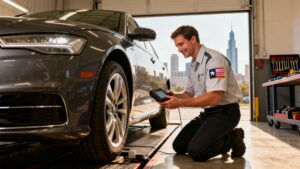
The OBDII test is as simple as it sounds. The inspector connects a scanner to your car's OBDII port—that little plug usually found under the dashboard. This tool reads the data from your car’s computer, looking for any trouble codes and confirming that all the emissions components are reporting for duty.
A "pass" on the OBDII test just means your car's computer says all systems are go. It’s the fastest and most common type of emissions inspection you'll see in Texas today.
Heads up: if your check engine light is on, that's an automatic fail for the OBDII test. That light is your car's way of telling you it has already found a problem that could be polluting the air. You can learn more about all the parts involved in our full guide on what a car inspection in Texas entails.
Acceleration Simulation Mode (ASM) Test
Now, for the classic rides. If you have a gasoline-powered vehicle from model year 1995 or earlier, the process looks quite different. These cars don't have the sophisticated onboard computers for a quick scan, so they get what's called an Acceleration Simulation Mode (ASM) test.
Picture putting your car on a treadmill. That's basically what an ASM test does. The vehicle's drive wheels are placed on a machine called a dynamometer, which lets the technician "drive" the car at different speeds without it ever moving.
While the car is running through this simulated drive, a probe in the tailpipe is literally sniffing the exhaust. It measures pollutants like hydrocarbons and carbon monoxide to make sure the vehicle meets emissions standards under real-world conditions.
What to Bring and What to Expect
No matter which test your car needs, the whole process is designed to be pretty quick. To make sure things go off without a hitch, you just need a couple of things on hand.
What you need for the inspection:
- Proof of Liability Insurance: A current, valid insurance card for the vehicle is a must.
- Payment for the Fee: Inspection fees can vary, so be ready to pay when you arrive.
Once the test is done, the results are zapped over to the state's vehicle database automatically. A passing grade gives you the green light to renew your registration. It's this direct line of communication that makes the "Two Steps, One Sticker" system work so well.
While we're focused on gas-powered cars here, the world of vehicle testing is always changing. For a peek into how the rules are adapting, you can explore some of the evolving electric vehicle testing processes. Knowing what's coming helps you walk into your next inspection with confidence.
Common Reasons for Failing an Emissions Test and How to Fix Them
Seeing that dreaded "FAIL" on your Vehicle Inspection Report is always frustrating, but it's rarely a total mystery. Most vehicles that don't pass the Texas emissions test stumble over a handful of common, and thankfully, fixable issues. The best way to think about it is that your car often gives you a heads-up long before the test—usually with that little Check Engine light.
Getting familiar with these common culprits can save you a ton of time, a nice chunk of change, and the headache of a second trip to the inspection station. When you know what to look for, you can be proactive and make sure your car is ready to pass the first time around.
Let's break down the top reasons cars don't make the cut.
The Ever-Present Check Engine Light
This one is the most straightforward reason for an automatic failure. If your Check Engine light is glowing on the dashboard, the inspection is over before it even starts. That light is your car's On-Board Diagnostics (OBDII) system screaming that it has already found a fault somewhere in the engine or emissions system.
Driving into the inspection lane with that light on is a guaranteed fail. Before you even think about getting your car tested, you absolutely have to get that issue diagnosed and fixed by a professional. Understanding what triggers this light is key; getting familiar with comprehensive car diagnostic tests can help you spot emissions-related problems early.
Top 5 Emissions Test Failure Points and Solutions
Beyond just the Check Engine light, a few specific parts are frequent offenders. These components are the unsung heroes working behind the scenes to keep your car’s exhaust clean. When they get old or fail, your emissions levels can spike, leading to a failed test.
Here’s a look at the most common failure points and what you can do about them.
| Common Problem | What It Does | How to Fix It |
|---|---|---|
| Faulty Oxygen (O2) Sensor | Measures unburned oxygen in the exhaust to help the car’s computer fine-tune the air-fuel mixture. | A professional diagnostic check will confirm a bad sensor. Replacement is a fairly common and straightforward repair. |
| Worn-Out Catalytic Converter | This is the main pollution control device, converting harmful gases into less harmful substances. | A failing converter is a serious problem. It often needs to be replaced, which can be one of the more expensive emissions repairs. |
| Loose or Broken Gas Cap | It seems simple, but this maintains pressure in the fuel system and stops gas vapors from escaping. | First, try tightening your cap until it clicks. If the seal is cracked or worn, a new gas cap is an inexpensive and easy DIY fix. |
| Malfunctioning EGR Valve | The Exhaust Gas Recirculation (EGR) valve reduces nitrogen oxide emissions by cycling some exhaust back into the engine. | If the valve is clogged or stuck, it can sometimes be cleaned. Otherwise, it will need to be replaced by a technician. |
| Dirty Air Filter | A clogged filter restricts airflow to the engine, which can throw off the air-fuel mixture and increase emissions. | This is an easy and cheap fix! Replacing your engine air filter is a basic maintenance task you can often do yourself. |
Knowing these common failure points gives you a huge advantage. Instead of waiting for a problem to pop up on test day, you can keep an eye on these components as part of your regular maintenance routine.
Proactive Steps to Ensure You Pass
Honestly, the best way to deal with an emissions test is to be prepared. A little bit of preventive maintenance goes a long way and can help you avoid the hassle of a re-test. These small steps can make all the difference.
Pre-Inspection Checklist:
- Check the Gas Cap: Make sure it's screwed on tight until you hear it click. If it looks cracked or the rubber seal is worn out, just buy a new one. It’s one of the cheapest fixes you can make.
- Get an Oil Change: Old, dirty oil can contain contaminants that get burned off as hydrocarbons, which could be just enough to tip you into the "fail" category. Fresh oil helps your engine run much cleaner.
- Drive Before You Arrive: Before you pull into the inspection station, take your car for a solid 15-20 minute drive on the highway. This gets the engine and catalytic converter fully heated up so they're working at peak efficiency.
- Address Warning Lights Immediately: Never, ever go for an inspection with the Check Engine light on. Have a trusted shop like Kwik Kar pull the codes, diagnose the problem, and get it repaired first. For more tips, check out our guide on how to pass a vehicle inspection.
What to Do If Your Vehicle Fails the Test
Seeing a "FAIL" stamp on your Vehicle Inspection Report (VIR) can be a real gut punch. It feels like a major roadblock, but it's really more of a detour than a dead end. Think of the VIR as a diagnostic map—it tells you exactly why your car didn't pass, pointing you and your mechanic in the right direction to get things fixed.
Once you know what’s wrong, the clock starts ticking. Texas law gives you a helpful window to get your vehicle sorted out. You have 15 days from the day of the initial inspection to make the necessary repairs. If you bring it back to the same inspection station within that timeframe, you get one free re-test. It’s a huge benefit, so don't put off tackling the issues on your report.
Navigating Repairs and Re-Testing
More often than not, a failed Texas emissions test comes down to that dreaded check engine light. That little glowing icon can mean a lot of different things, but the infographic below breaks down some of the most common triggers we see every day.

As you can see, the problem could be as simple as a gas cap that wasn't screwed on tight. Or, it could point to a more serious issue like a bad oxygen sensor or a failing catalytic converter. If that light is on, our team can perform a professional engine light service to figure out exactly what’s going on under the hood and get you on the path to a passing re-test.
When Repairs Get Expensive: Waivers and Extensions
What happens if the repair estimate is eye-watering? The state gets it—not everyone has the cash on hand for a sudden, thousand-dollar repair bill. That’s why Texas created a few programs to act as a safety net, allowing you to legally register your vehicle even after a failed test.
These aren't get-out-of-jail-free cards, but they offer a lifeline when you're in a tough spot.
- Repair Cost Waiver: If you spend a certain minimum amount on emissions-related repairs at a recognized shop and your car still won't pass, you might qualify for a waiver. This spending threshold changes, so it’s always a good idea to check the current amount with the Texas Commission on Environmental Quality (TCEQ).
- Low-Income Time Extension: This program gives eligible vehicle owners a one-time, 30-day extension to get the repairs done. It buys you a little more time to save up for the fixes without worrying about getting ticketed for an expired registration.
A failed emissions test is really just your vehicle's way of telling you it needs some attention. By understanding the report, acting quickly on repairs, and knowing about your waiver options, you can turn a stressful problem into a manageable task.
These programs are there to help responsible drivers who are making a real effort to follow the law. You'll need to show proof of what you spent, like repair receipts, to the Texas Department of Public Safety (DPS). Following these steps will help you navigate a failed test and get back on the road safely and legally.
Finding a Trusted Emissions Testing Station in Dallas

When inspection time rolls around, you need a local shop you can count on to do the job right. The state is pretty clear on this: every Texas emissions test has to be done at an official station certified by the Texas Department of Public Safety (DPS). But what really separates a great inspection station from just any old certified shop?
It really comes down to experienced technicians, honest service, and a real commitment to getting you back on the road without a bunch of hassle. A shop you can trust won't just run the test; they'll take the time to explain the results clearly and give you straightforward advice if your vehicle fails, turning a potentially stressful event into a simple problem to solve.
Why Kwik Kar is the Go-To for Dallas Drivers
For drivers all over the Dallas area, Kwik Kar has become the partner of choice for keeping their vehicles compliant and well-maintained. We get it—your time is valuable. That’s why we’ve built our entire service model around convenience and genuine expertise. We aren't just another inspection station; we’re a complete auto care center.
This all-in-one approach means you can get your official Texas emissions test and, if it comes to it, any needed repairs handled right here under one roof. Our skilled technicians are experts at diagnosing and fixing the common culprits behind a failed test, from a bad oxygen sensor to catalytic converter issues.
At Kwik Kar, we see the emissions test as just one part of our commitment to your vehicle's overall health. Our goal is to make sure your car is not only compliant but also safe and reliable for the year ahead.
The Kwik Kar Advantage
We’re focused on making the whole process as smooth as possible for every customer who pulls into one of our Dallas locations.
- Convenience Seven Days a Week: Life is busy, and car troubles don't stick to a 9-to-5 schedule. That’s why we’re open every day, making it easy to fit your inspection into your schedule, not the other way around.
- Expertise in Both Testing and Repairs: Our technicians are armed with advanced diagnostic tools to pinpoint the exact reason for an emissions failure. This means you only pay for the repairs your car actually needs.
- A Reputation Built on Customer Satisfaction: We pride ourselves on clear communication and transparent service. We’ll walk you through your vehicle's report and provide honest recommendations you can always depend on.
Texas has been smart about managing air quality for a long time, even using a remote sensing program that can flag high-polluting vehicles for an early inspection. This program alone collects over 1 million measurements a year, which shows just how important it is to keep your vehicle compliant. It’s a service that Dallas drivers and fleet managers trust Kwik Kar to provide quickly and effectively. You can learn more about how Texas keeps an eye on vehicle emissions. Booking your appointment with us is simple and the best way to make sure you're ready for the road.
Got Questions About the Texas Emissions Test? We’ve Got Answers.
When it comes time for your annual registration renewal, navigating the rules of the Texas emissions test can feel a little confusing. We get a lot of questions from drivers here in Dallas and across the state, so we’ve pulled together the most common ones to give you clear, straightforward answers.
Think of this as your personal cheat sheet for everything you need to know before you pull into an inspection station. We're covering the essentials, from costs to what happens if you fail, so you can stay compliant and on the road.
How Much Does the Emissions Test Cost?
The total inspection fee can vary a bit from one station to another, but the state does set a maximum price. For just the emissions portion of the inspection, you can expect to pay around $25.50. It’s important to remember this is just one part of the overall state safety inspection, which might have its own separate costs.
You'll pay this fee directly to the inspection station. It never hurts to give your local shop, like Kwik Kar, a quick call to confirm their current pricing before you head over.
Keep in mind: This inspection fee is completely separate from your annual vehicle registration fee. You pay the station for the inspection service, and you pay the state to get that new sticker for your windshield.
What if I Just Moved to a County That Requires Testing?
Welcome to the neighborhood! If you've moved from a county without emissions testing into one that requires it (like Dallas, Collin, or Tarrant County), you’ll need to get your vehicle inspected here before you can register it locally. Your car has to meet the emissions standards for your new home county.
This applies even if you still have a valid inspection sticker from where you used to live. The whole system is based on where your vehicle is registered, so you'll need to pass the local emissions test to get your registration transferred over.
Can I Still Register My Car If It Fails the Test?
In short, no. You won't be able to renew your vehicle's registration in Texas until it passes the emissions test. The state’s “Two Steps, One Sticker” program directly links a passing inspection to your ability to register, so a failure puts an immediate hold on your renewal.
But a failed test isn't a dead end. You'll be given a Vehicle Inspection Report (VIR) that spells out exactly why your car didn't pass. You then have 15 days to make the necessary repairs. If you bring it back to the same station within that window, you get one re-test for free. It’s a system designed to give you a clear path to get your vehicle compliant and your registration renewed.
Don’t let your annual inspection become a headache. The expert technicians at Kwik Kar Oil Change and Auto Care are here to make your Texas emissions test fast, easy, and stress-free. Whether you just need a quick inspection or have a check engine light that needs an expert diagnosis, we’re open seven days a week to help. Schedule your appointment online today and drive with confidence.