

ASE Certified Technicians

RepairPal Certified

ASE
Certified
RepairPal
Certified
Certified
Certified
Let's get straight to it—most drivers should see their brake pads last somewhere between 30,000 and 70,000 miles. That's a huge window, I know. But this wide range is where the real story begins, because the average life of brake pads is just a starting point, not a guarantee.
Think of your brake pads like the soles on a pair of running shoes. Someone who just walks around the neighborhood can make a pair last for years. But a marathon runner who pounds the pavement every day? They'll wear through them in a fraction of the time.
It’s the same with your brakes. A commuter who sticks to gentle highway miles will get far more life out of their pads than a Dallas driver battling stop-and-go traffic on the Central Expressway. The simple truth is, no two drivers will ever get the exact same lifespan from their brake pads. That "average" is really a mix of three things: your vehicle, your driving habits, and the roads you drive on.
The single biggest factor is the sheer size and weight of what you're driving. It’s simple physics. Heavier vehicles like SUVs and pickup trucks need a lot more force to come to a stop, which puts a ton of extra strain on the brake pads and wears them down faster. Lighter cars, like compacts and sedans, have it much easier and can often go a lot longer between replacements.
This variation is pretty predictable. Automotive experts generally agree on that 30,000 to 70,000-mile range, with most vehicles landing somewhere around the 50,000-mile mark. But if you look closer, you'll see compact cars pushing 70,000 miles, while some heavy-duty trucks might need new pads closer to 35,000 miles. You can find some great breakdowns on brake pad life expectancy that dig into these details.
To make this a bit clearer, here’s a quick look at what you can generally expect based on what you drive.
This table gives you a rough idea of the average brake pad lifespan you might expect for different types of vehicles under normal driving conditions.
| Vehicle Type | Average Lifespan (Miles) |
|---|---|
| Compact Car | 60,000 – 70,000 |
| Sedan | 50,000 – 65,000 |
| SUV | 40,000 – 55,000 |
| Pickup Truck | 35,000 – 50,000 |
Remember, these are just ballpark figures. Your personal driving style and local conditions can easily shift these numbers up or down.
Key Takeaway: While 50,000 miles is a common benchmark for the average life of brake pads, your vehicle's specific design and weight are the primary determinants of where you'll fall within the broader 30,000 to 70,000-mile range.
Ultimately, numbers on a page can only give you a guideline. The only way to know for sure where you stand is with a professional inspection. Here at Kwik Kar, our technicians can give you a precise, hands-on assessment of your brake health, so you have a crystal-clear picture of their remaining life.
Not all brake pads are created equal, and the material they're made from is a massive factor in how long they'll last you. Think of it like buying shoes—you wouldn't wear dress shoes for a marathon. Selecting the right brake pad material for your vehicle and driving style can completely change your experience on the road.
Let's break down the three main types you'll run into. This choice directly impacts how often you’ll need replacements and how your car performs every time you hit that pedal.
To make the best choice for your vehicle, it helps to see how these materials stack up against each other. Each one has its own set of strengths and weaknesses, perfectly suited for different drivers and cars. The table below lays it all out, comparing everything from lifespan and performance to how much noise and dust you can expect.
| Material Type | Average Lifespan | Performance | Noise & Dust | Ideal For |
|---|---|---|---|---|
| Organic | Shorter | Good for daily driving, less effective in extreme conditions. | Very quiet, low dust. | Everyday commuters in light traffic. |
| Semi-Metallic | Medium | Excellent stopping power, handles heat well. | Can be noisy, produces more dust. | Versatile performance for sedans, trucks, and SUVs. |
| Ceramic | Longest | Consistent, quiet performance across temperatures. | Extremely quiet, very low dust. | High-performance vehicles, stop-and-go city driving. |
Ultimately, whether you prioritize quiet comfort, all-around utility, or top-tier performance and longevity will guide you to the perfect brake pad.
Organic brake pads, often made from a mix of fibers and resins like rubber and glass, are the quiet, budget-friendly option. They’re like your favorite pair of comfortable sneakers—soft, quiet, and perfect for casual, everyday use.
Because they are made from softer materials, they generate less noise and are easier on your brake rotors, which can save you money on rotor wear over time. However, this softness is also their biggest drawback. Organic pads wear out faster than other types, especially in demanding conditions like heavy Dallas traffic or hilly terrain.
Next up are semi-metallic brake pads, which are a blend of metal fibers (like steel, iron, or copper) and other filler materials. These are the cross-training shoes of the brake world—durable, reliable, and built to handle a wide range of activities.
They offer better stopping power and heat dissipation than organic pads, making them a great all-around choice for many vehicles, from sedans to light trucks. The trade-off? They can be noisier and produce more brake dust. Their tougher composition also means they can cause more wear on your brake rotors over time.
Ceramic brake pads represent the top tier of performance and longevity. Composed of ceramic fibers and nonferrous filler materials, they are the high-performance athletic shoes of the brake pad world—lightweight, durable, and engineered for excellence.
Ceramic pads offer quiet operation, produce very little dust, and provide consistent braking performance across a wide range of temperatures. Their biggest advantage is their exceptional lifespan. In fact, recent data shows ceramic pads can last over 62,000 miles, outperforming semi-metallic pads by more than 50%, especially in stop-and-go traffic. You can find more insights about ceramic pad longevity on frenobrake.com.
This diagram shows how the average life of brake pads varies by vehicle type, with an overall average of 50,000 miles.
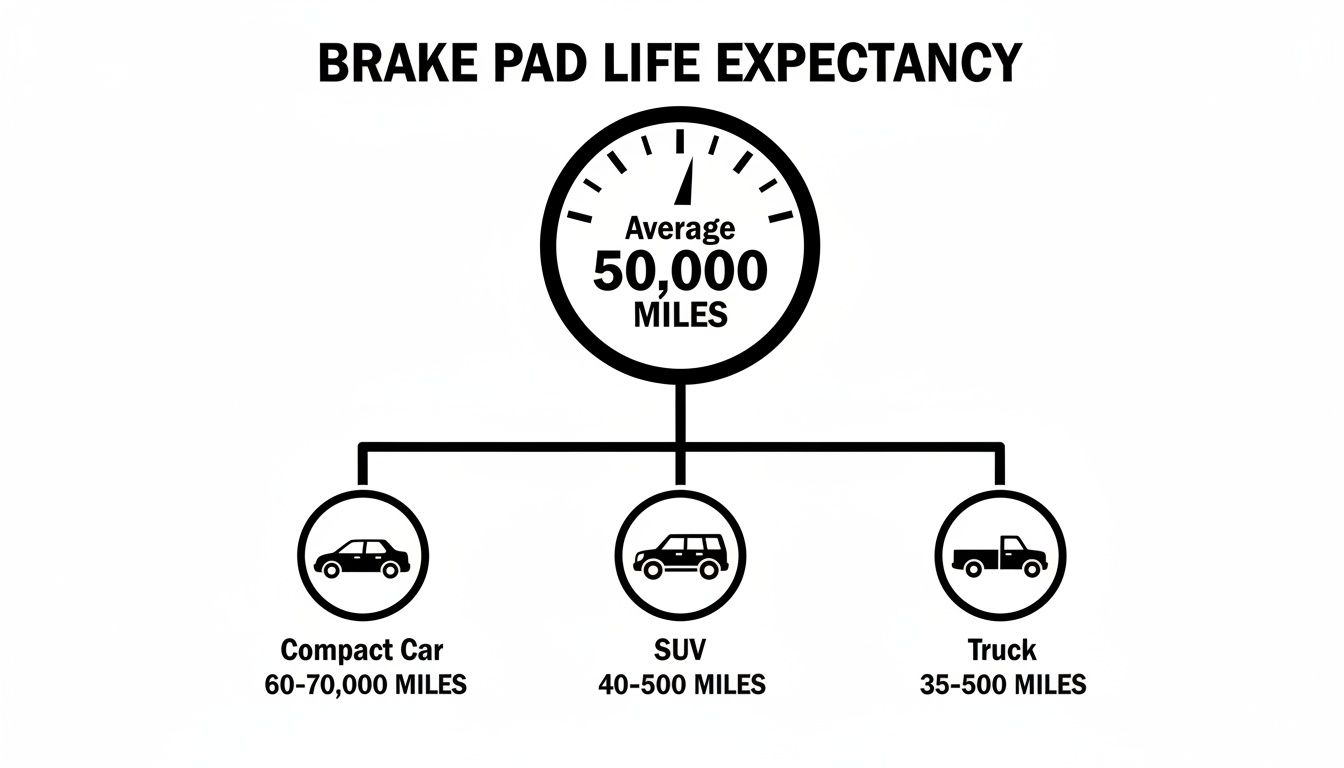
The data clearly shows that lighter compact cars can expect a longer lifespan, while heavier trucks see a shorter one. Choosing a durable material like ceramic can help extend these averages across the board.

More than any other factor, your personal driving style dictates the lifespan of your brake pads. The difference between a cautious driver and an aggressive one can easily be tens of thousands of miles. It’s what separates replacing your pads every few years from feeling like you're doing it every few months.
Think about two very different Dallas drivers. The first is a 'Highway Glider.' Their commute is mostly on the George Bush Turnpike. They leave plenty of following distance, coast toward stops, and apply the brakes gently. It’s no surprise they can get 70,000 miles or more from a set of pads—they keep friction and heat to a minimum.
Now, let's picture the 'Urban Duelist.' This driver battles the constant stop-and-go traffic downtown, hitting the brakes hard and often tailgating. For them, getting a brake job every 30,000 miles is a frustrating but common reality. Their habits put intense, repetitive stress on the pads, grinding away the friction material at a rapid pace.
Aggressive driving is the number one cause of premature brake wear. Period. Every hard stop generates a massive surge of heat, and heat is the ultimate enemy of your brake pads. It breaks down the resins that hold the pad material together, causing it to crumble away far too quickly.
This problem gets even worse with typical city driving habits:
The core principle is simple: the more heat you generate, the faster your pads will wear out. Easing into stops and anticipating traffic allows your pads to operate at cooler temperatures, directly extending their lifespan.
It’s not just about how you drive, but also what you carry. Towing a trailer or filling your truck with heavy equipment puts a massive extra workload on your brakes. The system now has to stop your vehicle's weight plus the cargo's weight, which requires much more force and generates far more heat.
Driving on steep hills has a similar effect. Heading downhill forces you to brake frequently just to control your speed, which can quickly overheat the pads and rotors. This kind of sustained use wears parts out much faster than driving on flat ground. While these habits can chew through pads, some modern electric vehicles use a regenerative braking system to help out, converting stopping energy back into electricity and saving the pads from some of that work.
By simply adopting smoother driving habits—looking ahead, coasting more often, and avoiding sudden stops—you can seriously improve the average life of brake pads on your car. It's a smart approach that saves you money on repairs and perfectly complements the expert care you get right here at Kwik Kar.
Your vehicle is pretty good at telling you when its brakes need attention, but you have to know what to listen for. Catching these early warnings is the key to preventing a simple maintenance item from snowballing into a major safety hazard or an eye-watering repair bill. Think of these signs as your car's way of asking for help before things get serious.
Some newer vehicles even have a dashboard warning light that takes the guesswork out of the equation. This system uses sensors to keep an eye on pad thickness and will alert you when it's time for a change, often based on your unique driving habits.
The most common sign of worn-out brake pads is a sharp, high-pitched squealing sound when you step on the brake pedal. This isn't just a random noise; it's a deliberate, built-in safety feature. A small metal tab, called a wear indicator, is designed to scrape against the brake rotor once the pad material wears down to a certain point.
Think of this squeal as your car's 'low battery' warning for its brakes. It’s a harmless but urgent alert telling you it’s time to schedule a service before the situation gets worse.
If you let that initial squeal go on for too long, it will eventually turn into a much nastier sound.
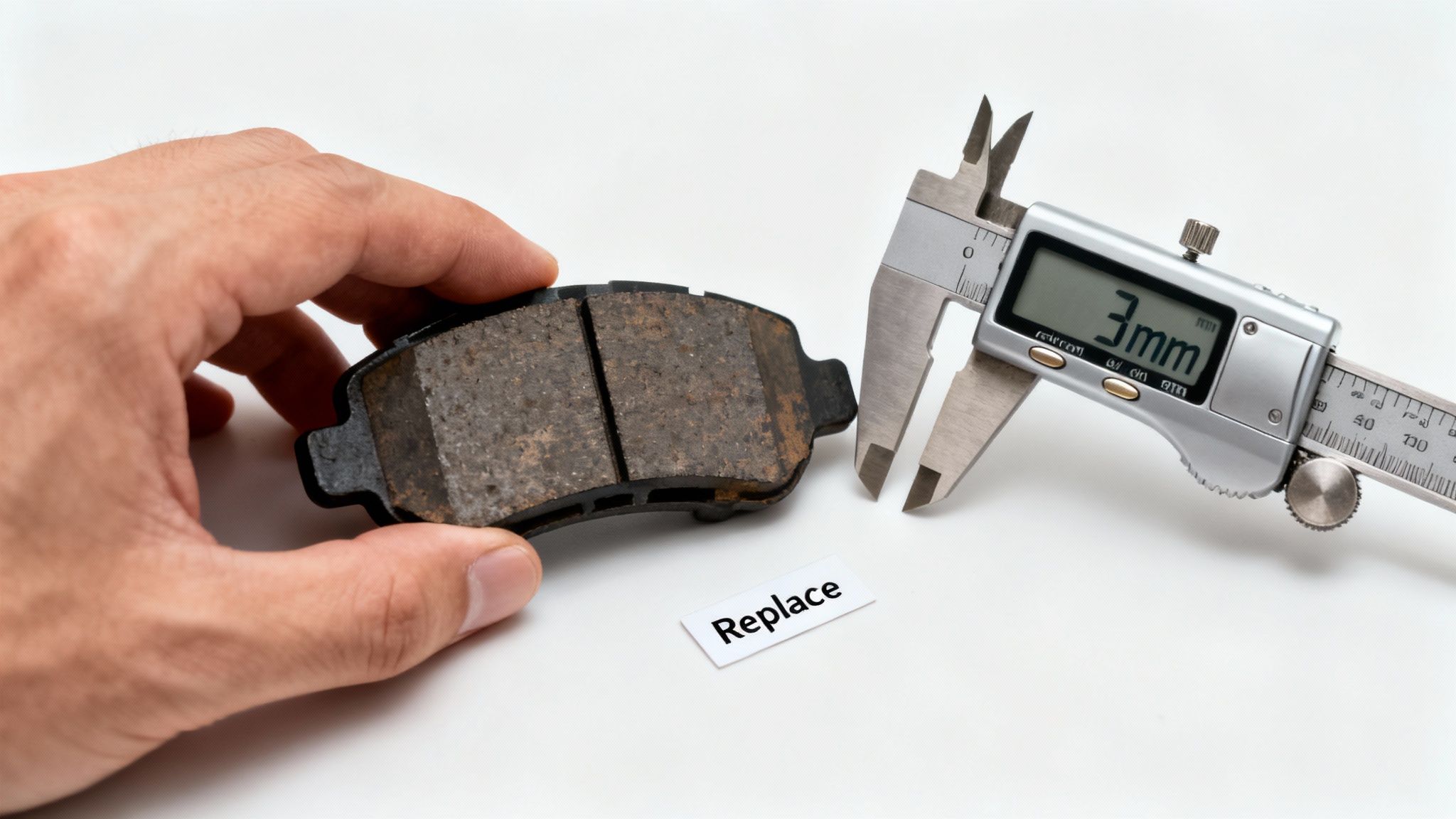
You don't always have to rely on your ears. A quick visual check can also give you a good idea of your brake pads' health. Just look through the spokes of your wheel at the brake caliper—that's the clamp-like part that holds the pads. You should be able to see the outer pad pressed against the shiny metal rotor.
If the friction material looks dangerously thin, it's definitely time for a replacement. A good rule of thumb is that the pad thickness should never be less than a quarter of an inch, or about 3-4 millimeters. Anything less is considered unsafe and needs immediate attention.
Another huge sign is a noticeable change in how your car brakes. If you find it's taking longer to stop or the brake pedal feels mushy and spongy when you press it, don't put it off. These are classic symptoms of advanced wear. You can learn more about these and other issues in our guide to common car brake problems. A professional inspection here at Kwik Kar can pinpoint the problem and get your vehicle's safety back where it needs to be.
When you're managing a fleet, the typical lifespan of a set of brake pads isn't just a maintenance note—it's a critical number that impacts your operational efficiency and total cost of ownership. The averages you see for passenger cars, somewhere between 30,000 to 70,000 miles, become almost meaningless in the commercial world. Here, the rules are completely different. The vehicle's job, what we call its "duty cycle," is the single most important factor.
Think about a long-haul truck that spends its days cruising down the highway. Its brakes are used gently and infrequently, with very little stop-and-go action. That consistent, low-stress environment is the perfect recipe for brake longevity.
Now, picture a local delivery van fighting its way through Dallas city traffic. That vehicle is in a constant cycle of accelerating and hard braking, which generates a massive amount of heat and friction. Its brake pads are under relentless assault, which means they'll have a much, much shorter service life.
The difference in brake pad life between those two scenarios is absolutely staggering. For heavy-duty fleet trucks operating under ideal highway conditions, brake pads can last an incredibly long time. Some fleets have reported getting over 400,000 miles from a single set of pads—a number that just dwarfs what any passenger car could achieve. You can get more insights on how fleet duty cycles impact brake wear on jittruckparts.com.
This massive gap really highlights how a vehicle’s day-to-day job dictates its maintenance needs. A few key factors will define any fleet vehicle's brake wear profile:
For fleet managers, maximizing uptime means you have to move beyond standard averages and adopt a proactive maintenance strategy. This involves choosing the right brake components for each specific application and sticking to a schedule tailored to that vehicle's unique duty cycle.
A one-size-fits-all approach to fleet maintenance just doesn't cut it. To truly control costs and keep your vehicles on the road, you need to partner with an experienced auto care provider. Our specialized fleet services at Kwik Kar are designed to help Dallas-area businesses create maintenance plans that match their real-world operational demands, ensuring safety, reliability, and a healthier bottom line.
At the end of the day, understanding how long your brake pads last is really about one thing: keeping you and your family safe on the road. We've covered a lot of ground—from the typical 30,000 to 70,000 mile lifespan to how different materials and your own driving habits can dramatically change that number. You now know the signs to look and listen for.
Now, it’s time to put that knowledge to good use.
Don’t ever guess when it comes to the most critical safety system in your vehicle. The only way to know for sure what’s going on with your brakes is to have a professional take a look. Here at Kwik Kar Oil Change and Auto Care, we give Dallas drivers and fleet managers the expertise they need for total peace of mind.
Our skilled technicians use state-of-the-art diagnostic tools to give you an honest, accurate assessment of your entire braking system. We’ve built our reputation on transparent service, which means we’ll explain exactly what your vehicle needs without any sales pressure. Think of us as your reliable partner in complete auto care.
Driving with confidence starts with knowing your vehicle is in expert hands. Proactive brake maintenance is not just a repair—it's an investment in your safety and the longevity of your car.
Ready to make sure your brakes are in top condition? The next logical step is scheduling an inspection. Our team is here to handle everything from a quick check-up to a full replacement. You can learn more about our comprehensive brake services in Dallas and see exactly how we can help.
Stop wondering and start driving with certainty. Schedule your professional brake inspection with Kwik Kar today and feel secure every single time you get behind the wheel.
Even after getting the basics down, you probably still have a few questions floating around. That’s perfectly normal. We hear a lot of the same questions from drivers here in Dallas, so we’ve put together some straightforward answers to help clear things up.
Yes, your front brake pads almost always wear out faster than the rear ones. It all comes down to simple physics. When you step on the brake pedal, the momentum and weight of your car shift forward, putting a ton more pressure on the front braking system.
Because they handle the bulk of the work—often as much as 70% of the total stopping force—the front pads generate way more friction and heat. This heavier workload means they'll need replacing more often, sometimes twice as frequently as the pads in the back.
The final price for a brake pad replacement can swing quite a bit. A few key things will influence your bill: the make and model of your vehicle, the type of pads you choose (organic, semi-metallic, or ceramic), and the local shop’s labor rates.
As a general ballpark, you can expect to pay anywhere from $150 to $300 per axle. If you drive a high-performance car or opt for premium ceramic pads, you’ll likely land on the higher end of that range. The best way to know for sure is to get a direct quote from a technician who can assess your specific vehicle.
Remember, that cost usually covers the parts and labor for just one axle (either the front or the rear). If both your front and rear pads are shot, the total will be higher to account for the extra parts and time.
This is one of the most common questions we get, and the answer is: not always, but it's often a very smart move. Your brake rotors are the smooth metal discs that the pads squeeze against to stop your car. After thousands of miles of intense heat and friction, these rotors can get worn down, grooved, or even warped.
If you slap brand-new pads onto old, uneven rotors, they won't make clean, solid contact. This leads to all sorts of problems, like weaker braking, annoying vibrations when you stop, and chewing through your new pads way faster than you should. A good technician will inspect your rotors and tell you if they can be resurfaced (machined smooth again) or if a full replacement is the safest bet for reliable stopping power.
For a professional and honest assessment of your vehicle's braking system, trust the experts at Kwik Kar Oil Change and Auto Care. Schedule your appointment online or stop by our Dallas location for service you can count on. Learn more at https://www.kwikkarspringvalley.com.