



That unsettling vibration you feel through the steering wheel or seat is more than just a minor annoyance. It's your car's way of telling you something's wrong. Most of the time, the answer to "why is my car shaking?" points straight to your tires and wheels, but it could also be a warning sign from your brakes, suspension, or even the engine.
Paying close attention to when the shaking happens is the first step any good mechanic takes, and it's something you can do right from the driver's seat.
Your Quick Guide To Diagnosing Car Shakes
Think of that sudden shimmy or vibration as a clue in a mystery. While it can be alarming, figuring out the source often comes down to observing the details. Does it happen only at high speeds? When you hit the brakes? Or as you're trying to get up to speed?
Each of these scenarios points to a different part of your vehicle. A shake that only shows up when you press the brake pedal is almost always a brake system problem, usually a warped rotor. On the other hand, a vibration that gets worse as you speed up and makes your steering wheel buzz is the classic sign of unbalanced tires.
Understanding the Symptoms
Imagine you're cruising down I-35 here in Dallas. As you get up to 60 mph, the steering wheel starts to vibrate in your hands. That's the textbook definition of a tire imbalance. It's the single most common cause of car shaking, with auto experts citing it as the reason for vibrations in over 70% of reported cases at highway speeds.
In fact, major tire service centers report that about 1 in 5 vehicles they inspect have unbalanced tires, with symptoms often starting as low as 50-55 mph. You can learn more about the top causes of car shaking and how they're fixed.
This diagnostic flowchart can help you visualize the process and narrow down the potential culprits.
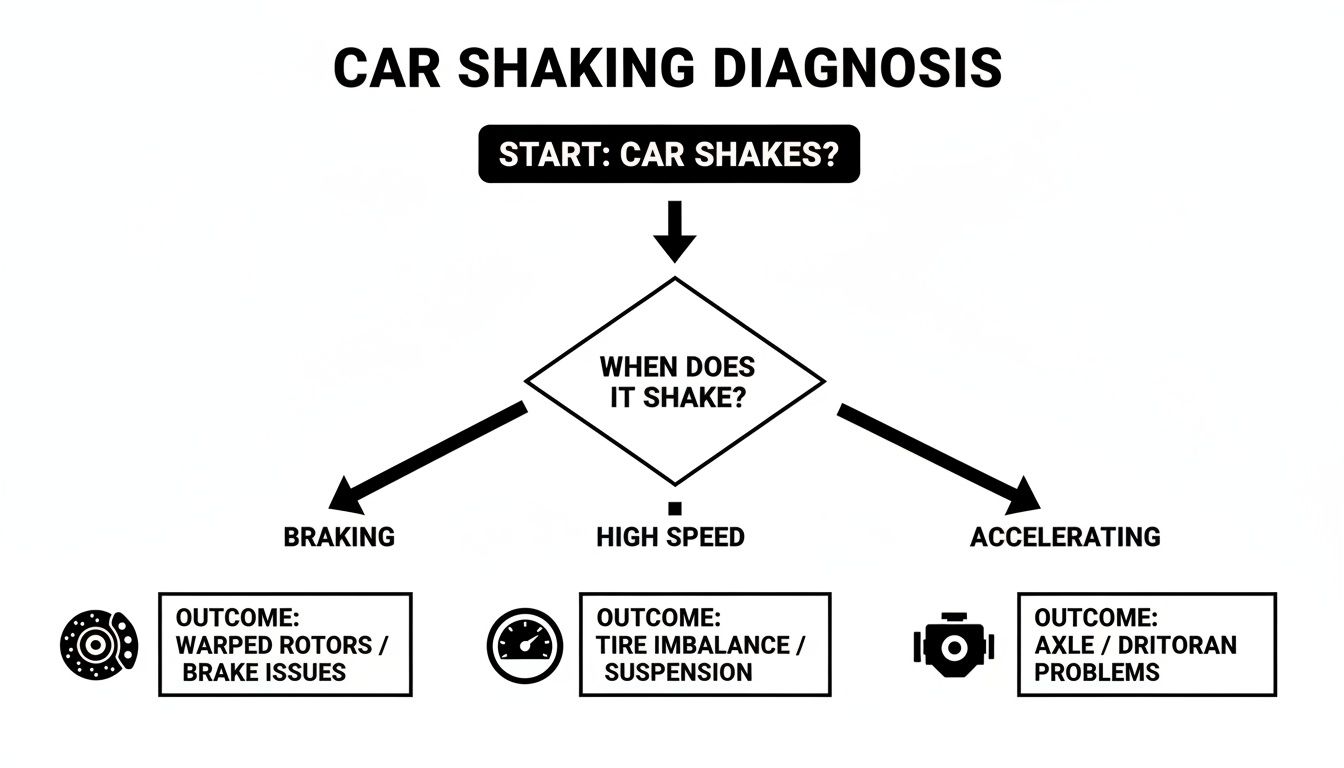
As you can see, the path to a diagnosis starts with simple observation: does it happen when braking, accelerating, or just cruising at speed? Each answer points our technicians in a different direction.
Quick Diagnostic Chart For Car Shaking Symptoms
To help you get a head start, we've put together this simple chart. Just match the shaking you're feeling with the most likely cause and our recommended action.
| Symptom | Most Likely Cause | Urgency Level |
|---|---|---|
| Steering wheel vibrates at 55-65 mph | Tire Imbalance / Wheel Alignment | Medium – Schedule an inspection soon to prevent uneven tire wear. |
| Shaking or pulsing when braking | Warped Brake Rotors | High – Compromised braking is a safety risk. Inspect immediately. |
| Vibration felt when accelerating | Axle, CV Joint, or Engine Mount Issue | High – Potential for serious drivetrain damage. Professional diagnosis needed. |
| Constant shaking at all speeds | Damaged Tire / Suspension Problem | High – Could lead to a blowout or loss of control. Stop driving and seek help. |
This chart is a great starting point, but keep in mind that a professional inspection is the only way to be 100% certain. Some of these issues can be serious safety concerns, so it's always better to be cautious.
When you’re trying to figure out, "why is my car shaking when I drive?" the answer almost always starts where the rubber meets the road. Your tires and wheels are ground zero for vibrations, and they’re behind the vast majority of shaking-related complaints we see.
The good news is that these issues are usually simple to fix. The bad news? Ignoring them can lead to much bigger, more expensive problems down the line. Think of your tires and wheels as the foundation of a smooth ride. If any part of that foundation is off—even by a tiny bit—the entire car is going to feel it, especially once you hit highway speeds around Dallas.
The Classic Culprit: Tire Imbalance
By far, the most common reason for a shaky steering wheel is a simple tire imbalance. It’s a lot like your washing machine during the spin cycle when all the heavy towels have shifted to one side. The whole machine starts to thump and vibrate like crazy. Your car's tires work on the exact same principle.
No tire and wheel is perfectly balanced from the factory; there are always slight imperfections in how the weight is distributed. To fix this, a technician uses a special machine to identify the heavy spots and attaches small, precisely measured weights to the rim. This process, called wheel balancing, makes sure the tire rotates smoothly without any wobble.
Over time, hitting potholes or just normal wear and tear can cause these weights to fall off, or the tire’s weight distribution can shift. Suddenly, you have an imbalance again. You won’t feel it pulling out of your driveway, but once you get up to around 55-65 mph, that tiny imbalance creates a powerful force that causes a distinct vibration right in your steering wheel.
A tire that’s out of balance by just 0.5 ounces generates a force of about 12 pounds with every single rotation at 60 mph. That constant hammering is what creates the rhythmic vibration you feel.
Driving on an imbalanced tire isn't just annoying; it puts a ton of extra stress on your tires, struts, shocks, and other steering parts, wearing them out faster. Getting your wheels balanced is a quick and inexpensive fix that makes your ride smooth again and protects the rest of your car.
When Your Wheels Are Out Of Alignment
Wheel alignment is a different beast from balancing, but it can also cause your car to shake. Alignment is all about the angles of your wheels in relation to the car and each other. When the alignment is right, your tires make perfect, flat contact with the road.
All it takes is one good smack against a curb or a deep Dallas pothole to knock your wheels out of alignment. When that happens, your tires are no longer pointing perfectly straight ahead. They might be fighting each other, causing the car to pull to one side and creating a gentle but persistent vibration at different speeds.
You can usually tell alignment is the problem if you notice these signs:
- The car drifts to the left or right when you take your hands off the wheel for a second.
- Your steering wheel is crooked even when you’re driving in a straight line.
- The tread on your tires is wearing down unevenly, with one edge looking much more worn than the other.
A wheel alignment service at Kwik Kar will get those angles corrected. This ensures your car drives straight, your tires wear evenly, and it can solve certain types of shaking. You can learn more about general upkeep by exploring our guide to essential tire maintenance tips.
Tire Damage And Uneven Wear
Sometimes, the problem isn't the balance or alignment but the condition of the tire itself. A damaged or unevenly worn tire simply can't roll smoothly, which leads to vibrations you can feel at almost any speed. This is usually a more constant shake, not one that only appears at highway speeds like an imbalance.
Common tire problems to look out for include:
- Bulges or Blisters: These are weak spots in the tire's sidewall that look like a bubble. That lump causes a rhythmic thumping and vibration as it rolls. A bulging tire is a major safety hazard and could blow out without warning.
- Flat Spots: If a car sits parked for a long time or if you slam on the brakes and skid, flat spots can develop. This means a section of the tire is no longer perfectly round, causing a distinct vibration with every rotation.
- Uneven Tread Wear: Often caused by bad alignment or not having enough air in your tires, uneven wear creates a rough, noisy, and shaky ride. To get to the bottom of car shakes, it's crucial to give your tires a good look-over, including checking the minimum tyre tread depth, as worn-out tread is a frequent cause of instability.
A quick visual inspection of your tires can often spot these issues. If you see any damage, strange wear patterns, or feel a constant vibration that doesn't go away, it’s time to have a professional at Kwik Kar take a look. We can tell you if the tire can be saved or if it needs to be replaced to keep you safe on the road.
When Brakes And Suspension Cause The Problem

If your car's shaking seems to pop up only under certain circumstances—like when you hit the brakes or drive over a rough patch of road—the problem probably isn't your tires. At this point, your brake and suspension systems are the next places we need to look. Unlike a tire imbalance that creates a steady vibration at high speeds, these issues are directly tied to specific actions or road conditions.
Understanding these conditional shakes is a huge help. Pinpointing exactly when the vibration happens is the most valuable piece of information you can bring to our technicians at Kwik Kar. It lets us narrow down the possibilities and diagnose the problem much faster, which saves you both time and money.
Brake System Shakes: A Pulsing Problem
Ever feel a noticeable shudder or a pulsing feeling through the steering wheel or brake pedal, but only when you’re slowing down? That’s the classic sign of a problem with your brake rotors.
Think of it like a bicycle wheel with a slight warp in the rim. Every time that bent spot spins past the brake pad, you feel a little bump. It’s the same idea with your car. The brake rotor is that shiny metal disc your brake pads clamp onto to stop the vehicle.
The intense heat from braking can eventually cause this disc to warp, developing tiny, uneven high and low spots across its surface. When you hit the brakes, the pads grab this now-uneven surface, creating a pulsing or shaking you can feel. The vibration will be completely gone during normal driving and show up the instant you apply the brakes.
A warped rotor can significantly increase your vehicle's stopping distance. Ignoring this symptom is a direct safety risk, as your ability to brake effectively in an emergency could be compromised.
This is one symptom you need to address immediately. It might start as a minor annoyance, but it’s a clear signal that your braking system’s performance is no longer at 100%.
Common Signs Of Warped Brake Rotors
- Pulsing Brake Pedal: You can physically feel the brake pedal vibrating or gently pushing back against your foot as you press down.
- Shaky Steering Wheel During Braking: The vibration travels up from the wheels, making the steering wheel shake in your hands as you slow the car down.
- Squealing or Grinding Noises: Sometimes, the uneven surface causes strange sounds to go along with the shaking.
Suspension Shakes: The Unstable Ride
Your car’s suspension is essentially its skeleton, full of joints and shock absorbers built to keep your ride smooth and stable. It’s the buffer between you and every imperfection on the road. When parts of this system wear out, your car loses its ability to soak up bumps, leading to a very different kind of shake.
Instead of the high-speed hum of an imbalanced tire or the braking-only pulse of a warped rotor, a suspension issue often creates a more jarring, inconsistent vibration. You'll likely feel it most after hitting a pothole or driving on a rough road. The car might even feel "loose" or seem to wander, and the shaking can often be traced to a specific corner of the vehicle.
Worn-out components are the usual culprits. Parts like ball joints, tie rods, and your shocks or struts can develop looseness, or "play," after thousands of miles. This extra movement allows the wheel to wobble, creating a shake that gets much worse on bumpy terrain. At Kwik Kar, we can get your vehicle on a lift to check these components for the wear and tear that could be causing your unstable ride. A thorough suspension check is a critical step when asking, "why is my car shaking when I drive?"
How Axles And The Drivetrain Can Cause Shaking
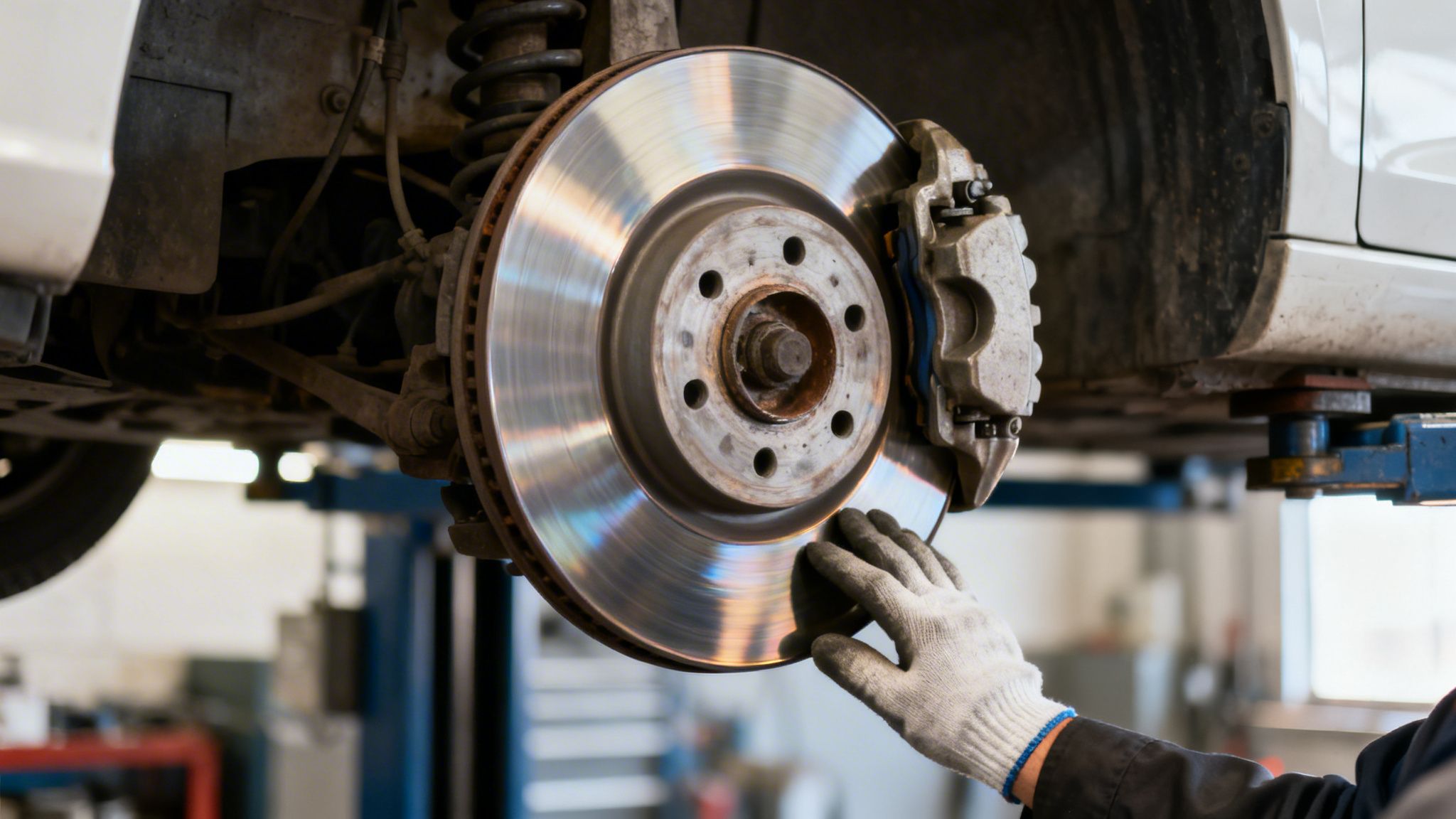
If your car’s shaking doesn’t feel like a tire, wheel, or brake issue, it’s time to look deeper. We need to investigate the components that actually send power from your engine to the wheels. This entire system is called the drivetrain, and it includes crucial parts like axles and driveshafts.
Vibrations coming from the drivetrain are usually very specific. Unlike a simple tire imbalance you feel at highway speeds, a drivetrain vibration often changes depending on whether you're accelerating or just cruising along. These symptoms are huge clues for our technicians and can point to serious mechanical wear that needs immediate attention.
The Job Of The CV Axle
On any front-wheel-drive car, the Constant Velocity (CV) axles are the workhorses delivering engine power to the front wheels. To do this effectively, each axle has flexible joints on both ends called CV joints, and they are absolutely essential for a smooth ride.
You can think of a CV joint like your wrist. It can bend up, down, and side-to-side while still letting your hand twist and turn. A CV joint does the same thing for your car, allowing the axle to spin and power the wheel even as the suspension bounces over bumps and you steer left or right.
A worn or damaged inner CV joint is a classic cause of shaking that you feel only when you step on the gas. The shuddering or vibration is distinct while you're accelerating but vanishes the second you ease off the pedal.
This on-again, off-again vibration is a dead giveaway for a bad inner CV joint. Over time, its internal parts wear down, creating a looseness that only becomes a problem under the load of acceleration. For a deeper dive, check out our guide on the common signs of worn CV joints.
Problems With The Driveshaft
In rear-wheel-drive and all-wheel-drive vehicles, power gets to the back wheels via a long, spinning metal tube called a driveshaft. Just like a tire, this part is meticulously balanced at the factory so it can rotate smoothly at thousands of revolutions per minute.
But over years of driving, the small counterweights attached to the driveshaft can fall off. The universal joints (U-joints) that connect it at either end can also wear out. When this happens, the driveshaft gets thrown off balance, creating a powerful vibration that feels very different from a tire problem.
- You Feel It In The Floor: An unbalanced tire usually makes the steering wheel shake. An unbalanced driveshaft, however, often creates a deep vibration you can feel through the entire floor and seats of the car.
- It’s Speed-Dependent: The shaking typically starts at a certain speed and gets noticeably worse the faster you go.
A damaged driveshaft isn’t just an annoyance; it's a major safety hazard. If a U-joint fails completely, the entire driveshaft can drop out from under the car while you're driving. This causes a total loss of power and can lead to catastrophic damage. If you feel a deep, rumbling vibration coming from beneath your car, it is critical to have it inspected by a professional at Kwik Kar right away.
Tracing Tremors Back to Your Engine and Transmission
While a lot of vibrations trace back to your wheels or brakes, a different kind of shake often starts deep inside your vehicle—in the engine and transmission. These tremors can feel more fundamental, signaling a problem with the very components that create and deliver power.
Unlike a tire imbalance that hums predictably at highway speeds, these shakes are usually tied to what the engine is doing. You might feel it when idling, accelerating, or shifting gears. It’s not something to ignore, as these symptoms can point to internal issues that only get more complicated and expensive the longer you wait.
The Role Of Engine Mounts
Think of your engine as a powerful, vibrating machine. To keep you from feeling every little shudder, it’s secured to your car’s frame with engine mounts. These aren’t just solid metal brackets; they’re clever combinations of steel and heavy-duty rubber, and some are even filled with fluid.
Their one job is to absorb the engine's natural vibrations, sort of like how the soles of your running shoes cushion your feet from the pavement. But when these mounts wear out, the rubber cracks or the fluid leaks, and they can’t do their job anymore. The engine’s raw vibrations then transfer right through the car’s frame.
You'll usually notice the signs of a bad engine mount in these situations:
- A Rough Idle: The whole car might feel like it's sputtering or vibrating too much while you're stopped at a red light.
- A Jolt on Acceleration: You may feel a distinct "clunk" or shudder the moment you hit the gas from a dead stop.
- Vibrations in the Steering Wheel: A constant, rough vibration can be felt through the steering wheel and even the floorboards.
A failing engine mount puts extra stress on everything around it and can eventually cause serious damage. Getting it replaced brings back that buffer between you and your engine, restoring the smooth, quiet idle you expect.
Transmission Troubles Causing Shakes
Your car's transmission is a complex piece of engineering, responsible for seamlessly sending power to the wheels. When it starts having problems, it can create a very specific shudder that many people say feels like driving over the rumble strips on the side of the highway.
This sensation is often caused by an issue with the torque converter in an automatic transmission. The torque converter's job is to manage the fluid connection between the engine and the transmission. If it starts to fail, or if the transmission fluid is old and broken down, it can cause slipping or shuddering, especially when you're cruising at a steady speed.
This "rumble strip" feeling, which mechanics call torque converter shudder, often pops up between 30 and 45 mph. It’s a definite sign that your transmission needs a professional look-over right away to prevent serious internal damage.
Engine-related vibrations can also come from problems in the fuel system. For example, knowing the symptoms of bad fuel injectors can help you recognize a common cause of engine misfires, which definitely cause shaking.
Whether it’s the engine, transmission, or fuel delivery, a professional diagnosis is the only way to know for sure. If you're feeling these kinds of deep-seated vibrations, a full car diagnostic test can pull the error codes from your vehicle's computer and pinpoint the exact source of the trouble, which means a faster and more accurate fix.
Your Proactive Plan For A Smooth And Safe Ride
Knowing why your car is shaking is one thing, but preventing it from ever happening is the real goal. Instead of waiting for a problem to pop up, you can take a few simple, proactive steps to keep your ride smooth and steady. Think of routine maintenance not as just another expense, but as a smart investment in your safety, comfort, and the long-term health of your vehicle.
A little prevention goes a very long way. Most of the common culprits behind a shaky car—things like unbalanced tires, warped brake rotors, and poor alignment—are completely avoidable with regular checks. When you catch these issues early, you stop a minor annoyance from turning into a major, wallet-draining repair down the road.
Your Essential Maintenance Checklist
Sticking to a simple schedule is your best defense against those unexpected shakes and shudders. Here’s a practical game plan to help you stay ahead of trouble and lock in that smooth-ride feeling.
- Tire Rotation and Balancing (Every 5,000-7,000 miles): Regularly rotating your tires is key to making sure they wear down evenly, which gets you more miles out of every set. Balancing them at the same time fixes any small weight distribution problems that have popped up, stopping those high-speed vibrations before they even begin.
- Wheel Alignment Check (Annually or after hitting a major pothole): An alignment check once a year, especially on our Dallas roads, keeps your car pointed straight. This simple step prevents the kind of uneven tire wear that's a classic cause of a constant, nagging shake.
- Brake Inspection (Every 12,000 miles): Have a professional look over your brake pads and rotors annually. This gives a technician the chance to spot the early signs of wear or warping, so you can handle it long before your ability to stop safely is ever compromised.
This kind of regular care isn't just about preventing a shake; it’s about improving your car's overall safety and performance.
A well-maintained vehicle is a safe vehicle. By investing in routine checks for your tires, alignment, and brakes, you're not just ensuring a smoother ride—you're protecting yourself and your passengers from potential component failure on the road.
Trust The Experts At Kwik Kar In Dallas
While this guide helps you get a handle on the question "why is my car shaking when I drive," the only way to know the cause for sure is with a professional diagnosis. Guessing can lead to paying for repairs you don't need while the real problem is left to get worse.
At Kwik Kar in Dallas, our skilled technicians use advanced diagnostic tools to pinpoint the exact source of any vibration. We’ll give you a clear, honest explanation of what’s going on and a transparent estimate for the fix. Don't let a mysterious shake ruin your drive or put your safety at risk. Schedule your comprehensive vehicle inspection with Kwik Kar today and get back the peace of mind that comes with a smooth, reliable, and safe ride.
Frequently Asked Questions About Car Shaking
After digging into all the things that can make your car shake, it's completely normal to have some practical questions buzzing in your head. We've pulled together the most common concerns we hear from drivers just like you to give you clear, straightforward answers.
Is It Safe To Drive My Car If It's Shaking?
Honestly, it really depends on what you're feeling. A minor vibration that only crops up at highway speeds could just be a simple tire imbalance that you can get looked at soon. But some situations are far more urgent.
Any severe or violent shaking is a huge red flag. You need to pay immediate attention if the vibration happens when you brake, or if it comes with loud noises or a blinking check engine light.
If the shaking is intense, the absolute best thing you can do is pull over safely and call for a tow. Pushing it could lead to a major part failing completely, potentially causing you to lose control of the car.
How Much Does It Cost To Fix A Shaking Car?
The cost is tied directly to whatever is causing the problem. A simple fix like a tire balance might only run you $20-$40 per tire. A full four-wheel alignment is usually in the $80-$150 neighborhood.
More involved repairs, naturally, come with a higher price tag. Replacing a set of warped brake rotors can easily cost several hundred dollars. For bigger issues like a failing CV axle or a broken engine mount, you could be looking at a bill anywhere from $300 to over $1,000. The only way to know for sure is to get a professional diagnosis, which gives you a precise, transparent estimate before any work begins.
Can A Simple Oil Change Fix A Shaking Problem?
While getting an oil change won't fix a mechanical vibration, it's the perfect opportunity for a preventative check-up. Any quality auto shop includes a courtesy vehicle inspection with routine maintenance—we certainly do.
During this look-over, our technicians can often spot the early signs of problems that lead to shaking, like uneven tire wear, a loose suspension part, or fluid leaks. It’s a great way to catch issues early, before they turn into expensive headaches and safety risks.
Don't let a mysterious vibration put your safety on the line. The expert technicians at Kwik Kar Oil Change and Auto Care have the advanced diagnostic tools to pinpoint the problem and give you a clear path forward. Visit us at https://www.kwikkarspringvalley.com to schedule your inspection and get back to driving with confidence.