
A 4-wheel alignment is a precision service that adjusts your vehicle’s suspension system, not the tires themselves. The goal is to get all four wheels pointing in the exact same direction, perfectly angled to each other and the road surface. This ensures your car drives straight, handles predictably, and gets the most life out of your tires.
Why a 4 Wheel Alignment Is Essential for Your Vehicle
Think of your car's alignment like the foundation of a house. If that foundation is even slightly off, everything built on top of it feels the stress. The same thing happens with your vehicle; when the wheels are misaligned, it puts a ton of unnecessary strain on your tires, suspension components, and even your engine, which has to work harder just to move the car forward.
A professional 4-wheel alignment service corrects the three critical angles that dictate how your car performs on the road:
- Toe: This is the angle of your tires when you look down at them from above. Are they pointing inward or outward, like your feet?
- Camber: This is the inward or outward tilt of your tires when you look at them from the front of the vehicle.
- Caster: This angle relates to your steering axis. Getting it right is crucial for steering stability and smooth cornering.
When our technicians dial these three angles into your manufacturer's exact specifications, your vehicle operates at its absolute best. You’ll notice a smoother ride, more responsive steering, and a much safer driving experience on Dallas roads. Putting off an alignment doesn't just feel wrong—it actively costs you money in premature tire wear and lower gas mileage.
More Than Just a Service It Is a Necessity
The importance of wheel alignment isn’t just something mechanics talk about; the numbers back it up. The global wheel alignment industry was valued at over USD 1,014.74 million in 2021 and is only expected to grow. Even more startling, a staggering 80% of vehicles on U.S. roads are estimated to have some level of misalignment, leading to billions in unnecessary tire replacement costs every single year. You can read the full research about the wheel alignment market for more details.
A proper alignment is one of the most effective ways to protect your investment. It not only extends the life of your tires but also safeguards critical suspension components from excessive wear and tear, preventing more expensive repairs down the road.
This is exactly why regular alignment checks are so important. All it takes is one bad pothole or a minor bump against a curb to knock your suspension out of whack. Keeping your wheels perfectly positioned is fundamental to your vehicle's health and a core part of any smart tire maintenance tips.
Understanding Camber, Caster, and Toe
A proper 4-wheel alignment isn't just guesswork; it's a precise science involving three critical angles. These angles—camber, caster, and toe—are the foundation of how your vehicle drives, handles, and wears its tires. Getting a handle on what they do takes the mystery out of the process and shows why every adjustment matters.
Think of these angles as your car's posture. If your own posture is off, you might end up with back pain or wear out your shoes unevenly. It's the same idea with your car—the wrong angles lead to poor handling, shredded tires, and even safety issues.
Let's break down each one.
Camber: The Leaning Angle
Camber is the inward or outward tilt of your tires when you look at your car head-on. If you've ever seen a race car with wheels that look tilted in at the top, you've seen an aggressive camber setup.
- Positive Camber: The top of the tire tilts away from the vehicle.
- Negative Camber: The top of the tire tilts inward, toward the vehicle.
Your car's manufacturer designs a slight camber angle into the suspension to help it grip better in turns. But if you smack a classic Dallas pothole, that angle can get knocked out of whack. Too much tilt in either direction will chew up one edge of your tire tread, sending your expensive tires to an early grave.
Caster: The Stability Angle
Caster is the angle of your steering axis when viewed from the side. This one is a little harder to see, but its effect is something you feel every time you drive. Think about the front wheels of a shopping cart—they naturally want to follow the direction you're pushing. That self-centering magic is thanks to caster.
In your car, caster is what provides steering stability and helps your steering wheel return to center after you make a turn.
An incorrect caster angle can make your steering feel either way too light and twitchy or heavy and sluggish. Getting it right is essential for that confident, stable feel on the highway.
If your car tends to wander or drift instead of tracking straight, a bad caster angle is a likely suspect. It’s a huge part of what makes a 4-wheel alignment so crucial for a safe, comfortable drive.
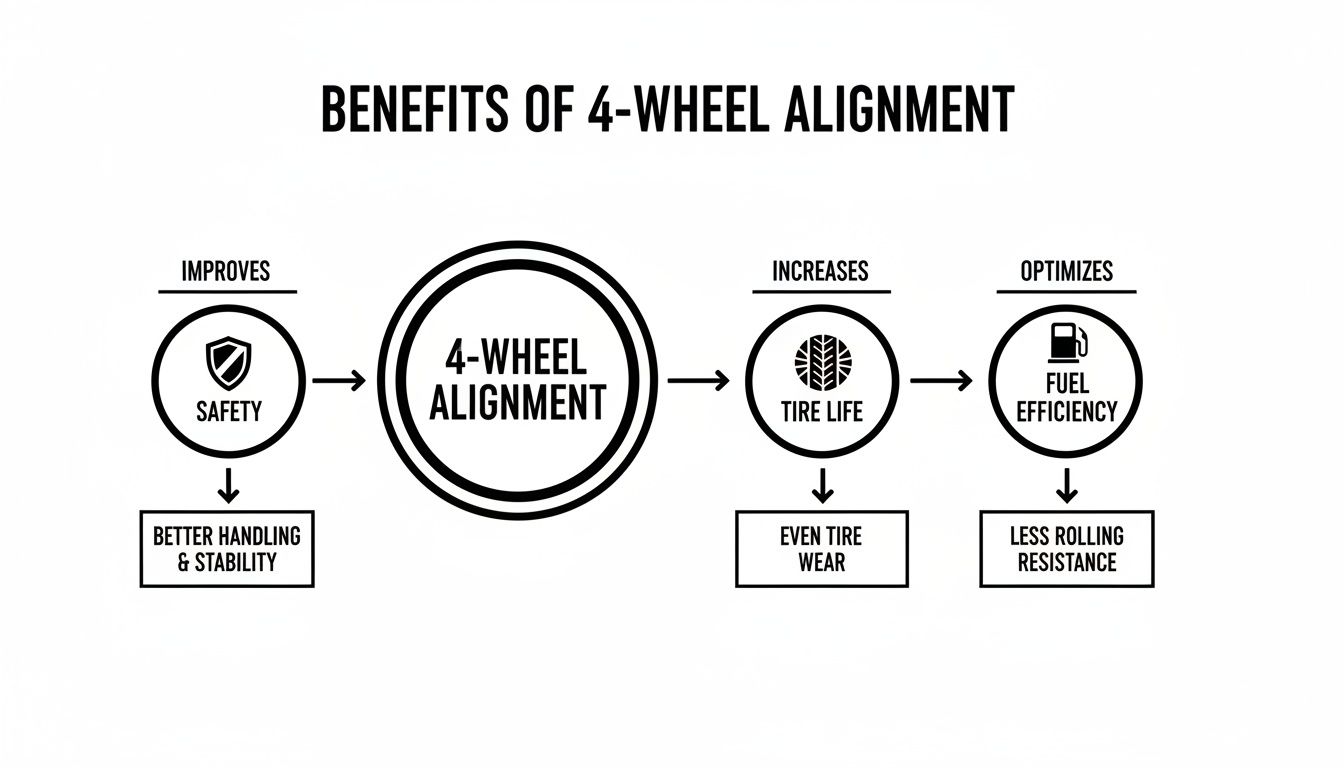
As you can see, getting these angles right has a ripple effect, improving everything from safety to your gas mileage.
Toe: The Directional Angle
Finally, there's toe. This is the direction your tires are pointing relative to each other if you were looking down from above. Think about your own two feet: if they point slightly inward, that's "toe-in." If they point outward, it's "toe-out."
- Toe-in: The front of the tires are angled closer together than the rear.
- Toe-out: The front of the tires are angled farther apart than the rear.
An incorrect toe setting is the number one killer of tires. If the toe is off, your tires are essentially fighting each other as you drive down the road, scrubbing rubber off with every mile. This creates a "feathered" wear pattern you can often feel by running your hand across the tread. Adjusting the toe on all four wheels is an absolute must for any complete alignment.
Seven Signs Your Car Needs an Alignment

Your car has ways of telling you something is wrong, sending subtle (and sometimes not-so-subtle) signals through its performance. When it comes to your suspension, these hints are an early warning system. Ignoring them can turn a simple fix like a 4 wheel alignment into a much more expensive problem down the road.
Learning to spot these signs lets you act fast, saving you money on tires and protecting your car’s most important components. Here are the seven most common symptoms that mean it’s time to see a pro.
1. Uneven or Rapid Tire Wear
This is the big one—the most common and obvious sign of bad alignment. When your suspension angles are off, your tires can't sit flat on the road. This imbalance forces certain parts of the tread to take on all the friction and weight, causing them to wear down way too fast.
- Inner/Outer Edge Wear: If the inside or outside tread of your tires is going bald while the center looks fine, that's a classic symptom of a bad camber angle. The tire is literally tilted and riding on its edge.
- Feathered Wear: Run your hand across the tread. Does it feel smooth one way but sharp and jagged the other, almost like saw teeth? This "feathering" points directly to an incorrect toe setting. Your tires are essentially being dragged sideways as they roll forward.
2. Vehicle Pulling to One Side
Ever feel like you’re in a constant battle with your steering wheel just to drive straight? If you let go of the wheel on a flat, straight road and the car consistently drifts left or right, your alignment is almost certainly the culprit.
This pull is usually caused by uneven camber or caster settings between the two front wheels. Your car is literally trying to turn because the wheels on one side are angled differently than on the other. Fighting this isn't just annoying; it's a safety issue that leads to driver fatigue.
3. A Crooked Steering Wheel
When you're driving straight, the logo on your steering wheel should be perfectly level. If you find it’s tilted to one side even though the car is tracking straight, that’s a clear red flag for an alignment problem.
Even if the car seems to drive fine, a crooked steering wheel means the alignment is off. The steering and suspension systems are out of sync, and the car is compensating for a problem that needs to be fixed.
4. Squealing or Screeching Tires
Your tires shouldn't be making a fuss during simple, slow turns, like when you're pulling into a parking space. If you hear a squeal or screech, it’s often because the tires are being scrubbed across the pavement instead of rolling smoothly. This is a tell-tale sign of a severe toe misalignment forcing the tire to fight the direction of the turn.
5. Noisy or Vibrating Steering
Feeling a vibration through the steering wheel or hearing clunking noises, especially when turning, can point to worn suspension parts that are throwing your alignment out of whack. While vibrations can also mean your tires are unbalanced, when you notice it along with other symptoms on this list, a 4 wheel alignment check is a must. Worn-out parts like tie rods or ball joints can make it impossible for your wheels to hold the correct alignment.
6. Steering Feels Loose or Unstable
A properly aligned car feels tight and responsive. You know exactly how it will react. If your steering suddenly feels vague, loose, or like you need to turn the wheel more than usual to get a response, you might have a bad caster angle or worn steering components. That feeling of instability is especially dangerous at highway speeds.
7. Your Vehicle Just Had Suspension Work
This one is less of a symptom and more of a rule. If you’ve recently replaced tires, shocks, struts, or any other part of your steering and suspension system, a 4 wheel alignment isn't just a good idea—it’s mandatory. Any time these components are changed, your vehicle's geometry is altered. An alignment is the final, critical step to make sure all those new parts work together as they should.
The Kwik Kar Alignment Process Explained
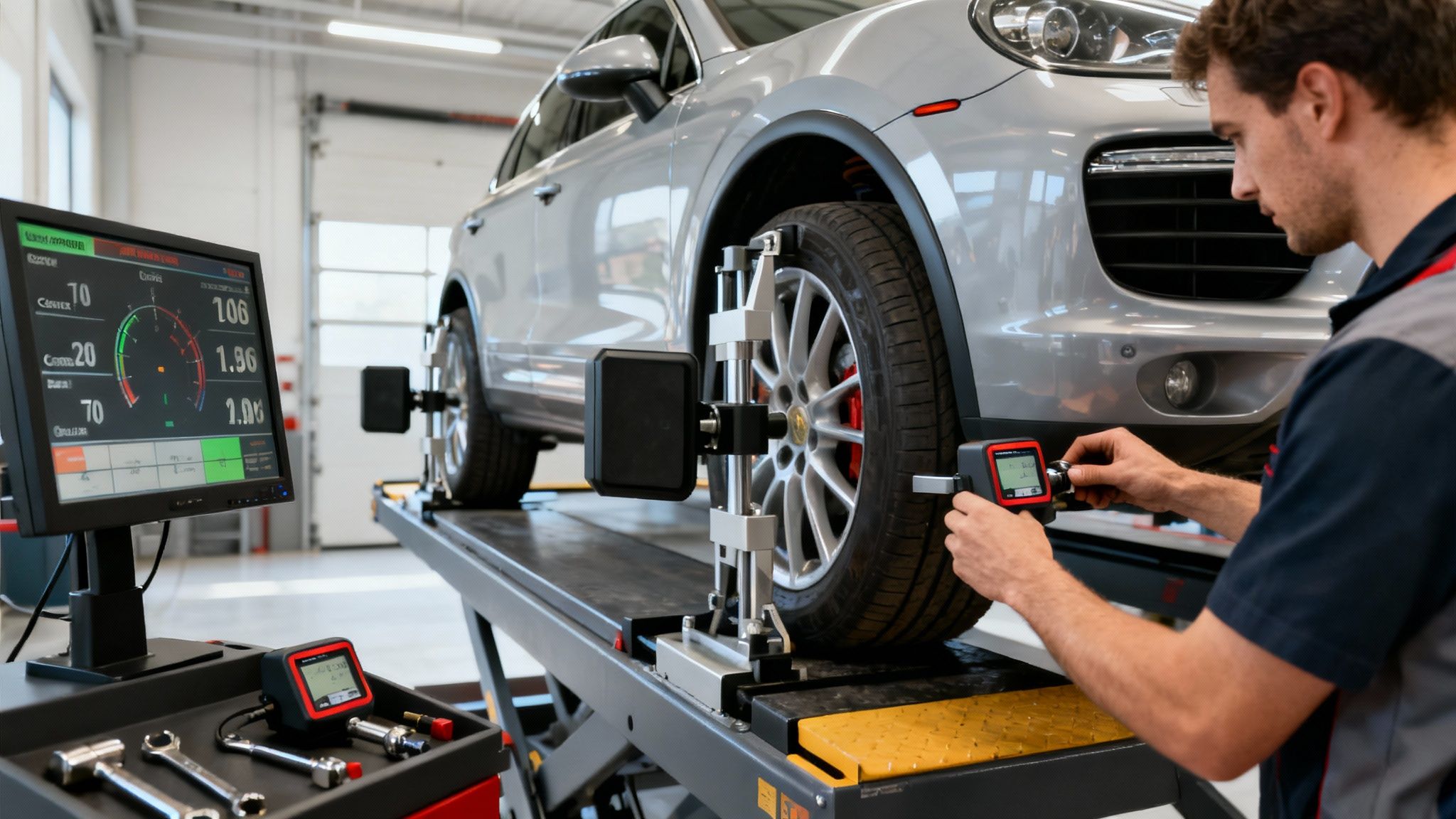
A 4 wheel alignment might sound complicated, but it's really a fascinating blend of old-school mechanic know-how and incredible modern technology. Here at Kwik Kar, we're big on transparency—we want you to know exactly what’s going on with your vehicle. Let's pull back the curtain and show you how our certified technicians bring your car back into perfect balance.
Our whole process is systematic and incredibly thorough. We measure and correct every angle to meet your vehicle manufacturer's precise standards. This is about more than just nudging your tires around; it’s about fine-tuning your car's entire suspension geometry so it drives its best and keeps you safe.
Step 1: Initial Vehicle Inspection
Before we hook up a single machine, our work starts with a hands-on assessment. One of our technicians will take your vehicle for a quick test drive. This lets them feel the same symptoms you have, whether it's that annoying pull to one side or a steering wheel that's not quite straight.
Next, we get your vehicle up on a lift for a good look at all the steering and suspension parts. We're specifically checking for:
- Worn Parts: We inspect ball joints, bushings, tie rods, and other key components. If these parts are worn out, your vehicle won't hold an alignment, so we need to spot these problems first.
- Tire Condition: We check your tire pressure and look closely at the wear patterns. Uneven wear is a dead giveaway that tells us a lot about what kind of misalignment we're dealing with.
- Ride Height: We also make sure the vehicle sits at the height the manufacturer intended, since this can throw off the alignment angles.
Step 2: Mounting the Precision Sensors
Once the visual check is done, we connect your vehicle to our state-of-the-art alignment machine. This means mounting highly accurate sensors, or targets, onto each of your four wheels.
These targets are pretty amazing. They talk to a central computer that uses advanced 3D imaging technology. As the wheels turn, the sensors feed a constant stream of data, creating a real-time, three-dimensional model of your car's suspension.
Did you know? The industry's move to 3D wheel aligners is a game-changer. These systems use cameras and powerful algorithms to get measurements so accurate they reduce errors to under 0.1 degrees. Considering that misalignment causes over 75% of tires to wear out early—costing U.S. drivers $3 billion a year and hurting fuel economy by up to 4%—this level of precision is critical. Kwik Kar uses this tech for fast, spot-on diagnostics and repairs.
Step 3: Measuring the Angles and Comparing Data
With the sensors fired up, our technicians get exact readings for the "big three" alignment angles—camber, caster, and toe—on all four wheels. These initial numbers show us precisely how far your vehicle has drifted from its factory settings.
The alignment system then cross-references these readings with a massive database of manufacturer specs for your car's exact make, model, and year. The result is a simple, color-coded report that shows us which angles are good to go (green) and which ones need a little TLC (red).
Step 4: Making Meticulous Adjustments
This is where the magic happens, as expert skill meets high-tech precision. Guided by the computer's live data, our technician uses specialized tools to carefully adjust various suspension components. They dial in the camber, caster, and toe angles until every single one is perfectly within the manufacturer's specified range.
For a true 4 wheel alignment, we always start with the rear wheels. You have to get the rear axle perfectly square with the vehicle's centerline first. Only then can we adjust the front wheels to match, making sure all four wheels are working together as a team.
Once everything is perfect, we give you a final printout showing the "before" and "after" numbers. It’s our way of proving your vehicle is back in perfect alignment. To learn more about keeping your tires in great shape, check out our other tire services.
Maximizing Fleet Efficiency with Regular Alignments
For any business running a fleet of vehicles, uptime isn't just a goal—it's everything. A single truck or van stuck on the sidelines isn't an inconvenience; it's a direct hit to your revenue. That's why smart, proactive maintenance, with a 4 wheel alignment at its core, isn't just another expense. It's one of the best tools you have for boosting your bottom line.
Think about it. When one vehicle has bad alignment, it guzzles more fuel and shreds its tires ahead of schedule. Now, multiply that waste across a fleet of 10, 20, or 50 vehicles. The financial drain adds up fast, quietly eating into your profits month after month.
The Financial Impact of Proactive Alignments
Putting off alignments might look like you're saving a few bucks today, but the long-term costs will catch up to you. A consistent alignment schedule for your fleet delivers a powerful return on investment by directly tackling three of your biggest operational expenses.
This strategy is only getting more important. The global market for automotive wheel alignment systems is expected to grow by USD 681.1 million between 2024 and 2028, largely because modern vehicles are so much more complex. The data doesn't lie: proper alignment can boost fuel efficiency by 3-5% and cut tire wear by as much as 30%. For a commercial fleet, those numbers translate into massive savings and prevent the kind of downtime that kills profitability.
This isn't just about maintenance; it's about building a more financially stable and reliable operation.
Key Benefits for Fleet Operations
A scheduled alignment program does a lot more than just keep your vehicles driving in a straight line. It sets off a chain reaction of efficiency that makes your entire operation stronger.
- Extended Tire Longevity: Tires are one of the most significant recurring costs for any fleet. Correct alignment ensures the tread wears down evenly on every tire, helping you meet or even beat the manufacturer's mileage estimates. That means buying fewer tires and spending less time and labor on replacements.
- Improved Fuel Economy: When wheels are fighting each other, they create drag that forces the engine to work harder and burn extra fuel. A 4 wheel alignment gets all four wheels working together, minimizing that rolling resistance. A 3-5% fuel savings might not sound like much for one truck, but across your whole fleet, it adds up to thousands of dollars saved each year.
- Reduced Suspension Stress: Misalignment puts constant, uneven pressure on critical suspension parts like ball joints, tie rods, and bushings. This causes them to wear out prematurely, leading to expensive repairs that can take a vehicle off the road for days. Regular alignments protect these components from unnecessary strain.
By investing in routine alignments, you are transforming a maintenance task into a financial strategy. You are actively reducing your largest variable costs—fuel and tires—while simultaneously protecting your most valuable assets from unnecessary wear and tear.
A Reliable Partner for Dallas Fleets
Managing fleet maintenance requires a partner who gets it—someone who understands the urgency and precision your business depends on. Here at Kwik Kar, we offer specialized services built to keep your vehicles on the road, earning you money. Our efficient process means minimal downtime, and our detailed reporting gives you the clear data you need to manage your assets well.
We create custom programs that fit your operational schedule, making it simple to put a proactive alignment strategy in place. If you're ready to cut costs and make your fleet more reliable, check out our dedicated fleet service programs and see how we can help.
Got Questions About 4-Wheel Alignments? We’ve Got Answers.
Even after you get the basics down, it’s totally normal to have a few more questions rattling around. We get it. To make sure you feel completely confident before you hand over the keys, we’ve put together a few of the most common questions we hear from drivers just like you.
Think of this as your quick-and-easy guide to clearing up any final confusion.
Is an Alignment the Same as Wheel Balancing?
This is probably the most common mix-up we see, but the answer is a firm no. They’re two totally different jobs that solve two very different problems.
- Wheel Alignment: This is all about the angles of your car's suspension. Think of it as adjusting how the entire wheel and tire assembly sits in relation to the car itself. It corrects the camber, caster, and toe to make sure your tires hit the road perfectly flat. This is what fixes that annoying pull to one side and stops your tires from wearing out unevenly.
- Wheel Balancing: This deals with weight distribution issues in the tire and wheel combo. A technician spins the wheel on a special machine and attaches tiny, precise weights to the rim. This ensures it spins smoothly without any wobbling, which is what prevents those vibrations you feel in the steering wheel, especially at highway speeds.
So, in a nutshell: alignment fixes how your car tracks down the road, while balancing fixes how your wheels spin. Both are crucial for a smooth ride and getting the most life out of your tires.
Do I Really Need an Alignment After Getting New Tires?
Yes, absolutely. In fact, we’d say it’s non-negotiable if you want to protect your investment. A new set of tires isn't cheap, and putting them on a misaligned vehicle is the fastest way to ruin them. The way your old tires wore down might have been hiding a subtle alignment issue that will immediately start chewing up your brand-new rubber.
Think of it this way: you wouldn't spend a fortune on beautiful new flooring just to install it on a crooked, unlevel foundation. A 4-wheel alignment gives your new tires a perfectly straight and true platform to start their life on, ensuring you get every last mile you paid for.
Getting an alignment with new tires is standard practice for a reason. It's the only way to guarantee you're getting the full value and performance out of them.
Can a Bad Alignment Cause Vibrations?
It can, but it’s not the usual suspect. The number one cause of vibrations, especially in the steering wheel, is almost always unbalanced tires.
However, a really bad alignment can definitely cause a shake. If your toe angle is way off, for instance, your tires are essentially being dragged sideways down the road, causing them to scrub and skip against the pavement. Over time, this creates such a choppy, uneven wear pattern that it can lead to vibrations you feel in the steering column or even through the floor. If your car is shaking, a pro needs to check both the balance and alignment to nail down the real culprit.
Ready to make sure your vehicle drives straight, your tires last longer, and your ride is as safe as it can be? Trust the certified experts at Kwik Kar Oil Change and Auto Care for a precision 4-wheel alignment. We use state-of-the-art technology to get every angle perfect. Schedule your appointment online today!