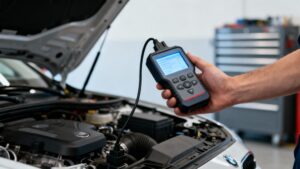
That glowing check engine light is your car’s way of talking to you. It's signaling that its internal computer has found a problem with how the engine is running or with the emissions system. To figure out what's wrong, we perform an engine light diagnostic, using a special tool to read the error code and get right to the source of the issue.
What That Glowing Dashboard Light Really Means

Seeing that little amber engine symbol light up on your dash can definitely be a bit stressful, but it's rarely a reason to panic. Think of it as your car's built-in health monitor sending you a message. This alert comes from the On-Board Diagnostics (OBD-II) system, a network of sensors constantly checking hundreds of functions, from your engine's timing to its fuel-to-air ratio.
When the OBD-II system spots a problem it can't fix on its own, it saves a specific code, known as a Diagnostic Trouble Code (DTC), and switches on the check engine light. It’s a smart system, but because the light can mean so many different things, a lot of drivers just end up ignoring it.
Understanding the Urgency
Believe it or not, the way the light behaves gives you big clues about how serious the problem is. Not all check engine lights are created equal.
To help you figure out what's going on, here’s a quick reference guide to the light's different behaviors.
Decoding Your Check Engine Light's Behavior
| Light Status | What It Means | Recommended Action |
|---|---|---|
| Solid/Steady Light | A non-critical issue has been detected. This is often an emissions system problem or a faulty sensor. | The issue isn't an emergency, but you should get it checked out soon to prevent it from getting worse. You can usually keep driving safely. |
| Flashing/Blinking Light | A severe and potentially damaging problem is happening right now, most often a major engine misfire. | This is a "pull over now" situation. Stop driving as soon as it's safe and turn off the engine to prevent serious damage. |
A flashing light is a big deal. Continuing to drive could quickly destroy expensive parts like your catalytic converter.
Common Triggers for the Check Engine Light
The reasons behind a check engine light are all over the map, ranging from something you can fix in seconds to more complex mechanical problems. You’d be surprised how often it’s something minor.
Here are a few of the usual suspects we see all the time:
- Loose Gas Cap: It sounds too simple, but if the cap isn't tight, it can mess with the fuel system's vapor pressure and trigger the light.
- Failing Oxygen Sensor: This sensor is key to fuel efficiency, as it measures the unburned oxygen in your exhaust to help the computer get the air-fuel mixture just right.
- Worn-Out Spark Plugs: Old plugs don't fire correctly, leading to engine misfires, poor performance, and wasted gas.
- Catalytic Converter Issues: This is one of the more serious culprits. A bad catalytic converter means your car isn't properly filtering out harmful exhaust fumes.
Ignoring the light is always a gamble. It's a surprisingly common issue—reports suggest that in the U.S., a staggering 40% of vehicles on the road have an active check engine light. You can learn more about why vehicle diagnostics are so critical and find detailed market insights over at marknteladvisors.com.
Simple Checks You Can Do Yourself

Before you jump to scheduling a professional engine light diagnostic, there are a couple of quick checks you can do right in your driveway. Sometimes, the fix is surprisingly simple, and taking a few moments to look things over can save you a trip to the shop.
The first and most common culprit behind a sudden check engine light is the gas cap. It’s a small part, but it has the big job of sealing the fuel system. A loose or faulty cap can easily trigger an evaporative emissions (EVAP) system code.
Check Your Gas Cap First
This check takes less than a minute. Just unscrew your gas cap and then screw it back on until you hear it click several times. A single click is usually enough, but giving it a few extra turns guarantees you have a tight seal.
While it's off, give the cap a quick visual inspection:
- Look for any cracks in the plastic.
- Check the rubber seal or O-ring for signs of drying out, cracking, or crumbling.
If the cap looks damaged, a new one is cheap and easy to find. Just know that after tightening or replacing it, the light won't always turn off immediately. It can take a few drive cycles for the car’s computer to rerun its checks and give the all-clear.
Pro Tip: Don’t panic if the light stays on right after you tighten the gas cap. Drive your car normally for a day or two. If it’s still lit up after that, it’s time to move on to the next step.
Pay Attention to How Your Car Behaves
If the gas cap wasn't the issue, it’s time to play detective. Your car is probably giving you other clues beyond just that little light on the dash. Start paying close attention to any new or unusual symptoms.
These observations are gold when you talk to a technician. Ask yourself these questions:
- Is there a drop in power? Does the car feel sluggish or weak when you step on the gas?
- Are you hearing strange noises? Listen for any knocking, hissing, or sputtering from the engine. A hissing sound, for example, is a classic symptom of a vacuum leak.
- Can you smell anything unusual? A rotten egg smell could point to a bad catalytic converter, while a strong gasoline odor might mean you have a fuel leak.
- Is your fuel economy worse than usual? A sudden drop in miles per gallon is a dead giveaway that something is hurting your engine's efficiency.
Jotting these symptoms down is incredibly helpful. Instead of just telling a mechanic, "the check engine light is on," you can give them a detailed account that points them in the right direction. It makes for a much faster and more accurate diagnosis. For instance, knowing what to look for can be a real game-changer; our detailed guide on how to check for vacuum leaks can help you get started.
How Professionals Read and Interpret OBD-II Codes
The key to any solid engine light diagnostic is getting straight to the source: the Diagnostic Trouble Code (DTC) your vehicle's computer has stored away. This short, alphanumeric code tells a technician exactly which system is waving a red flag. Professionals don’t guess; they use specialized tools to listen to what your car is trying to say.
The whole process kicks off when we connect a professional-grade OBD-II scanner to your car's diagnostic port, which is usually tucked away under the dashboard on the driver's side. Once it's plugged in, the scanner talks to your car's brain and pulls the specific DTC that triggered the light. That code is the first breadcrumb on the trail to figuring out what's wrong.
Translating the Code's Language
An OBD-II code isn't just a random string of characters; it's a structured message. For instance, a common one we see is P0420, which points a finger directly at a problem with the catalytic converter's efficiency.
Breaking down the code’s structure helps take the mystery out of it:
- First Character (Letter): This tells you the general area of the problem. ‘P’ is for Powertrain (engine, transmission), ‘B’ is for Body, ‘C’ is for Chassis, and ‘U’ is for Network Communication.
- Second Character (Number): A ‘0’ means it's a generic, government-mandated code that applies to pretty much every vehicle on the road. A ‘1’ or ‘2’ signals a manufacturer-specific code, which requires a bit more specialized knowledge.
- Remaining Characters (Numbers): These final digits get very specific, pinpointing the exact subsystem and the fault—like a malfunction in an oxygen sensor circuit or an engine misfire in a particular cylinder.
A DTC is a clue, not a conclusion. A code like P0301 points to a misfire in cylinder one, but it doesn't automatically mean you need a new spark plug. The culprit could just as easily be a bad coil, a clogged fuel injector, or something deeper inside the engine.
Common OBD-II Codes and Their Meanings
To give you a better idea of what these codes mean in the real world, here are a few of the most frequent ones we run into. Think of this as a quick reference guide to what your car might be trying to tell you.
| Code | Common Cause | Severity Level |
|---|---|---|
| P0420 | Failing catalytic converter, faulty oxygen sensor, exhaust leak | High – Address ASAP to avoid costly damage. |
| P0300-P0308 | Worn spark plugs, bad ignition coil, clogged fuel injector | Moderate to High – Can lead to engine damage if ignored. |
| P0171 | Vacuum leak, faulty mass airflow sensor, weak fuel pump | Moderate – Affects fuel economy and performance. |
| P0455 | Loose or missing gas cap, leak in the evaporative system | Low – Often an easy fix, but still needs checking. |
| P0135 | Faulty O2 sensor heater circuit | Moderate – Impacts fuel efficiency and emissions. |
Remember, this table is just a starting point. The code tells us where to look, but a thorough diagnostic confirms the why.
From Code to Concrete Diagnosis
Once the code is pulled, a skilled technician's real work starts. They'll combine the DTC information with their own expertise and more advanced diagnostic gear. This means looking at live data streams from various sensors, checking for any related codes that might be hiding, and running targeted tests to confirm the root cause. This methodical approach is what keeps us from just throwing parts at a problem and hoping for the best.
Interestingly, U.S. data shows that emissions-related issues are the trigger 40% of the time. Even something as simple as a loose gas cap is responsible for 20% of alerts, and faulty sensors make up another 15%. With the right tools and experience, a good shop can accurately pinpoint and fix the problem on the first visit in over 70% of cases. You can see just how fast this tech is evolving by checking out the latest trends in the automotive diagnostic tools market.
Distinguishing DIY Fixes From Professional Repairs
So, you've got the diagnostic trouble code. Now what? This is the moment you have to decide whether to grab the toolbox or grab the phone. An engine light diagnostic is really just the starting point; the decision you make next is what will save you real time and money.
Some issues are perfect for a weekend project, while others need the steady hand and deep knowledge of a certified technician. Knowing the difference is everything.
A code for a minor EVAP leak, for instance, often points to nothing more than a loose or faulty gas cap. That's a five-minute fix you can do yourself for just a few bucks. Similarly, swapping out an engine air filter or cleaning a dirty sensor are totally within reach for most car owners. These are simple, low-risk jobs that won't make things worse if you follow the steps.
This chart gives you a simplified look at the decision-making process. It helps visualize when to move forward on your own and when it’s time to call in the experts.

As the flowchart shows, getting the code is step one. Understanding what it really means is what dictates your next move.
When to Step Away From the Wrench
On the other hand, many codes point to complex problems that can quickly become a nightmare if you try to tackle them at home. Attempting these repairs without the right tools and training can turn a small issue into a catastrophic—and very expensive—failure. This is especially true for anything touching your car’s core systems.
Here are some definite signs that a repair is best left to the pros:
- Internal Engine or Transmission Work: Problems like a failing timing chain, bad piston rings, or anything inside the transmission housing demand a deep mechanical understanding and highly specialized equipment.
- Complex Electrical System Faults: Modern cars are packed with computers and miles of wiring. Tracking down faults in wiring harnesses, control modules, or sensor circuits is next to impossible without pro-level scanners and detailed diagrams.
- Fuel System and Emissions Components: Messing with fuel injectors, fuel pumps, or the catalytic converter isn't a simple parts swap. These systems require careful handling and precise calibration. If you want a peek into how intricate these related systems can be, check out our guide on what is throttle body cleaning.
A professional technician isn't just a parts-swapper. They use advanced scan tools to view live data streams, perform pressure tests, and confirm that every component is talking to the car's computer correctly.
The Value of Professional Diagnostic Equipment
The scanner you buy at the auto parts store is great for telling you what the trouble code is. A professional's diagnostic equipment tells you why it's there. These advanced tools, which can cost thousands of dollars, tap into manufacturer-specific data that basic readers can't even see.
This level of detail allows a technician to pinpoint the exact source of the failure. It’s what prevents you from replacing a perfectly good oxygen sensor when the real culprit was a tiny, hidden vacuum leak.
Paying for a professional diagnostic isn't just about reading a code. It's an investment in accuracy that makes sure you're only fixing what’s actually broken.
What a Professional Engine Diagnostic Involves

Bringing your car in for a professional engine light diagnostic can feel a bit like a black box, but knowing what happens behind the garage door makes the whole thing a lot less stressful. This isn't just about plugging in a simple code reader; it's a deep-dive investigation by a skilled technician to find the real source of the problem.
The whole process kicks off when we connect an advanced, professional-grade scan tool to your vehicle’s OBD-II port. This might look similar to what you’d see at an auto parts store, but the equipment we use in the shop is a world apart in terms of power and capability.
Beyond Generic Codes
Unlike the basic handheld readers that just spit out generic trouble codes, our professional scan tools give us a much deeper, more complete picture of your car's health. They can access manufacturer-specific codes and, crucially, display live data streams from dozens of sensors all over your engine and emissions systems.
This real-time feedback lets a technician see exactly how different components are behaving while the engine is actually running. For instance, they can watch things like:
- Fuel trim adjustments
- Oxygen sensor voltage fluctuations
- Engine coolant temperature readings
- Ignition timing advance
Seeing these metrics live is what separates an educated guess from an accurate diagnosis. It helps a technician confirm if a sensor has truly gone bad or if it's just reacting to another issue somewhere else in the system.
A professional diagnostic is an investment in accuracy. It ensures you're not paying to replace a perfectly good part based on a generic code. It’s about finding the root cause to fix it right the first time.
The Diagnostic and Communication Process
After analyzing the codes and live data, the technician will often run specific functional tests to confirm what they're seeing. This could mean anything from running a smoke test to find a sneaky vacuum leak, to checking fuel pressure, or testing electrical circuits with a multimeter. This methodical approach is the key to pinpointing the exact failure. For a closer look, our guide on the complete car diagnostic test process breaks these steps down even further.
Once the problem is nailed down, clear communication is everything. You should get a detailed report that lays out:
- The Specific Problem: The tech will explain the confirmed issue in plain English, not confusing jargon.
- The Recommended Repair: They’ll detail exactly what needs to be done to fix it correctly.
- A Transparent Quote: You'll see a clear breakdown of costs for both parts and labor before any work starts.
The complexity of modern cars is exactly why these advanced tools are so necessary. In fact, the global automotive diagnostic scan tools market is projected to hit USD 41.4 billion by 2026, all driven by the need for shops like ours to accurately figure out what those engine warnings mean. You can learn more about how crucial these tools are in the full automotive diagnostic scan tools market research.
Common Questions About Engine Light Diagnostics
Even after getting the basics down, it’s completely normal to have a few more questions rattling around. We get it. Dallas drivers often come to us with the same concerns, so we’ve pulled together the most common ones right here to give you some straight answers and a little more peace of mind.
This isn't just about what the light means; it's about knowing what to do next. Being informed helps you make smarter, calmer decisions when that little light pops on.
How Long Can I Drive with the Check Engine Light On?
Honestly, this all boils down to what other symptoms your car is showing. If the light is solid and the car feels totally normal—no strange noises, no hesitation, no loss of power—you can usually drive it for a bit to get a professional diagnosis. Don’t let it go for weeks, but heading across town to the shop is typically fine.
However, a flashing light is an emergency. This is a major red flag. It almost always means a severe engine misfire is happening, dumping raw fuel into your exhaust system. That can absolutely fry your catalytic converter, a repair that can easily run over $1,000. If that light starts blinking, or if the car is shaking, running rough, or losing power, pull over as soon as it's safe and call for a tow. It's not worth the risk.
Will the Check Engine Light Turn Off On Its Own?
Sometimes, yes—but you shouldn’t count on it. For a really minor issue, like a gas cap that you forgot to tighten all the way, the light might shut off by itself after a few driving cycles. Your car's computer is constantly running self-checks, and if it sees the problem has been resolved, it will clear the code on its own.
For pretty much everything else, that light is staying on until the root problem is fixed and the code is manually cleared with a professional scan tool. Ignoring it is a bad bet, because a small initial fault can easily cascade into much more serious (and expensive) damage down the road.
Key Takeaway: While the light can turn off by itself, it’s a gamble. A persistent light is your car's way of telling you a component has failed or is out of spec, and it needs a professional to take a look.
Is an Engine Light Diagnostic Expensive?
The diagnostic service itself is usually a very reasonable, flat-rate fee. Think of it as paying for a specialist's time, their expertise, and their access to advanced equipment that goes far beyond a basic code reader. This initial cost is a critical investment that almost always saves you money in the long run.
An accurate diagnosis stops you from playing the expensive guessing game of just replacing parts until the light goes away. By pinpointing the exact cause, you ensure you only pay for the specific labor and components needed to fix the problem right the first time. It’s the smartest, most cost-effective way to handle the situation.
Can Regular Maintenance Prevent the Light from Coming On?
Absolutely. Staying on top of your maintenance schedule is the single best defense against that dreaded check engine light. While it can't prevent every single possible failure, it dramatically lowers the odds.
- Routine Oil Changes: This is non-negotiable. It keeps all your engine's moving parts properly lubricated and running cool.
- Filter Replacements: Clean air and fuel are essential for performance and efficiency. Clogged filters can trigger a host of issues.
- Fluid Checks: Keeping all your fluids topped off and clean prevents everything from overheating to system failures.
Regular service visits also give a trained technician a chance to spot developing issues—like a worn-out belt or a tiny leak—before they get bad enough to trigger a warning light. It's all about proactive care that keeps your car dependable.
Don't let a glowing dashboard light stress you out. For an accurate, no-nonsense engine light diagnostic, trust the experts at Kwik Kar Oil Change and Auto Care. Schedule your visit today and get back on the road with confidence.