That little glowing light on your dashboard doesn't have to spell doom for your car. The best way to think about the check engine light is as a message from your car's brain, letting you know it needs some attention. Getting a professional engine light service is simply the best way to translate that message and get you safely back on the road.
Decoding That Glowing Light On Your Dashboard

When that little amber engine icon pops on, it’s a direct alert from your car's On-Board Diagnostics (OBD-II) system. This is a complex network of sensors that act like your car’s nervous system, constantly checking everything from engine performance to fuel economy. If any sensor picks up a reading that's outside the normal range, it flags the main computer, which then flips on the light to get your attention.
It's a common enough alert that it has created a massive industry. The global market for check engine light diagnostics was valued at over $3.6 billion and is only expected to grow. This isn't surprising when you consider how complex modern cars are, with hundreds of sensors that can flag anything from a loose gas cap to a major engine problem. You can learn more about the global market for check engine light diagnostics on wiseguyreports.com.
Steady Versus Flashing: A Critical Distinction
Not all check engine lights are created equal. Knowing the difference between a steady light and a flashing one is absolutely critical for both your safety and your car's long-term health. Think of it this way: a steady light is a polite request for a check-up, while a flashing light is an emergency siren.
A steady check engine light points to a non-urgent but important issue. Your car is telling you something isn't working as it should. You don't need to pull over right this second, but you should definitely schedule an engine light service soon to keep a small problem from becoming a big one.
A flashing check engine light, on the other hand, is a serious warning. It almost always signals a severe engine misfire. This can rapidly overheat and destroy your catalytic converter—a repair that can easily cost over $1,500.
What A Flashing Light Demands
If you see that light blinking, it means unburned fuel is getting into the exhaust system, creating an immediate risk of catastrophic damage. You need to act fast.
- Immediately reduce your speed and stop accelerating hard.
- Pull over to a safe spot as soon as you possibly can.
- Turn off the engine to prevent any more damage.
- Call for a tow truck to get your vehicle to a trusted shop like Kwik Kar.
Ignoring this warning can turn what might be a simple fix, like new spark plugs, into one of the most expensive repairs your car can have. Staying calm and reacting the right way is the first step toward a safe and affordable fix.
The Most Common Reasons Your Check Engine Light Is On
Seeing that little engine-shaped light pop up on your dashboard is like getting a cryptic text message from your car. It can definitely cause a moment of panic, but the issue behind it usually falls into one of several common categories, ranging from a quick, simple fix to a more involved repair.
Getting a handle on these usual suspects is the first step toward figuring out what kind of engine light service you'll need. Most of the time, the problem lies somewhere within the systems that manage your vehicle's fuel, ignition, or emissions. These parts have to work together in a pretty delicate balance, and when one stumbles, your car’s computer is quick to send up the warning flag.
Simple Fixes Versus Serious Faults
Sometimes, the culprit is surprisingly minor and cheap to fix. A loose or faulty gas cap is one of the most common triggers, believe it or not. This simple part is responsible for keeping the fuel system pressurized and preventing harmful fumes from getting out. If it’s not screwed on tight or the seal is cracked, the system flags it as a leak and turns on the light.
On the flip side, more complex parts can also be to blame. Your car is packed with a network of sensors, and when one of them goes bad, it can throw off performance and trigger the light. Ignoring these warnings is a gamble that can lead to much bigger, more expensive problems down the road.
Think of your engine's components as a sports team. If one key player—like an oxygen sensor—gets tired and stops doing its job right, the whole team’s performance suffers. The result? Poor fuel economy and higher emissions.
The key is not to panic but to see the light as a call to action. Getting it checked out promptly means you can catch small issues before they snowball.
Top 5 Common Culprits
While dozens of things can set off the check engine light, a few offenders show up far more often than others. Here are the top five reasons you might find yourself needing an engine light service.
- Failing Oxygen (O2) Sensor: This sensor is a critical part of your exhaust system, measuring how much unburned oxygen is present. It helps your engine's computer figure out the perfect air-to-fuel ratio. When it fails, it can’t provide the right data, causing your fuel economy to drop by as much as 40%.
- Worn-Out Spark Plugs or Ignition Coils: Spark plugs are what ignite the fuel and air mixture in your engine's cylinders. If they get old or dirty, they can cause a misfire. You'd probably feel this as a stutter or hesitation when you step on the gas.
- Faulty Mass Airflow (MAF) Sensor: The MAF sensor's job is to measure how much air is coming into the engine so the computer can add the right amount of fuel. A bad sensor can lead to stalling, a rough idle, and poor acceleration.
- Loose or Damaged Gas Cap: We mentioned it before, but it’s worth repeating. A simple loose cap can break the fuel system's seal, which triggers an evaporative emissions code. Always give your gas cap a few extra clicks after you fill up.
- Failing Catalytic Converter: This is one of the more serious—and expensive—issues. The catalytic converter is your car’s last line of defense, turning harmful carbon monoxide into much less harmful emissions. It almost never fails on its own; it's usually the result of ignoring another problem, like bad spark plugs or a faulty O2 sensor, for too long.
A flashing light is a much more urgent signal, often pointing to a severe engine misfire that can quickly destroy the catalytic converter. And if your car is overheating, that can cause serious engine damage and light up multiple warnings at once. You can learn more about what to do if you find your car is overheating in our detailed guide.
Common Check Engine Light Causes and Symptoms
To help you connect the dots between what you're experiencing and what might be wrong, we've put together this quick-reference table. It breaks down the most frequent triggers for the check engine light, helping you identify potential issues based on your car's symptoms.
| Potential Cause | Common Symptoms | Urgency Level | DIY Check Possible? |
|---|---|---|---|
| Loose Gas Cap | Smell of fuel, light appears after refueling | Low | Yes |
| Failing O2 Sensor | Poor gas mileage, rough idle | Medium | No |
| Bad Spark Plugs | Reduced power, engine misfires, poor MPG | Medium | Yes (with tools) |
| Faulty MAF Sensor | Engine stalling, jerky acceleration | Medium | No |
| Bad Catalytic Converter | Rotten egg smell, reduced engine power | High | No |
This chart is a great starting point, but remember, only a proper diagnostic scan can tell you exactly what’s going on under the hood.
Inside a Professional Diagnostic Service
When you bring your car in for an engine light service, you’re setting a whole process in motion. It's part detective work, part science, and it’s a lot more involved than just plugging in a tool and getting an immediate answer. The whole point is to find the root cause of the problem, so we can deliver a fix that lasts—not just a temporary patch that makes the light go away for a few days.
It all starts with a simple conversation. A good technician or service advisor will listen to you describe what’s been going on with your car. They’ll ask things like, "Did you notice any weird noises?" or "How was the car accelerating right when the light came on?" This back-and-forth gives us critical context that no computer scan can provide on its own.
The First Step: Retrieving The Code
Once we have your side of the story, the technician gets down to the first technical step: connecting an advanced On-Board Diagnostics (OBD-II) scanner to your vehicle’s port. This tool talks directly to your car’s computer and pulls any Diagnostic Trouble Codes (DTCs) it has stored. Every car and light truck made since 1996 has this system built-in.
Each DTC points to a specific problem detected by one of the many sensors in your car. For instance, a P0420 code often suggests an issue with the catalytic converter's efficiency, while a P0301 code tells us cylinder one is misfiring. These codes are just the starting point of our investigation.
It's a huge misconception that the code is the final diagnosis. In reality, the code is just a clue—a breadcrumb leading the technician in the right direction. It tells them where to look, not necessarily what is broken.
A single problem can sometimes trigger several codes, and one code can have multiple possible causes. Just replacing the part named in the code’s description without doing any more digging is a surefire way to see that light come back on. That’s why a cheap, handheld scanner from the auto parts store is no substitute for a professional diagnostic service. If you want to get into the nitty-gritty, you can learn more about the entire car diagnostic test process in our detailed guide.
Beyond The Code: The Real Investigation
With the DTC in hand, the real detective work begins. A professional technician uses that code as a roadmap for a multi-step investigation to pinpoint the exact failure and avoid replacing parts that aren't actually broken.
This investigative workflow usually involves:
- Visual Inspection: The technician will get their eyes on the system related to the code. For an emissions code, this could mean checking for cracked vacuum hoses, loose electrical connections, or any obvious damage to sensors.
- Component Testing: Using specialized tools like multimeters or oscilloscopes, the technician tests the suspected component to see if it’s actually failing. For example, they might test an oxygen sensor's voltage output to confirm it’s bad before recommending you pay for a new one.
- Checking Technical Service Bulletins (TSBs): Car manufacturers often release TSBs for known issues on specific models. An experienced tech will always check these databases to see if your car’s problem is a common, documented fault with a well-known fix.
This infographic gives you a simplified look at how common issues are diagnosed, starting with the easy stuff and moving to the more complex possibilities.
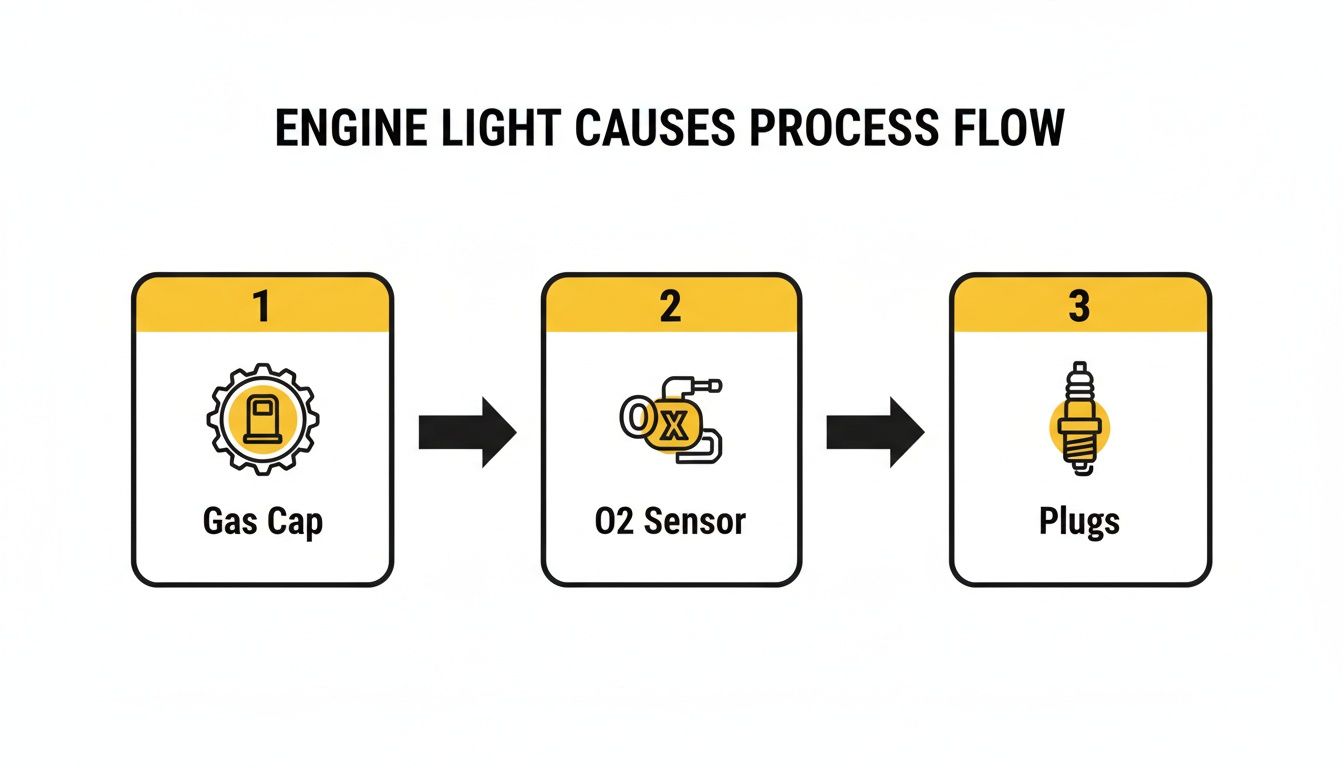
As you can see, the process often starts with the simplest and most common culprits, like a loose gas cap, before we ever start looking at pricier components like sensors or spark plugs. This methodical approach saves you time and money by focusing on the true source of the problem. It’s the difference between guessing and diagnosing.
Breaking Down Repair Costs And Timelines
When that little amber engine light pops on, every driver's mind jumps to two questions: "How much is this going to set me back?" and "How long will my car be out of commission?" Getting a handle on the potential cost and time commitment of an engine light service can take a lot of the stress out of the situation and help you make a smart call.
The honest answer is that costs can be all over the map. On one end, you might have a fix as simple as tightening a loose gas cap, which costs nothing. Or maybe you need a new one, which is usually under $20. On the other hand, a more serious problem like a dying catalytic converter could push your repair bill over $1,500. This huge range is exactly why a professional diagnosis is non-negotiable—it keeps you from guessing and throwing money at parts you don't actually need.
Common Repair Cost Estimates
To give you a clearer picture, let's run through some ballpark figures for the most common culprits behind a check engine light. These are just estimates and can shift depending on your car's make and model, but they offer a decent starting point for budgeting.
- Oxygen (O2) Sensor Replacement: You're typically looking at $200 to $500. This is a really common repair because these sensors just wear out over time.
- Spark Plugs and Ignition Coils: A fresh set of spark plugs might run between $150 and $400. If an ignition coil has also failed, that total will climb.
- Mass Airflow (MAF) Sensor: For parts and labor on this job, expect to pay somewhere between $250 and $450.
Ignoring that light is a gamble you don't want to take. We've seen it time and again: putting off a repair almost always turns a small fix into a huge expense. In fact, research shows that drivers who delay service by over 100 miles can face repair costs three times higher than if they'd come in right away. For a typical passenger car—which is where most check engine lights pop up—prompt service means technicians can fix up to 90% of the issues on the same day. You can discover more insights about these repair trends on cognitivemarketresearch.com.
Understanding Repair Timelines
Just like costs, repair timelines can vary quite a bit. The good news is that a lot of common issues can be diagnosed and sorted out in a single day.
For straightforward jobs like swapping out a sensor or replacing spark plugs, you can often expect to have your car back in just a few hours, assuming we have the parts on hand.
Of course, more complicated diagnostics or repairs that need special-order parts are going to take longer. If our technicians have to chase down a tricky electrical gremlin or if a specific part for your car isn't available locally, your vehicle might need to stay with us for an extra day or two.
Here at Kwik Kar, we believe in straight talk. Once we've done the initial diagnosis, we'll always give you a clear-cut estimate and a realistic timeline. Our goal is simple: get you back on the road safely and quickly, without any surprise bills or frustrating delays.
Proactive Maintenance To Prevent Engine Issues
The best engine light service is the one you never need. While you can't prevent every single problem, a consistent, proactive approach to taking care of your vehicle can seriously cut down the odds of seeing that dreaded light. Think of it as spending a little time now to save yourself a ton of money and headaches later.
Many common triggers for the check engine light—like a failing oxygen sensor or worn-out spark plugs—don't just happen overnight. They’re usually the result of slow, steady wear and tear that you can either slow down or catch early with some basic, routine care. A few simple habits are all it takes to keep your engine’s complex systems running smoothly together.
Your Simple Maintenance Checklist
You don't have to be a mechanic to get ahead of common engine problems. Just work these small actions into your regular routine, and you’ll make a huge difference in your car's long-term health.
- Check Your Gas Cap: Every time you fill up, give the gas cap a few extra clicks to make sure it's tight. A loose or cracked cap is one of the top culprits for an emissions-related check engine light, and it’s by far the easiest fix.
- Follow Your Oil Change Schedule: Clean oil is everything to your engine. Sticking to the manufacturer's recommended schedule prevents sludge from building up and keeps all the moving parts lubricated, reducing strain and the risk of overheating.
- Use High-Quality Fuel: Using the fuel grade your owner's manual recommends helps keep your engine and fuel system clean from nasty deposits. This leads to cleaner combustion and helps critical sensors perform their best.
- Listen to Your Car: Pay close attention to any new or weird sounds. A sudden rattle, a new whine, or a grinding noise is often your car’s first cry for help, long before a sensor ever gets triggered.
Proactive care is all about controlling what you can. You can't stop a sensor from eventually wearing out, but regular maintenance ensures the systems it's monitoring are in the best possible shape, often extending the life of those very components.
Connecting Habits to Prevention
Each of these simple habits directly pushes back against a common cause of a check engine light. For example, regular oil changes and tune-ups that include checking the spark plugs can prevent the kind of engine misfires that lead to a flashing light and potential catalytic converter damage.
Even something as simple as maintaining a clean engine bay can help. While it's not directly tied to a sensor, it makes it much easier to spot fluid leaks or frayed wires early on. Catching a small oil leak before it becomes a major problem is a perfect example of prevention in action.
Ultimately, preventative maintenance is about building a buffer against those unexpected breakdowns. Your vehicle’s manual is your best friend here, laying out the specific service intervals for everything from fluid flushes to timing belt replacements. By following that schedule and just paying attention to how your car performs day-to-day, you put yourself in the driver's seat—solving problems when they are small, simple, and cheap to fix.
Why Dallas Drivers Choose Kwik Kar
When that little light pops up on your dashboard, you don't just need a quick fix—you need a team you can actually trust. For so many drivers across Dallas, Kwik Kar has become the go-to partner for reliable engine light service. Why? Because we’ve built our shop on a foundation of honesty, expertise, and genuine care for our customers. We know how frustrating car trouble can be, so we focus on making your experience as smooth and straightforward as possible.
Our reputation is everything, and it comes from building real relationships and a commitment to avoid common customer service pitfalls that leave drivers feeling confused or taken advantage of. We believe an informed customer is a confident one. That's why we take the time to walk you through our findings in plain English, show you exactly what's going on with your vehicle, and lay out your options clearly. You'll have all the info you need to make the best call for your car and your budget.
The Kwik Kar Difference
What truly sets us apart isn't just one thing—it's our combination of skilled technicians and a customer-first mindset. We don't just fix cars; we provide peace of mind.
- ASE-Certified Technicians: Our team isn't made up of hobbyists. These are trained, certified professionals who live and breathe the complex systems in modern vehicles. They know how to get to the root cause of an issue, not just treat the symptom.
- State-of-the-Art Equipment: We invest in the same high-level diagnostic tools the dealerships use. This gear lets us pull precise trouble codes and run deep-dive tests on components, ensuring we get the diagnosis right the first time.
- Transparent Communication: You'll never be left wondering what’s happening. From the first diagnostic report to the final estimate, we keep you in the loop every step of the way. No surprises on your bill—that's a promise.
We’ve seen firsthand how a little bit of trust goes a long way. Our approach is simple: treat every car like it’s our own and every customer like a neighbor. It’s why so many of our first-time visitors become lifelong clients.
Solutions For Fleets And Families
We get it—the needs of a family SUV are completely different from a commercial work van. Kwik Kar offers solutions for both, making sure everyone gets the dedicated service they deserve.
For our fleet partners, we design maintenance programs focused on one thing: maximizing uptime and keeping your business on the move without breaking the bank.
For Dallas families, our convenient hours and commitment to getting you back on the road quickly mean less disruption to your already packed schedule. Whether you're a fleet manager with a dozen vans or a parent juggling school runs, Kwik Kar delivers the reliable, high-quality engine light service that keeps Dallas moving safely.
Common Questions About Engine Light Service
Navigating the world of car maintenance can feel like learning a new language, especially when a mysterious light pops up on your dashboard. When it’s an engine light service, Dallas drivers often have the same key questions. We’ve gathered the most common ones to give you the clear, direct answers you need.
Is It Safe To Drive With The Light On?
This is always the first question, and the answer really depends on how the light is behaving. Think of it as your car using two very different tones of voice.
A steady, solid check engine light is your car’s way of asking for attention. It means the On-Board Diagnostics (OBD-II) system has logged a fault, but it isn't an immediate, catastrophic failure. You can usually keep driving, but you should book a diagnostic check soon. Ignoring it can let a small problem snowball into a big one.
A flashing check engine light is the emergency siren. This signals a severe problem, almost always a major engine misfire. If you keep driving, you can quickly destroy your catalytic converter—a repair that can easily top $1,500. Pull over as soon as it's safe, shut off the engine, and call for a tow. It's not worth the risk.
Will A Check Engine Light Fail My Texas Inspection?
Yes, it's an automatic failure. In Texas, the annual state vehicle inspection includes connecting to your car's OBD-II system. If that system shows any active trouble codes (which is what triggers the light in the first place), your vehicle can't pass.
This is a critical point for Dallas drivers. Trying to sneak through an inspection with the light on is just a waste of time and money. The right move is to get a proper engine light service to find and fix the root cause before you head to the inspection station.
To get fully prepared, check out our guide on how to pass your vehicle inspection for more tips.
Why Not Just Use A Cheap Code Reader?
Those little handheld code readers you can grab at an auto parts store seem like a smart shortcut, but they only give you a tiny piece of the puzzle. A cheap scanner might pull a code like "P0301," but it can't tell you why that code appeared.
A professional diagnostic service is a whole different ballgame. Our ASE-certified technicians use that code as a starting point. From there, they use advanced scan tools and good old-fashioned expertise to test components and trace the problem to its source. This process finds the actual cause, so you don't waste money throwing parts at a problem you haven't properly diagnosed.
How Long Does The Diagnosis Take?
We get it—your time is valuable. For most cars, the initial diagnostic process here at Kwik Kar usually takes between 60 and 90 minutes.
This gives our technicians enough time to pull the codes, perform a thorough visual inspection, and run the preliminary tests needed to accurately pinpoint the issue. Once we know what's going on, we’ll give you a clear explanation, a detailed estimate, and a realistic timeline for the repair.
When that light comes on, don’t guess—get answers. The expert team at Kwik Kar Oil Change and Auto Care has the tools and experience to diagnose the problem correctly and get you back on the road with confidence. Schedule your appointment today at https://www.kwikkarspringvalley.com.