That big red 'FAIL' stamp on your vehicle inspection report is definitely frustrating, but it's not the end of the road. A failed emission test is just your car’s way of telling you that its exhaust is pushing out more pollutants than the law allows. Usually, it’s a sign of a manageable issue that needs attention before you can get your registration renewed.
What a Failed Emission Test Really Means for You

Seeing that stamp can feel like a major setback, but trust us, it’s more common than you’d think. A failed emissions test is a clear signal that something in your vehicle's complex system isn't running quite right. The test is specifically designed to measure harmful pollutants coming out of your tailpipe, including:
- Hydrocarbons (HC): Basically unburned fuel that contributes to smog.
- Nitrogen Oxides (NOx): Nasty gases that can lead to acid rain and irritate your lungs.
- Carbon Monoxide (CO): A toxic gas that shows your engine isn't burning fuel completely.
If your car or truck goes over the state-mandated limits for these gases, it fails. This isn't just about following environmental rules; it’s a direct clue about your car's overall health and fuel efficiency.
Understanding the Types of Failures
The reason for the failure often comes down to the kind of test your vehicle gets. For most cars and trucks made after 1996, the inspection station uses the On-Board Diagnostics (OBD-II) system. If your check engine light is on, it's an automatic fail. That light is your car’s computer telling you it has already found an emission-related problem.
Older vehicles might get the old-school tailpipe "sniffer" test, which directly measures the exhaust. Failing this test usually points to bigger-ticket items like a bad catalytic converter or a problem with the air-fuel mixture.
Before we dive into the common culprits, it helps to see what our technicians look for first. Here’s a quick rundown of the most frequent issues we see that lead to an emissions failure and the systems they impact.
Top Culprits Behind a Failed Emission Test
| Common Cause | Affected System | Typical Symptom |
|---|---|---|
| Faulty Oxygen (O2) Sensor | Fuel & Exhaust | Poor fuel economy, rough idle |
| Worn Spark Plugs/Wires | Ignition System | Misfiring engine, trouble starting |
| Leaky Gas Cap | Evaporative (EVAP) System | Check engine light, fuel smell |
| Clogged Catalytic Converter | Exhaust System | Sluggish performance, rotten egg smell |
| Mass Airflow Sensor (MAF) Failure | Air Intake System | Hesitation during acceleration |
| Dirty Air Filter | Air Intake System | Reduced horsepower, black smoke |
These are just the starting points, of course, but a huge percentage of failures trace back to one of these components. Pinpointing the exact cause is what the diagnostic process is all about.
Key Takeaway: Think of a failed emission test as a diagnostic tool. It’s telling you that a component—whether it's a tiny sensor or a major exhaust part—needs attention to get your vehicle running efficiently and cleanly again.
This is a widespread issue for drivers. In fact, over 1.2 million vehicles fail their emissions tests in Texas each year, which is about 12% of all inspections. This high rate just goes to show how often problems like worn-out oxygen sensors or aging catalytic converters pop up. You can learn more about the factors that contribute to these state-wide emissions test results. Understanding how common this is can take some of the stress out of the situation and help you get ready for the next steps.
Diagnosing the Root Cause of Your Test Failure
Failing an emissions test feels like a roadblock, but it's really your car sending you a very specific message. Think of it as the first clue in a mystery.
Often, your car has been dropping hints for a while. Have you noticed your gas mileage dipping? Is the engine running a little rough at stoplights? Even something as specific as a "rotten egg" smell points directly to a struggling catalytic converter.
Paying attention to these little red flags helps you walk into the shop armed with useful information. It's the difference between saying "it failed" and "it failed, and I've been noticing X, Y, and Z."
Let's break down the usual suspects to make the diagnostic process less of a headache.
Common Emissions Culprits
Most of the time, emissions failures boil down to just a handful of components. The good news is that they vary wildly in cost, so you can start by checking the cheap stuff first.
The most expensive fix is usually a clogged catalytic converter, which can run anywhere from $800 to $2,500. On the other end of the spectrum, a faulty oxygen (O2) sensor is a much more palatable $150–$350 repair, and a loose or cracked gas cap—a common trigger for the EVAP system—can be fixed for under $50.
Here’s a quick rundown of the most frequent offenders:
- Bad O2 Sensors: These are crucial for getting the air-fuel mixture just right. When they fail, the engine runs too rich or too lean.
- Catalytic Converter Blockage: Over time, these can get clogged, which literally chokes your exhaust flow and spikes emissions.
- EVAP System Leaks: Often, this is just a bad gas cap seal, but it's enough to set off that dreaded check engine light.
- Dirty Mass Airflow (MAF) Sensor: If this sensor is fouled, it can misreport airflow by up to 20%, leading to high hydrocarbon (HC) emissions.
- Worn Spark Plugs: A simple and cheap fix at just $10–$75, but old plugs can torpedo your combustion efficiency and cause a fail.
Knowing these possibilities helps you ask smarter questions and steer clear of a technician who just wants to throw parts at the problem.
What Your Mechanic Will Check
When your car is in the bay, a good technician will follow a logical diagnostic path. They won't just guess.
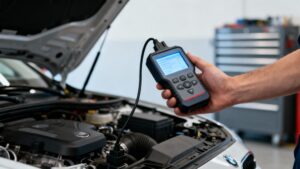
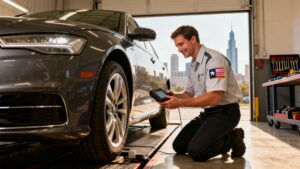
They'll start by hooking up a scanner to read the OBD-II trouble codes. This gives them a starting point, telling them which system reported the fault. From there, they might perform a smoke test to pinpoint tiny, invisible leaks in the EVAP system or watch live data streams from the O2 and MAF sensors to see if they're behaving erratically.
Of course, they'll also use an advanced five-gas analyzer to measure the actual tailpipe emissions, confirming what the onboard computer is seeing. For a deeper dive into how this all works, check out our guide on car diagnostic tests.
Here’s what you can expect for the most common repairs:
| Component | Cost Range |
|---|---|
| Oxygen Sensor | $150–$350 |
| Catalytic Converter | $800–$2,500 |
| Gas Cap Replacement | $10–$50 |
"Clear symptoms save shops valuable time and cut your repair bill."
From Data to Done Deal
Once the diagnostics are complete, you should have a clear picture of the problem. Ask your mechanic to show you the numbers—the O2 sensor readings, the fuel trim charts, and the emissions printout.
This isn't just for your own curiosity. It’s about verification.
- A healthy oxygen sensor should have a voltage that bounces consistently between 0.1 and 0.9V.
- Short-term fuel trim should ideally stay within a ±10% range.
- An EVAP system should hold pressure steadily during a test.
Seeing this data helps you understand why a part needs to be replaced. It turns a vague diagnosis into a concrete, actionable repair plan. And always, always keep your repair receipts. You’ll need them for any warranty claims or if you have to apply for a state waiver.
Prepping for Your Shop Visit
To make the process as smooth and quick as possible, go in prepared.
Jot down any symptoms you've noticed and when they started. Did you try any quick fixes yourself, like a new gas cap or a highway drive (the old "Italian Tune-Up") to burn off carbon deposits? Let your technician know.
Finally, ask for a "before and after" emissions reading. This is the ultimate proof that the repair did its job. A little preparation goes a long way and gets you back on the road with a passing certificate in hand.
Your Pre-Retest Checklist: Simple DIY Fixes
Before you schedule another test, take a moment. A surprising number of vehicles that fail on paper can sail through with a few quick, inexpensive checks right in your driveway. These straightforward tips tackle the most common snags behind a failed emission test.
This flow shows how a technician usually works, beginning with the priciest culprit (your catalytic converter) and ending with easy fixes like sensors or the gas cap. It’s all about logical troubleshooting—no guesswork, no extra parts.

This sequence cuts down on shop time and prevents unnecessary replacements.
Inspect Your Gas Cap
A tiny twist makes a big difference. Your EVAP system relies on a tight seal, so a loose or damaged gas cap often trips the check engine light and nixes the OBD-II test.
- Remove the cap and peer at the rubber gasket.
- Look for cracks, brittleness or gaps.
- Reinstall until you hear three or four clicks.
Caps in rough shape or silent on the click? A new one costs under $20 and can be all you need for a retest pass.
Perform An Italian Tune-Up
No exotic tools required. Just find a safe stretch of road and cruise at 55–65 mph for about 20–30 minutes. That steady run heats your engine and converter, burning off carbon that builds up from stop-and-go routines.
This technique cleans oxygen sensors and the catalytic converter, often dropping emission levels enough to earn a retest “PASS.”
Add A Fuel System Cleaner
Carbon deposits can be sneaky. A reputable cleaner slashes gunk on injectors, valves and the combustion chamber for a more complete burn—and cleaner exhaust.
- Fill half your tank with fuel.
- Pour in the recommended amount of cleaner.
- Drive until the tank hits near empty before refueling.
Most drivers see eye-opening results after this single treatment.
These checks tackle a large chunk of minor issues and give you the best shot at passing without a garage trip. Vacuum leaks can also be a hidden cause; you can learn more about how to check for vacuum leaks in our detailed guide.
When to See a Pro: What to Expect at the Repair Shop
If you’ve tried the quick fixes and that check engine light is still staring back at you, it’s time to hand the keys to a professional. This is where advanced tools and years of experience come together to find the exact reason your car failed its emission test. Don't worry—walking into a shop isn’t so intimidating when you know what’s coming.

The first thing any good technician will do is plug a professional-grade OBD-II scanner into your car’s port. This isn’t just about reading the basic trouble code that lit up your dash; it's about tapping into a massive stream of live data from your vehicle’s computer.
The Diagnostic Deep Dive
A professional scan goes way beyond what a simple, off-the-shelf code reader can do. A technician will analyze these data streams to see how key parts are performing in real-time.
They’re specifically looking at things like:
- Oxygen Sensor Readings: Are the sensors switching between high and low voltage like they should? A "lazy" or dead sensor can’t correctly manage the air-fuel ratio.
- Fuel Trim Values: These numbers tell us if the engine's computer is desperately trying to compensate for a problem by adding or cutting fuel. High values often point straight to a vacuum leak or a bad sensor.
- Misfire Counters: The scanner can pinpoint which cylinder is misfiring, immediately narrowing the problem down to a specific spark plug, ignition coil, or fuel injector.
This data-driven approach takes the guesswork out of the equation. It lets a technician confirm the root cause instead of just throwing parts at a problem based on a generic code.
Advanced Troubleshooting Techniques
Sometimes, an OBD-II code only gives you part of the story. For trickier issues, especially those related to the EVAP system (a very common culprit in emissions failures), we need to bring out the bigger guns.
This is where a smoke machine becomes invaluable. A technician will pump a harmless, visible vapor into the EVAP system. Wherever you see smoke escaping—from a tiny crack in a hose, a bad gasket, or a leaky valve—that's your leak. It’s an incredibly precise method that finds problems impossible to spot with the naked eye.
A smoke test can turn a frustrating, hours-long hunt for an EVAP leak into a quick, 15-minute diagnosis. This saves you a ton in labor costs and makes sure the right part gets fixed the first time.
Understanding Repair Costs
Once the problem is properly identified, you can get a solid estimate for the repair. Costs can vary dramatically depending on what failed, so it helps to have a realistic idea of what to expect.
A faulty oxygen sensor, for instance, is a pretty common and straightforward fix. You're typically looking at a range of $150 to $350, including parts and labor. On the flip side, replacing a catalytic converter is a major repair that can set you back anywhere from $800 to over $2,500, depending on your car.
This is a huge issue in our area. Here in Dallas-Fort Worth, the emissions test failure rate can be as high as 14.2%, and bad catalytic converters account for a whopping 22% of those failures. While the average repair bill after a failed test can easily top $500, at Kwik Kar, our transparent pricing and regular specials help keep the vast majority of our emissions-related fixes under $300. You can explore more about emissions trends and their financial impact to get the bigger picture. By diagnosing the issue accurately from the start, we avoid replacing expensive parts you don’t need, which directly saves you money.
Navigating the Retest Process in Dallas
Alright, with the repairs handled, you're in the home stretch. Getting through the retest process in Dallas after a failed emission test isn't complicated, but knowing the local rules can definitely save you time and a bit of cash. The main thing is to act quickly.
Here in Texas, when your vehicle fails its initial inspection, you are typically granted one free retest. This isn't an open-ended offer, though. You have to go back to the original inspection station that gave you the bad news to claim it.
Most shops will give you between 15 and 30 days from the initial failure to come back. Always ask for their specific policy and hang on to your vehicle inspection report—you’ll absolutely need it.
Setting Yourself Up for a Pass
Before you head back for round two, a little prep work can make all the difference. One of the oldest and most effective tricks in the book is to make sure your vehicle is fully warmed up.
Get on the highway and drive your car for at least 20-30 minutes right before pulling into the station. This simple step gets your catalytic converter up to its optimal operating temperature, where it can do its job of converting harmful gases most efficiently. A hot engine and converter seriously boost your odds of passing.
Pro Tip: Don't just let the car idle in your driveway. You need to drive it under a real load. That's what properly heats up the entire exhaust system and gets every component ready for the test.
For business owners managing a fleet of vehicles, this back-and-forth can quickly turn into a logistical nightmare. That's where a good fleet program comes in, taking the burden right off your plate. These programs can streamline scheduling for both inspections and retests, track compliance across all your vehicles, and minimize downtime to keep your business moving.
Getting a handle on the specific requirements for a Texas emissions test can simplify this process even further for everyone, from individual owners to fleet managers.
By following these steps, you can turn a frustrating failure into a successful retest with a lot less stress. The end goal is to get that new passing sticker on your windshield so you can get back on the road, safely and legally.
Preventive Maintenance to Avoid Future Failures
The best way to handle a failed emissions test is to make sure it never happens again. Moving past one-off fixes means adopting a proactive mindset focused on keeping your car in top shape. A well-maintained vehicle doesn't just pass inspections; it runs better, saves you money at the pump, and helps you sidestep those big, unexpected repair bills down the road.
Think of it this way: your car's engine is constantly producing byproducts from burning fuel. Regular maintenance acts like a cleanup crew, preventing all that gunk from building up and throwing things out of whack. This isn't just about passing a test—it's about getting more life out of your vehicle and reducing your carbon footprint.
Building a Simple Maintenance Routine
Getting into a good maintenance habit is easier than it sounds. You don't have to be a mechanic to stay on top of the simple things that make the biggest difference in your car's emissions.
A smart place to start is with consistent vehicle health monitoring, which can give you a heads-up on problems that could lead to a failed test. Beyond that, focus on these key tasks:
- Regular Oil Changes: Clean oil is your engine's lifeblood. It lubricates moving parts, cuts down on friction, and flushes out contaminants that can foul up sensors. Just stick to the schedule your car's manufacturer recommends.
- Routine Tune-Ups: This is where you replace spark plugs and wires at the right intervals. A fresh set of plugs ensures your engine burns fuel completely, which directly slashes hydrocarbon emissions.
- Air Filter Replacement: A clogged air filter basically suffocates your engine, forcing it to run "rich" (too much fuel, not enough air) and pump out more pollution. Swapping it out every 12,000 to 15,000 miles is a cheap and easy fix.
Why Proactive Care Matters in Dallas
For those of us driving in Dallas, staying ahead of maintenance is a big deal. Older cars are especially likely to fail the local smog check—in fact, over 25% of pre-2010 vehicles in Texas have failed due to older technology.
Proactive service, like the kind we provide at Kwik Kar, can dial in your engine's performance, cutting down on harmful NOx and CO emissions by as much as 30% with each visit. For a deeper dive on how maintenance impacts vehicle emissions across different industries, you can find additional data on automotive climate responsibility.
By making maintenance a non-negotiable part of owning a car, you switch from a reactive "fix it when it breaks" mentality to a forward-thinking strategy. This keeps your car healthy, compliant, and dependable for years to come.
Common Questions After a Failed Emissions Test
Failing an emissions test can feel confusing and frustrating, leaving you with more questions than answers. It’s a pretty common speed bump for Dallas drivers, but knowing the rules of the road makes the whole process much smoother.
Does a Check Engine Light Mean I Automatically Fail?
Yes, in Texas, an illuminated check engine light is an automatic fail for any vehicle that gets an OBD-II emissions test. No ifs, ands, or buts.
That little light means your car’s own computer has already flagged a problem in an emissions-related system. So, before the technician even hooks up the tailpipe sensor, the inspection is already over. Think of it as your car raising its hand and admitting there's an issue.
How Long Do I Have to Get a Retest?
Once you've failed an emissions test, the clock starts ticking. You have until your vehicle's registration expires to get the necessary repairs done and pass a new test.
Most inspection stations in the Dallas area, including ours, offer one free retest. The catch? You have to come back to the same station within a certain time frame—usually 15 days. Acting fast can save you the cost of another inspection fee.
What about an emissions waiver? This is a last-resort option in Texas. To even be considered, you have to spend a state-mandated minimum amount on repairs at a recognized facility and still not be able to pass. You’ll need a mountain of paperwork to apply.
This is truly for vehicles with incredibly complex or expensive problems that can't be reasonably fixed.
If your car failed its inspection, guessing at the problem is the quickest way to waste time and money. The expert technicians at Kwik Kar Oil Change and Auto Care use advanced diagnostic tools to pinpoint the exact cause of the failure. Let us get you back on the road legally. Schedule your diagnostic appointment today at https://www.kwikkarspringvalley.com.