That little light on your dashboard, or a needle creeping into the red zone, is more than just a number—it’s a critical warning from the heart of your engine. Think of it like your car's blood pressure. When it spikes, it's a sign of dangerous stress on its most vital parts. Ignoring this can quickly lead to some seriously severe and expensive engine damage.
What High Oil Pressure Means for Your Engine
To get a good picture of what’s happening, imagine your engine's oil system is like the circulatory system in a person. The oil pump is the heart, and the engine oil itself is the blood. This "blood" has to circulate under just the right amount of pressure to lubricate, clean, and cool all those fast-moving parts, keeping them from grinding themselves into oblivion.
Normal pressure ensures that oil gets into every nook and cranny. But when that pressure gets too high, it's like kinking a garden hose. The force becomes excessive, putting immense strain on gaskets, seals, and other sensitive components. This isn't some minor issue; it's a direct threat to your engine's health.
The Risks of Excessive Pressure
High oil pressure is far from a harmless glitch. The consequences can range from messy leaks all over your driveway to catastrophic engine failure. Ignoring that high reading can lead to repair bills for things like warped cylinder heads or blown gaskets. In North America, where oil pressure monitoring is a standard safety feature, those repairs average between $1,500 and $4,000. You can explore the growing importance of these systems to see just how vital they've become.
Some of the key risks include:
- Blown Gaskets and Seals: All that intense pressure has to go somewhere, and it often forces oil right past your seals and gaskets, causing major leaks.
- Damaged Oil Filter: The filter canister itself can get deformed or even burst under extreme pressure. When that happens, it dumps all the contaminants it was holding right back into your engine.
- Engine Bearing Damage: We all know low pressure starves bearings of oil, but did you know that excessively high pressure can also break down that protective film of oil, leading to premature wear and tear?
A high oil pressure reading is your engine's cry for help. It’s telling you there’s a restriction or a malfunction that is actively working against the very system designed to protect it. The only way to stop a small alert from turning into a major mechanical failure is to take quick action.
Normal vs High Oil Pressure at a Glance
So, what numbers should you actually be looking for on your gauge? While the exact ranges can vary depending on your car's manufacturer and how warm the engine is, we can give you a general guide to help you tell the difference between normal operation and a potential problem. A sudden spike on your gauge isn't just a number—it’s a call to action.
This table is a quick reference guide to help you understand the difference.
Normal vs High Oil Pressure at a Glance
A quick reference guide to understand typical oil pressure ranges and the potential engine risks associated with high pressure readings.
| Operating Condition | Normal PSI Range | High PSI Range (Potential Risk) | Associated Risk Level |
|---|---|---|---|
| Engine Cold Start (Idle) | 40-60 PSI | 80+ PSI | Moderate to High |
| Normal Operating Temp | 25-65 PSI | 80-100+ PSI | High |
| At Highway Speeds | 40-70 PSI | 100+ PSI | Severe |
Remember, these are general guidelines. If your dashboard gauge or warning light tells you there’s a problem, it’s always best to get it checked out by a professional.
The Top 5 Causes of High Oil Pressure
When that oil pressure gauge on your dashboard suddenly climbs into the red, it’s not something you can ignore. It’s your engine's way of telling you that something is seriously wrong with its circulatory system. Getting to the bottom of it means understanding what could be causing the pressure to spike.
Let's walk through the five most common culprits our technicians see.

As you can see, ignoring that warning light can lead straight to danger, mechanical damage, and some hefty repair bills.
1. Incorrect Oil Viscosity
This is one of the most common—and completely avoidable—reasons for high oil pressure. Viscosity is just a technical term for how thick an oil is. Think of it like this: trying to suck water through a straw is easy, but trying to suck a thick milkshake through that same straw takes a lot more effort.
If the oil you put in your car is thicker (has a higher viscosity) than what the manufacturer designed it for, your oil pump has to work overtime just to force it through the engine's narrow passages. All that extra effort translates directly into dangerously high pressure.
We often see this when people put a heavier-weight oil in their car, thinking it will offer more protection. For a daily driver, this usually does more harm than good, creating a ton of unnecessary strain.
Always, always use the oil viscosity your owner’s manual recommends. Putting in oil that's too thick is a recipe for high pressure, especially in cold weather when the oil is naturally even thicker.
2. A Clogged or Defective Oil Filter
The oil filter has a straightforward job: it catches all the grit, grime, and tiny metal bits floating around in your oil. But if you push your oil changes too far past their due date, that filter can get completely packed with gunk.
When the filter is clogged solid, oil can't get through it easily. It's like a coffee filter so full of old grounds that water just pools on top. Your oil pump doesn't know this, so it keeps pushing, causing the pressure to back up and skyrocket behind the blocked filter.
Sometimes, the filter itself is the problem. A cheap, poorly made filter might have a design flaw or just fail internally, causing the same kind of restriction. To get a better handle on how these parts work, take a look at our guide on the 7 types of oil filters.
3. A Faulty Oil Pressure Sending Unit or Sensor
Every now and then, the problem isn't the oil pressure at all—it's the part that measures it. The oil pressure sending unit (or sensor) is what reads the pressure and tells the gauge on your dash what to display.
Like any sensor, it can wear out, get gummed up with sludge, or have an electrical short. When that happens, it might send a wildly inaccurate, high reading to your gauge, making you think you have a serious problem when everything is actually fine. It’s like having a broken thermometer that always reads 104 degrees.
A recent analysis found that high oil pressure incidents shot up by 18% after 2020. This spike was partly tied to supply chain issues that led to less-than-ideal parts being used in some vehicles. For a commercial fleet, a single sensor-related failure can cost over $2,000 per incident, showing just how critical these little parts are.
4. A Stuck Pressure Relief Valve
To protect your engine from itself, every oil pump has a pressure relief valve. It’s a simple spring-loaded valve that’s designed to open up if pressure gets too high, letting some oil bypass the system to bring things back to a safe level.
The trouble is, this valve can get stuck in the closed position, usually because of sludge or a small piece of debris. When it's stuck shut, it can’t do its job. The oil pump just keeps forcing more and more oil into the engine with no way to relieve the building pressure.
A stuck relief valve is a major mechanical failure. Your engine's main defense against over-pressurization is gone, which puts seals, gaskets, and even the oil filter itself at risk of blowing out.
5. Blocked Oil Passages or Galleries
Your engine is filled with a whole network of tiny channels and passages known as oil galleries. These are the arteries that carry oil to every critical moving part, from the crankshaft deep in the block to the camshafts in the cylinder head.
Over time, especially if oil changes have been neglected, these passages can get clogged with thick, hardened sludge and carbon. It’s the engine equivalent of a clogged artery.
When a passage is blocked, the oil pump is still trying to force the same amount of fluid through a much smaller opening. This causes pressure to build up dramatically before the clog while starving the parts on the other side of the oil they desperately need. This is a fast track to severe engine wear and catastrophic failure.
Warning Signs You Should Never Ignore
Your engine almost never fails without giving you a few hints first. When it comes to high oil pressure, learning to spot these red flags is the key to preventing a small problem from turning into catastrophic damage. Some signs are obvious, but others are much easier to miss until it’s too late.
The most common sign, of course, is a warning light on your dashboard. Depending on your car's age, you'll see one of two things. Most modern vehicles use a simple oil pressure warning light—it's either on or off. If that light comes on, it’s screaming that there’s a serious pressure issue, either too high or too low, and you need to act fast.

Other cars, particularly older models or performance vehicles, have an actual oil pressure gauge. This gives you a live reading in pounds per square inch (PSI). If you see that needle creeping deep into the red zone, there's no question—the pressure is well beyond safe limits.
The Dashboard Is Only Half the Story
While your dashboard is your first line of defense, it doesn’t always tell the whole story. A bad sensor can trigger a false alarm, but you should never just assume that's the problem without getting it checked out. If a warning light pops up, it’s time to play detective and look for other clues.
You can often confirm high oil pressure just by using your eyes and ears. These physical signs are usually the proof you need that there's a real mechanical issue.
When pressure inside your engine gets too high, it has to go somewhere. That force will push on the weakest points of the system, creating visible and audible symptoms that you should never, ever ignore.
Common Physical Symptoms
Keep an eye (and an ear) out for these classic signs that often show up alongside a high pressure reading:
- Fresh Oil Leaks: Noticing new, dark puddles under your car? Extreme pressure can literally force oil right past the seals and gaskets meant to contain it. The rear main seal, valve cover gaskets, and oil pan gasket are common spots for these leaks to appear.
- Unusual Engine Noises: A healthy engine has a nice, consistent hum. If you suddenly hear new rattling, ticking, or knocking sounds, it could be a cry for help. A failing pressure relief valve might make a chattering noise, while starving bearings can start to knock.
- Noticeable Drop in Performance: An engine fighting incorrect oil pressure just won't run right. You might feel the car is sluggish, hesitates when you accelerate, or idles roughly. This happens because the oil pump is working overtime, putting extra strain on the engine.
Spotting these warnings is the first crucial step. For a deeper dive, our guide on how a professional engine light diagnostic can pinpoint the exact source of these problems is a great resource. Each symptom points to an underlying cause, and connecting the dots is how a fast and accurate repair happens.
DIY Checks vs Professional Diagnostics
Seeing that high oil pressure warning light flash on your dashboard can definitely get your heart racing. Before you jump to the worst-case scenario, though, there are a few straightforward checks you can do yourself. These steps won't solve a serious mechanical issue, but they can help you rule out the simple stuff and give you a clearer picture before calling in the pros.

These initial inspections are perfectly safe, don't require any special tools, and you can do them right in your driveway. They are the first logical step in figuring out what that alert really means.
Safe At-Home Inspections
First, let your car cool down completely. Then, pull the dipstick and check your oil level. While an overfilled engine typically causes low pressure, it can sometimes make the oil foamy and cause erratic readings, so it's a good place to start.
Next, think about your last oil change. If you have the receipt, see what kind of oil was put in. Using an oil that's thicker than what your manufacturer recommends is a classic cause of high oil pressure. For instance, putting a 10W-40 oil in an engine designed for 5W-20 is like trying to force honey through a coffee straw—the resistance builds up and skyrockets the pressure.
Finally, take a quick look under your car. Do you see any new, dark puddles of oil? A fresh leak could be a sign that the high pressure has already forced its way past a seal or gasket.
Why Professional Diagnostics Are Critical
While these at-home checks are helpful, they simply can't take the place of a professional diagnosis. Think of it this way: a DIY check is like using a forehead thermometer at home, while a shop diagnostic is like getting a full medical workup with an MRI. One gives you a clue; the other delivers the definitive answer.
A dashboard gauge is just an indicator, not the absolute truth. It relies on a sensor that can and does fail. A professional diagnosis bypasses this weak link to find out what’s really going on, saving you from a guessing game that could lead to expensive and unnecessary repairs.
A trained technician uses specialized equipment to methodically track down the source of the problem. This precise approach is the only way to be sure you’re fixing the right thing.
The Technician's Toolkit
When you bring your vehicle to a shop like Kwik Kar, our technicians don't just guess. We follow a systematic process to get to the root of the problem.
Mechanical Gauge Test: The first and most important step is to verify the pressure reading. A technician will hook up a mechanical pressure gauge directly to the engine where the factory sensor usually sits. This tool gives a true, real-time reading and tells us immediately if you have an actual pressure problem or just a faulty sensor.
Diagnostic Trouble Code (DTC) Scan: Next, we use an advanced OBD-II scanner to pull any fault codes from your car’s computer. These codes can point directly to a failing sensor, an issue with the oil pump’s electrical circuit, or other electronic gremlins that are common in modern cars.
This matters because the market for these parts is growing. The global automotive oil pressure switch market hit USD 820.50 million in 2024 and is expected to reach USD 1,345.70 million by 2032. With high oil pressure from failing parts affecting 12-15% of vehicles annually, accurate diagnostics have never been more critical.
Ultimately, investing in a professional diagnosis is the smartest move you can make. It ensures you’re only paying to fix what's actually broken. To see how this process works in more detail, check out our guide on what to expect during a comprehensive car diagnostic test.
Understanding High Oil Pressure Repair Costs
Seeing that oil pressure warning light can definitely make your heart skip a beat, and it's natural to worry about a huge repair bill. The good news is that not every high oil pressure issue ends with a multi-thousand-dollar engine replacement. The final cost really comes down to what's causing the problem in the first place.
Some fixes are surprisingly simple and won't break the bank, while others are more involved and require a good bit of labor. Once you understand the link between the cause and its solution, you'll have a much clearer picture of what it might take to get your car running safely again. Let's break down the common repairs and what you can expect.
Costs for Simpler High Oil Pressure Fixes
More often than not, a high pressure reading is just a symptom of a basic maintenance issue or a sensor that's gone bad. These repairs are on the lower end of the cost spectrum and are pretty quick for a trained mechanic to handle. They usually take care of the most frequent culprits behind that scary dashboard light.
For instance, if the problem is just the wrong kind of oil or a filter that's seen better days, the solution is nice and simple.
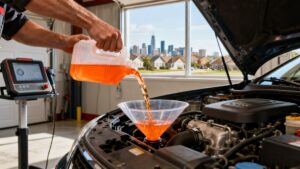
- Oil and Filter Change: This is your best-case scenario. If someone put the wrong grade of oil in your engine or the filter is completely plugged up, a straightforward oil and filter change with the right products will often fix it on the spot. This is by far the cheapest and fastest solution.
- Faulty Oil Pressure Sensor Replacement: If a technician hooks up a mechanical gauge and confirms your actual oil pressure is perfectly fine, then the sensor (also called a sending unit) is the problem. Swapping out this small electronic part is a very common fix that gets rid of those false high-pressure alarms.
It's absolutely critical to confirm the real pressure before just replacing a sensor. Throwing new parts at a problem without a proper diagnosis is a fast way to waste money. A professional check ensures you’re fixing what's actually broken.
Costs for More Complex Mechanical Repairs
If the problem goes beyond a simple fix, it usually points to a more complex mechanical part inside the engine. These jobs take more time, skill, and specialized tools, which naturally means they cost more. These are the kinds of issues that, if ignored, can lead to catastrophic engine damage.
A stuck pressure relief valve is a classic example of one of these more serious mechanical failures.
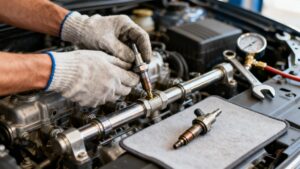
- Pressure Relief Valve Repair/Replacement: This little valve is usually part of the main oil pump. Depending on your car's engine design, a mechanic might need to drop the oil pan to even get to it. The repair involves trying to clean and free up the stuck valve or, more often, just replacing the entire oil pump assembly.
- Blocked Oil Passages: This is the most severe and labor-intensive problem you can face. Fixing internal oil galleries clogged with sludge requires a major engine teardown. In many situations, it can actually be more cost-effective to replace the entire engine than to attempt such a deep and complicated cleaning process.
To give you a better idea of the numbers, here is a breakdown of what you might expect to pay for these common high oil pressure fixes.
Estimated Repair Costs for High Oil Pressure Problems
This table summarizes the common repairs for high oil pressure, their complexity, and estimated cost ranges to help you budget for potential fixes.
| Problem | Common Repair Solution | Estimated Cost (Parts & Labor) | Typical Time Required |
|---|---|---|---|
| Incorrect Oil/Clogged Filter | Oil and Filter Change | $75 – $150 | Under 1 hour |
| Faulty Pressure Sensor | Replace Sensor/Sending Unit | $150 – $400 | 1-2 hours |
| Stuck Pressure Relief Valve | Replace Oil Pump Assembly | $500 – $1,200+ | 4-8 hours |
| Blocked Oil Passages | Engine Flush or Rebuild | $2,000 – $7,000+ | Several days |
As these estimates show, tackling a high oil pressure light can cost anywhere from a routine service to a major engine overhaul. This is exactly why getting a quick, accurate diagnosis from a trusted shop like Kwik Kar is so important—it guarantees you get the right fix at a fair price, without any guesswork.
Why Trust Kwik Kar with Your Engine Health
When you’re dealing with a serious problem like high oil pressure, the last thing you need is guesswork. You need a service partner you can trust to get the diagnosis right the first time and give you a straightforward repair plan. For drivers all over Dallas, Kwik Kar is that partner. We know that surprise car troubles are a major headache, and we’ve built our shop around being honest, accurate, and getting you back on the road without unnecessary stress.
It all starts with our diagnostic equipment. We don’t guess what’s wrong; we invest in the right tools to find the precise cause of the high pressure. This approach means you aren’t paying for parts you don’t need or repairs that don’t solve the problem.
Expertise That Dallas Drivers and Fleets Depend On
The real heart of our service is our team of experienced, ASE-certified technicians. These aren't just mechanics; they're career pros who take pride in their work. They've seen just about every cause of high oil pressure there is, and they know the difference between a cheap sensor that's gone bad and a major internal engine problem. That level of experience saves you time and protects you from an expensive misdiagnosis.
At Kwik Kar, our philosophy is simple: provide honest answers and deliver quality work. We explain the problem, show you our findings, and give you clear options, empowering you to make the best decision for your vehicle and your budget.
This commitment to reliable service is why local businesses count on us, too. In the Dallas metroplex, we know that when a company vehicle is down, it’s costing you money. Our specialized fleet service programs are built to keep your business moving by minimizing downtime and controlling maintenance costs. We offer priority service and custom maintenance schedules to make sure your fleet is an asset, not a constant problem.
When you're facing a worrying engine light or a strange gauge reading, don't leave your vehicle’s health to chance. Let the expert team at Kwik Kar give you the clarity and quality service you deserve. Schedule your appointment today and drive with the confidence that your engine is in the best hands in Dallas.
Frequently Asked Questions About Oil Pressure
Even after learning what causes high oil pressure, it's natural to have a few more questions. We hear these concerns from drivers all the time, so let's get you some quick, clear answers from our team.
Is It Safe to Drive with a High Oil Pressure Warning?
Absolutely not. You should never continue driving if you see that oil pressure light or the gauge is maxed out. Think of it as a smoke alarm for your engine—you don't ignore it, you act immediately.
Pushing your luck can force oil right past seals, destroy your oil pump, or starve vital engine components of lubrication. This can quickly lead to catastrophic, and very expensive, engine failure. Your best move is to pull over as soon as it's safe, shut off the engine, and call for a tow. A few more miles can be the difference between a simple repair and a full engine replacement.
How Often Should My Oil Pressure Be Checked?
Your car is actually doing this for you constantly. That dashboard light is tied directly to a sensor that monitors pressure whenever the engine is running, so you don't need to check it yourself.
The best way to head off high oil pressure problems is to simply stick to your regular maintenance schedule. That really is the secret.
- Get your oil and filter changed on schedule.
- Make sure the right grade of oil is used every single time.
- Keep an ear out for any strange new noises or an eye out for leaks under the engine.
Can Cold Weather Cause High Oil Pressure?
Yes, it sure can. It's completely normal to see your oil pressure gauge read higher for the first few minutes after starting up on a cold morning. Motor oil gets thick when it's cold, almost like molasses, so the pump has to work much harder to push it through the engine, causing a temporary spike in pressure.
A high reading on a cold start that settles back to normal as the engine warms up isn't something to worry about. However, if that pressure stays high even after you've been driving for a while, it's signaling a real problem that needs a professional diagnosis.
If you’re staring at a high oil pressure warning or just have a gut feeling something’s not right with your engine, don't put it off. The expert technicians at Kwik Kar Oil Change and Auto Care are ready to provide the accurate diagnostics and reliable repairs you need to get back on the road with confidence. Schedule your service today at https://www.kwikkarspringvalley.com.