



Picture your car's drivetrain as the system that gets power from the engine to the wheels. Now, imagine trying to keep that power flowing smoothly while steering around a tight corner or driving over a bumpy, uneven road. That’s the magic of a Constant Velocity (CV) joint. They are like the powerful, flexible wrists in your car's drivetrain, ensuring your wheels get consistent power no matter the angle or suspension movement.
Understanding what they do is the key to spotting the critical signs of worn CV joints before they become a major problem.
What CV Joints Do for Your Car
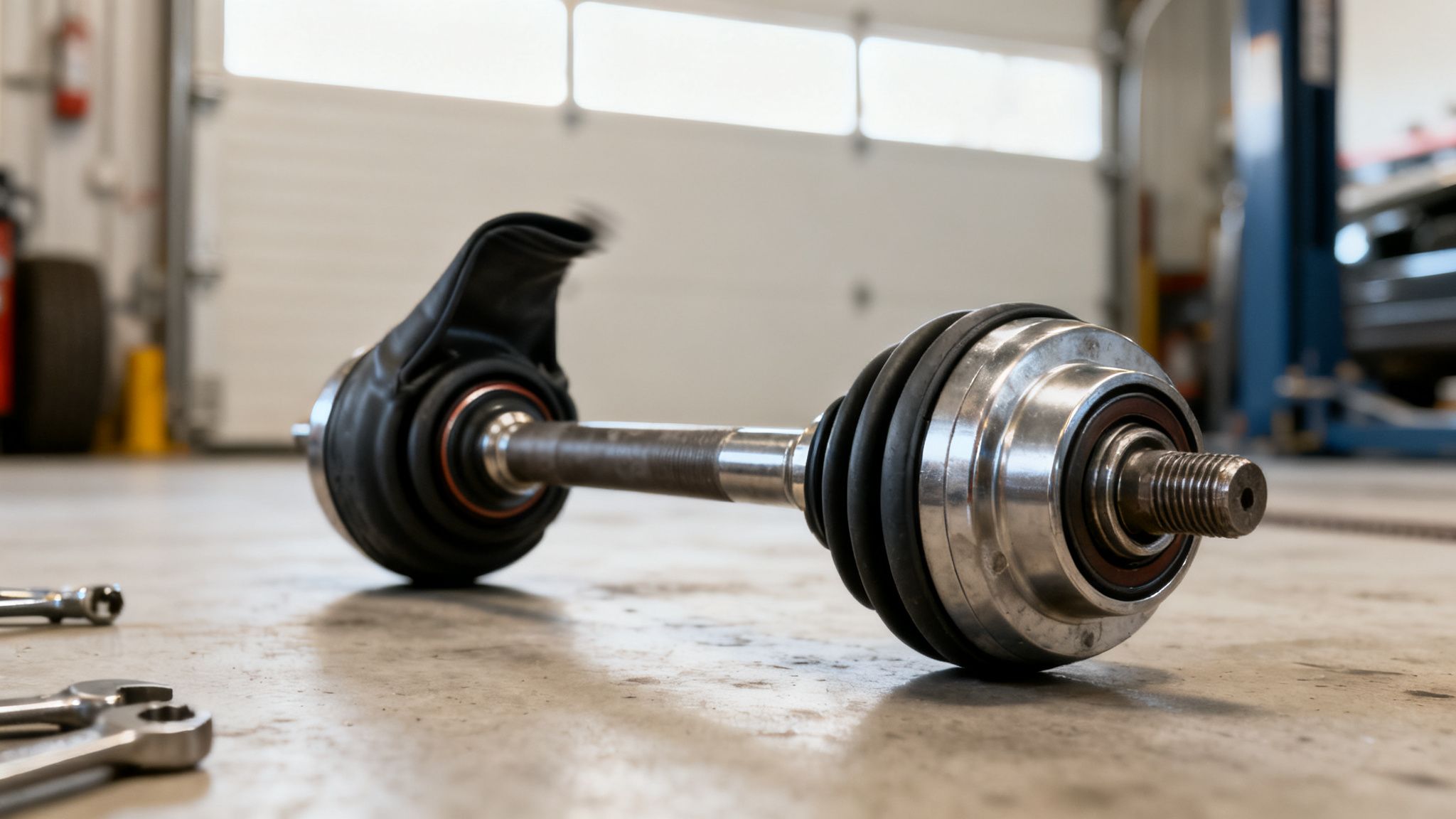
Your engine and transmission generate all the horsepower, but that force needs a way to travel down a complex path to finally spin the wheels. This is where CV axle shafts, with a CV joint at each end, do their heavy lifting. They are essentially high-tech universal joints designed to send torque to the wheels at a constant speed, even when bending and flexing all over the place.
This incredible flexibility is essential for two main reasons:
- Steering: Every time you turn the wheel, your front wheels have to pivot. The outer CV joints are built to handle these sharp angles, allowing the axle to keep spinning the wheel without any interruption in power.
- Suspension Movement: As you drive, your suspension is constantly moving up and down over bumps, potholes, and dips in the road. The inner CV joints allow the axle shaft to change its angle and length to accommodate this motion seamlessly.
The Anatomy of a Healthy CV Joint
Each CV joint is a clever piece of engineering, packed with ball bearings and cages that allow for that smooth, powerful rotation. To shield these delicate moving parts from rocks, water, and road grime, they’re sealed inside a flexible, accordion-style rubber or plastic cover called a CV boot.
This boot isn't just a dust cover. It’s packed with a special high-temperature grease that lubricates everything inside, cutting down on friction and preventing premature wear. Its job is simple but vital: keep the good stuff (grease) in and the bad stuff (dirt, water, salt) out.
A torn or compromised boot is the number one enemy of a CV joint. Once that boot rips, the essential grease slings out, and abrasive contaminants start working their way in. That contamination quickly turns a smoothly operating joint into a mess of grinding metal, leading to rapid failure. This is why a quick visual check of the boots is often the first thing a mechanic does when diagnosing a potential issue, and why catching the signs of worn CV joints early can save you a lot of trouble.
The Clicking and Popping Noise When Turning
If there's one tell-tale sign of a bad CV joint, this is it. We’re talking about that unmistakable, rhythmic clicking or popping that seems to come from your front wheels, but only when you're making a sharp, slow turn. Think about pulling into a tight parking spot or making a U-turn; that's the moment this classic symptom decides to make itself known.
This noise isn't just a random quirk; it’s a direct SOS from a failing outer CV joint. The best way to picture the joint is as a complex wrist, with tough steel ball bearings that roll inside perfectly machined grooves. This clever design is what allows your wheel to both steer and receive power from the engine at the same time.
But when the protective rubber boot around it tears, the special grease that keeps it lubricated escapes. Worse, dirt, grit, and water get inside. This contamination turns that smooth grease into a gritty, sandpaper-like paste, which starts to rapidly grind down those critical internal parts.
What’s Causing the Click?
As the ball bearings and their tracks wear down, they develop too much space, or what mechanics call "play." They no longer fit together as a single, tight unit. So, when you crank the steering wheel for a sharp turn, the extreme angle forces these worn, loose parts to bind up and then suddenly release under the engine's power.
That "click" or "pop" you hear is the sound of those bearings violently snapping into place as they shift around inside their worn-out grooves. Each click is a tiny impact event happening inside the joint, telling you its structural integrity is gone.
What begins as a faint, occasional click will always get louder and more constant as the wear gets worse. Before long, you might start hearing it during gentler turns or even when you're just driving straight—a sure sign of severe damage and impending failure.
An Unmistakable Warning
This clicking sound is much more than a simple annoyance. It’s your car’s most direct way of screaming that an outer CV joint is on its last legs. It’s one of the most common signs, especially for front-wheel and all-wheel drive vehicles. In fact, automotive industry data shows that CV joint failures account for roughly 15-20% of all drivetrain-related repair shop visits in busy urban areas like Dallas, where constant turning and stop-and-go traffic put extra stress on these components. You can learn more about the automotive constant velocity joint market and its trends.
The progression is nearly always the same:
- Initial Stage: You only hear a faint clicking during full-lock, slow turns, like in a parking garage.
- Intermediate Stage: The popping gets louder and happens during most normal turns.
- Critical Stage: You hear constant clicking or even grinding noises, even when you're driving in a straight line.
Ignoring this sound is a huge gamble. A clicking CV joint is actively tearing itself apart from the inside. If it fails completely while you're on the road, the axle can separate, leading to a total loss of power to that wheel and, in the worst-case scenario, a loss of control of your vehicle. The very moment you hear that rhythmic click, it's time to get a professional inspection.
Finding Leaking Grease and Damaged Boots
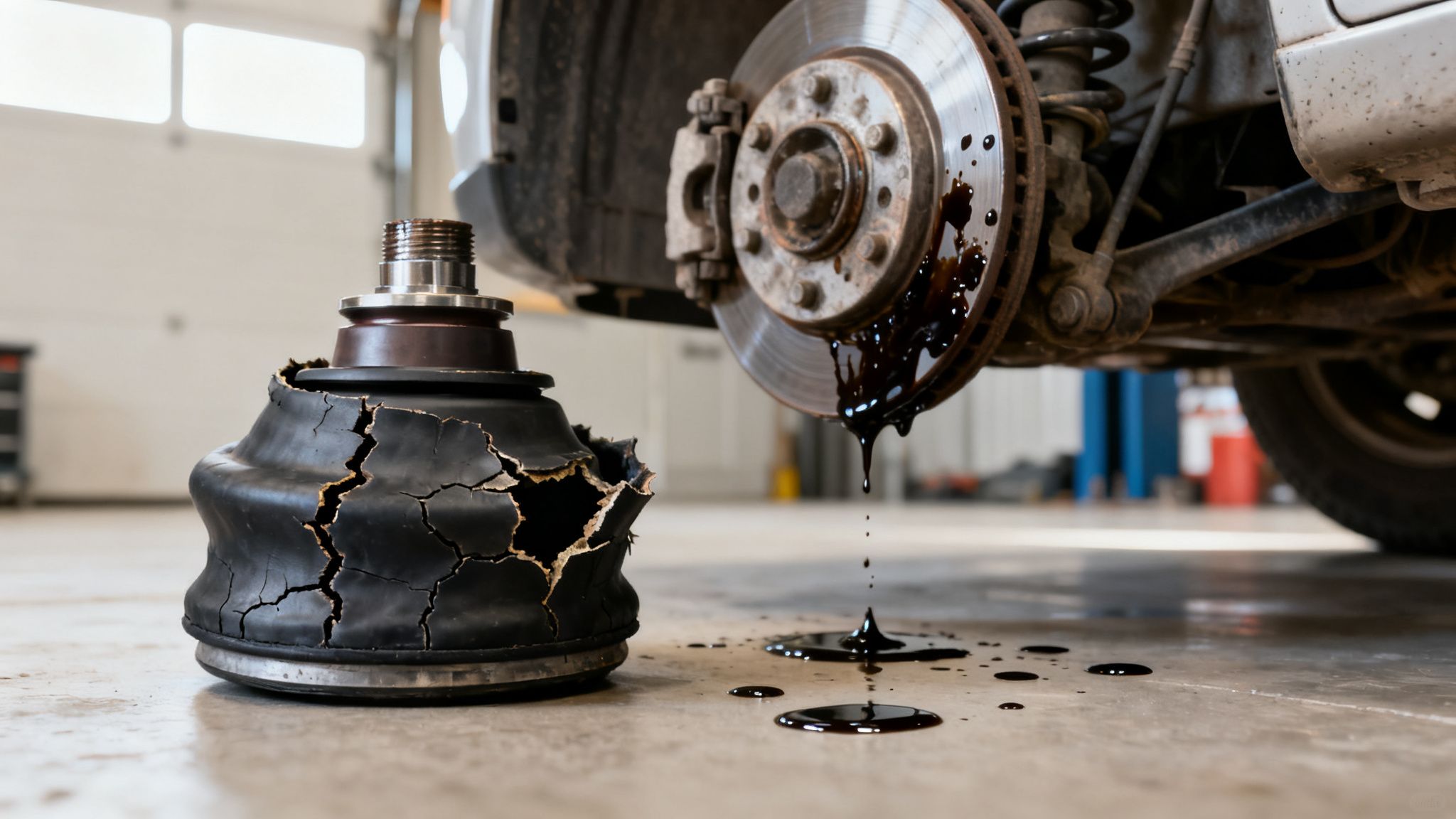
Long before you ever hear a click or feel a strange vibration, one of the first signs of worn CV joints is something you can see. The culprit is a failed CV boot—that flexible, ribbed rubber cover protecting the joint. Think of it as a sealed pouch packed with the special grease that keeps everything inside moving without friction.
When that boot gets a tear or crack, things get messy, fast. As the axle spins, it flings the dark, thick grease everywhere. It's a clear warning sign. You might spot dark, greasy splatters on the inside of your front wheels, along the inner rim of the tire, or caked onto other suspension parts.
The Countdown Timer Starts with a Leak
This isn't just a messy inconvenience; it's the start of a countdown to a much bigger problem. A torn boot is a two-way street for trouble. Not only is that vital grease getting out, but dirt, grime, water, and road salt are getting in.
Once those gritty contaminants mix with whatever grease is left, they create a grinding paste that chews up the joint's internal metal parts from the inside out. This process dramatically speeds up wear, turning what could have been a simple, affordable boot replacement into a much more involved and costly CV axle replacement. Spotting that grease is your best chance to fix the small problem before it becomes a big one.
A grease leak is a glaring red flag. Once the protective boot fails and the joint is exposed to the elements, its lifespan is drastically shortened. Ignoring it guarantees a more significant and costly repair down the road.
Grease flung around your wheel wells is one of the most obvious visual signs of worn CV joints. It means the boot has failed, and the clock is ticking. Industry data suggests that boot failures affect roughly 25% of vehicles that have passed the 100,000-mile mark. For Dallas drivers and fleet managers trying to control costs, catching this greasy evidence early can prevent repair bills that easily top $500. Once contaminated, joints can fail up to 40% faster if not addressed right away. You can see more on the aftermarket trends for automotive CV joints to understand the numbers.
Vibrations and Shudders During Acceleration
While clicking sounds are the classic calling card of a failing outer joint, sometimes the problem is one you feel instead of hear. If you've noticed a distinct vibration or a shudder that only shows up when you step on the gas, you're likely feeling one of the most common signs of a worn CV joint—specifically, the inner joint.
This isn't your typical wheel imbalance that you feel at a steady cruising speed. This vibration is directly tied to the engine's torque. It’s at its worst when you're accelerating and tends to fade away or disappear completely once you're cruising or coasting. You might feel the shake through the steering wheel, up through the floor, or even resonating through the whole car.
Why Acceleration Triggers the Shudder
The inner CV joint has a special job: it slides in and out to compensate for the up-and-down motion of your car’s suspension. Over time, it can wear down, creating excessive "play" or looseness in its internal parts. When you hit the accelerator, that slop prevents the joint from transferring power smoothly.
Think of it like trying to spin a wobbly top—the motion is unstable and jerky. In the same way, a worn inner joint causes the axle to wobble as it struggles to deliver power, which creates that shudder you feel. This not only makes for an unpleasant ride but also puts a lot of extra strain on other parts of your drivetrain.
A vibration that comes and goes with the gas pedal is a clear signal from your inner CV joint. Unlike tire-related shakes, this symptom is a direct result of the joint struggling to handle the engine's power, indicating significant internal wear that needs immediate attention.
Differentiating from Other Vibration Issues
It’s easy to misdiagnose a vibration, but the key is to pay attention to when it happens.
- Tire Imbalance: This vibration usually appears at certain higher speeds (like 55-65 mph) and stays there, whether you're accelerating or just cruising along.
- Brake Issues: If you feel a shake, it will only happen when you press the brake pedal. If your front end shakes when braking, other components are likely the culprit. Learn more about shakes when braking in our guide.
- Worn CV Joint: The vibration is at its worst during acceleration and quiets down or vanishes when you let off the gas.
Feeling vibrations or bouncing when you accelerate, especially at speeds over 40 mph, is a sign of advanced wear. This is a huge driver for repairs; in fact, the automotive CV joint market is expected to hit $20.2 billion by 2033. This growth is partially driven by the popularity of SUVs and crossovers, which often have more joints per vehicle. Here in major U.S. markets like Dallas, fleet data shows that 18% of drivetrain complaints from vehicles over 80,000 miles are traced back to this exact problem.
A Quick Checklist for Worn CV Joint Symptoms
Knowing the individual signs of a worn CV joint is one thing, but understanding how they all connect is what really empowers you as a driver. Different noises and vibrations often point to specific parts of the CV axle. Learning to spot them can help you catch a problem long before it leaves you stranded on the side of the road.
Think of this as a quick-reference guide to help you connect the dots between what your car is doing and what’s likely going on under the hood.
This simple infographic breaks down the top three symptoms you'll want to watch for.
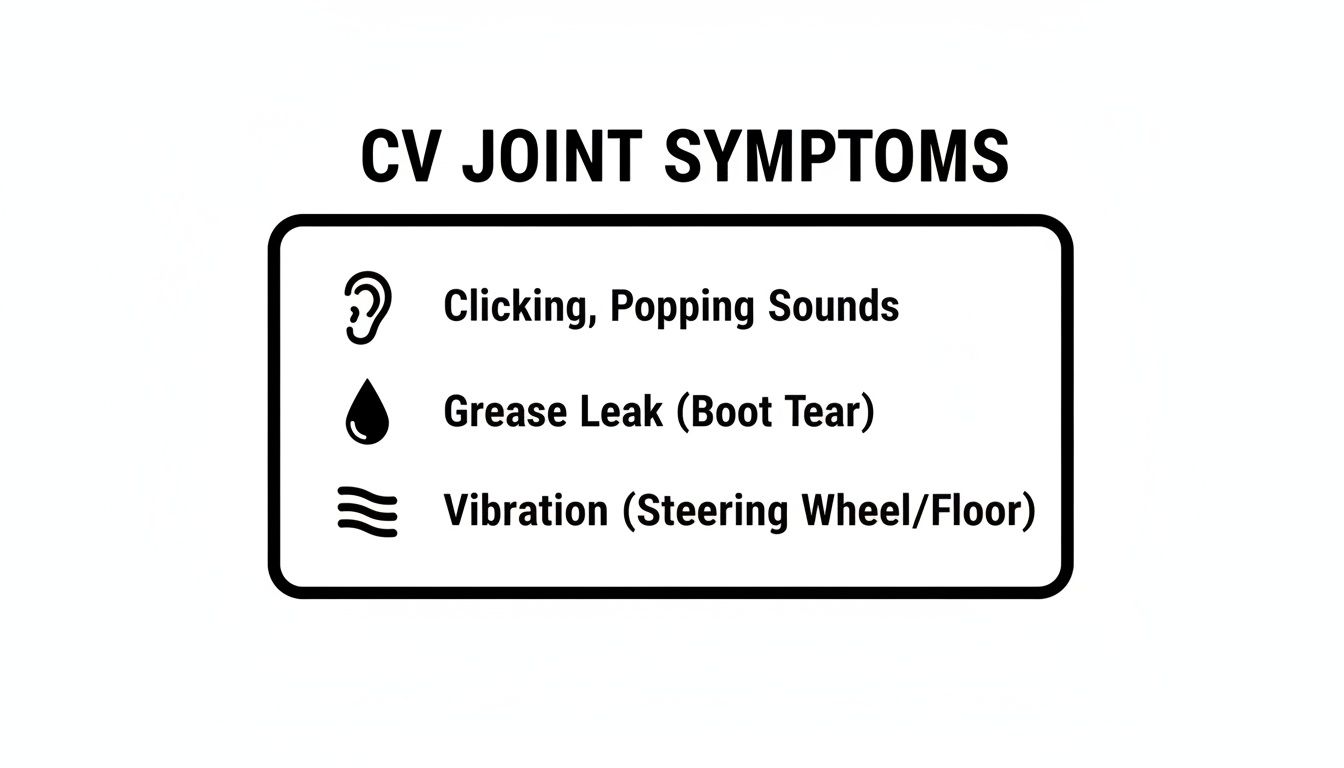
Each of these icons—audible, visual, and tactile—represents a key way your car tries to tell you something is wrong with its CV joints.
Quick Guide to Worn CV Joint Symptoms
While you'll always want a professional diagnosis, paying close attention can give you a pretty good idea of where the problem lies. This table breaks down the most common symptoms and their likely causes so you know what you’re looking for.
| Symptom | What It Means | When You'll Notice It Most |
|---|---|---|
| Clicking/Popping Noise | This is the classic, textbook sign of a worn outer CV joint. The ball bearings inside have developed too much play and are starting to bind under pressure. | Usually during sharp, slow-speed turns, like when navigating a parking lot or making a U-turn. |
| Greasy Splatter | A torn or cracked CV boot has flung its protective grease everywhere. This means dirt and grime are getting in, which will quickly destroy the joint. | You'll spot dark, thick grease on the inside of your wheels, your shocks, or other suspension components. |
| Vibration/Shudder | This typically points to a failing inner CV joint. When it gets too loose, it can’t transfer power from the engine smoothly, causing a shudder. | Almost always during acceleration. The vibration often disappears once you're cruising at a steady speed. |
| Loud Clunking | This sound indicates severe wear in either joint. The clunk is the sound of all the slack in the drivetrain being suddenly taken up. | When you shift between Drive and Reverse, or right as you accelerate from a dead stop. |
Knowing what to look for makes it much easier to have an informed conversation with your mechanic and understand the urgency of the repair.
Your At-Home Visual Inspection
You don't need any special tools to perform a quick visual check yourself. Just turn your steering wheel all the way to one side—this gives you a clear view behind the front tire. Find the rubber, accordion-like CV boot.
Look for any obvious cracks, tears, or greasy residue that's been slung onto nearby parts. If you see any of that greasy mess, that's your cue to schedule a professional inspection right away.
A simple visual check is one of the most powerful preventative maintenance tasks you can do. Spotting a torn boot early is the #1 way to avoid a much more expensive CV axle replacement down the road. If the boot is intact, the joint is still protected.
While this checklist is a fantastic starting point, a full diagnosis really requires a trained eye. You can find more tips on what to look for in our comprehensive vehicle inspection checklist.
Why Ignoring These Signs Is a Costly Mistake
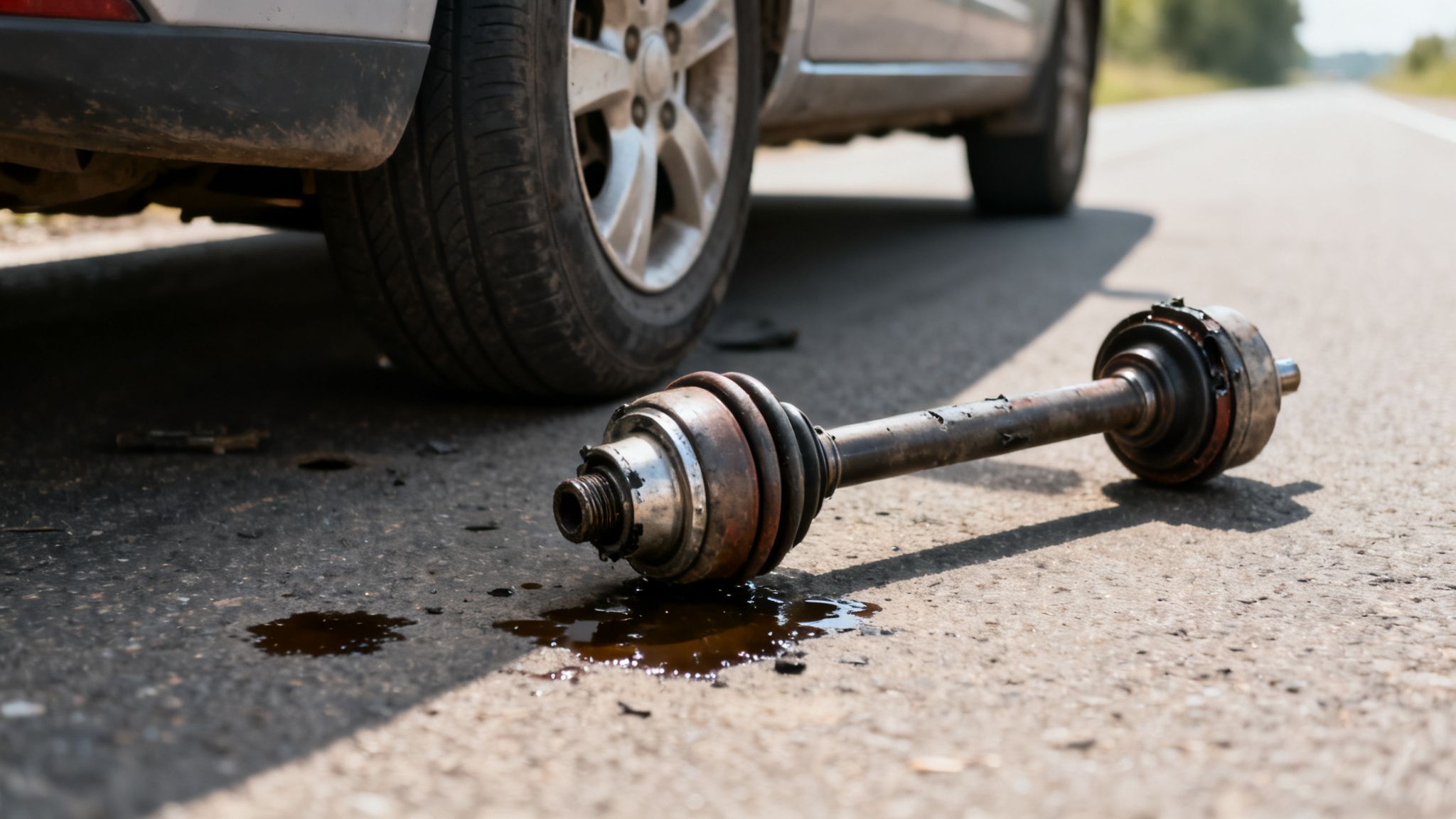
Putting off a CV joint repair is a gamble where the stakes are high, impacting both your safety and your wallet. Those first signs of worn CV joints—a faint click or a tiny spot of grease—are your vehicle’s way of giving you a heads-up. If you ignore them, you’re essentially driving on borrowed time.
The most terrifying risk is a catastrophic joint failure. This isn't a slow-motion problem; it's a sudden, violent event where the joint shatters. When that happens, the axle can completely separate, instantly severing the connection between your engine and that wheel. Your car will grind to a halt, leaving you stranded and risking a total loss of control, a scenario that's especially dangerous at high speeds.
The Financial Snowball Effect
When it comes to your finances, procrastination is the absolute worst strategy. A small tear in a CV boot is a relatively minor and affordable fix if you catch it early. But once that boot is compromised, every mile you drive is an invitation for dirt, grit, and water to get inside and grind away at the joint’s precision-engineered components.
What started as a simple boot replacement quickly snowballs into a much more expensive problem.
- Minor Fix: A torn CV boot caught early is often a simple, inexpensive replacement.
- Major Repair: An ignored boot inevitably leads to a contaminated, destroyed joint. Now you need a full CV axle replacement, which can cost hundreds more.
- Catastrophic Cost: A complete failure doesn't just stop there. It can cause serious collateral damage to your transmission, wheel bearings, and other suspension parts, turning a manageable repair bill into a major financial headache.
Think of it this way: ignoring the early symptoms is like watching a small, containable leak turn into a full-blown flood. A quick, proactive repair is always the smartest, safest, and most economical choice.
Staying on top of your vehicle's health through regular preventive maintenance for vehicles helps you catch these issues before they become major breakdowns. Early detection doesn’t just save you a pile of money—it ensures you and your passengers stay safe out on the road.
Get a Professional Diagnosis You Can Trust
Spotting the clicking, vibrations, or greasy splatters we've talked about is a huge first step. Good job. But turning that suspicion into an accurate repair plan? That takes an expert eye. While a quick look in your driveway can point you in the right direction, a lot of drivetrain issues have overlapping symptoms. For something as critical as a CV joint, a professional diagnosis is non-negotiable.
Trying to figure it out yourself can be a real gamble. A vibration you think is a bad inner CV joint could just be a simple tire imbalance. That clunking sound might not be the axle at all, but a worn-out suspension part instead. A misdiagnosis like that leads to paying for repairs you don't need while the real, potentially dangerous, problem is left to get worse.
Why Expert Inspection Matters
Skilled technicians don’t just guess; they have a process and the right equipment to nail down the exact cause of the trouble.
- Hands-On Testing: An expert gets your vehicle up on a lift to physically check for excessive play or looseness in the axle shaft. That’s something you just can’t do safely on the ground.
- Specialized Tools: They use specific listening tools to hear for internal joint noise and check for damage that isn't visible to the naked eye.
- Real-World Experience: A seasoned mechanic has seen hundreds of these issues. That experience helps them instantly tell the difference between a failing CV joint and other problems that sound or feel similar, making sure you get the right fix the first time.
A professional diagnosis is your best insurance against paying for the wrong repair. It gives you peace of mind, knowing exactly what’s wrong and having a clear, reliable plan to make your vehicle safe again.
Finding a trusted auto care partner who explains the issue clearly is key. Understanding the steps involved in auto diagnostic services helps you know what to expect during a thorough inspection. This knowledge empowers you to ask the right questions and feel confident in the work being recommended.
A proper inspection confirms not just the problem but also how bad it is. This prevents a simple boot replacement from being done on a joint that's already chewed itself up on the inside. To learn more about the tools and techniques we use, check out our guide on how a car diagnostic test works.
If you've noticed any of the warning signs we've covered, don't wait for the problem to escalate. Protect your vehicle and your safety by scheduling a professional inspection. The expert technicians at Kwik Kar Oil Change and Auto Care are here to provide a clear, accurate diagnosis and get you back on the road with confidence. Book your appointment today at https://www.kwikkarspringvalley.com.