


Let's get straight to the point: what should you expect to pay for new tires? For most drivers we see, a new set of four tires in 2026 will typically run between $600 and $1,200. Of course, that’s a pretty wide range. The final price really comes down to what kind of vehicle you drive, the brand you choose, and the tire’s performance level.
Your Quick Guide to New Tire Costs
Think of it like buying a new pair of running shoes. A simple, everyday pair for walking around town is going to cost a lot less than specialized, high-performance shoes built for a marathon runner. The exact same idea applies to your vehicle’s tires. The price you see on the tire itself is really just the start of the conversation.
To give you a clearer idea, the biggest factor in your total expense is what you drive. A compact sedan just doesn't need the same kind of tire as a heavy-duty truck, and that difference shows up right on the price tag. For most car owners, understanding the complete, out-the-door cost is what truly matters, not just the initial sticker price.
Estimated Price for a Set of Four New Tires
To help you set a realistic budget before you even walk into the shop, we've put together this quick reference table. It shows the estimated total cost for a set of four new tires, including basic installation, for the most common vehicle types we see in 2026. Just keep in mind these are general estimates, and your final cost can vary.
Estimated Average Price For a Set of Four New Tires by Vehicle Type
| Vehicle Type | Tire Price Range (Per Tire) | Estimated Total Cost (Set of 4, Installed) |
|---|---|---|
| Compact/Midsize Sedan | $120 – $220 | $550 – $950 |
| Crossover/Small SUV | $150 – $275 | $650 – $1,150 |
| Full-Size SUV/Truck | $200 – $400+ | $850 – $1,600+ |
As you can see, the tire itself is only one piece of the puzzle. Your final bill will include essential services that make sure your new tires are safe and ready for the road.
Key Takeaway: The price on the tire itself is only one part of the equation. Your final bill will include necessary services that ensure your new tires perform safely and effectively.
These additional costs, which we’ll break down next, aren't just "add-ons." They're critical services that guarantee a smooth ride and help you get the most life out of your investment. To help manage these expenses, it's always smart to look for promotions. You can check out our current coupon for a set of tires to see how you can save on your next purchase.
Breaking Down Your Final Tire Bill
Have you ever glanced at the final bill for new tires and seen a total that’s a bit higher than the sticker price you were quoted? It’s a pretty common moment of confusion. The price tag on the tire itself is just the starting point—think of it as the main course. The final bill includes the essential services that make sure that main course performs safely and gives you thousands of miles of trouble-free driving.
These aren't just random "add-on" fees. They are critical, professional services. Without them, you’d be driving on improperly installed tires, which can lead to a shaky ride, premature wear, and even unsafe handling. A good shop, like Kwik Kar, will always be upfront about each line item, so you know exactly where your money is going.
From Sticker Price to Out-The-Door Cost
When you get a quote for a new set of tires, you're paying for more than just the rubber. Let's break down the common charges you’ll see on your invoice.
Mounting and Balancing: This is the hands-on process of putting the new tire on its wheel and then using a high-tech machine to make sure the weight is distributed perfectly. A properly balanced tire is crucial for a smooth ride and prevents those annoying vibrations you can feel in your steering wheel at highway speeds. It’s absolutely non-negotiable for safety and performance.
Tire Disposal Fee: Old, worn-out tires can't just be tossed in the trash. In Texas, there are environmental regulations for how they must be handled. This small fee covers the cost of having your old tires responsibly recycled, keeping them out of landfills.
Wheel Alignment: While this is often listed as an optional service, we almost always recommend it with new tires. An alignment adjusts your car’s suspension angles to ensure the tires sit flat on the road. If you skip it, you risk having your brand-new tires wear down unevenly, which can chew through your investment in a hurry.
Just the base price of the tires alone can vary quite a bit depending on what you drive.
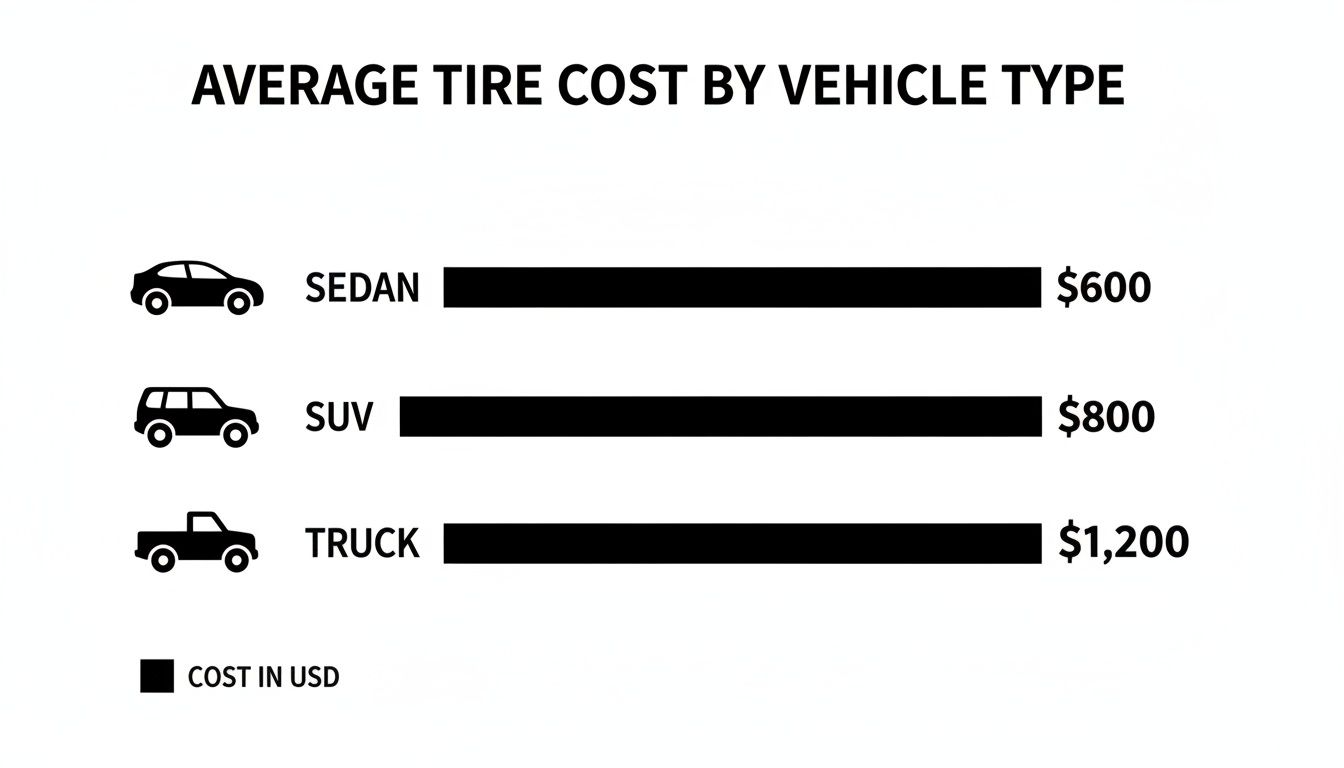
As you can see, bigger vehicles like trucks and SUVs generally need larger, more robust tires, which naturally come with a higher price tag.
The Bottom Line: Your final bill is a combination of the tires themselves and the professional labor needed to install them safely and correctly. Every fee has a purpose—to protect your investment and keep your vehicle running at its best.
Finally, you’ll also see state and local sales tax added to the total. Once you understand what each part of the bill is for, it stops being a confusing document and becomes a clear, transparent record of a job done right.
What Really Drives Tire Prices
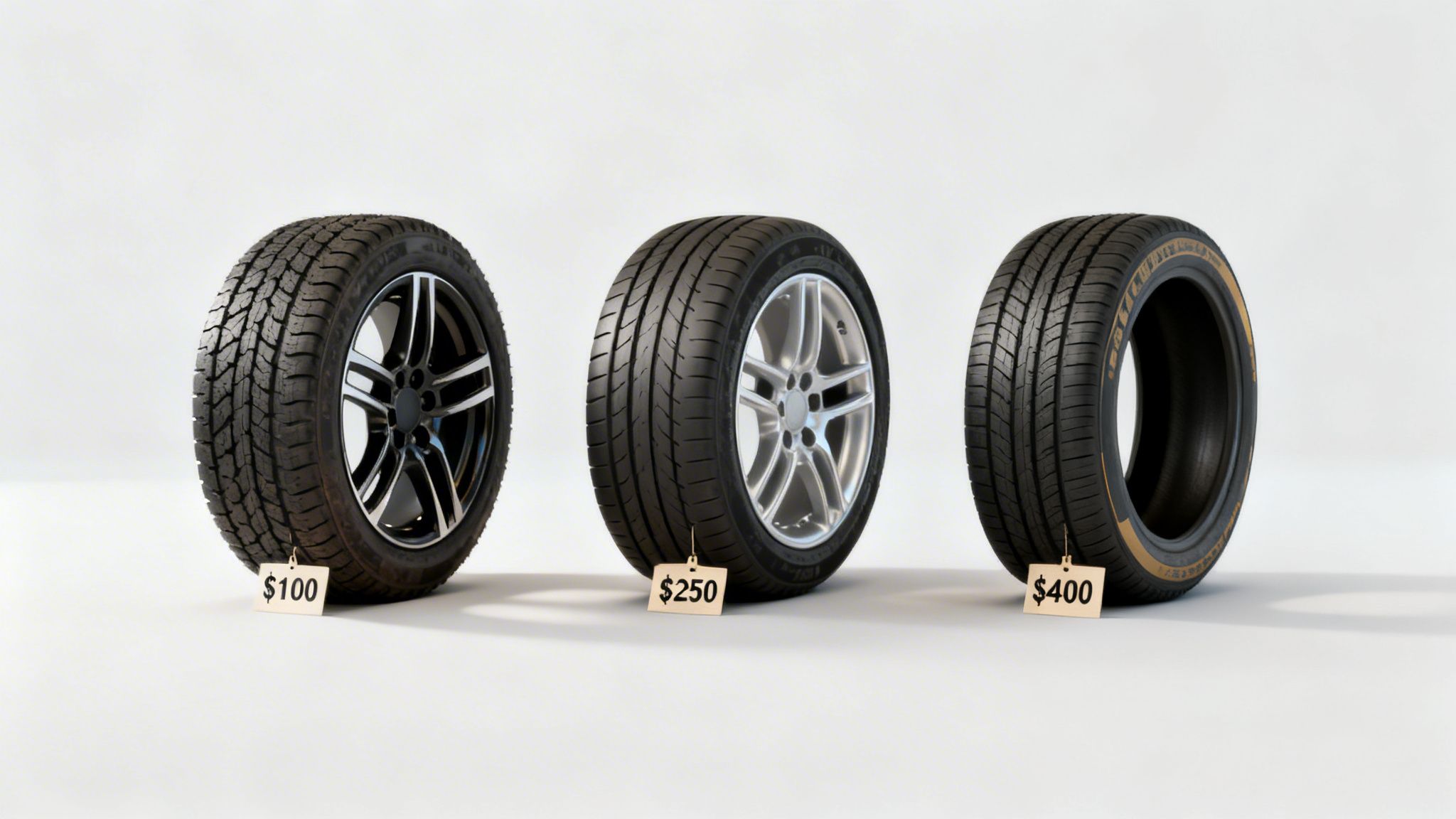
Ever wondered why one tire costs $100 while another that looks almost the same is priced at $400? It’s a great question, and the answer goes way beyond just the brand name stamped on the side.
The price of a new tire is a complex mix of engineering, the materials used, and what it’s built to do. It’s a lot like buying a new phone; you can grab a basic model that just makes calls or a top-of-the-line device with a pro-level camera. The price reflects what’s inside, and with tires, that means safety, performance, and how long they’ll last.
Getting a handle on what drives the average price for new tires helps you find that sweet spot between your budget and what your car truly needs. Let’s break down the key factors that determine what you'll end up paying.
Tire Size and Vehicle Type
The most obvious factor that hits your wallet is the tire's size. It's simple, really: bigger tires need more raw materials like rubber, steel belts, and chemical compounds to make, which bumps up the price. A tire for a compact Honda Civic is just physically smaller and less beefy than one for a Ford F-150.
But it’s not just about getting bigger. Tires are engineered for specific types of vehicles. A truck tire, for example, has to be built tough enough to handle heavy loads and rougher terrain. That requires a much more robust construction than a tire designed for a lightweight sedan, and that specialized engineering adds to the cost.
Brand and Performance Category
Just like with almost any product, brand reputation plays a huge part in what you’ll pay. The tire market is basically split into three tiers:
- Premium Brands: These are the big names you know, like Michelin, Goodyear, and Bridgestone. They pour millions into research and development, using advanced rubber compounds and tread designs for top-tier performance, comfort, and tread life. You’re paying for the latest tech and a ton of testing.
- Mid-Range Brands: Brands like Cooper, Hankook, and Kumho are fantastic for finding a balance between quality and cost. They often deliver performance that’s close to the premium guys but at a much more wallet-friendly price.
- Budget Brands: These tires meet all federal safety standards, but they’re made with simpler designs and less advanced materials. You get a low upfront cost, but the trade-off might be faster wear and less grip in bad weather.
A tire's performance category—like all-season, high-performance, or all-terrain—also shapes its price. A high-performance summer tire uses a soft, sticky rubber compound for maximum grip, which is more expensive to produce than the harder, more durable compound you’d find on a standard touring tire. To get the most for your money, it's crucial to read more about how alignment affects performance and protects your new investment.
Speed Load and Warranty
Those numbers and letters on the side of your tire aren't just for decoration; they’re critical codes that directly influence the price. The speed rating (like an 'H' for 130 mph) tells you the maximum safe speed, while the load index (like a '91' for 1,356 lbs) shows how much weight each tire can support. Higher ratings demand more sophisticated engineering and stronger materials, which costs more to produce.
A longer tread life warranty is a direct reflection of the manufacturer's confidence in its materials and construction. Tires guaranteed for 80,000 miles use more advanced, durable rubber compounds than those warrantied for only 40,000 miles.
This is where paying a bit more upfront can actually lead to a lower cost-per-mile in the long run.
Finally, you have market forces that you can’t see. Things like marketing investments, as explored in the new rules of automotive marketing for 2026, can affect a company's overhead and pricing. Wider economic trends, like the cost of raw materials, have a direct impact, too. The Producer Price Index for tires, for example, climbed to 188.074 by early 2026, partly due to a massive 72% surge in natural rubber prices, which ultimately hits your wallet at the shop.
How Global Events Impact Your Wallet
Ever wonder why tire prices seem to shift for no reason? The price you pay for new tires here in Dallas isn’t just decided in a local shop. It’s tied to a huge global network of raw materials, manufacturing, and shipping lanes.
Think of it like your morning coffee. If a bad frost hits the coffee bean fields in Brazil, you eventually feel that pinch at your local cafe. The same thing happens with your vehicle's tires, which rely on a complex global supply chain that can be surprisingly fragile.
When there are sudden shortages of key materials, like natural rubber or the synthetic compounds made from oil, manufacturing costs can spike almost overnight. International shipping delays or political issues in a major tire-producing country can also create massive bottlenecks, which tightens the supply and drives up prices for everyone.
Tariffs and the Cost of Imports
One of the biggest global factors hitting your wallet is government policy—specifically, tariffs. A tariff is just a tax on imported goods. When the U.S. government puts tariffs on tires from countries like China or Thailand, that extra cost doesn't just vanish.
It's a common myth that the country exporting the goods pays the tariff. In reality, the company importing the tires pays that tax, and that cost almost always gets passed down the line until it lands on your final bill.
This means a chunk of what you pay for certain tires is directly linked to international trade deals. When you see the average price for new tires start to climb, global politics and government actions are often a big part of the story.
This is especially true for the American market. In fact, a staggering 63.4% of all passenger tires sold in the U.S. last year were imported. That exposes a huge portion of our market to tariff hikes, which can range anywhere from 26% to 46% for tires coming from key suppliers.
For a typical set of four passenger car tires, which can average $600-$800 in a major market like Dallas, those tariffs add up fast. You can explore more about how these trends affect tire prices to get the full picture.
How Global Tire Prices Compare to the U.S.
To put things in perspective, it's helpful to see how our prices stack up against the rest of the world. The table below uses a Tire Price Index, with the U.S. as the baseline (1.00), to show the cost differences.
| Country | Tire Price Index | Price Difference vs. U.S. |
|---|---|---|
| United States | 1.00 | Baseline |
| Canada | 1.12 | +12% |
| Germany | 1.25 | +25% |
| United Kingdom | 1.30 | +30% |
| Australia | 1.45 | +45% |
| Brazil | 1.60 | +60% |
| Japan | 0.95 | -5% |
As you can see, factors like local taxes, import duties, and economic conditions mean that drivers in countries like Australia and Brazil pay significantly more for the exact same tires. While the U.S. isn't the cheapest, we benefit from a highly competitive market.
Ultimately, these global forces are way beyond what any single shop can control. But understanding what’s happening behind the scenes helps make sense of why prices change over time.
Smart Ways to Save on Your Next Tire Purchase
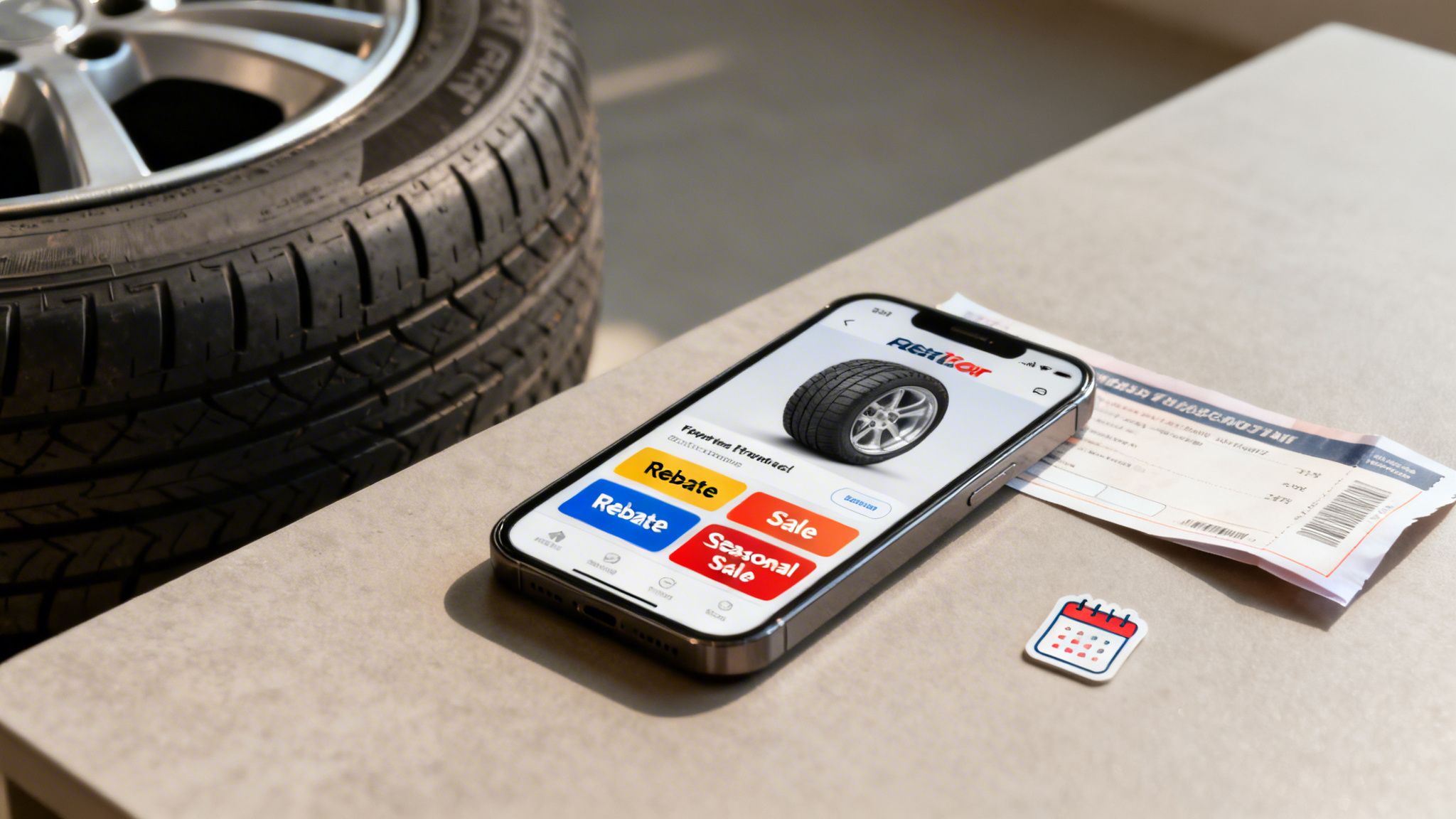
Knowing what goes into the average price for new tires is a great start, but the real win is finding ways to actively save money. Thankfully, a little bit of planning can make a huge difference on your final bill. Being a savvy tire shopper isn't about cutting corners on quality or safety; it's about making smarter, more informed decisions.
The easiest way to save is to think like a retailer. Major sales and promotions often pop up around holidays like Memorial Day, Labor Day, and Black Friday. Tire manufacturers and shops roll out rebates and special deals during these times, making them an ideal window to make your purchase.
You should also keep an eye out for manufacturer rebates. Brands like Goodyear, Michelin, and Cooper frequently offer online or mail-in rebates when you buy a complete set of four tires. These promotions can easily save you $50 to $100, taking a nice chunk out of your total cost.
Align Your Purchase with Your Driving Needs
One of the most common mistakes we see is drivers overspending on tire features they will never actually use. It's a bit like buying a professional-grade camera just to snap a few family photos at a barbecue. You have to be realistic about your daily commute and driving habits.
Honest Assessment: If you spend most of your time on city streets and highways around Dallas, you probably don't need a pricey set of high-performance summer tires or aggressive all-terrain models. A quality all-season touring tire will almost always provide the perfect blend of comfort, longevity, and value.
Consider Mid-Range Brands: While premium brands pack in some incredible technology, mid-range brands such as Hankook, Kumho, and Firestone deliver fantastic performance and durability for a much friendlier price. For many drivers, they represent the sweet spot.
By matching the tire to your real-world lifestyle, you stop paying a premium for capabilities meant for a racetrack or a rugged trail you have no plans to visit. That simple shift in thinking can save you hundreds.
The most affordable tire isn't always the cheapest one on the shelf. Long-term value comes from a tire that lasts, performs safely, and maximizes your vehicle's fuel efficiency.
Maximize Savings Through Long-Term Maintenance
Your savings opportunities don't end the moment you drive off our lot. Proper, consistent maintenance is the single best thing you can do to protect your investment and get every last mile out of your new tires. Neglecting it is just like throwing money away.
Think of it this way: a small, regular investment in maintenance can help you delay the big expense of a new set of tires by thousands of miles. This really comes down to a few key services.
- Regular Tire Rotations: Rotating your tires every 5,000 to 7,000 miles is essential for promoting even tread wear across all four tires.
- Proper Inflation: Underinflated tires wear out much faster and kill your gas mileage. A quick pressure check once a month is a must.
- Wheel Alignments: A good alignment ensures your tires hit the road at the right angle, which prevents the edges from wearing down prematurely.
Even the air inside your tires can play a role. For anyone looking to get the most stable tire pressure, you can learn more about filling your tires with nitrogen and see how it helps maintain consistent inflation. When you make these habits part of your routine, you truly maximize every dollar you spent.
Frequently Asked Questions About Buying New Tires
Even after you have a good idea of the average price for new tires, a few questions usually pop up before you make a final decision. That's completely normal. We put this list together to answer the most common questions our technicians hear from drivers just like you.
Getting the right answers is just as important as finding a good price. A smart tire purchase keeps your vehicle safe, ensures it handles the way it should, and gives you real value for your hard-earned money. Let’s clear up some of that confusion.
How Do I Know What Size Tires My Car Needs?
The quickest and most reliable way to find your tire size is to look at the information sticker inside your driver's side doorjamb. This sticker has the exact size recommended by your vehicle’s manufacturer, which guarantees the best safety and performance.
You can also find the size printed on the sidewall of the tires you have now. If you're ever in doubt, our technicians at Kwik Kar are always happy to pop outside and verify the correct size for you.
What Does a Tire Warranty Actually Cover?
New tires usually come with a couple of different warranties. The main one is the manufacturer's tread life warranty, which guarantees the tire for a certain number of miles (e.g., 50,000 miles).
Important Note: This is almost always a prorated warranty. If your tires wear out early, you don’t get a free set. Instead, you get a credit toward new tires based on the mileage you didn't get.
Tires also have a separate warranty that covers any defects from the manufacturing process. You might also be offered a road hazard warranty, which is an optional purchase that protects you from damage caused by potholes or road debris. It's extra peace of mind.
Besides Price, What Is the Most Important Factor?
Hands down, it's safety and making sure the tire is right for your local driving conditions. For our customers here in Dallas, a quality all-season tire is almost always the perfect choice. It gives you a great balance of performance on hot, dry roads and in our occasional wet weather.
Matching the tire’s capabilities to your car and how you drive every day is what ensures great handling, top-notch safety, and long life. That approach delivers far better value in the long run than just grabbing the cheapest option on the shelf.
Ready to equip your vehicle with the perfect set of tires? The expert technicians at Kwik Kar Oil Change and Auto Care are here to help you find the right fit for your car and budget. Visit us online to schedule your appointment and see our latest specials. https://www.kwikkarspringvalley.com