




A lot of drivers see the check engine light come on, glance at the battery a second later, and assume those two things can’t be related. That’s where trouble starts.
You might be heading across Dallas for work, loading kids into the car for school, or trying to get a fleet vehicle back on the road before the next job. The engine starts, but it sounds a little slower than usual. The headlights may seem slightly dim. Then that warning light stares back at you. Is it a bad sensor, a charging problem, or just an aging battery sending the wrong signals through the car’s electrical system?

Many people wait too long. A survey of 1,239 American drivers found that 25% ignore the check engine light indefinitely, even though a weak battery can trigger the warning when voltage drops disrupt ECU signals, according to Kelley Blue Book’s check engine light survey.
That matters because battery-related faults often look like engine problems at first. The car’s computer only knows it received bad or unstable information. It doesn’t know whether the root cause is a dying battery, corroded terminal, weak alternator output, or an actual engine component.
If you’re trying to sort out a check engine light battery problem, the goal is simple. Separate a voltage issue from a mechanical one before you spend money on parts you didn’t need.
A basic scan can help point you in the right direction. If you want to understand what a code reader is telling you, this overview of a car diagnostic test can help.kwikkarspringvalley.com/automotive-insights/car-diagnostic-test/) gives useful context before you start troubleshooting.
A check engine light tied to low voltage is often less about combustion and more about communication. Sensors need clean, steady power to report accurately.
Introduction
A car battery doesn’t just start the engine. It supports the entire electrical conversation inside the vehicle.
Think of the battery as the heart of the system. It sends a steady electrical supply to the starter, the onboard computer, and a long list of sensors. If that supply weakens or becomes unstable, the rest of the car starts making bad decisions based on bad information.
What stable voltage looks like
A healthy battery should stay near 12.6V at rest and 13.7 to 14.7V during operation, and when voltage drops below those ranges the ECU can misread sensor signals and switch on the check engine light with false codes, as explained in this guide to battery issues and engine light behavior.
That’s why drivers get confused. The warning says “engine,” but the cause may be electrical.
Here’s the easy version:
- Battery at rest: This is the voltage you measure with the engine off.
- Battery under charge: This is what you should see with the engine running and the alternator working.
- Cranking performance: This is the battery’s ability to deliver power while the starter turns the engine over.
Why Dallas heat makes this worse
Heat is hard on batteries. Underhood temperatures in hot weather can speed up fluid loss and internal corrosion. In real-world driving, that means an older battery may still “kind of” work while delivering unstable power.
Short-trip city driving adds another layer. If the car rarely stays on long enough to recover from each start, the battery spends too much time partly discharged. Drivers often blame the starter, spark plugs, or a sensor because the car still starts sometimes.
Practical rule: If your car starts a little slower than normal and the check engine light appears around the same time, treat the battery and charging system as suspects early.
Why the ECU gets tricked
Modern vehicles rely on a network of sensors. Those sensors don’t just need power. They need steady power.
When voltage sags, the ECU may interpret normal sensors as faulty ones. Oxygen sensor readings can look erratic. Airflow data can look inconsistent. Throttle response can seem wrong. The result is a code list that looks bigger and scarier than the actual problem.
If you’ve been dealing with repeat electrical issues, this article on a battery that keeps dying can help you think beyond the battery itself and toward charging or drain problems.
The one term worth learning
Cold cranking amps, often shortened to CCA, describe how strongly the battery can deliver power for starting. You don’t need to memorize a technical definition to use the idea well. Just remember this: a battery can have enough power to light up the dash and still be too weak to supply clean, stable voltage when the starter loads it down.
That’s when weird warnings appear.
Common Fault Codes and Symptoms
The tricky part of a check engine light battery issue is that the scan results often don’t read like “replace battery now.” They often look indirect.
A weak battery can trigger the check engine light in up to 20 to 30% of initial misdiagnosed cases because voltage instability corrupts ECU communication, and voltage drops below 10V during cranking can send bad data into the system, according to GreatWater 360 Auto Care’s explanation of battery-related check engine faults.
Battery-related fault codes
| Code | Symptom | Likely Cause |
|---|---|---|
| P0562 | Warning light on, weak starting, strange electrical behavior | System low voltage from weak battery, poor connection, or charging issue |
| P0620 | Battery warning or charging complaints, possible repeat starting issues | Generator or alternator control circuit problem |
| Loss of communication codes | Multiple unrelated warnings, intermittent light, modules acting oddly | Voltage instability interrupting module communication |
| Pending sensor codes | Rough idle, hesitation, or inconsistent performance that comes and goes | Battery voltage drop causing false sensor readings |
What drivers usually notice first
Most battery-related warning events start with everyday symptoms, not dramatic breakdowns.
You may notice:
- Slow cranking: The starter sounds heavier or lazier than usual.
- Dim or flickering lights: Headlights or dash lights don’t stay consistent.
- Clicking on startup: The car tries to start but struggles to deliver enough current.
- Erratic idle: The engine may idle unevenly because sensor readings are unstable.
- Multiple warning lights: This often points to power supply problems, not multiple unrelated failures.
When a code is urgent
Not every code means “stop now,” but the pattern matters.
Use this quick priority guide:
- Get immediate help: The car stalls, won’t restart reliably, or the warning light appears with major electrical symptoms.
- Schedule service soon: The car still runs, but starts slowly and the same light returns after clearing.
- Monitor briefly, but don’t ignore: The light came on once after a jump-start or after the battery ran down, and the car now seems normal. You still need a proper check if it returns.
A low-voltage code doesn’t prove the battery is the only problem. It tells you the electrical system lost stability, and that can involve the battery, alternator, grounds, or cable connections.
Why symptoms mimic engine trouble
In such cases, many owners spend money they didn’t need to spend. The ECU may log a sensor complaint because it saw a distorted signal, not because the sensor itself failed.
For example, if voltage dips while cranking or idling, the computer may blame a component downstream. That can lead to replacing a sensor, coil, or throttle-related part when the problem lives at the battery post or in the charging circuit.
When several minor electrical symptoms appear together, step back and look for a shared cause. In many cases, power quality is that shared cause.
DIY Battery and Electrical System Checks
Before you replace parts, gather evidence. A careful driveway inspection can tell you a lot.
Start with the simple things first, because a loose terminal or poor ground can create exactly the kind of unstable voltage that confuses a vehicle computer.
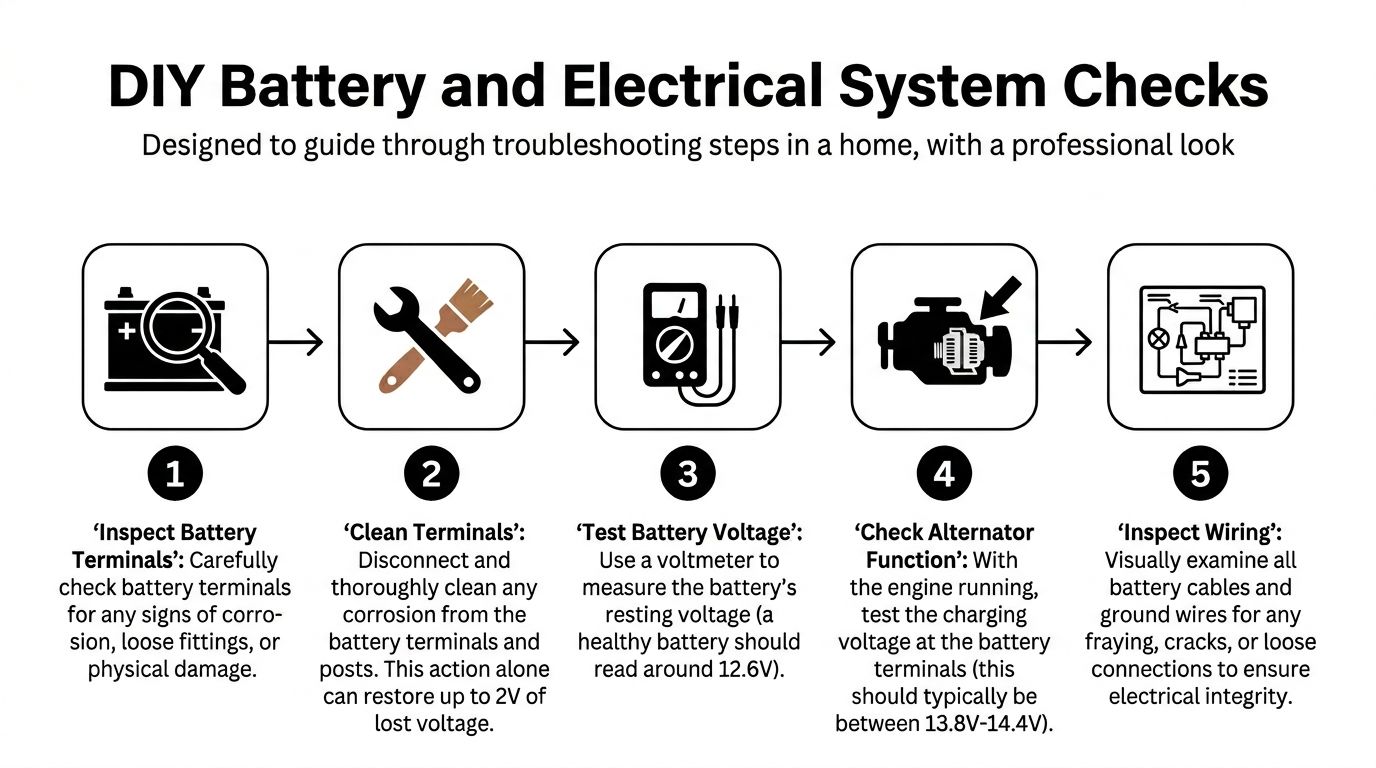
Persistent or repeat check engine lights caused by loose or corroded terminals show up often on older vehicles, and targeted fixes like cleaning and proper torque resolve 70 to 80% of those cases, according to this community-based discussion of check engine lights with battery terminal issues.
Start with a visual inspection
Open the hood and look closely before grabbing a meter.
Check for:
- White or bluish buildup: Corrosion around the posts or clamps.
- Loose terminal fit: A clamp that twists by hand is too loose.
- Damaged cables: Cracked insulation, frayed wire, or swollen cable ends.
- Ground problems: Loose or rusty grounding points where the cable meets the body or engine.
A connection can look “mostly fine” and still create micro-voltage drops. That’s enough to trigger intermittent lights.
If you want an additional hands-on reference for basic fixes, this guide on how to repair car battery problems offers a useful companion read.
Clean and tighten correctly
Disconnect the negative cable first. Then remove the positive cable. Clean corrosion from the posts and inside the terminal ends with the proper battery-cleaning tools or a terminal brush.
Reinstall the positive side first, then the negative. Tighten each connection securely. Don’t guess if the terminal design calls for a specific torque value. A clamp that’s slightly under-tightened can pass a casual glance but still fail under vibration.
If the check engine light keeps returning after you “fixed” the battery, recheck the connections before assuming the computer or a sensor is bad.
Measure battery voltage
A digital multimeter gives you the next clue.
Use these checks:
- Engine off reading: A healthy battery should be around 12.6V at rest.
- Cranking test: Watch voltage while someone starts the car. If it falls too far, the battery may be weak even if the car starts.
- Engine running reading: Charging voltage should move into the normal operating range rather than staying near resting voltage.
This is also a good time to inspect cable condition at the same moment you test. Voltage numbers only tell part of the story. A good battery connected through a bad cable can still behave like a weak system.
For recurring mystery drains, this overview of testing car battery drain helps explain what happens when the battery is healthy but loses charge while parked.
A short video can also help if you prefer watching the testing process before trying it yourself.
Check the alternator and possible drain issues
If the battery tests weak, don’t stop there. Ask why it became weak.
A few useful questions:
- Does the charging voltage stay in range with the engine running? If not, the alternator may not be replenishing the battery.
- Does the car need jump-starts after sitting? That suggests a parasitic drain.
- Did the issue begin after accessories were added? Aftermarket electronics can create hidden drains or connection problems.
Parasitic drain testing is more advanced, but the idea is simple. With the car off, something may still be pulling power when it shouldn’t. That can leave the battery weak enough to trigger false codes the next morning.
Know when to stop DIY work
DIY checks make sense when you can safely inspect, clean, and measure. They stop making sense when you’re chasing an intermittent fault across multiple systems.
Get help if:
- The battery tests fine but the light returns.
- The alternator output seems inconsistent.
- Multiple communication codes appear.
- The vehicle has repeat no-start episodes.
- You suspect a hidden drain but don’t have the right meter setup.
That’s usually the point where freeze-frame scan data and circuit testing matter more than another guess.
Professional Diagnostics and Repair Options
Sometimes the home checks answer the question quickly. Other times they only narrow the field.
The most common point of confusion comes after battery replacement. Many drivers expect the warning light to disappear immediately, but replacing a bad battery clears the check engine light automatically in only 40 to 60% of low-voltage cases. The remaining 40% need a manual OBD-II reset or further alternator and ground checks, and 30% of unresolved lights are tied to parasitic drains, according to Ervine’s explanation of battery replacement and persistent check engine lights.
What a shop can confirm that a basic DIY test can’t
A professional diagnosis usually focuses on four questions.
- Was the battery failing?** Load testing gives a better answer than voltage alone.
- Is the alternator charging consistently? A charging system can test fine one moment and weak under load the next.
- Did the ECU store low-voltage history? A scan tool can identify whether the light remains because of memory, not because the fault is still active.
- Is there a drain while the vehicle is parked? This often takes time and methodical circuit isolation.
Comparing the likely repair paths
| Service path | Best when | What it helps determine |
|---|---|---|
| Battery test and replacement | The battery is old, weak, or fails load testing | Whether the battery can still provide stable starting and system voltage |
| Alternator and charging test | The battery keeps going low or the warning returns after charging | Whether the charging system is replenishing the battery correctly |
| Code scan and reset | The battery issue is fixed but the warning remains | Whether stored low-voltage codes need to be cleared and rechecked |
| Parasitic drain diagnosis | The battery goes dead after sitting or repeat no-starts occur | Whether a module, accessory, or circuit is drawing power with the car off |
Why freeze-frame data matters
This is one of the most useful tools in a stubborn check engine light battery case.
Freeze-frame data captures what the vehicle was doing when the code set. That can show whether the code appeared during startup, idle, low speed driving, or another condition. When a code sets during cranking, that often points the technician back toward voltage drop instead of a failed emissions component.
That’s how a shop separates cause from effect.
When professional service saves money
The biggest financial mistake in electrical diagnosis is replacing parts in a chain.
It often goes like this:
- Replace the battery because the car started slowly.
- The light stays on.
- Replace a sensor named by the code.
- The problem returns because the actual issue was poor charging or a drain.
A shop with proper scan tools and charging-system equipment can check these systems in sequence instead of by guesswork. One option in Dallas is Kwik Kar Oil Change and Auto Care, which offers battery testing, charging-system checks, and diagnostic scanning for warning light issues.
If the battery is new but the light remains, don’t assume the new part is defective. The vehicle may still be holding old low-voltage codes, or the battery may have been damaged by another fault upstream.
Signs you shouldn’t delay
Professional help moves from “nice to have” to “do this now” when the vehicle shows a pattern that can strand you or damage other components.
Don’t wait if you notice:
- Repeated jump-starts
- Battery replacement followed by another low-voltage event
- Stalling or near-stalling with warning lights
- Burning smell or hot battery cable
- Intermittent no-start conditions that come and go
These point to a problem that is no longer just inconvenient. It’s affecting reliability and possibly the charging system itself.
Conclusion and Next Steps
A check engine light battery problem usually isn’t random. The car is telling you the electrical system lost stability, even if the warning code looks like something deeper inside the engine.
Start with the basics. Inspect the terminals. Check for corrosion. Measure battery voltage. Pay attention to slow cranking, dim lights, and repeat warnings after jump-starts or short-trip driving. If the light returns after a cleaning or battery swap, broaden the diagnosis to the alternator, grounds, and possible parasitic drain.
What matters most is timing. Electrical issues rarely get simpler when ignored. They usually become harder to trace because one weak connection can create a trail of false clues.
If you’re in Dallas and need a firm answer instead of another guess, a professional battery and charging-system inspection is the fastest way to sort out whether you’re dealing with a battery problem, a cable problem, or a deeper electrical fault.
If your dashboard warning won’t go away, schedule a diagnostic visit with Kwik Kar Oil Change and Auto Care. A proper check engine light battery inspection can identify whether the issue is the battery, charging system, terminal corrosion, or a hidden drain so you can get back on the road with fewer surprises.