



The labor rate in auto repair is the hourly charge a shop bills you for service work, covering far more than a mechanic’s paycheck. It includes shop rent, diagnostic equipment, insurance, technician training, and profit margin. As of 2026, national average rates range from $120 to $159 per hour, with independent shops typically charging $80 to $130 per hour and dealerships running $120 to $180 or more. Understanding this distinction matters because the number on your estimate reflects the full cost of running a professional repair operation, not just the time a technician spends under your hood. Shops use two primary billing methods: flat-rate and hourly. Knowing which one applies to your repair changes how you read and compare estimates.
What does labor rate mean in auto repair, and what does it cover?
The labor rate is the industry term for the per-hour billing charge a shop applies to every service job. It is not the same as the mechanic’s hourly wage. The gap between those two numbers is significant and intentional.
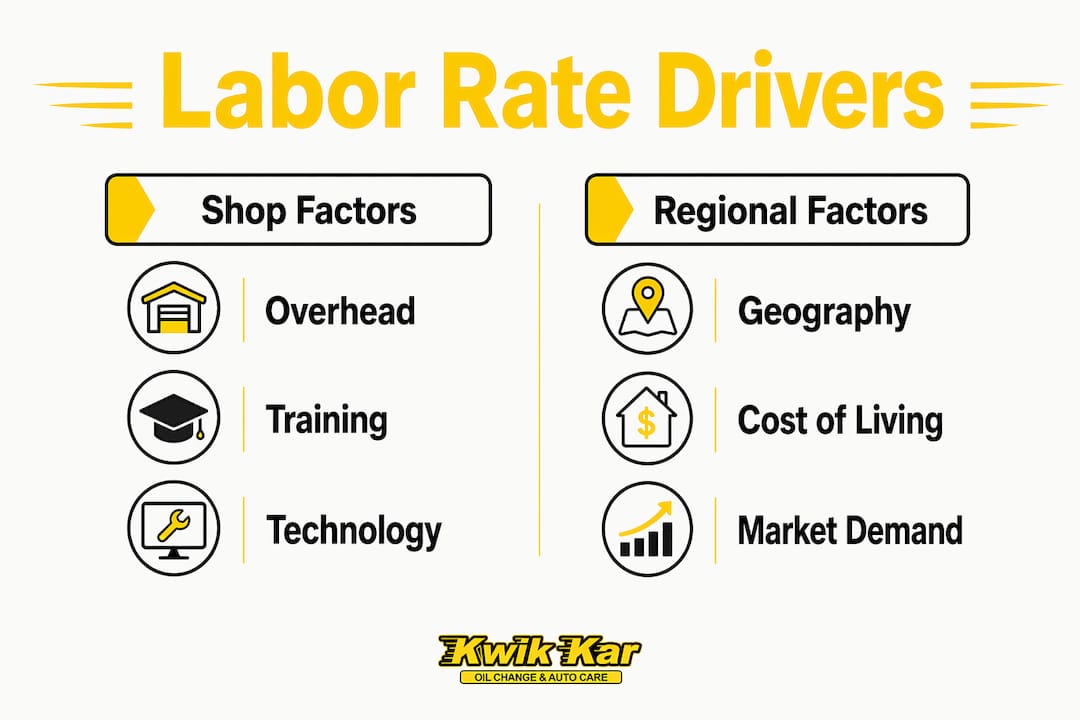
When a shop sets its labor rate, it accounts for every cost required to keep the doors open and the work quality high:
- Technician wages and benefits (the largest single component)
- Shop rent or mortgage payments
- Diagnostic equipment and specialty tools
- Liability insurance and workers’ compensation
- Ongoing ASE certification training
- Warranty risk on completed repairs
- Utilities, software subscriptions, and administrative costs
Labor rate covers overhead well beyond the technician’s wage, including rent, diagnostic equipment, insurance, and training. This means a shop charging $130 per hour is not pocketing $130 per hour. A significant portion of that rate goes directly to keeping the facility equipped, compliant, and staffed with qualified people.
Pro Tip: Ask your service advisor to confirm the shop’s posted labor rate before authorizing any work. Reputable shops display this rate openly, and knowing it upfront lets you verify the math on your final invoice.

Why do labor rates vary so much between shops and regions?
Labor rate variation across shops is not random. Three factors drive most of the difference: geography, shop type, and vehicle complexity.
Geography and cost of living
Regional cost of living directly shapes what shops must charge to cover their own operating expenses. A shop in California or New York pays higher rent, higher wages, and higher insurance premiums than a comparable shop in Mississippi or Maine. Those costs flow directly into the labor rate you see on your estimate.
Shop type and specialization
The table below shows how shop type typically affects the rate you pay:
| Shop type | Typical labor rate | What drives the difference |
|---|---|---|
| Independent shop | $80–$130/hr | Lower overhead, broader vehicle range |
| Dealership | $120–$180+/hr | Factory training, OEM tools, brand-specific software |
| Specialty shop (EV, European) | $130–$200+/hr | Advanced certifications, proprietary scan tools |
Dealerships invest in factory-grade scan tools and manufacturer-specific training that independent shops may not carry. That investment justifies a higher rate, particularly for complex or warranty-covered repairs.
Vehicle technology and required training
Modern vehicle complexity requires shops to invest in factory-grade scan tools, specialized software, and training on hybrid and EV systems. A shop equipped to diagnose a Ford F-150 Hybrid or a Tesla Model 3 has spent considerably more on tools and training than one servicing older, simpler vehicles. That investment is reflected in the rate.
Pro Tip: A higher labor rate at a well-equipped shop can actually lower your total repair bill. Better diagnostics mean fewer misdiagnosed repairs and fewer return visits. When comparing quotes, factor in the shop’s equipment and certifications, not just the hourly number.
Flat-rate vs. hourly billing: how do they affect your repair costs?
Auto repair shops use two billing methods, and the one your shop uses changes how your labor cost is calculated. Understanding both protects you from surprises on your invoice.
How flat-rate billing works
Flat-rate billing assigns a standard repair time from a manufacturer labor guide, such as the Mitchell or AllData database, regardless of how long the job actually takes. Flat-rate labor guides assign standard repair times regardless of actual time spent, incentivizing efficiency but sometimes confusing customers who expect time-based billing.
For example, if a brake job is listed as 2.0 hours in the flat-rate guide, you pay for 2.0 hours whether the technician finishes in 90 minutes or takes 2.5 hours. The rate is fixed to the job, not the clock.
How hourly billing works
Hourly billing charges you for the actual time the technician spends on your vehicle, tracked by the shop’s management system. This method is more transparent in theory, but it can work against you if a technician is slower or if unexpected complications arise mid-repair.
Here is a quick comparison of both methods:
| Factor | Flat-rate billing | Hourly billing |
|---|---|---|
| Basis for charge | Book time from labor guide | Actual shop time |
| Customer cost certainty | High (predictable) | Variable |
| Technician incentive | Finish faster, earn more | Less urgency |
| Best for customer when | Technician is experienced | Job is unusual or complex |
Shops use flat-rate pricing to standardize customer charges, creating pricing certainty but potential variance in technician incentives. Most shops in the U.S. use flat-rate billing as the default, which is why your estimate often shows a fixed labor charge rather than an open-ended time estimate.
How to read and compare labor rates on a repair estimate
A repair estimate contains more information than most car owners realize. Reading it correctly helps you compare quotes accurately and avoid overpaying.
Follow these steps when you receive any written estimate:
- Locate the posted labor rate. This is the per-hour charge listed at the top or bottom of the estimate. Confirm it matches what the shop advertises.
- Check the billed labor hours. This number, multiplied by the labor rate, equals your total labor cost. Labor cost equals the shop’s hourly rate multiplied by billed hours, which may come from a flat-rate guide rather than actual time.
- Separate parts costs from labor costs. Estimates should itemize these clearly. A shop with a lower labor rate but inflated parts markups can cost more overall.
- Ask about shop fees and miscellaneous charges. Some shops add environmental disposal fees, shop supply charges, or diagnostic fees on top of the stated labor rate.
- Compare total repair cost, not just the hourly rate. A shop charging $150 per hour but billing 1.5 hours costs less than one charging $100 per hour but billing 2.5 hours for the same job.
The relationship between labor rate and billed hours is what determines your actual cost. A shop with a higher rate but fewer billed hours can be cheaper overall than one with a lower rate and longer billed time. This is the most common misunderstanding car owners have when comparing repair quotes, and it costs real money when overlooked.
You can learn more about the full picture of repair estimate differences across shops to sharpen your comparison skills. For a broader look at what shapes your bill, the guide on car repair cost factors covers the topic in detail.
Pro Tip: When getting multiple quotes, ask each shop to specify whether they use flat-rate or hourly billing and which labor guide they reference. This single question reveals whether you are comparing apples to apples.
Key takeaways
The labor rate in auto repair is a composite charge that reflects wages, overhead, equipment, and expertise. Comparing shops on hourly rate alone without checking billed hours and billing method leads to poor decisions and unexpected costs.
| Point | Details |
|---|---|
| Labor rate is not mechanic pay | The rate covers rent, tools, insurance, training, and profit beyond the technician’s wage. |
| National rates range widely | Independent shops charge $80–$130/hr; dealerships charge $120–$180+/hr as of 2026. |
| Flat-rate billing is the standard | Most shops bill from a labor guide, so your charge is based on book time, not actual time. |
| Higher rates can mean lower total cost | Better-equipped shops diagnose accurately the first time, reducing repeat visits and total spend. |
| Compare total cost, not just the rate | Multiply rate by billed hours and add parts and fees to get a true quote comparison. |
Our take on labor rates and what they really tell you
At Kwik Kar Oil Change & Auto Care, we have seen the confusion that labor rates create for car owners, and we think most of it comes from one simple gap: shops do not explain what the rate actually includes. A customer sees $140 per hour and assumes the mechanic is pocketing that entire amount. That assumption leads to frustration, distrust, and sometimes a decision to choose a cheaper shop that ends up costing more in the long run.
Here is what we have learned from years of servicing both domestic and import vehicles: the labor rate is one of the most honest numbers on your estimate when you understand what it represents. Higher labor rates at shops equipped for modern and hybrid vehicles often result in fewer return visits, reducing long-term costs despite the higher hourly figure. We have seen this play out repeatedly. A customer saves $30 per hour at a shop without the right scan tools, gets a misdiagnosis, and ends up spending twice as much to fix the original problem correctly.
The shops that post their labor rate clearly, explain their billing method upfront, and provide itemized estimates are the ones worth trusting. Transparency is not a marketing tactic. It is a sign that the shop is confident in the value it delivers. When you walk into any repair facility, including ours, you should feel comfortable asking exactly what the labor rate covers and how billed hours are determined. If a shop hesitates to answer those questions, that tells you something important.
— Kwik Kar
Experience transparent labor pricing at Kwik Kar Spring Valley
Kwik Kar Oil Change & Auto Care takes the guesswork out of auto repair labor costs. Our ASE Certified Master technicians provide written estimates before any work begins, with the labor rate, billed hours, and parts costs clearly itemized so you know exactly what you are paying for and why. We are proud to hold RepairPal and ASE certifications that reflect our commitment to fair pricing and quality service on both domestic and import vehicles. Whether you need routine maintenance or a complex diagnostic repair, you can trust that our labor rate reflects real expertise and real investment in the tools required to get your vehicle right the first time. Explore our full auto repair services and schedule your visit today.
FAQ
What does labor rate mean in auto repair?
The labor rate is the hourly charge a repair shop bills for service work, covering technician wages, shop overhead, equipment, insurance, and profit. It is distinct from the mechanic’s actual hourly pay.
What is the average labor rate at an auto repair shop?
National average rates range from $120 to $159 per hour as of 2026, with independent shops typically charging $80 to $130 per hour and dealerships charging $120 to $180 or more.
Is auto repair labor billed by the hour or by the job?
Most shops use flat-rate billing, which charges a fixed time from a manufacturer labor guide rather than actual time spent. Some shops use hourly billing, which tracks real shop time on your vehicle.
Why is the labor rate at a dealership higher than at an independent shop?
Dealerships invest in factory-specific scan tools, OEM software, and manufacturer-required training, all of which raise operating costs and justify a higher rate. Independent shops carry lower overhead, which typically translates to a lower posted rate.
How do I find an ASE-certified mechanic to get fair labor pricing?
Look for shops that display ASE certification credentials and are listed on platforms like RepairPal. You can also use resources like this guide to finding certified mechanics to locate qualified technicians in your area.