



Your car’s exact oil quantity is set by the manufacturer — check your owner’s manual first. For a quick estimate while you locate it, most passenger vehicles need around 4–6 quarts of motor oil, though engine size and design push that number up or down. Never treat a generic range as a final answer.
- 4-cylinder engines: typically a moderate amount of oil
- V6 engines: typically require somewhat more oil
- V8 and larger truck/SUV engines: often require significantly more oil
- Turbocharged or performance engines: typically need more oil than their naturally aspirated counterparts
Before you pour a single drop, pull the dipstick and confirm the manual’s service capacity. That two-minute check prevents the two most common and costly mistakes: underfilling and overfilling.
Key Takeaways
The manufacturer’s service capacity, verified on the dipstick after a brief engine run, is the only reliable way to know you’ve added the right amount of oil.
| Point | Details |
|---|---|
| Always check the owner’s manual | Look under Specifications, Capacities, or Lubrication System for the exact “with filter” figure. |
| Typical range is 4–6 quarts | Most passenger cars fall in this range; trucks and V8s often need 6–8 quarts or more. |
| Filter adds 0.2–0.5 quarts | The “with filter” manual figure includes this volume; account for it on a full service. |
| Add conservatively, then verify | Pour 80–90% first, run the engine 30–60 seconds, wait 2–3 minutes, then recheck the dipstick. |
| Kwik Kar Oil Change & Auto Care | ASE-certified technicians confirm your exact capacity, fill to spec, and verify level before you leave. |
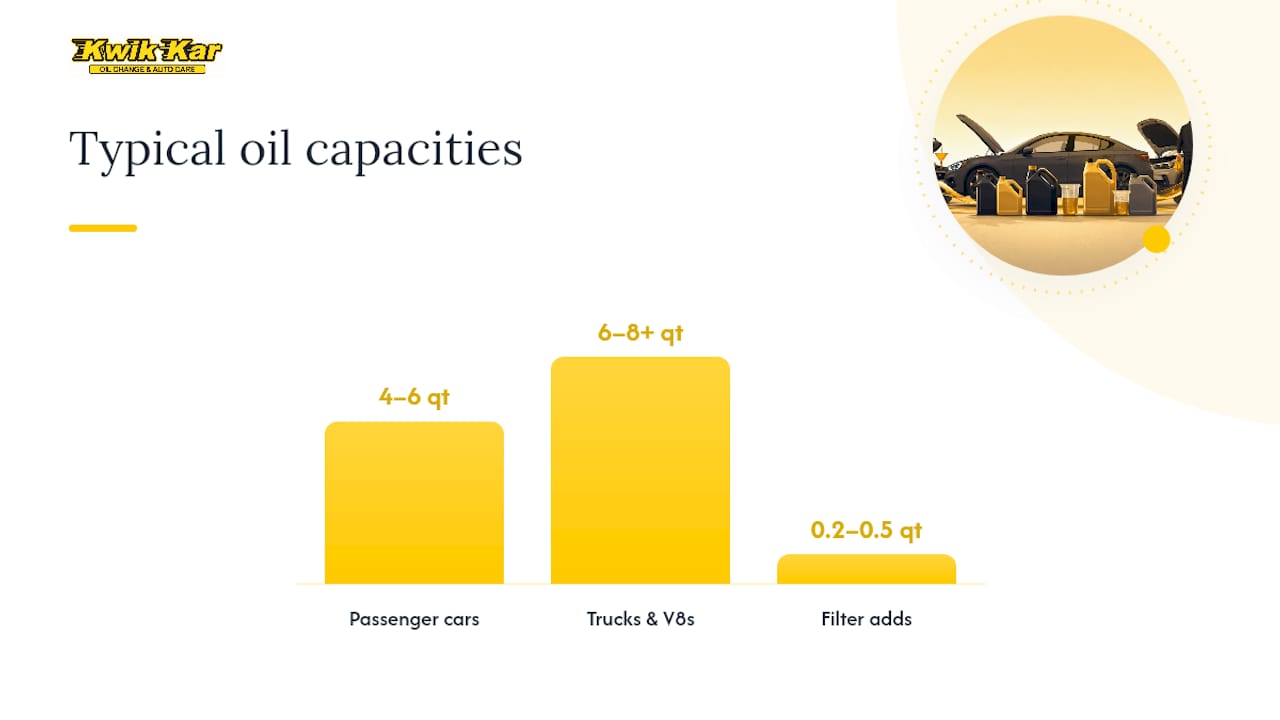
Table of Contents
- How do you find your car’s exact oil capacity?
- Quick capacity estimates when you can’t access the manual
- Does the oil filter change how much oil you need?
- Step-by-step: how to add oil and check the level safely
- What happens if you underfill or overfill, and how to fix it
- How professionals avoid measurement errors
- When to DIY and when to call a professional
- Precise oil changes at Kwik Kar Oil Change & Auto Care
- Sources
- FAQ
How do you find your car’s exact oil capacity?
The fastest, most reliable source is your owner’s manual. Look under Specifications, Capacities, or Lubrication System — those three sections cover virtually every vehicle. Castrol recommends using the manual or an official oil-finder tool rather than relying on generic estimates, and that advice holds whether you drive a compact sedan or a full-size pickup.
If the physical manual is missing, you have solid alternatives:
- Manufacturer digital manuals: Most automakers publish free PDFs by VIN or year/make/model on their official websites.
- VIN lookup tools: The VIN decodes your exact engine configuration, which matters because two cars wearing the same model badge can carry different oil capacities depending on which engine is under the hood.
- AMSOIL’s Auto & Light Truck Lookup: The AMSOIL oil capacity and viscosity lookup returns both capacity and recommended viscosity for your specific year, make, model, and engine.
- Oil-cap labeling: Some vehicles print the recommended viscosity grade on the oil-fill cap, though this rarely states total capacity.
Pay attention to how the manual phrases the number. “With filter” means the figure already accounts for the oil the new filter holds. “Without filter” is the pan-only volume. “Dry fill” applies only to a completely drained, disassembled engine — not a standard oil change. For a routine service, always use the “with filter” figure.
Pro Tip: If your model year offered two or more engine options (common on trucks and crossovers), use the VIN rather than the trim name to confirm which engine you actually have. The 2.5L and 3.5L versions of the same nameplate often differ by a full quart.
Quick capacity estimates when you can’t access the manual
These ranges give you a safe starting point, but treat them as estimates only — not a substitute for the manufacturer’s specification.
- 4-cylinder (1.4L–2.5L): 4–5 quarts (3.8–4.7 liters)
- V6 (2.5L–3.8L): 5–6 quarts (4.7–5.7 liters)
- V8 (4.6L–6.2L): 6–8 quarts (5.7–7.6 liters)
- Large trucks, diesel engines, and SUVs: 8 quarts or more (7.6+ liters)
- Turbocharged and performance engines: add 0.5–1 quart above the naturally aspirated equivalent for the same displacement
Unit conversion: 1 quart = 0.946 liters. If your manual lists capacity in liters, divide by 0.946 to convert to quarts. Always match the unit your manual uses when measuring your pour.
Does the oil filter change how much oil you need?
Yes, and overlooking this is one of the most common reasons a fresh oil change reads slightly low on the dipstick. Oil filters typically hold an additional 0.2–0.5 quarts of oil, and your manual’s “with filter” capacity already includes that volume. When you install a new, dry filter during a full service, the filter draws oil from the pan as soon as the engine starts — which is exactly why you recheck the dipstick after a brief run.
- Full oil change with new filter: use the “with filter” capacity from the manual; this already includes the filter volume.
- Top-off only (no filter replacement): the filter is already saturated, so just bring the level up to the full mark on the dipstick.
- Dry fill after engine work: use the “dry fill” figure if available; it is higher than the service refill figure.
Pro Tip: When doing a full service, add most of the capacity first, then run the engine briefly to fill the filter, wait, and recheck before topping off to avoid a false reading.
Step-by-step: how to add oil and check the level safely
Follow this procedure every time, whether you’re doing a full change or a simple top-off.
- Park on level ground. An uneven surface tilts the oil pan and gives a misleading dipstick reading.
- Let the engine cool. For the most accurate reading, check oil when the engine is cold or after it has sat for at least 10 minutes. Your manual may specify “hot” or “cold” — follow it. Our guide on checking oil hot or cold explains how temperature affects the reading.
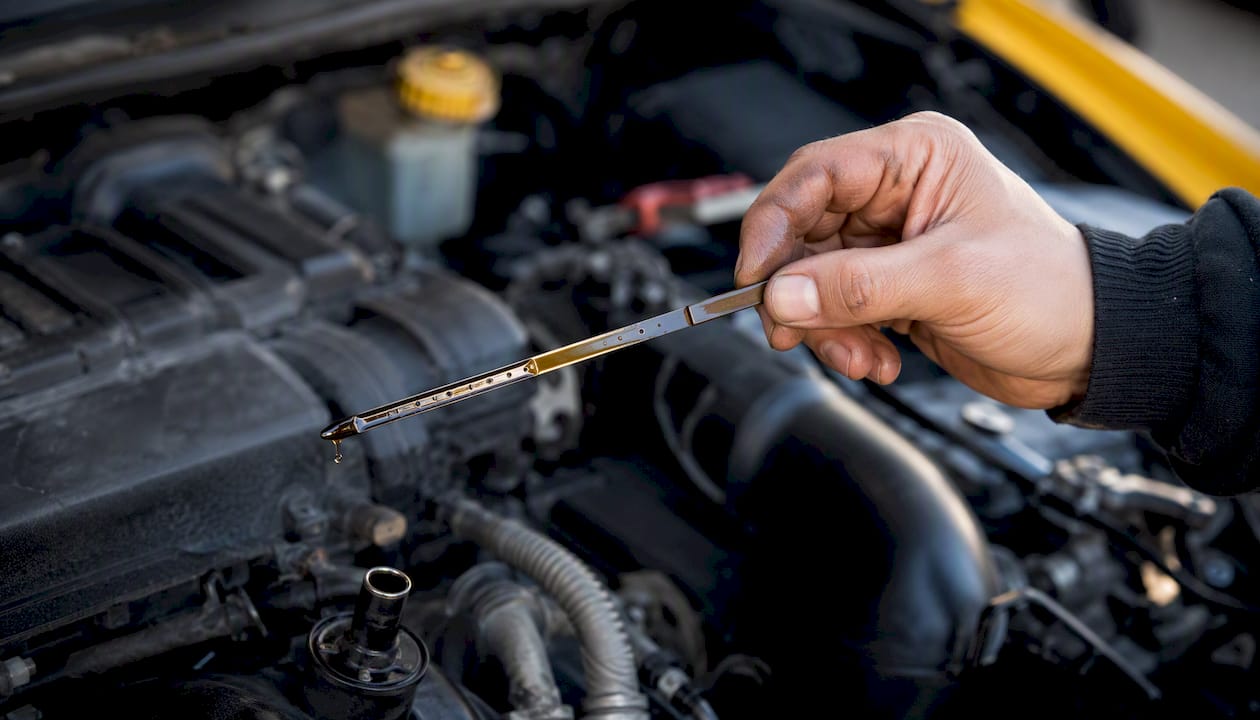
- Pull and wipe the dipstick. Reinsert it fully, then pull it again for a clean reading. The oil level should fall between the MIN and MAX marks.
- Pour conservatively. Add 80–90% of the required capacity (or 0.5-quart increments for a top-off), then stop.
- Wait 2–3 minutes after pouring to let oil drain from upper engine components back into the pan.
- Recheck the dipstick. If the level is still below the MAX mark, add another 0.25–0.5 quart and wait again.
- For a full service with a new filter: start the engine and let it run for 30–60 seconds to circulate oil into the filter. Shut it off, wait 2–3 minutes, then do a final dipstick check.
- Replace the dipstick and oil-fill cap securely before closing the hood.
For a detailed walkthrough of the engine oil level check procedure, including what color and consistency to look for, that guide covers it step by step.
What happens if you underfill or overfill, and how to fix it
Getting the volume wrong in either direction causes real mechanical damage — and the fixes differ.
Underfilling risks:
- Increased friction and heat, accelerating wear on bearings and cylinder walls
- Potential engine seizure if the level drops critically low
- Oil pressure warning light activation (do not ignore this)
Overfilling risks:
- Oil aeration: the crankshaft whips air into the oil, turning it foamy and reducing its ability to lubricate
- Excess pressure that blows out seals and gaskets
- Catalytic converter damage from oil pushed past seals into the exhaust system
Overfilling by about half a quart or more should be corrected promptly to avoid long-term harm. Here’s what to do:
- Overfill by less than 0.5 quart: monitor the level and correct at the next oil change if no symptoms appear.
- Overfill by 0.5 quart or more: drain or siphon the excess before driving. A hand-pump oil extractor inserted through the dipstick tube works for small amounts.
- Underfill: add oil in 0.5-quart increments, checking the dipstick between each addition, until the level reaches the MAX mark.
- If you’re unsure of the amount or notice smoke, unusual noise, or a warning light: stop driving and have the vehicle inspected.
How professionals avoid measurement errors
Two mistakes show up repeatedly in shop environments. First, bulk oil dispensers make it easy to overshoot the target volume because the pump delivers oil faster than a quart bottle. Second, checking the dipstick immediately after filling gives a false high reading because oil hasn’t had time to drain back into the pan.
Standard shop protocols that prevent both errors:
- Use quart containers for the final 1–2 quarts of any fill to control volume precisely
- Wait a minimum of 2–3 minutes after the final pour before reading the dipstick
- Run the engine 30–60 seconds after a filter change, then wait again before the final check
- Cross-reference the dipstick reading with the recorded service capacity — if the numbers don’t align, investigate before closing the hood
A vehicle service maintenance checklist used by professional shops formalizes these steps so nothing gets skipped under time pressure.
Pro Tip: If you’re ever unsure whether you’ve overfilled or underfilled, an ASE-certified technician can verify the level and correct it quickly — often faster than sourcing a hand pump and doing it yourself.
When to DIY and when to call a professional
A straightforward top-off or full oil change is well within reach for most vehicle owners: you have the manual, the right oil, and basic tools. DIY makes sense when the capacity is confirmed, the engine is a standard naturally aspirated unit, and you’re comfortable with the dipstick procedure above.
Book a professional service when:
- You can’t locate the capacity spec and the engine has multiple configuration options
- You’ve already overfilled by 0.5 quart or more and need the excess removed cleanly
- The vehicle is turbocharged, diesel, or has a performance engine with higher-than-average oil demands
- A warning light appeared after the last fill
Kwik Kar Oil Change & Auto Care’s ASE-certified technicians use calibrated equipment and follow standardized fill-and-verify protocols on every service. For high-mileage vehicles, the choice of oil grade matters as much as the quantity — see the guide on best oil for high-mileage cars for viscosity recommendations by mileage range.
Precise oil changes at Kwik Kar Oil Change & Auto Care
Knowing the right oil quantity is one thing. Having it measured, filled, and verified by a certified technician is another level of confidence entirely. Kwik Kar Oil Change & Auto Care offers fast, precise oil changes performed by ASE-certified professionals who confirm your vehicle’s exact service capacity, use the correct grade, and do a post-fill dipstick check before handing back your keys. Pricing is transparent, with estimates provided upfront.

Right now, Kwik Kar is offering $20 off an oil change — a straightforward way to get a precision fill without the guesswork. Book your service appointment online or stop by the Spring Valley location. Every oil change comes backed by Kwik Kar’s workmanship guarantee and RepairPal certification.
Sources
These are the most reliable places to confirm your vehicle’s oil capacity and viscosity before you start:
- How much oil does my car need: Quick DIY Guide | Castrol® USA
- What Happens When You Overfill Your Car With Oil?
- Auto & Light Truck Lookup Guide: Oil Capacity & Viscosity
- How Much Oil Does My Car Need? Find the Exact Capacity
- Truth About Oil Capacity for My Car: A Friendly Guide
- How Much Oil Does My Car Need? – AutoZone
FAQ
Is 2 quarts of oil enough for a car?
No. Most passenger vehicles require 4–6 quarts for a full service, so 2 quarts alone is not sufficient. Use it only to top off a level that reads slightly low on the dipstick.
How do I know how much oil to put in my car?
Check your owner’s manual under Specifications or Capacities for the “with filter” service refill amount. If the manual isn’t available, use a VIN-based lookup tool like the AMSOIL Auto & Light Truck Lookup to confirm the exact figure.
Can I drive straight after adding oil?
Yes, briefly — but check the dipstick first. Start the engine for 30–60 seconds to circulate oil into the filter, shut it off, wait 2–3 minutes, then verify the level is between MIN and MAX before driving normally.
Is it better to overfill or underfill oil?
Neither is safe, but overfilling by 0.5 quart or more causes oil aeration, seal damage, and potential catalytic converter harm. Correct an overfill promptly by draining or siphoning the excess before driving.