
No, emissions testing is not free in most of the country, but it’s not universally expensive either. Ohio and Wisconsin run state-funded programs that don’t charge drivers a dime, and Delaware offers free testing at its DMV-operated facilities. Everywhere else, expect to pay a fee set by either the state’s emissions agency or a market-priced private station. Your best move is checking your own state DMV or environmental agency page before you assume either extreme applies to you.
Quick fact: About 28 states plus Washington, D.C. require some form of emissions testing, while 22 states have no statewide testing mandate at all. Where you live decides almost everything about whether you’ll pay, and how much.
Key Takeaways
Emissions testing is free only in a handful of state-funded programs; most drivers pay between $15 and $50, with market-priced states like California running higher.
| Point | Details |
|---|---|
| Free testing is the exception | Ohio, Wisconsin, and Delaware run free or state-funded programs; most states charge a fee. |
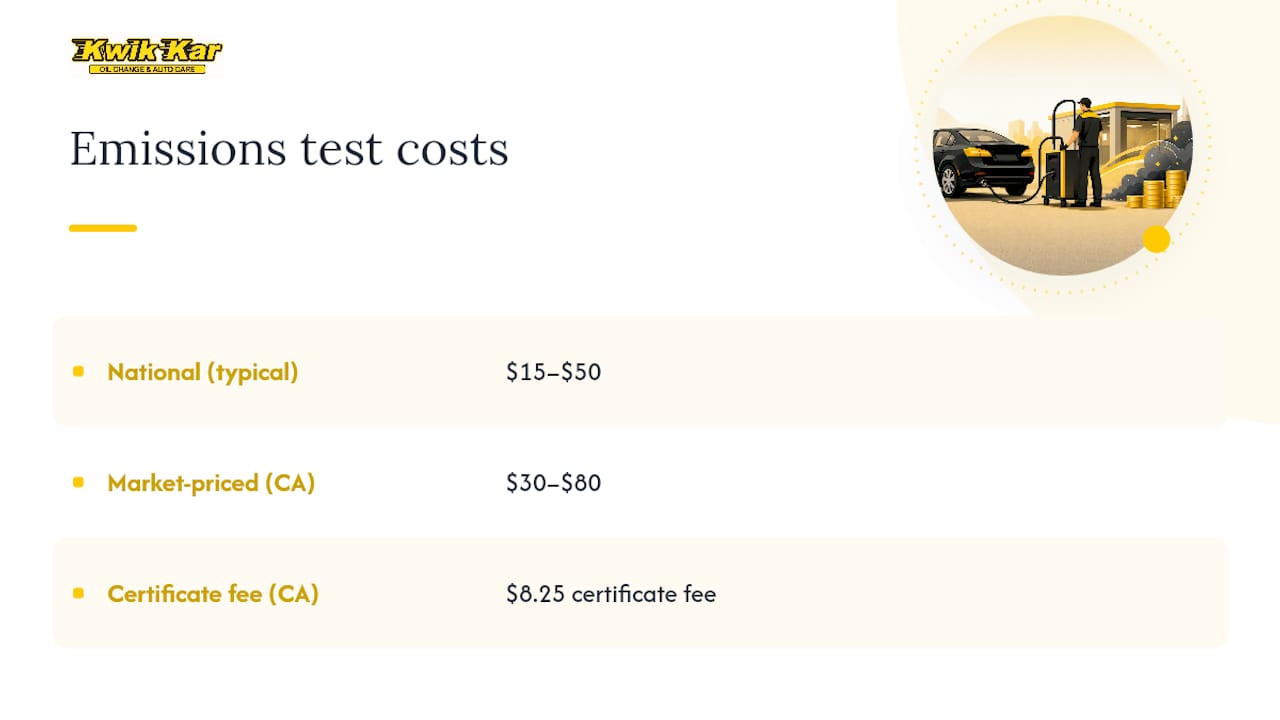
| Typical fees range $15 to $50 | California’s market-priced Smog Check can run $30 to $80 plus an $8.25 certificate fee. |
| Free retests often available | Many programs allow one free retest within 30 to 60 days after a failed test. |
| Testing fees don’t cover repairs | Budget separately for any fixes needed if your vehicle fails. |
| Pre-test diagnostics reduce risk | Kwik Kar Oil Change & Auto Care offers ASE-certified diagnostic checks before you head to your official test. |
Table of Contents
- Do I Need an Emissions Test in the First Place?
- How Much Does Emissions Testing Cost?
- Are There Free Emissions Testing Programs?
- What Should I Bring to My Emissions Test?
- What Happens If My Vehicle Fails the Emissions Test?
- How Does the Actual Testing Process Work?
- Expert Tips to Pass Your Emissions Test the First Time
- Get Your Vehicle Test-Ready Before You Pay a Testing Fee
- Sources
- FAQ
Do I Need an Emissions Test in the First Place?
Before worrying about cost, figure out whether you’re even required to test. States that mandate emissions testing typically trigger it based on three factors:
- Where you’re registered. Testing requirements often apply only to specific counties or metro areas with air quality concerns, not the whole state.
- Your vehicle’s model year. Many programs exempt brand-new vehicles (often the first few model years) and very old vehicles, focusing instead on the middle-age fleet.
- Registration events. Buying a used car, moving from out of state, or renewing your registration can all trigger a required test even outside the normal cycle.
Most programs run on a biennial schedule, meaning you test every two years alongside registration renewal. Some states also run change-of-ownership testing or directed testing tied to suspected tampering, and California law specifically authorizes these out-of-cycle checks when a vehicle is flagged by remote sensing equipment.
Pro Tip: Your registration renewal notice usually spells out whether a test is due and where nearby testing locations are. Don’t guess. Read the notice or check your state DMV’s account portal first.
How Much Does Emissions Testing Cost?
Where testing isn’t free, fees generally land between $15 and $50, though the number swings hard depending on how your state structures its program. Some states set a flat, regulated fee. Others let private stations set their own prices, which turns testing into more of a marketplace than a fixed cost.
A few examples show just how wide that range gets:
- California runs a market-priced Smog Check system, with prices typically reported between $30 and $80, plus an $8.25 certificate fee once you pass.
- Rhode Island charges a flat fee that reportedly covers a two-year testing cycle rather than charging per visit.
- Ohio and Wisconsin don’t charge a fee at all, since the state funds and operates the testing stations directly.
- Maryland and Colorado have both adjusted their emissions fees recently, which is a good reminder that fees aren’t locked in forever.
Test type matters too. OBD-only checks at a kiosk tend to run cheaper than full tailpipe or opacity testing at a staffed station, since the equipment and labor involved differ. If you’re in Texas, the Texas emissions test process and its fee structure follow their own set of rules worth reviewing directly.
Are There Free Emissions Testing Programs?
Yes, and they’re more common than most drivers realize. Free testing usually comes from one of a few setups:
- State-funded stations where the government absorbs the operating cost instead of passing it to drivers.
- DMV-run combined inspections that fold emissions checks into a broader vehicle inspection at no extra charge.
- Self-service kiosks placed in grocery stores or shopping centers, funded by the state.
- Mobile or pop-up testing events held periodically in certain counties.
Ohio, Wisconsin, and Delaware are the clearest examples of states running these programs at scale, and the funding typically comes from state budgets rather than driver fees. Many programs, free or not, also grant one free retest within a set window (often 30 to 60 days) if your vehicle fails the first time. If you’re curious what other free vehicle inspection routes exist beyond emissions specifically, it’s worth a look before you assume you have to pay.
Pro Tip: Free testing availability is often limited to specific counties or facilities within a state, not the entire state. Confirm your exact location on the state agency’s website rather than assuming a neighboring county’s rules apply to you.
What Should I Bring to My Emissions Test?
Show up prepared and you’ll avoid the most common reasons tests get delayed or bounced back. Bring your registration renewal notice, a photo ID, and proof of insurance if your state requires it at the testing site. If this is a retest after a repair, bring any repair forms or paperwork from the failed attempt too.
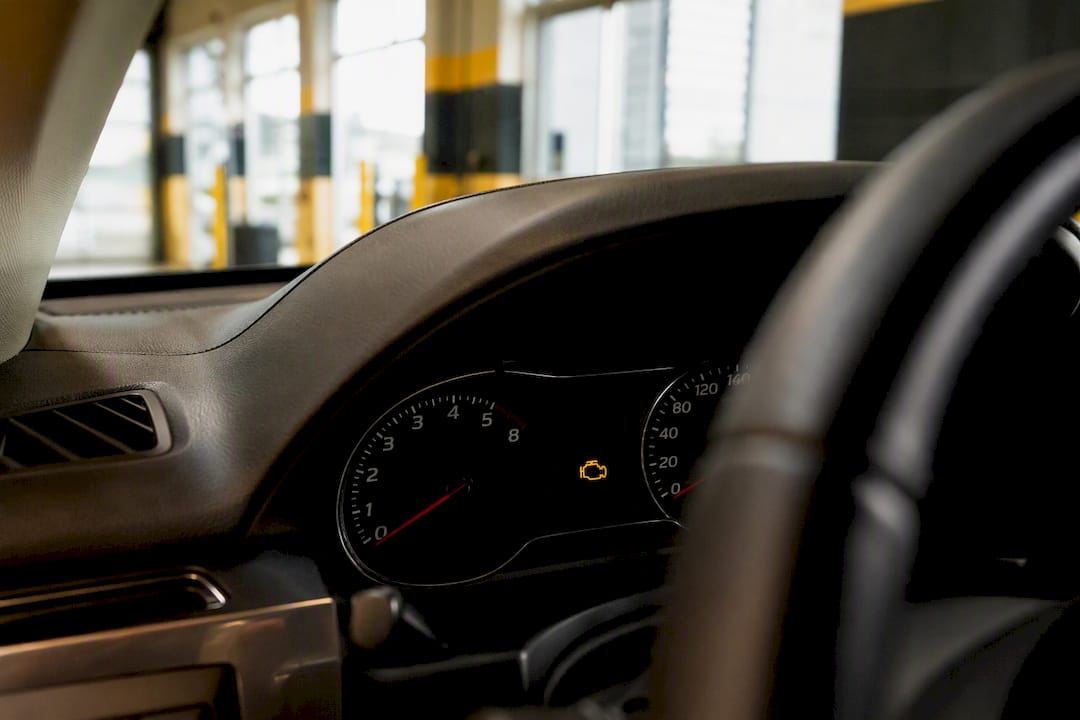
On the vehicle side, drive it for 10 to 15 minutes before arriving so the engine is properly warmed up, confirm your check engine light isn’t on, and make sure your gas cap is secured. Loose gas caps are a surprisingly common, entirely avoidable fail point.
Payment is typically due on-site at the testing station, either by card or cash depending on the facility, though some states fold the fee directly into your registration cost.
Pro Tip: If your check engine light was on recently, even if it’s off now, run a quick OBD scan at a local shop before your official test. A shop like Kwik Kar Oil Change & Auto Care can pull the codes and tell you whether it’s safe to test or worth fixing first.
What Happens If My Vehicle Fails the Emissions Test?
Failing isn’t the end of the road, but it does start a clock. Here’s the typical sequence:
- Diagnose the problem. A failed test report usually points to the system that triggered it, whether that’s a sensor, the catalytic converter, or an emissions leak.
- Get it repaired. Some states require documentation of the repair work, especially if you’re pursuing a waiver later.
- Retest within the free window. Many programs allow one free retest, commonly within 30 to 60 days, if you return to the same station.
- Pay for additional retests if you miss that window or need more than one recheck.
Some states offer waivers if you’ve spent above a certain repair threshold and the vehicle still fails, though the rules and dollar amounts vary by state. Miss your retest deadline entirely and you risk a registration hold. One thing that trips people up: the testing fee never covers the actual repair cost. If your vehicle fails, budget separately for the fix, and our guide on quick fixes for a failed emission test walks through the most common culprits.
How Does the Actual Testing Process Work?
Two main test types exist, and which one you get depends largely on your vehicle’s age and your state’s program.
| Test Type | How It Works | Typical Vehicles |
|---|---|---|
| OBD (onboard diagnostic) | Technician plugs into your vehicle’s computer to read stored emissions codes | Most vehicles |
| Tailpipe/opacity test | Direct sampling of exhaust output or smoke opacity | Older vehicles without OBD-II systems, or diesel trucks |
Who actually runs the test varies by state too. You might land at a state-run testing lane, a certified private station, a self-service kiosk, or occasionally a mobile testing event that rotates through counties. A failure in either test type usually traces back to something specific: a faulty oxygen sensor, a struggling catalytic converter, or a leak in the evaporative emissions system. None of that is exotic. It’s the same wear-and-tear stuff that shows up in a routine diagnostic scan.
Expert Tips to Pass Your Emissions Test the First Time
ASE-certified technicians consistently point to the same short list of pre-test checks: fresh spark plugs, a clean air filter, a secured gas cap, and a recent oil change. None of these are expensive fixes, but skipping them is how a lot of avoidable failures happen.
It also helps to understand why you’re paying at all. Emissions inspection programs exist to meet Clean Air Act standards, and the fees you pay typically go toward running the program itself, not generating profit for the state.
A short highway drive before testing lets your engine reach normal operating temperature, which matters more for OBD readiness monitors and tailpipe sampling accuracy than most drivers assume.
Pro Tip: Skip the cold-start test if you can help it. Driving 10 to 15 minutes beforehand often makes the difference between a pass and an unnecessary retest.
Helping Drivers Get Through Test Day Without Surprises
We spend a lot of our time helping customers avoid exactly the kind of last-minute scramble that turns a routine test into a wasted afternoon, whether that’s a quick diagnostic scan, a transparent repair estimate, or a free inspection bundled into certain service coupons. Our ASE-certified technicians are built for exactly this kind of pre-test prep, so if your check engine light has you nervous, that’s the first call to make.
Get Your Vehicle Test-Ready Before You Pay a Testing Fee
If your check engine light is on or you’re not sure your vehicle will pass, a diagnostic scan ahead of time is far cheaper than a failed test and a second trip. Kwik Kar Oil Change & Auto Care runs full engine diagnostics with ASE-certified technicians who can pull your codes, explain exactly what’s triggering the light, and give you a transparent estimate before any work starts. That’s a very different experience than showing up at a testing station and rolling the dice.
If your fluids, filters, or spark plugs are overdue, our $30 off maintenance service with a free inspection covers the exact pre-test items technicians recommend checking first. For drivers who prefer on-site diagnostics before heading to a testing lane, a mobile mechanic service is another option worth knowing about. Book a diagnostic appointment with Kwik Kar Oil Change & Auto Care through our full auto repair services page before your next test is due.
Sources
- Vehicle emissions inspection and maintenance (IM) general information | EPA
- What States Require Smog Checks? (2026)
- California Health & Safety Code Section 44011 | Leginfo
Always confirm exact pricing and procedure using your own registration renewal notice or your state DMV’s website.
FAQ
Do You Have to Pay for Emissions Tests?
In most states, yes, though the fee is usually modest, between $15 and $50. A few states, including Ohio and Wisconsin, run free state-funded testing programs instead.
How Much Does Emissions Testing Cost?
Costs typically range from $15 to $50 nationally, but market-priced states like California can run $30 to $80 plus an $8.25 certificate fee.
How Much Do Emissions Tests Cost in Texas?
Texas emissions testing fees vary by county and station type, so checking your specific Texas emissions test requirements directly is the most reliable way to confirm your local price.
What Do I Need to Bring to My Emissions Test?
Bring your registration renewal notice, a photo ID, and proof of insurance if your state requires it, along with any prior repair paperwork if you’re returning for a retest.
Can Kwik Kar Oil Change & Auto Care Help Me Prepare for a Test?
Yes. Kwik Kar Oil Change & Auto Care’s ASE-certified technicians offer engine diagnostics and pre-test checks to catch issues like check engine lights or worn spark plugs before you head to the testing station.