



A complete AC compressor replacement typically runs $800 to $1,500 at a professional shop, with RepairPal putting the national average between $1,038 and $1,383 for parts and labor combined. DIY replacement can be less expensive, potentially several hundred dollars for parts and supplies, but only if you have the right equipment and the failure is straightforward.
The spread exists for one main reason: not every compressor failure is the same job.
-
A simple leak repair costs far less than an internal failure that contaminates the whole system.
-
Parts alone range from about $100 to over $2,000 depending on your vehicle.
-
Labor, refrigerant type, and whether supporting parts need replacing all move the final number.
Your best next step is a professional diagnostic. It tells you which scenario you’re actually facing before you commit to a number.
Key Takeaways
A full AC compressor replacement costs $800 to $1,500 at a professional shop, and skipping the system flush after internal failure is the leading cause of repeat breakdowns.
| Point | Details |
|---|---|
| Professional cost range | Most complete replacements run $800 to $1,500, with a national average near $1,038 to $1,383. |
| DIY only for simple cases | DIY parts and recharge run roughly $350 to $650, but only fit accessible, non-contaminated failures. |
| Flush prevents repeat failure | Internal failures require a full system flush and new receiver/drier to avoid black death contamination. |
| Watch for masking symptoms | Grinding noises, burning smell, and rapid clutch cycling mean stop driving with the AC on and get a diagnostic. |
| Kwik Kar’s approach | Kwik Kar Oil Change & Auto Care uses ASE-certified technicians and transparent, itemized estimates before starting compressor repairs. |
Table of Contents
- Signs Your Car AC Compressor Is Failing
- How Much Does AC Compressor Replacement Cost?
- What Makes One Estimate Higher Than Another?
- Should You Replace the AC Compressor Yourself?
- What Happens During a Shop AC Compressor Replacement?
- Why a Quick Recharge Isn’t Always the Answer
- What the Cost Conversations Usually Miss
- How Kwik Kar Handles AC Compressor Replacement
- Sources
- FAQ
Signs Your Car AC Compressor Is Failing
Weak or warm airflow from the vents is the most common complaint, but it’s easy to confuse with a simple refrigerant leak. The difference matters: low refrigerant alone usually cools inconsistently and can often be fixed with a leak repair and recharge, while a failing compressor tends to produce mechanical symptoms on top of the weak cooling.
Watch for these signs:
- Grinding or rattling noises when the AC is running, especially at startup.
- A burning rubber smell, which often points to a seized compressor clutch or belt slipping under load.
- Oily residue around compressor fittings or hoses, since refrigerant oil leaks alongside the gas.
- A clutch that won’t engage at all, or cycles rapidly on and off, which stresses the drive belt and can damage the pulley.
AutoZone’s diagnostic guide lists these same symptoms as the clearest indicators that the compressor itself, not just the refrigerant charge, is the problem.
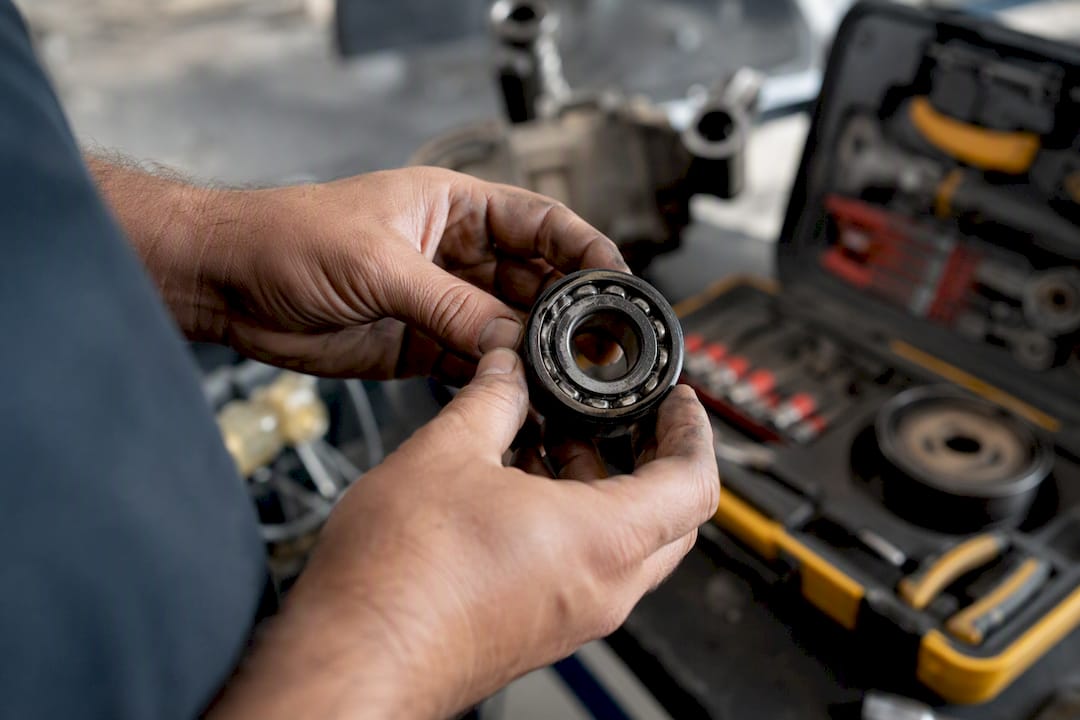
Pro Tip: If you hear a new noise only when the AC is on, don’t turn the AC off and ignore it. That noise is often the compressor bearing failing, and running it longer risks a full seizure that sends metal debris through your entire AC system.
How Much Does AC Compressor Replacement Cost?
Here’s the breakdown of what you’re actually paying for when a shop hands you an estimate.
Parts. The compressor itself is the biggest variable. Basic units for common economy cars can run around $100, while OEM compressors for high-end or rare models can exceed $2,000. Beyond the compressor, expect line items for the receiver/drier or accumulator, the expansion valve or orifice tube, and fresh O-rings and seals.
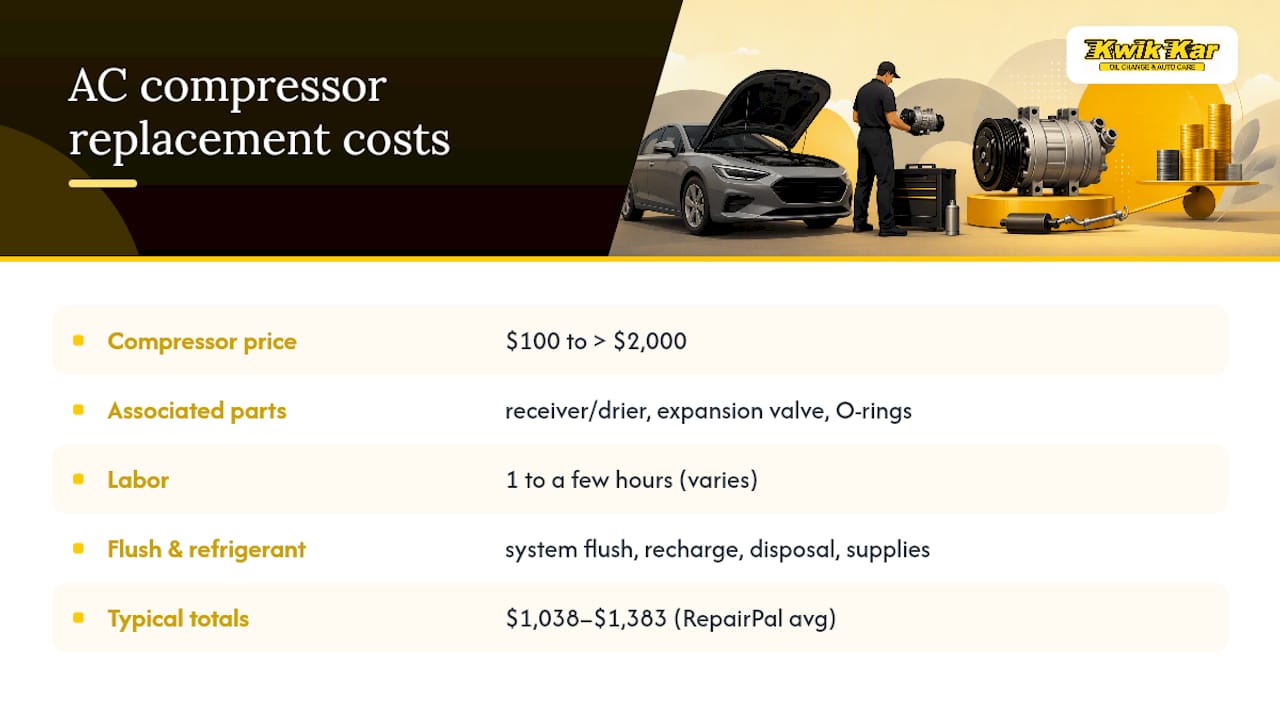
Labor. Most shops budget one to a few hours for the swap, though CarParts notes that harder-to-reach compressors on certain engine layouts push labor time higher. Multiply that by your local shop’s hourly labor rate, and you’ll see why two shops in the same city can quote noticeably different totals for identical parts.
Flush and refrigerant. If the compressor failed internally, the shop needs to flush the entire system before installing anything new. Skip this step and the new compressor is running through contaminated lines. Refrigerant recharge, disposal fees, and shop supply charges typically round out the bill.
RepairPal’s national average for a full compressor replacement lands between $1,038 and $1,383, a range that tracks closely with the $750 to $1,500 window AutoZone cites for professional shop work including flush and recharge.
Realistic scenarios look something like this: an economy sedan with an accessible compressor and no contamination might land near $800 to $1,000. A mainstream sedan or SUV needing a flush and new receiver/drier often falls in the $1,100 to $1,400 range. A luxury vehicle or rare import with a hard-to-source compressor and premium refrigerant can push past $1,800.
What Makes One Estimate Higher Than Another?
Two shops looking at the same symptom can hand you very different quotes, and it usually comes down to a handful of concrete variables.
- Make, model, and year. Some engine bays put the compressor within easy reach; others bury it behind the engine mount, adding labor hours.
- Parts choice. OEM parts cost more upfront but usually carry stronger warranties. Aftermarket and rebuilt compressors save money but vary more in quality.
- Severity of failure. A clean external leak repair is a fraction of the cost of an internal failure that demands a full flush plus new receiver/drier and expansion valve.
- Refrigerant type. Newer vehicles use R1234yf, which costs noticeably more per pound than the older R134a refrigerant found in older models, so an r1234yf recharge cost runs higher than a comparable R134a job.
- Local labor rates and timing. Shop rates vary by region, and AC repair demand spikes in summer, which can affect both pricing and parts availability.
When you call for an estimate on car AC repair, give the shop your VIN and a clear description of symptoms. That’s what lets them quote accurately instead of guessing.
Should You Replace the AC Compressor Yourself?
DIY replacement can save real money, but only under the right conditions. AutoZone estimates a DIY parts-and-recharge budget of roughly $350 to $650, well under the $750 to $1,500 professional range, provided you’re working with a straightforward, accessible compressor and no internal contamination.
Here’s what that actually requires:
- A vacuum pump and manifold gauge set to properly evacuate the system before recharging. Skipping proper evacuation traps moisture and air in the lines, which degrades the new compressor fast.
- Correct refrigerant handling knowledge, since improper handling carries both legal and safety issues under federal refrigerant rules.
- A clear diagnosis first. If you skip this and the compressor failed internally, a DIY recharge without a flush just feeds contaminated refrigerant into your new part.
DIY makes sense on an older, simple vehicle with good access and a confirmed external leak. It’s a poor bet if you suspect internal failure, don’t own a vacuum pump, or your car is under any remaining warranty.
Pro Tip: A rough recharge guide can walk you through the basics, but if your gauges show unusual pressure readings, stop and get a professional opinion before you spend money on parts you may not need.
What Happens During a Shop AC Compressor Replacement?
A proper shop visit follows a predictable sequence, and knowing it helps you read an estimate with confidence instead of guessing at line items.
- Diagnosis first. Technicians check refrigerant pressure, inspect the clutch, and rule out simpler fixes like a blown fuse or a bad electrical connector before condemning the compressor.
- Estimate review. You should see separate line items for the compressor, receiver/drier or accumulator, labor, system flush (if needed), refrigerant charge, and any applicable warranty.
- Flush and part replacement. If contamination is present, the shop flushes the lines and swaps the receiver/drier and expansion valve alongside the compressor.
- Recharge and test. The system is evacuated, recharged with the correct refrigerant, and tested under load before you drive away.
Most jobs finish same day if parts are in stock. Expect one to two days if parts need ordering or contamination requires extra flushing steps.
Why a Quick Recharge Isn’t Always the Answer
Topping off refrigerant feels like the cheap fix, but it often just buys time on a leak that’s going to get worse. HowToGeek warns that masking a leak this way delays the real diagnosis while contamination has more time to spread through the system.
That contamination has a name in the trade: black death, the metallic sludge left behind when a compressor fails internally. Once it’s in the lines, a simple recharge won’t fix anything, and a new compressor installed without a flush often fails again within months.
Before agreeing to any repair, ask the shop directly:
- Was the system flushed, or just recharged?
- Were the receiver/drier and O-rings replaced?
- Is there a written, itemized estimate with parts and labor broken out?
- What warranty covers the new compressor and the labor?
Get the answers in writing before you approve the work.
What the Cost Conversations Usually Miss
Most cost guides treat this like a shopping problem: get three quotes, pick the cheapest. That advice misses the part that actually determines whether you pay once or twice.
The real decision point isn’t the dollar amount on the estimate. It’s whether the shop is treating the failure as isolated or systemic. A compressor that seized internally has already sent metal debris through your lines, and a rock-bottom quote that skips the flush and the receiver/drier replacement isn’t a bargain. It’s a second repair bill waiting to happen, usually within a year.
We’d rather you pay a fair price once than a cheap price twice. That means asking pointed questions about flush procedures and supporting parts, even if it makes the estimate look bigger on paper. It also means DIY isn’t off the table for the right car and the right failure, but it’s a poor place to cut corners if you don’t already own a vacuum pump and know how to read gauge readings correctly.
The compressor replacement itself is rarely the hard part. Preventing the repeat failure is.
— Kwik Kar
How Kwik Kar Handles AC Compressor Replacement
Kwik Kar Oil Change & Auto Care runs every AC compressor job through the same process: diagnose first, flush when contamination is present, and hand you a transparent, itemized estimate before any work begins. Our technicians are ASE Certified, and Kwik Kar is recognized through RepairPal and NAPA AutoCare, the kind of third-party recognition that confirms our repair standards without us having to say so ourselves.

Most compressor jobs finish same day when parts are in stock, and seasonal AC service promotions can help offset the cost of a bigger repair. When you call or book online, have your VIN ready along with a description of your symptoms and any recent AC work done elsewhere. That information lets our technicians quote accurately the first time instead of revising the estimate mid-job.
Ready to find out what your repair actually costs? Schedule an AC diagnostic and estimate with Kwik Kar Oil Change & Auto Care today.
Sources
- AC Compressor Replacement Cost Estimate — RepairPal
- Signs your car’s AC compressor is about to fail — HowToGeek
FAQ
Does Car Insurance Cover AC Compressor Replacement?
Standard auto insurance generally doesn’t cover mechanical failures like a worn-out compressor; it’s treated as routine wear and maintenance rather than an accident-related repair.
Can You Replace Just the AC Clutch Instead of the Whole Compressor?
Clutch-only replacement is sometimes possible, but many shops find a full compressor swap more cost-effective once you factor in labor and reassembly time for a clutch-only repair.
What’s the Difference Between R134a and R1234yf Recharge Costs?
R1234yf, used in most vehicles from the past decade, costs noticeably more per pound than the older R134a refrigerant, making an r1234yf recharge cost higher even for an identical-sized job.
How Long Does a Compressor Replacement Warranty Typically Last?
Warranty coverage varies by shop and by whether you choose OEM, aftermarket, or rebuilt parts. Ask for the warranty terms in writing before the job starts, since Kwik Kar Oil Change & Auto Care provides warranty details as part of its upfront estimate.
Is It Normal for AC Recharge Cost to Vary Between Shops?
Yes. Car ac recharge price depends on refrigerant type, local labor rates, and whether a leak inspection is included, so it’s common to see meaningful differences between quotes for the same service.