When you press the gas pedal and your car struggles to get going, it's not just frustrating—it's a clear signal that something under the hood needs your attention. A car accelerating slowly is often your vehicle's way of telling you it can't "breathe" or get the fuel it needs to perform properly.
Why Is My Car Accelerating Slowly?
We’ve all felt that sinking feeling. You push the accelerator to merge onto the highway, but the response is sluggish and delayed. Don't panic. This isn't a death sentence for your car; it's a symptom, a clue pointing toward one of a few key systems that generate power.
Think of your engine's power as a simple recipe: it needs the right mix of fuel and air, ignited by a spark. When your car feels weak, it’s because one of those ingredients is missing or compromised.
The most frequent culprits fall into a few main categories:
- Fuel System: The engine is being starved of the gasoline it needs.
- Air Intake System: Not enough clean air is mixing with the fuel.
- Ignition System: The spark to ignite the air-fuel mixture is weak or misfiring.
- Exhaust System: The engine can't efficiently push out its exhaust gases.
Paying attention to the specifics is your best first step. Does your car sputter and hesitate? Does the check engine light glare at you from the dashboard? Maybe it only feels weak when you have the A/C running on a hot Dallas day. These details are vital clues.
To help you get a clearer picture, here’s a quick rundown of the usual suspects.
Common Causes of Slow Acceleration at a Glance
| Potential Cause | Common Symptoms | DIY Check Difficulty |
|---|---|---|
| Clogged Fuel Filter | Sputtering at high speeds, trouble starting | Moderate |
| Dirty Air Filter | Reduced fuel economy, sluggish feeling | Easy |
| Failing Spark Plugs | Rough idle, misfiring, poor fuel efficiency | Moderate |
| Clogged Catalytic Converter | "Rotten egg" smell, decreased power | Hard |
| Faulty Mass Airflow Sensor | Hesitation, stalling, check engine light | Moderate |
| Transmission Issues | Slipping gears, delayed engagement | Hard (Professional check recommended) |
This table can give you a general idea of what you might be up against, but the next step is to start narrowing it down.
Starting Your Diagnosis
Knowing where to look can help you have a more productive conversation with a mechanic and demystify the repair process. This decision tree offers a simple visual path to start figuring things out.
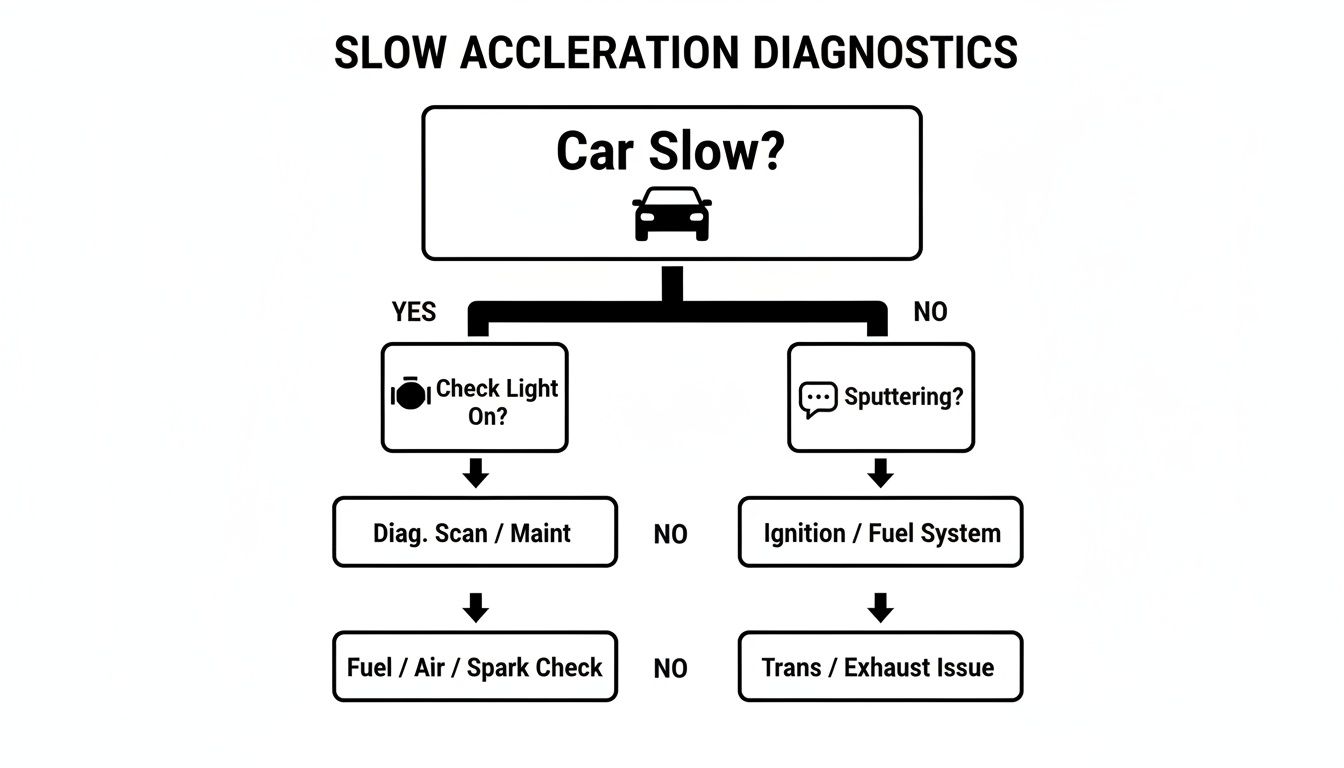
The flowchart is a great tool for anyone, regardless of mechanical skill. It helps you organize your car's symptoms by asking simple "yes or no" questions, guiding you from a general problem toward more specific potential causes.
Key Takeaway: A car that’s slow to accelerate is almost always a solvable issue. The trick is to pay attention to the other symptoms that come with the sluggishness. Those little details provide the best clues to finding the root cause.
Investigating Fuel and Air System Issues

When you press the gas pedal and your car just doesn't go like it used to, the problem often boils down to a simple recipe: fuel and air. Your engine needs a precise mixture of both to generate power. If that mix is off, you’ll feel it as sluggish, weak acceleration.
Let's walk through the most common suspects in the fuel and air systems, starting with the simplest checks you can do yourself.
The easiest place to start, and often the culprit, is your engine air filter. Think of it as the lungs of your car. A dirty, clogged filter literally suffocates the engine, starving it of the oxygen it needs to burn fuel effectively. You'll especially notice this lack of power when trying to merge onto a busy Dallas highway or climb an incline.
Checking the Fuel Delivery Path
If the air filter looks good, it's time to trace the fuel's journey to the engine. A very common cause for a car accelerating slowly is a clogged or failing fuel injector. We see this all the time. A detailed guide on a problem with fuel injector can give you more insight into symptoms and costs. In short, when injectors get dirty, they can't deliver that fine, even mist of fuel the engine needs.
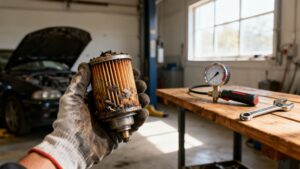
Another critical checkpoint is the fuel filter. Its entire job is to screen out gunk and debris from your gas tank before it can damage those sensitive injectors. Over time, that filter gets clogged and restricts the flow of gasoline.
When your fuel filter is getting plugged, your car will give you some tell-tale signs:
- The engine sputters or hesitates when you try to accelerate hard.
- You notice the car struggles more at higher speeds.
- It feels like it might stall out when you demand more power from the engine.
These are classic symptoms of fuel starvation. While it's often just a dirty filter, it’s important to get it checked out. You can learn more about this in our dedicated article on how to tell if you have a dirty fuel filter.
Failing Fuel Pumps and Faulty Sensors
A more serious, but less common, issue is a failing fuel pump. A clogged filter just restricts fuel; a weak pump can't build enough pressure to deliver it in the first place, especially under acceleration. The classic giveaway is a distinct whining noise from your gas tank area. Your car might also become hard to start or stall unexpectedly.
Modern cars also use a host of sensors to keep things running smoothly. One of the most important is the Mass Airflow (MAF) sensor. It's the gatekeeper that measures air coming into the engine and tells the computer how much fuel to add to the mix.
Over time, the MAF sensor can get coated with dust, oil, and grime. When this happens, it misreads the airflow, telling the computer there's less air than there actually is. The computer then injects too little fuel, creating a "lean" mixture that leads to hesitation and a serious lack of get-up-and-go.
Cleaning or replacing a bad sensor is a straightforward job for a technician, but it's crucial for restoring your car's performance. It's a perfect example of how a small, inexpensive part can have a huge impact on how your car drives.
Inspecting Your Ignition and Exhaust Systems
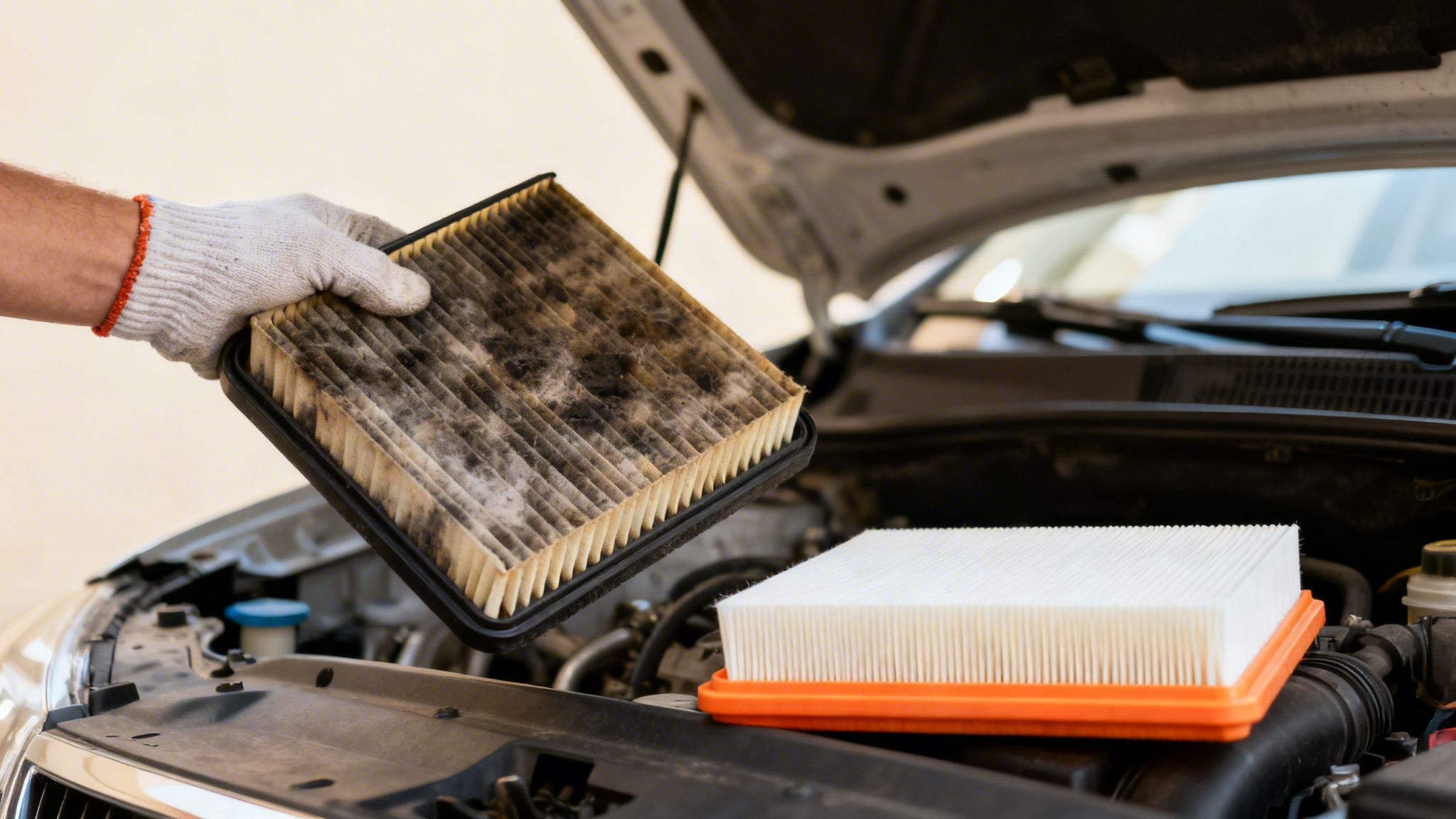
So, your engine is getting plenty of fuel and air, but it still feels completely gutless. The next place to look is at the two ends of the combustion process: the spark that ignites the mixture and the exhaust that clears it out.
A weak, inconsistent spark or a clogged-up exhaust will absolutely kill your car's performance. It often feels like you’re trying to accelerate with the parking brake still on. These ignition and exhaust problems are a top reason a car is accelerating slowly because they directly sabotage the engine's power-making cycle.
Tracing Ignition System Faults
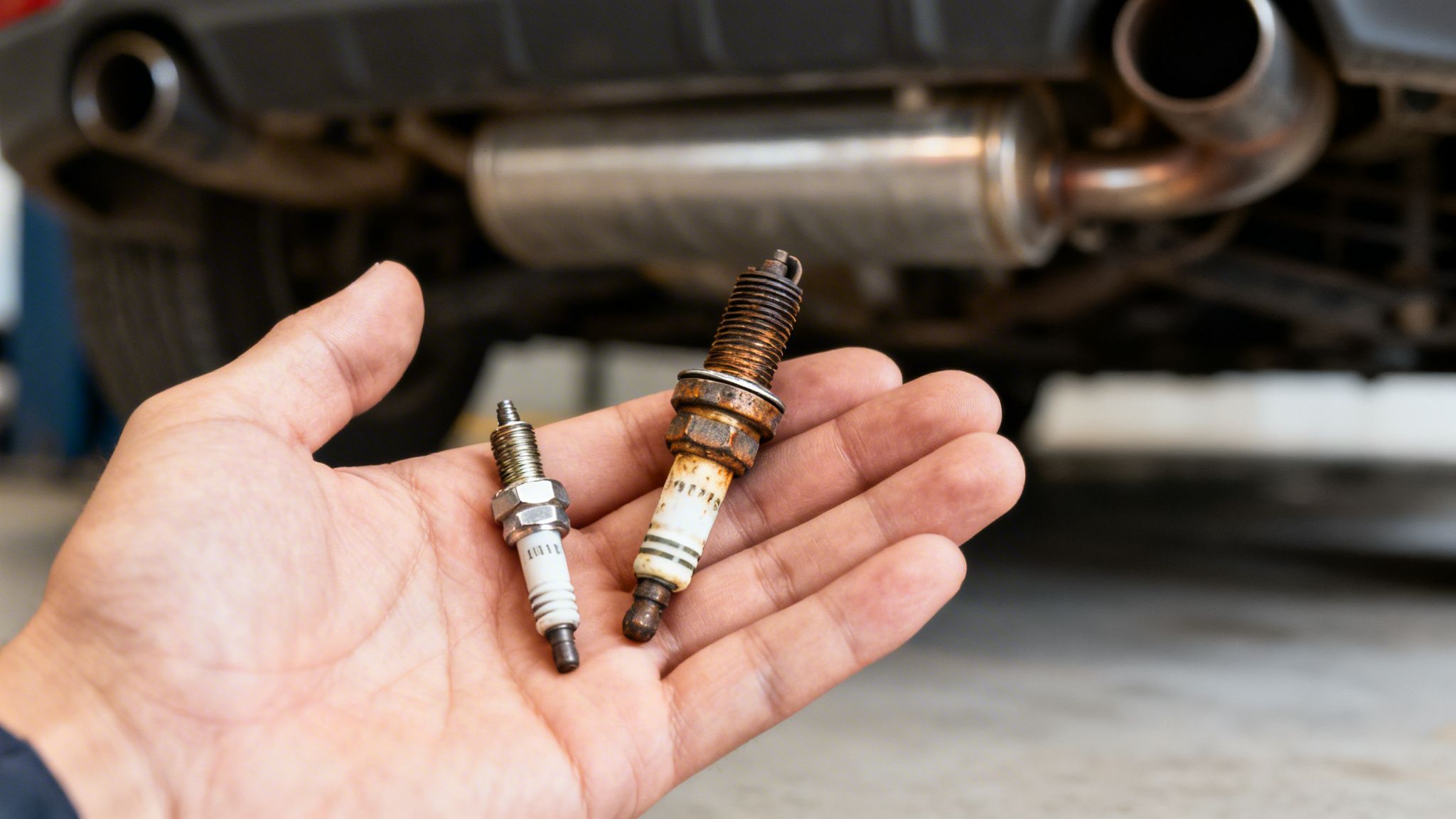
Your ignition system has one job: create a powerful spark at the perfect moment. The most common weak link here is the spark plugs. Think of them as tiny, hard-working lightning rods, firing thousands of times every minute. Over time, they wear out, and that powerful spark becomes a weak flicker.
When your spark plugs are failing, you’ll usually notice:
- A shaky or rough idle while you're stopped in traffic.
- Engine misfires, which feel like a stutter or hesitation as you try to speed up.
- An overall lack of power and a noticeable dip in fuel economy.
But don't just blame the plugs. The issue could be an ignition coil. The coil is a transformer, turning your car's 12-volt battery power into the thousands of volts needed to create a spark. When a coil goes bad, it usually takes down one cylinder with it, causing a very noticeable and constant misfire that's hard to ignore. Our guide on symptoms of a bad ignition coil can help you dig deeper into this specific problem.
When Your Exhaust Chokes the Engine
Now, let's look at the other end of the process: the exhaust. The most important—and often most problematic—part is the catalytic converter. Its job is to scrub harmful pollutants from your exhaust, but with age, it can get clogged with carbon and other gunk.
This blockage creates a massive amount of backpressure, basically choking the engine from the outside. It can't breathe out, so it can't breathe in a fresh charge of air and fuel.
The classic, tell-tale sign of a clogged catalytic converter is a distinct "rotten egg" or sulfur smell coming from the exhaust pipe. This is almost always paired with severe sluggishness that gets worse and worse, especially when you're going up a hill or trying to accelerate onto the highway.
It’s amazing how far engine technology has come. Back in 1958, a Chevrolet Corvette hitting 60 mph in 7.6 seconds was mind-blowing performance. Today’s engines are far more powerful and efficient, but that complexity means even a small problem can have a big impact. This is exactly why staying on top of maintenance is so critical for modern cars.
Are Transmission or Sensor Problems the Culprit?
What if your engine sounds perfectly healthy, but the car just refuses to get up and go? When the power isn't making it to the pavement, you could be dealing with something more complex than a simple fuel or air issue.
Transmission and sensor problems can be tough to pin down because they often feel like engine trouble. But if a car is accelerating slowly because of these parts, it’s less like the engine is choking and more like there’s a serious communication breakdown happening under the hood.
A classic—and very concerning—symptom is a slipping transmission. You'll step on the gas, hear the engine roar as the RPMs climb, but your speed barely budges. It's a disconnected feeling, almost like the car slipped into neutral for a second before the gear finally "catches" and lurches forward.
When Your Car Enters Limp Mode
In more serious situations, your vehicle might protect itself by entering "limp mode," sometimes called "safe mode." This is a feature where the car’s main computer detects a major problem, usually with the transmission or a vital sensor.
To prevent catastrophic failure, the computer deliberately cuts engine power and might even lock you into a single gear (typically second or third). Limp mode is your car’s way of saying, "Get me to a mechanic, now!" You'll have just enough power to safely get off the road and head to a shop. Ignoring it is never a good idea.
Expert Insight: Think of a slipping transmission or limp mode as your car's version of a heart attack. Pushing through it is a surefire way to turn a manageable repair into a complete transmission replacement that can cost thousands. The problem will only get worse.
The Web of Modern Vehicle Sensors
Today's cars are run by a complex network of sensors that act like a nervous system, constantly feeding data back to the engine control unit (ECU). When even one of these sensors goes bad, it sends faulty information, causing the ECU to make poor adjustments that kill your car’s performance.
Two of the most common culprits are:
- Oxygen (O2) Sensor: This part lives in your exhaust and measures unburned oxygen. A bad O2 sensor can't tell the ECU if the fuel mix is rich or lean. The computer then defaults to a "safe" mode that often results in sluggish acceleration and awful gas mileage.
- Throttle Position Sensor (TPS): The TPS tells the computer how hard you're pressing the gas pedal. If it's failing, you’ll notice a frustrating lag—you push the pedal, but there's a delay before anything happens. It can also cause jerky, unpredictable power delivery.
A failing sensor is one of the top reasons your check engine light will suddenly appear. That light can be nerve-wracking, but a quick diagnostic scan can tell us exactly which part is causing the trouble. If that light is on, you can learn more about what it might mean in our guide to professional engine light diagnostics. It’s a simple first step that takes all the guesswork out of the repair.
Proactive Maintenance to Prevent Slow Acceleration
The best way to fix a car that’s accelerating slowly is to stop it from happening in the first place. Instead of waiting for a sluggish engine to become a real problem, a proactive maintenance schedule keeps your car feeling responsive and powerful, just like it was designed to be.
Think of it like a routine health check-up. You wouldn't wait for a major illness before seeing a doctor, and the same logic applies to your vehicle. Sticking to a regular service plan is the single best investment you can make in your car's long-term health and performance.
This whole approach boils down to replacing key parts before they fail. Many components are designed to wear out over time, and getting ahead of that wear and tear is what separates a reliable car from one that always seems to have something wrong with it.
Creating a Practical Service Schedule
A good maintenance plan doesn't need to be complicated. It really just revolves around keeping an eye on and replacing a few critical items that directly impact your car's power and acceleration.
While you should always check your owner's manual for exact service intervals, here's a solid guide to get you started:
- Engine Air Filter: We recommend checking this at every oil change. Plan on replacing it every 15,000 to 30,000 miles. A clean filter is cheap insurance against a choked, underperforming engine.
- Fuel Filter: This should be replaced every 20,000 to 40,000 miles. Doing so prevents fuel starvation and protects your more expensive fuel pump and injectors from getting clogged with debris.
- Spark Plugs: Modern iridium or platinum plugs can last up to 100,000 miles, but it’s smart to check them for wear and tear well before that. A fresh set of plugs guarantees a strong, efficient spark for complete combustion.
- Fluids: This is about more than just motor oil. Your transmission fluid, coolant, and brake fluid all have specific lifespans and need to be checked and replaced according to your manufacturer's schedule.
To keep your car running like new and avoid problems like slow acceleration, it helps to build a schedule around these crucial preventative maintenance examples.
Key Takeaway: Being proactive with maintenance isn't just about dodging repair bills; it's about preserving your car's performance. Clean filters and fresh fluids let your engine breathe and work the way it was engineered to, delivering the power you paid for.
When to Call a Professional
Even with a perfect maintenance routine, some issues are just too complex or risky for a DIY fix. Knowing when to put down the wrench and call a professional can save you from turning a small problem into a costly disaster.
If you see any of these warning signs, it’s time to get an expert opinion right away:
- A flashing check engine light
- Any kind of burning smell coming from the engine bay or exhaust
- The engine revs high but the car doesn't pick up speed (a classic sign of transmission slip)
- Grinding, whining, or clunking noises when you press the gas pedal
For our neighbors in the Dallas area, Kwik Kar offers advanced diagnostic services to pinpoint the exact cause of your slow acceleration. We take the guesswork out of the repair process, ensuring a minor issue doesn't sideline your vehicle and turn into a major failure.
Common Questions About Sluggish Car Acceleration
When your car feels like it's dragging, a million questions can start running through your head. A car accelerating slowly isn't just frustrating; it's your vehicle's way of telling you something is wrong. We hear these same questions every day at our Dallas service centers, so let's clear up some of the most common concerns.
This is all about demystifying what’s going on under the hood, from how much a fix might cost to whether a simple oil change can really make a difference.
Can a Simple Oil Change Really Help My Car Accelerate Faster?
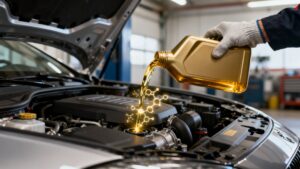
Yes, it often can, and it all comes down to one word: friction. Your engine oil's main job is to keep all the high-speed metal parts inside the engine gliding smoothly past one another with as little resistance as possible.
Over time, that oil gets old and dirty. It picks up soot, tiny metal shavings, and other gunk, turning from a slick lubricant into a thick, gritty sludge. When that happens, your engine has to fight against its own internal friction, which steals power that should be going to your wheels.
A fresh oil change is like hitting the reset button on your engine's lubrication. It won't magically add horsepower your car never had, but by cutting down on that internal drag, it lets the engine deliver all the power it was designed to. You'll often feel the result as a much smoother and more responsive ride.
My Check Engine Light Is On and My Car Is Slow—What Do I Do?
The very first thing you need to do is find out what trouble code your car has stored. Think of that check engine light as a signpost; it means your car’s computer has detected a fault and logged a specific Diagnostic Trouble Code (DTC) to point a technician in the right direction.
While many auto parts stores offer to read these codes for free, that only gives you a piece of the puzzle. A professional diagnosis is crucial because we don't just stop at the code. We use it as the starting point for more advanced testing to see if a sensor has truly failed or if a different problem is just making the sensor report an error.
It’s also critical to know whether the light is steady or flashing:
- Steady Light: This is a heads-up. Your car has an issue that needs attention soon, but it's generally safe to drive to the shop.
- Flashing Light: This is a serious, stop-driving-now warning. It means you have a severe engine misfire that's dumping raw, unburned fuel into your exhaust system. This can melt your catalytic converter in just a few minutes, turning a relatively small repair into a multi-thousand-dollar nightmare. If you see a flashing light, pull over safely and call for a tow.
How Much Does It Cost to Fix a Car That Is Accelerating Slowly?
This is the toughest question to answer without seeing the car, because the cost to fix slow acceleration can swing wildly. The final bill is entirely dependent on what our diagnostic process finds.
To give you an idea, here’s a look at the potential cost range for some common culprits, from simple maintenance to major component failure.
| Potential Repair | Estimated Cost Range | Description |
|---|---|---|
| Clogged Engine Air Filter | $40 – $70 | A very quick and affordable fix that can immediately restore power. |
| Worn Spark Plugs | $200 – $500 | A routine maintenance job. The cost depends heavily on your engine's design. |
| Failing Fuel Pump | $500 – $1,200+ | A more complex repair, as it involves getting inside the fuel tank. |
| Clogged Catalytic Converter | $1,500 – $3,000+ | This is one of the pricier repairs, mainly due to the high cost of the part itself. |
This huge range is exactly why a proper diagnosis is so important. Just guessing and replacing parts is a fast way to spend a lot of money without fixing the problem. We always start with a thorough inspection to provide a clear, transparent estimate before any work begins, so you'll never be in the dark.
Experiencing slow acceleration and not sure where to start? Don't let a small issue turn into a major headache. The expert technicians at Kwik Kar Oil Change and Auto Care in Dallas are here to help. We use advanced diagnostic tools to pinpoint the exact cause of your car's sluggish performance, providing transparent estimates and professional repairs to get you back on the road with confidence. Schedule your diagnostic appointment online today!