


You wake up in Dallas, look outside, and the neighborhood street is shiny from curb to curb. Not snow. Ice.
That’s when questions get urgent. Can you drive on it? Will all-wheel drive help? Should you put chains on tires, and if so, are they even safe on a newer car with sensors all over it?
For North Texas drivers, chains aren’t an everyday accessory. They’re emergency equipment. Used the right way, they can help you crawl out of a dangerous situation. Used the wrong way, they can damage the vehicle you’re trying to protect. That’s especially true on modern sedans and SUVs with tight clearances, ABS hardware, and driver-assistance systems.
When Do You Actually Need Chains on Tires in Dallas
Dallas winter weather is odd because most of the season is fine, then one ice event can shut the city down fast. In that narrow window, chains on tires can make sense.

What chains actually do
Tire chains wrap around the tread and create mechanical bite where rubber alone starts to skate. On plain cold pavement, you don’t need them. On a slick sheet of ice, they can be the difference between controlled movement and a car that won’t climb a mild intersection.
Chains have been around for a reason. Harry D. Weed invented the first practical snow chains in 1904, inspired by early motorists wrapping ropes around tires for grip. His patented Grip-Tread for Pneumatic Tires changed winter driving long before snowplows were common, as noted in the history of snow chains.
The Dallas situations where chains make sense
In North Texas, chains are for the worst conditions, not the first flurry. Good candidates include:
- Glazed neighborhood streets where the whole surface is slick and packed with freezing rain
- Untreated bridges and overpasses that freeze before the rest of the roadway
- Steep driveways or parking garage exits where traction disappears
- A necessary short trip for work, medicine, or getting to a safer location when roads are still icy
If roads are mostly wet, mostly clear, or only slushy in patches, chains are usually more trouble than help. They ride rough, limit speed, and can damage both the road and the vehicle if you run them on bare pavement.
Practical rule: If your tires can grip normally, leave the chains off. Save them for conditions where the tire itself can’t do the job.
Think of them as part of winter prep, not a daily solution
For Dallas drivers, the smart move is to decide before the storm whether your vehicle can even take chains. A lot of newer vehicles can’t use traditional chain sets safely. Some require low-profile options. Some shouldn’t use them at all.
That’s why basic seasonal prep matters more than panic buying during an ice event. If you want a broader checklist before cold weather hits, this winter car prep guide is a useful place to start.
Choosing the Right Traction Device for Your Vehicle
The biggest mistake I see with chains on tires isn’t poor driving. It’s buying the wrong traction device before the weather turns.
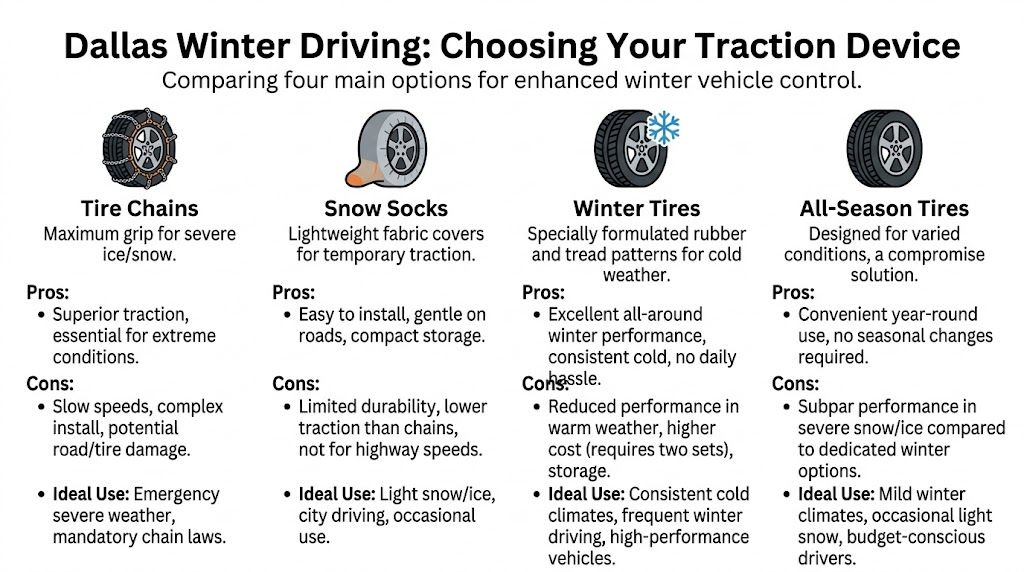
Four choices Dallas drivers usually consider
Here’s the fast comparison.
| Device | Best fit | What it does well | Main drawback |
|---|---|---|---|
| Tire chains | Severe ice, emergency use | Maximum bite | Rough ride, clearance risk |
| Snow socks | Short city use on light ice or snow | Easy to install, compact | Wear quickly and offer less grip |
| Winter tires | Regions with regular winter driving | Consistent cold-weather performance | Not practical for most Dallas drivers year-round |
| All-season tires | Normal North Texas use | Convenience | Limited help once roads turn to solid ice |
Traditional chains, cables, and hybrids
Not all chain-style products behave the same.
Traditional link chains give the hardest bite. They’re a better match for older trucks and some light trucks with room in the wheel well. They’re noisy, they shake the vehicle more, and they’re usually the least forgiving option on newer vehicles.
Cable chains sit lower and are often the safer choice for cars with limited space around the tire. If you drive a front-wheel-drive sedan or a crossover with tight suspension and brake clearance, cable-style units are often the first thing to check.
Hybrid or patterned chains are the middle ground. They spread contact more evenly and can be easier to live with on the road. According to Les Schwab’s chain selection guidance, hybrid or patterned chains can outperform traditional links by 25% in ride smoothness, and AAA reports that 18% of chain-related damages are caused by insufficient clearance.
That clearance point matters more than is often realized.
Match the device to the vehicle, not the weather alone
A simple buying guide works well:
- Sedan with low clearance: Start by checking whether the owner’s manual allows chains at all. If it does, low-profile cable or Class S style products are often the safer direction.
- SUV used around town: Don’t assume an SUV can take regular chains. Many newer ones have limited inner clearance near struts, brake lines, and sensor wiring.
- Light truck: If there’s enough room and the manual allows it, a more aggressive chain can work well in deeper accumulation or on steep grades.
- Performance car or low-profile tire setup: Chains may be a bad idea altogether. In many cases, the safe answer is “don’t install them.”
Clearance is a fitment issue, not a guess. If the chain sits too proud of the tire, it can slap the wheel well, hit suspension parts, or tear into wiring.
What works in real life
For occasional Dallas weather, the best answer is usually the traction device you can install correctly in freezing conditions and remove as soon as pavement clears. That often favors low-profile systems over heavy chain sets.
What doesn’t work is buying the most aggressive product on the shelf and hoping it fits. Chains on tires only help when the set matches the vehicle, the tire size, and the available clearance.
Your Step-by-Step Guide to Installing and Removing Chains
If you’re standing outside in gloves with cold hands and traffic stress building, the install has to be simple. That’s why preparation matters more than strength.
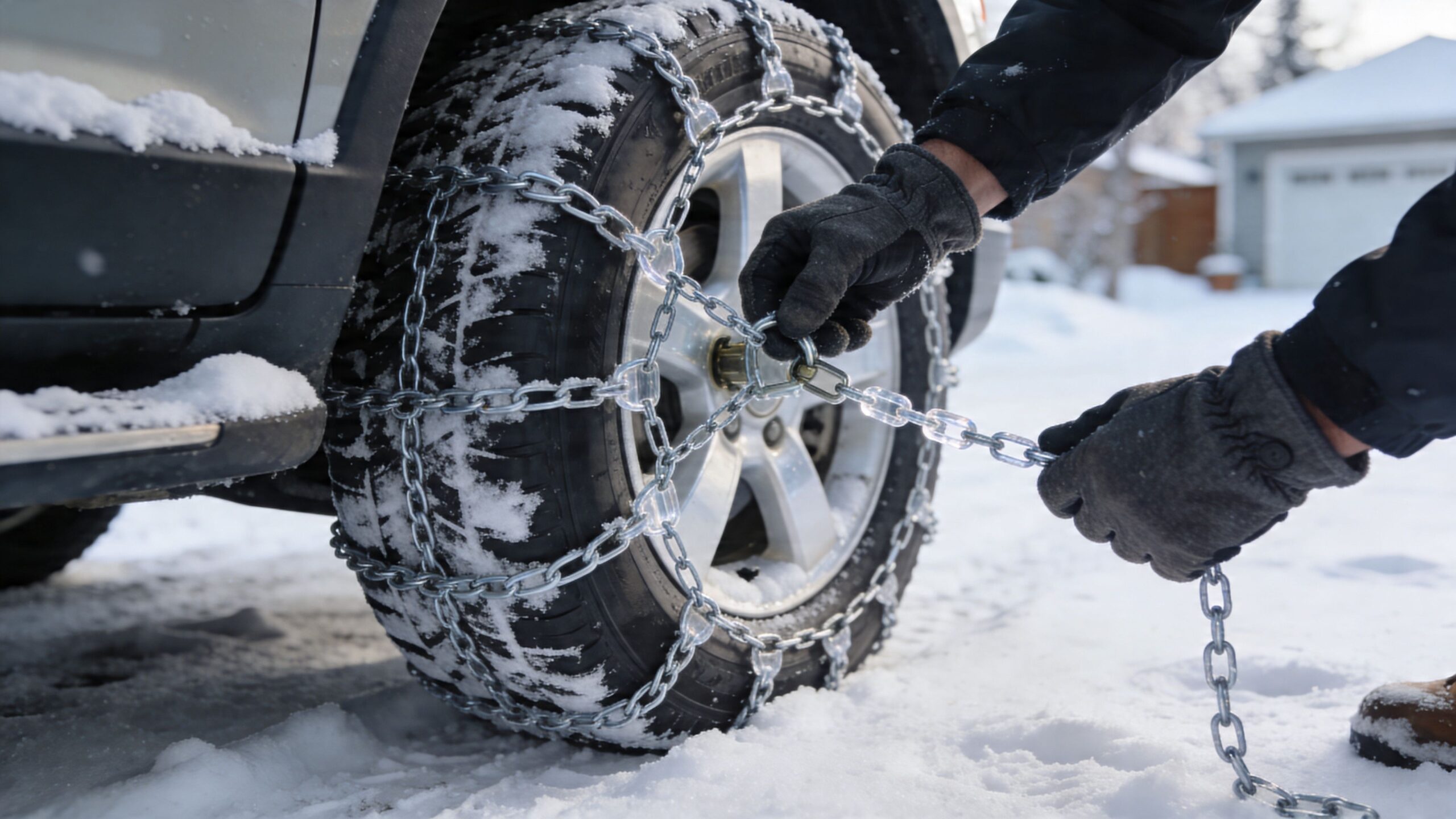
Before the chain touches the tire
Park on the flattest surface you can find. Set the parking brake. Turn on hazards if you’re near moving traffic.
Then do the part people rush through. Lay the chains flat and sort them out completely. According to Oregon DOT training discussed in this installation guidance, up to 40% of installation failures stem from pre-install tangles.
That number makes sense. Twisted side chains and flipped cross links create uneven tension, and uneven tension is what causes slapping, loosening, and damaged hardware.
Which tires get chains
Install chains on the drive tires unless the owner’s manual says otherwise.
- Front-wheel drive: front tires
- Rear-wheel drive: rear tires
- All-wheel drive or four-wheel drive: follow the manual exactly, because some vehicles call for all four and others have strict fitment limits
If you’re unsure, stop there and verify. Guessing on a modern driveline isn’t worth it.
Drape and connect the right way
Here’s the field method that works best.
- Face the hooks outward. You want the hardware oriented away from the tire and vehicle components where possible.
- Drape the chain over the top of the tire. Center it as evenly as you can.
- Feed the lower portion behind the tire. Make sure the chain sits flat, not twisted.
- Roll the vehicle slightly if needed. A short move helps expose the back side so you can finish the connection.
- Connect the inner fastener first. This is the one people skip because it’s awkward. It’s also the connection that stabilizes the set.
- Connect the outer fastener. Pull the slack out evenly.
- Attach the tensioning system. If your set uses cams, a built-in tightener, or rubber adjusters, apply them now.
Don’t worry about perfect final tension on the first try. Aim for even placement and full engagement.
A chain that’s slightly snug but centered is fixable. A chain that’s twisted or half-hooked is a damage risk.
The short drive that makes the install work
This is the step that separates a solid install from a roadside failure.
Drive forward 50 to 100 feet, then stop and retighten everything. In the same Oregon DOT training reference, that short settle-and-retighten step raises secure fit success to over 95% and can improve traction by 80 to 90% on ice after proper setup and retensioning.
Those gains come from letting the chain seat itself into the tread. The first few yards expose slack that you can’t see while parked.
Here’s a video demonstration that helps if you’ve never done it before:
A quick install checklist
Use this before you drive any real distance:
- Centered fit: Cross members should sit evenly across the tread
- No obvious twist: Side sections should lie flat
- Inner connector secure: Don’t skip it because it’s hard to reach
- Outer connector secure: No hanging loose end near the wheel well
- Tension applied: Slack should be minimal after the settle drive
Common mistakes that cause trouble
Some errors show up over and over:
- Installing on the wrong axle
- Leaving a tangle in the side chain
- Failing to retighten after the first short drive
- Using a chain too large for the tire size
- Trying to fit a standard chain on a vehicle that only has room for low-profile gear
The install shouldn’t require forcing parts together. If it does, the fit is likely wrong.
Removing chains without making a mess
Removal is easier if you do it before you hit long stretches of bare pavement.
Turn the steering wheel only as needed, park safely, and release the outer connector first. Then disconnect the inner side, pull the chain off the tread, and lay it flat on the ground. Move the vehicle slightly if a section is trapped under the tire.
Once they’re off, don’t throw them wet into the trunk and forget about them. Clean and dry them before storage. That keeps rust and seized hardware from making the next install harder than it needs to be.
Driving Safely with Chains and Proper Maintenance
Once the chains are on, the job changes. Now you’re managing speed, steering input, and mechanical sympathy.
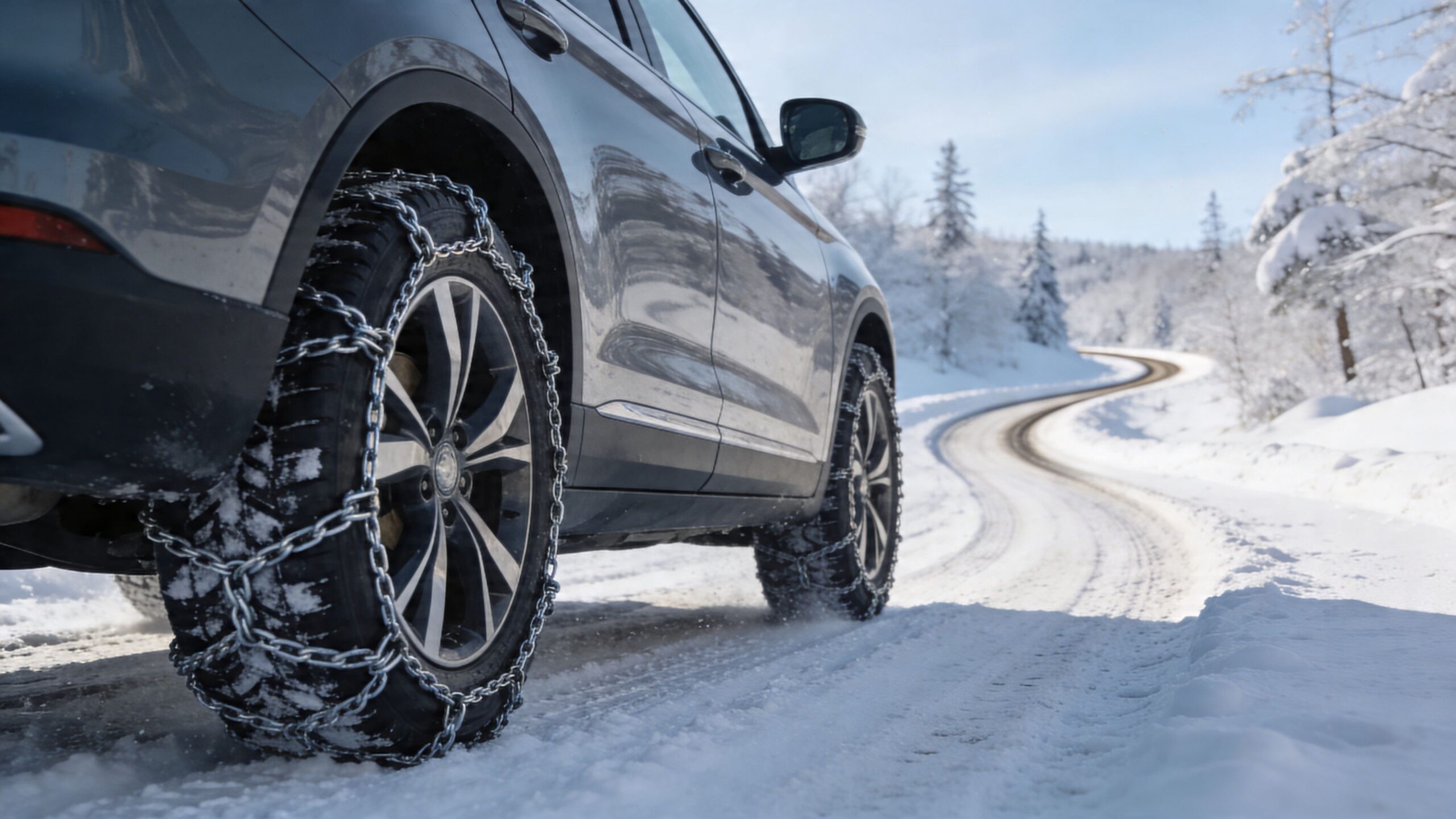
How to drive with chains on tires
Drive like every input matters, because it does.
- Keep speeds low: Chains are for controlled movement, not normal cruising
- Accelerate gently: Spinning the tire can loosen the set
- Brake early and smoothly: Sudden stops load the chains hard
- Avoid sharp steering inputs: That’s where clearance issues show up fast
- Listen to the vehicle: Rhythmic banging or heavy slapping usually means something is loose or misfit
The ride will be noisy and rough. That’s normal to a point. What isn’t normal is a repeated metallic strike that gets louder with wheel speed. If you hear that, stop and inspect.
Where chains should come off
Remove them as soon as you’re back on mostly clear pavement. Metal traction devices don’t belong on dry roads any longer than necessary.
That protects:
- The tire tread
- The chain hardware
- Suspension and wheel-well liners
- The road surface
If your route alternates between icy patches and clear pavement, decide whether the trip should wait. Chains work best in consistently bad conditions, not mixed urban driving where dry concrete appears every few blocks.
The safest chain is the one you remove as soon as conditions allow.
Post-use care
A little cleanup saves frustration later.
- Rinse off road grime and de-icer
- Dry the set fully before storage
- Check for bent links, worn cables, or damaged tensioners
- Repack them so the next install starts untangled
Good storage is part of tire maintenance too. If you want the broader habits that help tires last and perform properly in every season, these tire maintenance tips are worth keeping handy.
Regulations still matter
Even if Dallas doesn’t deal with chain mandates the way mountain states do, drivers should know that chain use is regulated in many places. Some states require chains on certain routes during storms, others restrict use to specific periods, and the market keeps growing around those safety and legal demands. Acute Market Reports projects the automotive snow chain market will grow at a 5.5% CAGR from 2025 to 2033 in response to those conditions and regulations, according to its automotive snow chain market report.
Texas Rules and Modern Vehicle Complications
A lot of chain advice online assumes any car can wear chains if the tire size matches. That’s outdated thinking.
On a newer vehicle, the question isn’t just “Will it fit the tire?” It’s “Will it clear the brake hardware, wheel well, wiring, and sensors when the suspension moves?”
Why modern cars are less forgiving
Today’s vehicles pack more hardware into tighter spaces. You’ve got ABS wheel speed components, traction and stability system inputs, parking sensor systems, and in many cases very little extra room around the tire.
A loose chain can do real harm. It can strike the inner liner, snag a brake line, or hit sensor-related components. Once that starts, damage happens fast.
According to AAA winter traction guidance, many manufacturers either prohibit chains entirely or specify only Class S types to avoid warranty issues, and a loose chain can damage ADAS sensors or brake lines, which makes compatibility especially important on newer vehicles. That warning appears in AAA’s winter prep traction guidance.
What Class S means in practice
Class S is the category many drivers in newer sedans and SUVs need to know. It refers to low-clearance traction devices intended for vehicles that can’t safely accept bulkier chain systems.
That doesn’t mean every Class S product is automatically safe for every Class S vehicle. You still need to confirm the exact tire size, the manufacturer’s chain guidance, and the actual room around the wheel assembly.
Vehicles that need extra caution
Some setups deserve a hard pause before you install anything:
- Low-profile tires
- Run-flat tire packages
- Sport suspensions
- Large wheel packages with little sidewall
- Post-2020 vehicles with dense ADAS packaging
- Models whose owner’s manual says chains are prohibited
If the manual says no chains, respect that. Don’t treat that warning as optional because an online fit guide says otherwise.
If the owner’s manual prohibits chains, the safest install is no install.
Dallas-specific reality
In Dallas, chains are more about emergency mobility during an ice storm than routine winter commuting. That changes the decision. You’re not building a winter setup for months of snow. You’re trying to avoid a bad choice during a rare event.
That’s why the practical sequence is simple:
- Check the owner’s manual first
- Confirm whether chains, cables, or only low-profile devices are allowed
- Inspect wheel-well clearance before purchase
- Test fit the set before the storm, not during it
- If there’s any doubt, don’t force the issue
On many modern vehicles, the safer answer may be to stay parked until conditions improve. That’s not overcautious. It’s often the smartest way to avoid body, brake, sensor, and warranty trouble.
When in Doubt Let the Pros at Kwik Kar Help
Chains on tires can be a smart tool for a Dallas ice storm. They can also become an expensive mistake if the fit is wrong, the install is rushed, or the vehicle wasn’t designed for them in the first place.
The hard part isn’t understanding the idea. It’s sorting out the practical details:
- whether your vehicle can use chains at all
- which axle should carry them
- whether you need a low-profile or Class S setup
- how much clearance the suspension and brake hardware have
- whether that noise after installation is normal or a warning sign
For older trucks and simple wheel setups, the answer is usually more straightforward. For newer sedans, crossovers, and SUVs, especially ones loaded with driver-assistance tech, it gets complicated fast.
A professional inspection removes a lot of guesswork. A technician can check clearance, look at the tire size and wheel-well space, and help you avoid the common problems that happen when drivers buy the wrong set in a hurry. If you need help with fitment or tire service before winter weather arrives, start with the shop’s tire services page.
The main thing is this. Don’t wait until freezing rain is already falling to figure out whether your vehicle can safely run chains. Rare weather causes rushed decisions, and rushed decisions are where most chain problems begin.
If you're dealing with a North Texas freeze and want a clear answer before you risk your vehicle, contact Kwik Kar Oil Change and Auto Care. The team can help inspect your tires, check vehicle fitment concerns, and point you toward the safest next step for winter traction and preventive maintenance.