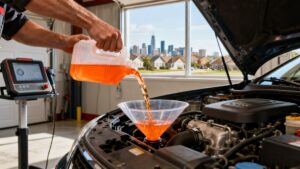
Yes, you can change your oil without changing the filter—but just because you can do something doesn't mean you should. It's a risky shortcut that any experienced mechanic will tell you to avoid.
Think of it like this: you wouldn't pour yourself a fresh, clean glass of water into a cup that still has yesterday's coffee grounds stuck to the bottom, right? You’d instantly ruin that clean water, and the same principle applies directly to your engine.
So, Can You Just Skip The Filter Change?
While it’s technically possible to drain your old oil and pour in new without touching the filter, it’s a classic case of being penny-wise and pound-foolish. You might save a few bucks now, but you're trading that for a massive risk to your engine’s health down the road.
Your old oil filter is already full of all the nasty stuff it’s been pulling out of your oil—tiny metal shavings, sludge, and carbon deposits. It's done its job, and its capacity is maxed out. When you pour in several quarts of fresh, clean oil, that dirty old filter simply can’t keep up. The new oil picks up all the junk the old filter is holding onto and starts circulating it right back through your engine.
Even worse, up to a full quart of old, sludgy oil can stay trapped inside that used filter and the surrounding engine passages. This means your "fresh" oil change is contaminated from the very first second the engine turns over. You can learn more about the right way to do things in our guide on when to change the oil in your car.
The bottom line is that a used oil filter has a limited lifespan. Once it’s full, it stops trapping particles. From that point on, it’s just letting abrasive debris flow freely through your engine’s most sensitive components.
To help you see the trade-offs clearly, we've put together a quick comparison.
Quick Comparison Skipping vs Replacing Your Oil Filter
This table breaks down exactly what you’re gaining—and what you’re giving up—when you consider skipping a filter replacement.
| Aspect | Changing Oil Only (Skipping Filter) | Changing Oil and Filter Together |
|---|---|---|
| Engine Protection | Low; new oil is immediately contaminated. | High; removes old oil and contaminants. |
| Long-Term Cost | High risk of expensive engine wear. | Low; prevents premature wear and tear. |
| Short-Term Savings | Minimal; saves only the $10-$20 cost of a filter. | None; a necessary maintenance expense. |
| Engine Longevity | Reduced; accelerates wear on critical parts. | Maximized; ensures optimal engine health. |
As you can see, the tiny bit of money saved upfront just isn't worth the accelerated wear and potential for costly engine damage. Always changing your oil and filter together is the single best and most affordable way to protect your investment and keep your car running smoothly for years to come.
How Your Oil and Filter Work as a Team
To really get why skipping a filter change is such a bad idea, you have to understand the critical partnership between your engine oil and the oil filter. They are a team, and they have to work together.
Think of your motor oil as your engine's bloodstream. It's constantly moving, lubricating all the fast-moving parts, carrying away intense heat, and fighting off corrosion. The oil filter? That’s the engine's kidney.
Its entire job is to clean that oil, pulling out all the nasty stuff that can cause damage. As your engine runs, it naturally creates tiny metal shavings, soot from combustion, and other gunk. Without a filter, all that abrasive debris would just grind away at the heart of your engine.
The Role of Clean Oil Circulation
When you have fresh oil and a new filter, the system is in perfect harmony. The oil pump sends clean oil through the filter, which traps any particles bigger than about 25 microns—that's thinner than a human hair. This freshly cleaned oil then heads to the most important parts of your engine:
- Crankshaft and Connecting Rod Bearings: These spin thousands of times per minute. They absolutely depend on a thin, clean film of oil to keep metal from grinding against metal.
- Camshafts and Lifters: The valvetrain needs clean oil to operate smoothly. Dirty oil here leads to rapid, expensive wear.
- Piston Rings and Cylinder Walls: Oil doesn't just lubricate here; it creates a vital seal needed for compression, keeping your engine powerful.
This cycle of cleaning and lubricating is what gives your engine a long, healthy life. But this perfect teamwork falls apart when you don't change the filter along with the oil.
This chart really drives home how little you save versus how much you risk.
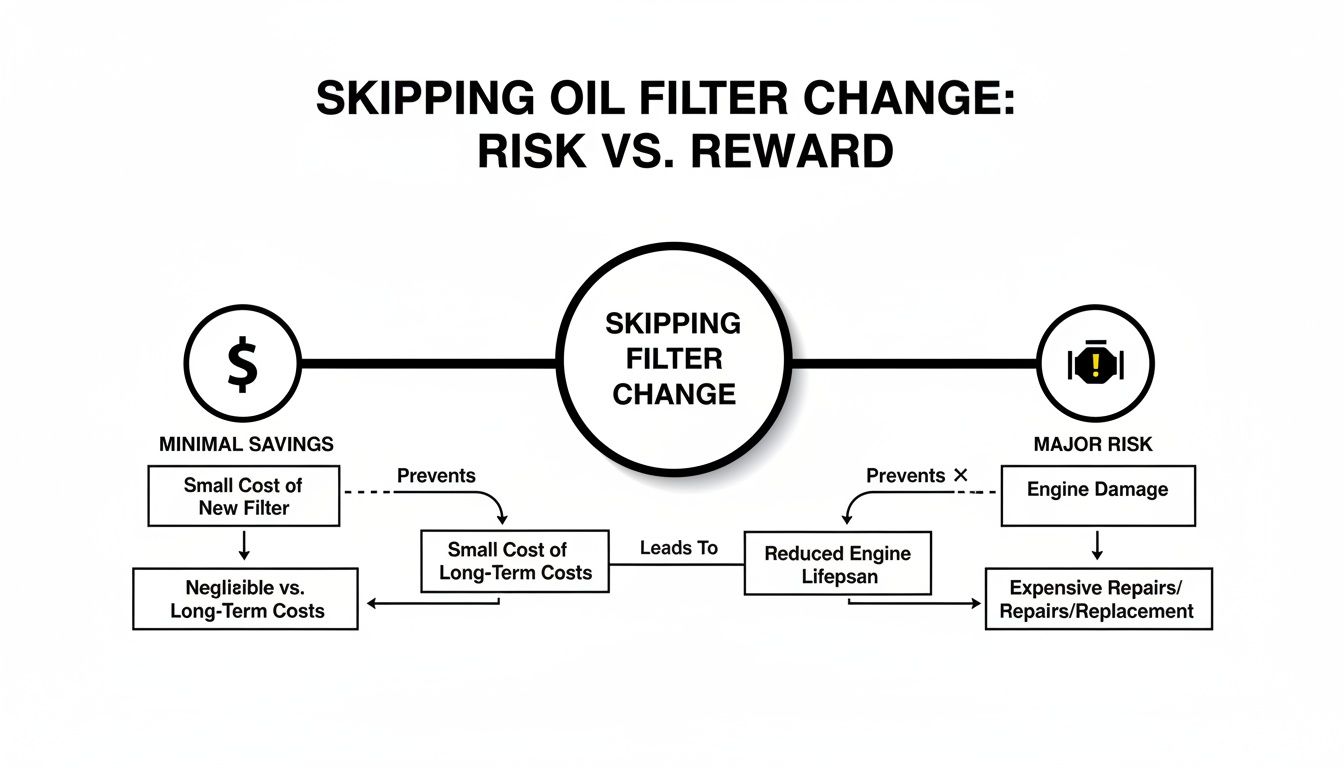
The tiny dollar sign compared to the huge engine warning light says it all. The potential for catastrophic engine failure just isn't worth the few bucks you might save on a filter.
When the Filter Clogs and Fails
An oil filter can only hold so much gunk. Once it’s full, it can't clean the oil anymore. When it gets saturated, something dangerous is designed to happen. To prevent the engine from being starved of oil (which would destroy it in seconds), every filter has a bypass valve.
When the filter gets too clogged for oil to pass through, this valve pops open. It’s a last-ditch failsafe to keep oil flowing, but it comes at a huge cost: the oil now completely bypasses the filter.
That means a steady stream of dirty, unfiltered oil—full of all the sludge and metal particles the filter was holding—is sent directly to your engine's most sensitive components.
Pouring fresh, clean oil into an engine with a clogged filter is like mopping the floor with a dirty mop. You’re just mixing the good with the bad and then circulating that contaminated sludge past the one part meant to clean it. The partnership is broken, and your engine is the one that suffers.
The Real Risks of Reusing an Old Oil Filter
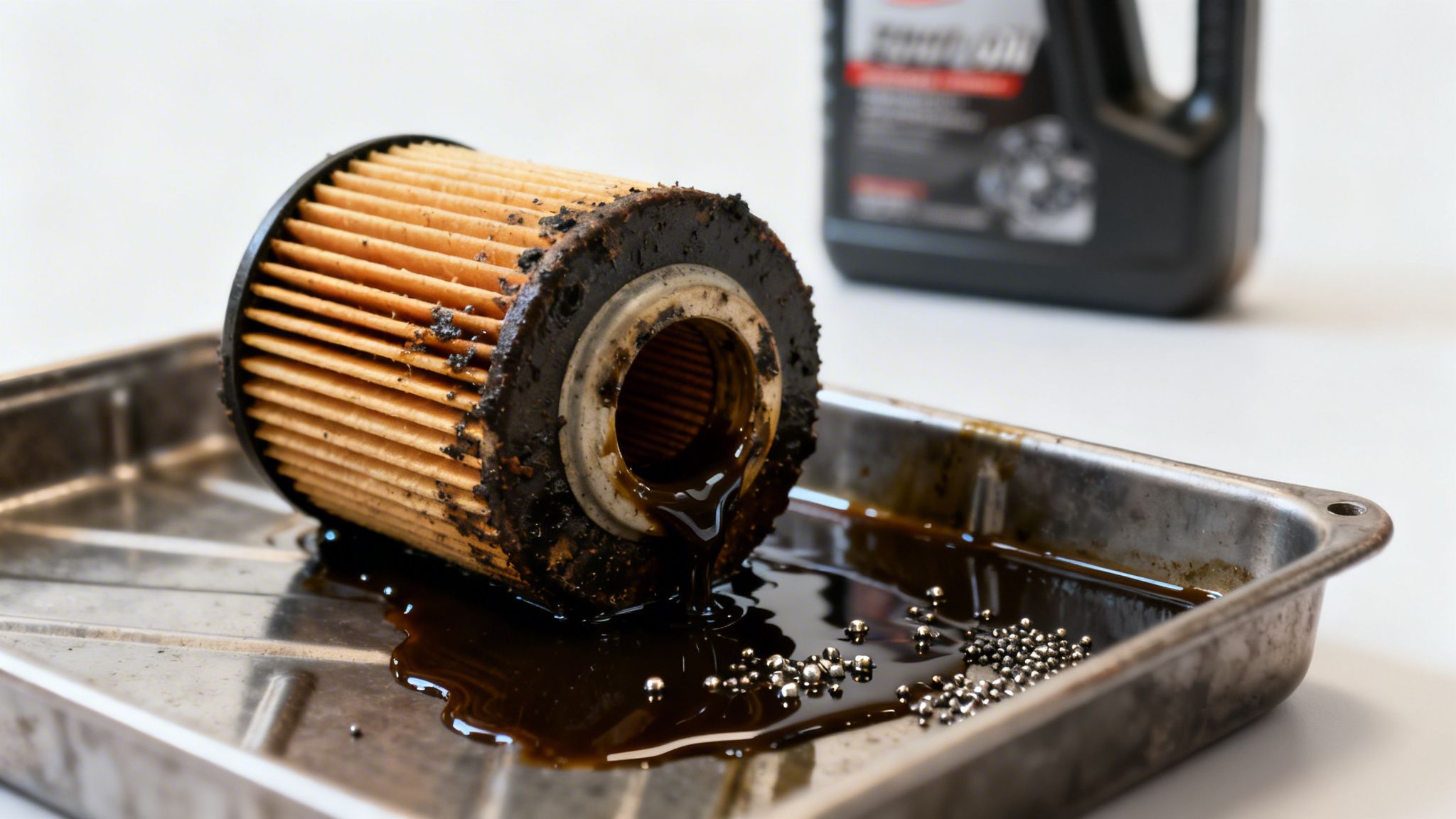
Let's stop talking theory and get down to the real, physical damage that happens when you change your oil but not the filter. An old filter isn't just a little dirty—it's completely saturated. Its ability to catch any new gunk is basically zero.
When you pour fresh, clean oil into your engine, it’s all for nothing if that oil’s first stop is a filter already packed with last month’s grime. The new oil is contaminated from the get-go, completely defeating the purpose of what you just did.
Here’s another way to think about it: a used filter can hold onto as much as a full quart of old, dirty oil. That means a shocking 20-25% of your "fresh" oil change is actually just the same old sludge that was already in there.
When you skip a filter change, you aren't just leaving a dirty part in place—you're actively sabotaging your new oil from the moment you start the engine. The minimal savings are immediately offset by the reduced effectiveness of the fresh oil.
The Bypass Valve Creates a Bigger Problem
It gets worse. Once that filter is totally clogged, something else happens. As we touched on before, the filter has a bypass valve that opens up to keep oil flowing and prevent the engine from seizing. That sounds like a good fail-safe, but it creates a much bigger, quieter problem.
With the bypass valve open, oil isn't being filtered at all. It's just going around it. Worse, the change in pressure can dislodge all the crud the filter worked so hard to trap. Suddenly, a concentrated blast of metal shavings, carbon, and sludge gets flushed right back into your engine.
This abrasive mixture then gets sent directly to your engine’s most delicate and critical parts. It’s like sandblasting your engine from the inside out. The damage isn't loud or immediate; it's a slow, grinding wear-and-tear that leads to one thing: premature engine failure.
The key parts at risk include:
- Engine Bearings: The soft metal bearings on the crankshaft and connecting rods get easily scratched by these particles. This is what leads to engine knock and, eventually, a seized engine.
- Camshafts and Lifters: These parts are responsible for your engine’s timing and breathing. When sludge builds up here, you’ll hear ticking noises, lose performance, and face some seriously expensive repairs.
- Cylinder Walls: Abrasive gunk can score the smooth cylinder walls. This ruins the seal, which means less compression, more oil burning, and a major loss of power.
A Recipe for Long-Term Damage
At the end of the day, changing your oil without changing the filter is just asking for accelerated engine wear. It's a bad bet where you're gambling a $15 filter against thousands of dollars in potential engine repairs or even a full replacement.
This isn’t just about following the manufacturer’s schedule; it's about protecting one of the biggest investments you have. Every oil change is your chance to hit the reset button on engine wear, and a new filter is a non-negotiable part of that process. It’s what allows your fresh oil to do its job and keep your engine running right for years to come.
The Rare Exceptions for Skipping a Filter Change
We always say to change your filter with your oil, and we mean it. It's the golden rule of auto care for a reason. But like any rule, there are a couple of very specific, very rare situations where you might bend it.
It's critical to understand that these are not part of a normal maintenance plan. They are one-off exceptions for unique circumstances, not a way to save a few bucks on your regular service. You have to be absolutely sure about your car’s condition and its service history before even thinking about it.
When It Might Be Acceptable
The main scenario involves high-end, long-life synthetic filters. Let's say you've invested in a premium filter rated for 15,000 miles, but you’re putting your vehicle through the wringer with severe driving—lots of heavy towing, constant stop-and-go traffic, or even track days.
In that case, you might decide to do an oil-only change at 7,500 miles. The thinking here is that your expensive, high-capacity filter is only at half of its lifespan and still has plenty of grit-grabbing power left for the fresh oil. This approach requires careful tracking and isn’t something we’d suggest for the average driver.
Another legitimate exception is a real emergency. Imagine you’re on a long road trip, your oil change light comes on, and you’re stuck in a small town that doesn't carry the right filter for your car. If you absolutely have to get fresh oil in there to protect the engine, a "drain and fill" is better than running on old, broken-down oil.
This is just a temporary patch to get you back on the road safely. As soon as you get to a place with the right parts, you need to do another full oil and filter change to get things right.
It’s also worth mentioning that the reverse situation can happen. If you're curious about that, you can read our guide on whether you can change an oil filter without changing the oil to fix something like a leak.
At the end of the day, these scenarios are few and far between. The hassle and risk of trying to track your filter's life separately from your oil just isn't worth the tiny amount you might save. For over 99% of drivers, the standard advice holds true because it works. Changing your filter with every oil change is the simplest, safest, and most effective way to keep your engine protected for the long haul.
Why Quality Filters Matter More Than Ever
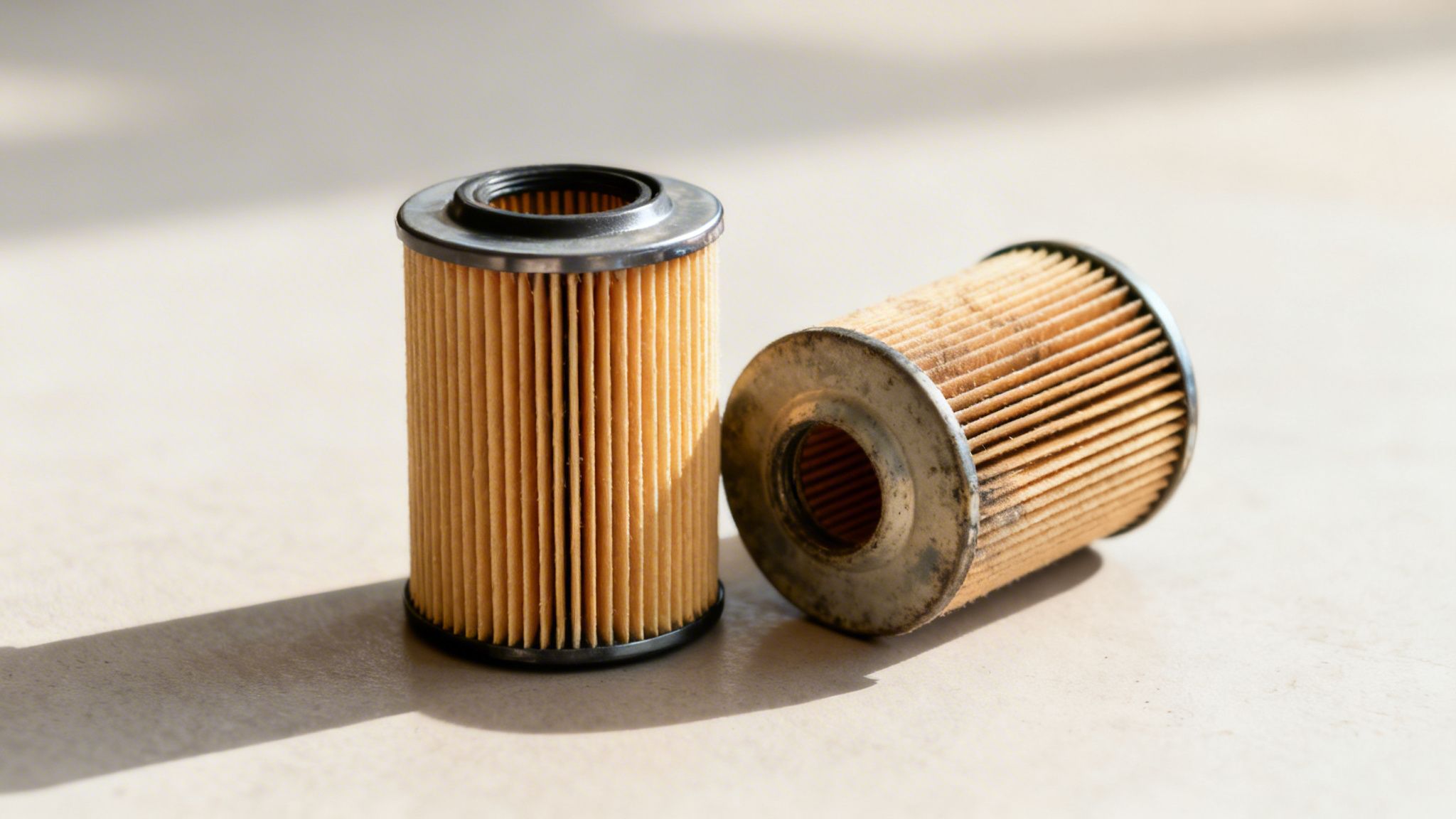
The world of vehicle maintenance has definitely shifted over the last decade. Modern full-synthetic oils now let you go 10,000 miles or even more between changes. While that's great for convenience, it puts a ton of pressure on your oil filter.
Think about it. That little canister has to work harder and longer than ever before, trapping grit and grime for thousands of extra miles. An old filter just wasn't built for that kind of marathon. Pushing it for a second round is asking for trouble.
The Filter as Your Engine’s Insurance Policy
This isn't just our opinion; the industry sees it too. The global oil filter market was valued at $4.86 billion in 2026 and is on track to hit $6.39 billion by 2030. That's not just about more cars on the road—it’s a sign of just how vital a good filter is for modern engines. You can see more on this trend in this detailed report.
When you change oil without changing filter, you’re making that old, clogged part the weakest link in your engine's protection. It’s like installing brand-new, high-tech locks on your house but leaving the back door wide open. You've wasted the money you just spent on fresh oil.
At Kwik Kar, we see it as our job to explain this. A premium filter isn't an upsell; it's essential insurance for your engine's health. A quality filter simply works better than a reused or budget one.
- Better Filtration Media: It catches the smallest, most damaging metal and carbon particles.
- Higher Capacity: It can hold much more gunk before it gets clogged and stops working.
- Stronger Construction: It's built to handle high oil pressure and long service intervals without failing.
A high-quality oil filter is one of the smartest and most cost-effective investments you can make in your vehicle's health. The dividends are paid out in engine longevity and the avoidance of expensive, preventable repairs down the road.
Picking a quality part isn't about the brand name. It’s about understanding the different materials and construction that go into it. If you're curious, take a look at our guide on the different types of oil filters to see exactly what makes a premium filter worth it.
Trust Kwik Kar for Your Complete Car Care
After weighing all the pros and cons, the bottom line is pretty straightforward: for the best possible engine health, you should always change your oil filter when you change your oil. It can be tempting to change oil without changing filter to save a few minutes or dollars, but taking that small extra step is the most powerful thing you can do for your car's long-term performance.
Here at Kwik Kar, we're not just another quick lube place; we see ourselves as your partner in keeping your car running right. Our technicians give honest, clear advice and will always recommend what’s truly best for your vehicle, not just what’s fastest.
Our Commitment to Quality Service
We know that good car maintenance starts with quality parts and fluids. That’s why we only use high-grade filters and premium oils that are a perfect match for your car, truck, or SUV. Our goal is to give you real value and peace of mind every time you visit.
We handle a wide range of services to keep you safe on the road:
- Comprehensive Oil Services: We always include a new, high-quality filter because we know it’s the only way to ensure your engine gets the clean lubrication it needs to thrive.
- Texas State Inspections: Our team provides fast and thorough inspections to keep your vehicle compliant and, more importantly, safe.
- Fleet Maintenance: We have programs designed specifically to keep your business's vehicles reliable and on the road, where they belong.
At Kwik Kar, our philosophy is simple: do the job right the first time. That means never cutting corners, especially when it comes to something as critical as your oil filter. Your engine's health is always our top priority.
Experience the Kwik Kar Difference
We make getting expert car care easy and affordable. You can trust our highly-rated team to make sure you drive away feeling confident that your vehicle is ready for whatever the road throws at it. Don't risk premature engine wear just to save a few bucks on a filter—it’s just not worth it.
Schedule your next service with Kwik Kar today and feel the difference that professional, thorough care makes.
Frequently Asked Questions
Even after you understand the risks, you probably still have a few practical questions. That’s normal. We hear them all the time at the shop, so here are some quick answers to the most common ones we get about skipping a filter change.
How Much Do You Really Save by Skipping an Oil Filter?
Let's be blunt: the savings are tiny. An oil filter for most cars and trucks costs somewhere between $10 and $20. It might feel like you’re saving a few bucks at the moment, but it's a terrible trade-off.
Think about the potential long-term cost. Contaminated oil wears out your engine faster, and that can lead to repairs easily costing thousands of dollars. Replacing engine bearings or a camshaft will make you wish you'd spent the extra pocket change on a filter. It's the cheapest insurance policy you can buy for your engine.
The risk of major, multi-thousand-dollar engine repairs is not worth the minor savings of skipping a $15 part. A new filter with every oil change is your cheapest insurance against premature engine failure.
Can I Use a Long-Life Filter for Two Oil Changes?
This is one of those situations where the answer is a very cautious "maybe, but we really don't recommend it." Some high-end synthetic filters are engineered to last up to 15,000 miles. If you're using a top-quality synthetic oil and changing it more often (say, every 7,500 miles because you do a lot of city driving), then you could technically reuse that filter one time.
But this strategy just adds risk and complication you don't need. You have to keep perfect records and only do it under absolutely ideal conditions with the right, premium products. For almost every driver out there, the simple, guaranteed protection you get from a fresh filter with every oil change is by far the safest bet.
What Happens If I Forgot to Change the Filter Once?
Don't panic. Accidentally forgetting to change the filter one time isn't likely to cause your engine to seize up on the spot. Modern engines are built with a bypass valve that will open if the filter gets totally clogged, preventing the engine from being starved of oil.
However, it does mean your brand-new oil immediately got dirty, and your engine ran on less-than-ideal lubricant for that whole cycle. It absolutely speeds up wear and tear on important parts. You should treat it as a close call. The best thing to do is get that old filter swapped out as soon as you realize the mistake. A quick filter-only change will get your engine back to being properly protected.
Don't gamble with your engine's health. For a professional oil and filter change using high-quality parts, trust the experts at Kwik Kar Oil Change and Auto Care. Schedule your service today and drive with confidence.