



TL;DR:
- Car maintenance costs vary widely based on vehicle make, model, and age, with averages around $900 to $936 annually. Regional labor rates, parts sourcing, and vehicle complexity influence quotes, making transparency and itemized estimates essential for budgeting. Electric vehicles typically cost less to maintain and require fewer repairs, but long-term costs depend on battery replacement expenses.
Most car owners assume maintenance costs are predictable. They’re not. Understanding how car maintenance costs are calculated reveals a system shaped by dozens of variables, from your zip code to your car’s country of origin. The average American spends around $900 to $936 yearly on routine maintenance and repairs, but that number masks enormous variation. A Honda owner and a Porsche owner are living in completely different financial realities. This guide breaks down exactly what drives those numbers, how shops calculate their quotes, and how you can budget realistically instead of getting caught off guard.
Table of Contents
- Key takeaways
- How car maintenance costs are calculated
- How your vehicle affects the numbers
- Methods for estimating maintenance costs
- Reading repair estimates the right way
- Budgeting for maintenance over time
- Our perspective on maintenance cost transparency
- Get transparent pricing at Kwik Kar Oil Change & Auto Care
- FAQ
Key takeaways
| Point | Details |
|---|---|
| Costs vary by vehicle type | Honda averages $583 annually while Porsche averages $1,623, showing how much make and model matter. |
| Labor is calculated by book time | Shops multiply standardized labor hours by their hourly rate, which ranges from $80 to $180. |
| EVs cost less to maintain | Electric vehicles average $420 to $660 per year, saving owners $600 to $900 compared to gas vehicles. |
| Costs are lumpy, not linear | Repairs don’t arrive on schedule, so a repair reserve fund matters more than a monthly average. |
| Itemized quotes protect you | Any estimate that doesn’t separate parts, labor, and fees is a red flag worth questioning. |
How car maintenance costs are calculated
When a shop hands you an estimate, that number is not a guess. It’s the result of a formula with several distinct parts, and knowing those parts puts you in a much stronger position.
Parts costs form the first layer. Shops source parts in three categories: OEM (original equipment manufacturer), aftermarket, and remanufactured. OEM parts come directly from your vehicle’s manufacturer and carry the highest price tag. Aftermarket parts are made by third parties and can cost 20 to 50 percent less, though quality varies significantly by brand. Remanufactured parts, such as rebuilt alternators or brake calipers, sit in the middle on both price and quality. Shops typically mark up parts by 25 to 50 percent above their wholesale cost, which is standard practice across the industry.
Labor charges are where most of the calculation happens. Shops use what the industry calls “book times,” which are standardized labor hours assigned to specific repairs by data publishers. A brake pad replacement might carry a book time of 1.5 hours. The shop then multiplies that figure by their hourly labor rate. Labor rates range from $80 to $180 per hour depending on shop type and location, with dealerships at the higher end and independent shops generally more affordable.
Diagnostic fees add another line to your estimate. When your check engine light comes on, most shops charge a diagnostic fee ranging from $75 to $150 to identify the problem. That fee may or may not be applied toward the final repair cost, so it’s worth asking upfront.
Beyond parts and labor, you’ll typically see these additional charges on any estimate:
- Shop supply fees: Charged for solvents, rags, and disposal. These should be 5 to 10 percent of labor cost or a small fixed fee. Anything significantly higher deserves a question.
- Taxes: Applied to parts and sometimes labor, depending on your state.
- Hazardous waste disposal: Common for oil changes and brake fluid flushes.
- Shop overhead markups: Built into labor rates to cover equipment, insurance, and facilities.
Regional labor rate differences can vary by 40 to 60 percent between urban and rural areas. A transmission service in Dallas will cost more than the same job in a small Texas town, even at shops with identical skill levels.
Pro Tip: Ask any shop whether their diagnostic fee is credited toward your repair total. Many shops do this automatically, but not all. A quick question before you authorize diagnostics can save you $100 or more.
How your vehicle affects the numbers
Your car’s make, model, age, and powertrain type all feed directly into the car maintenance price breakdown you’ll see on any estimate.
Make and model matter more than most people realize. Honda averages $583 annually in repair costs while Porsche averages $1,623. That gap comes from parts availability, parts cost, and the specialized labor required for luxury or performance vehicles. German brands like BMW and Mercedes-Benz tend to carry higher labor rates even at independent shops because their systems require specific diagnostic tools and expertise.

Vehicle age shifts the cost curve in a predictable direction. Newer vehicles under warranty have low out-of-pocket maintenance costs. Once a vehicle crosses 60,000 to 80,000 miles, wear items like timing belts, water pumps, and suspension components start demanding attention. Vehicles over 10 years old often face compounding repair needs, where fixing one system reveals stress on adjacent systems. The check engine light repair cost reached $554 in 2026, reflecting how even single diagnostic events can carry real financial weight on aging vehicles.
The comparison between electric vehicles and gas-powered cars tells a particularly clear story about how powertrain type shapes your long-term costs.
| Factor | Gas-Powered Vehicle | Electric Vehicle |
|---|---|---|
| Annual maintenance cost | $900 to $1,200 | $420 to $660 |
| Oil changes required | Yes (every 5,000 to 7,500 miles) | No |
| Brake wear | Standard | Reduced (regenerative braking) |
| Transmission service | Yes | Minimal |
| Annual savings vs. gas | Baseline | $600 to $900 |
| Common upkeep costs | Filters, belts, fluids, plugs | Tires, brakes, battery checks |
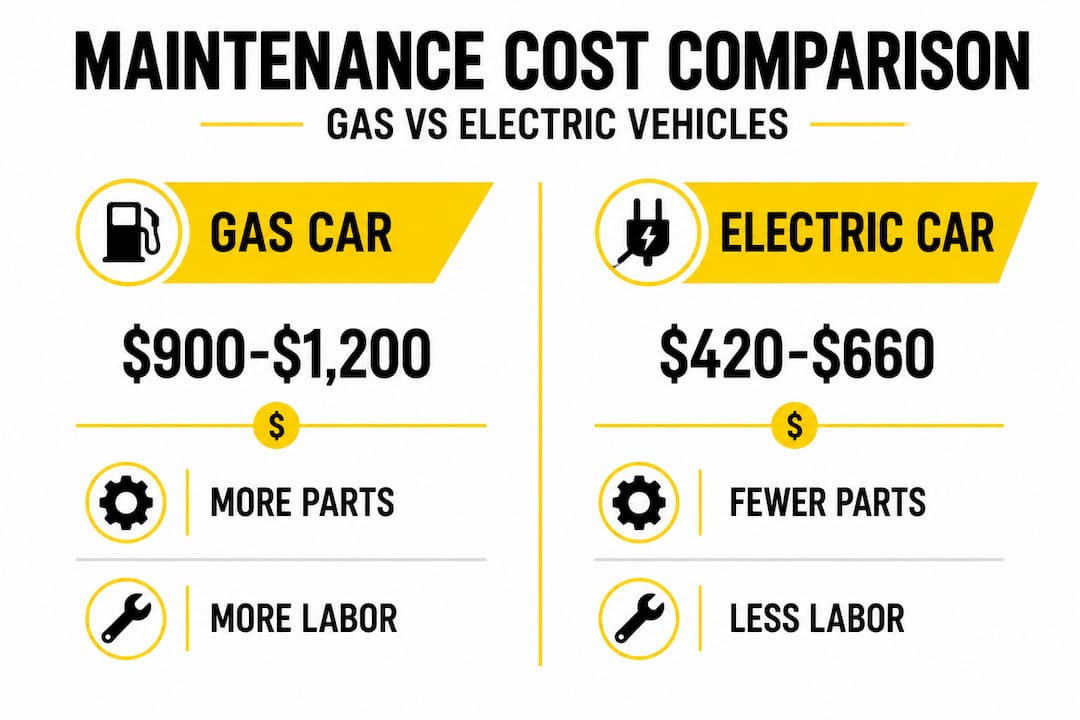
Electric vehicles save $600 to $900 annually compared to gas vehicles largely because they eliminate oil changes, have fewer moving parts, and experience less brake wear due to regenerative braking. That said, EV battery replacement, if needed outside warranty, can run $5,000 to $15,000, which is a cost that doesn’t appear in annual averages but belongs in any honest long-term budget.
Methods for estimating maintenance costs
Several approaches exist for calculating car service costs, and each has genuine strengths alongside real limitations.
The per-mile method
The per-mile approach assigns a cost to every mile you drive. Based on current data, comprehensive vehicle maintenance runs roughly 11 cents per mile or $1,650 annually for a driver covering 15,000 miles per year. This method works well for comparing vehicles or estimating annual budgets, but it smooths out the reality that repairs don’t arrive in neat, predictable increments.
The annual average method
This approach uses historical data to project what you’ll spend in a given year. It’s useful for setting a savings target, but it can mislead you into thinking you’ll spend roughly the same amount each year. In practice, you might spend $400 one year and $2,200 the next when a major repair surfaces.
Building a realistic budget step by step
Here’s a practical method for estimating vehicle maintenance costs that accounts for real-world variability:
- Start with your vehicle’s baseline. Look up average annual repair costs for your specific make and model using resources like RepairPal or Consumer Affairs. This gives you a grounded starting point rather than a generic average.
- Add scheduled maintenance costs. Use your owner’s manual to identify upcoming services by mileage interval. Price those services at local shop rates to get a concrete number for the next 12 months.
- Factor in your vehicle’s age and mileage. Vehicles over 75,000 miles should carry a 20 to 30 percent buffer above baseline estimates to account for increased repair frequency.
- Set aside a repair reserve. Savvy owners set aside separate funds anticipating irregular but significant repairs over time. A dedicated savings account with $50 to $100 per month works far better than relying on a monthly average.
- Use a tracking app. Tools that log your service history and flag upcoming maintenance needs help you stay ahead of costs rather than react to them. The best car maintenance apps can automate much of this tracking for you.
Pro Tip: When budgeting for car repairs, treat your vehicle like a rental property. Landlords don’t assume maintenance costs are zero between big repairs. They set aside reserves. You should too.
Reading repair estimates the right way
Getting a quote is only half the job. Understanding what’s in that quote is where most car owners lose money.
Transparent, itemized repair estimates should clearly separate parts costs, labor hours, the hourly labor rate, shop supply fees, and taxes. If a quote shows only a single total number, that’s a problem. You have no way to verify whether the labor hours are accurate or whether parts are priced fairly.
Here’s what to check on every estimate you receive:
- Labor hours vs. book time: Ask what book time the shop is using for your repair. You can cross-reference this with free tools online. Inflated labor hours without itemization are one of the most common ways overcharging happens.
- Parts sourcing: Ask whether OEM, aftermarket, or remanufactured parts are being used. This directly affects both cost and longevity.
- Shop supply fees: These should be modest. Anything above 10 percent of labor cost warrants a follow-up question.
- Diagnostic fee application: Confirm whether the diagnostic fee applies toward your repair total.
- Warranty on parts and labor: Reputable shops stand behind their work with at least a 12-month or 12,000-mile warranty.
“Data-driven repair estimates have replaced guesswork, utilizing industry-standard labor times and parts pricing for fair quotes.” — Auto Repair Cost Guide 2026
When choosing between a dealership, an independent shop, or a national chain, consider that dealerships carry the highest labor rates but have factory-trained technicians for your specific brand. Independent shops often offer lower rates with comparable quality, especially for choosing the best auto repair service that holds ASE certification. National chains offer consistency but vary widely by location.
Budgeting for maintenance over time
Knowing what influences car maintenance fees is only useful if you translate that knowledge into a financial plan. Here’s how to do it.
The 8% rule offers a practical starting point. Total monthly car expenses including your payment, insurance, fuel, and maintenance should not exceed 8 percent of your gross monthly income. If your car costs are running higher than that, you’re carrying more financial exposure than is sustainable.
A few strategies that work in practice:
- Separate depreciation from maintenance in your budget. Depreciation is the largest ownership cost for newer vehicles, but it’s not a cash expense. Tracking it separately keeps your maintenance budget honest.
- Build a repair reserve fund. Car maintenance costs don’t occur evenly; owners should keep a repair reserve fund rather than rely solely on averaged monthly budgets. Even $75 per month adds up to $900 per year, which covers most routine surprises.
- Stay current on scheduled maintenance. Following your car maintenance checklist consistently is the single most effective way to prevent small issues from becoming expensive repairs.
- Track every service visit. Logging your maintenance history helps you spot patterns, anticipate upcoming costs, and prove proper care if you sell the vehicle.
- Review costs annually. Reassess your reserve fund each year based on your vehicle’s age, mileage, and any new issues that emerged.
Our perspective on maintenance cost transparency
I’ve seen the same situation play out hundreds of times at Kwik Kar Oil Change & Auto Care. A customer comes in frustrated, not because the repair was expensive, but because they never saw it coming. Nobody had explained to them how the numbers worked or what to expect as their vehicle aged.
What I’ve learned is that the biggest source of financial stress around car maintenance isn’t the cost itself. It’s the surprise. When you understand that repair costs are inherently lumpy, that a quiet year can be followed by a $1,500 repair month, you stop treating your car budget like a fixed utility bill and start treating it like what it actually is: a variable expense that rewards preparation.
My honest take on estimates: any shop that won’t give you an itemized quote before starting work is not a shop you should trust with your vehicle. Transparency in pricing isn’t a courtesy. It’s a baseline standard. At Kwik Kar Oil Change & Auto Care, we provide written estimates before any work begins because we believe you deserve to understand exactly what you’re paying for and why.
The car owners who manage maintenance costs best aren’t the ones who spend the least. They’re the ones who plan the most.
— Kwik Kar
Get transparent pricing at Kwik Kar Oil Change & Auto Care
If this guide helped you understand what goes into your repair bill, the next step is finding a shop that actually prices that way.

At Kwik Kar Oil Change & Auto Care, our ASE Certified Master technicians provide written, itemized estimates before any work begins. We’re proud to be RepairPal and NAPA AutoCare certified, which means our labor rates and parts pricing are benchmarked against industry standards, not guesswork. Whether you need routine maintenance or a more involved repair, you can review our full auto repair services and take advantage of current specials to keep costs manageable. Budget-conscious drivers can also access a $30 off maintenance coupon to reduce out-of-pocket costs on their next visit.
FAQ
How are car maintenance costs calculated?
Car maintenance costs are calculated by combining parts costs, labor charges based on standardized book times multiplied by the shop’s hourly rate, diagnostic fees, shop supply fees, and applicable taxes. Regional location and shop type also affect the final total.
What is the average annual car maintenance cost in 2026?
The average American spends $900 to $936 per year on routine maintenance and repairs, though comprehensive costs including all upkeep reach approximately $1,650 annually for drivers covering 15,000 miles.
Why do car maintenance costs vary so much between vehicles?
Costs vary because parts availability, parts pricing, and required labor expertise differ significantly by make and model. Honda averages $583 per year in repair costs while Porsche averages $1,623, reflecting the real-world gap between accessible and specialized vehicles.
Are electric vehicles cheaper to maintain than gas cars?
Yes. Electric vehicles average $420 to $660 per year in maintenance costs, saving owners $600 to $900 annually compared to gas-powered vehicles, primarily because they require no oil changes and experience less brake wear.
What should an itemized repair estimate include?
A proper estimate should list the labor rate, total labor hours, a parts breakdown by item, shop supply fees, and taxes separately. Any estimate that shows only a single total without these details makes it impossible to verify whether the pricing is fair.