


You notice it while pulling out of a parking lot or merging onto Central Expressway. The steering wheel isn’t quite centered. The car drifts a little. On the highway, there’s a faint hum that wasn’t there a month ago. Then one day you look at the tires and one edge seems thinner than the rest.
That’s usually how uneven tire wear shows up. Subtly at first.
Most drivers think of tires as something they replace when the tread gets low. A mechanic looks at them differently. A tire is like a report card for the whole vehicle. It shows whether the air pressure is right, whether the alignment is still in spec, how the suspension is holding up, and sometimes even how the car is being driven day to day around Dallas.
Why Even Tire Wear Matters More Than You Think
A tire that wears evenly does its job the way it was designed to. It spreads the vehicle’s weight across the tread, grips the road more consistently, and gives you a more predictable feel when you brake, turn, or drive through standing water.
An unevenly worn tire does the opposite. It can make the vehicle pull, shake, hum, or feel unsettled on rough pavement. It can also shorten the life of the tire and make the car less efficient. That means you’re not just dealing with a maintenance issue. You’re dealing with a safety and cost issue at the same time.
In Dallas, that matters more than a lot of people realize. Dry heat, sudden rain, potholes, freeway expansion joints, and stop and go traffic all put extra stress on tires. If the tread is wearing more on one side or in one patch, the tire can’t grip the road evenly when you need it most.
Uneven wear usually starts as a small clue in the way the car feels before it becomes a visible problem in the tread.
A lot of drivers only check their tires when they’re already shopping for replacements. That’s late. A quick monthly look can catch a pressure issue, an alignment problem, or a suspension concern while it’s still cheaper to fix. If you want a good starting point, these tire maintenance tips from Kwik Kar are a practical checklist.
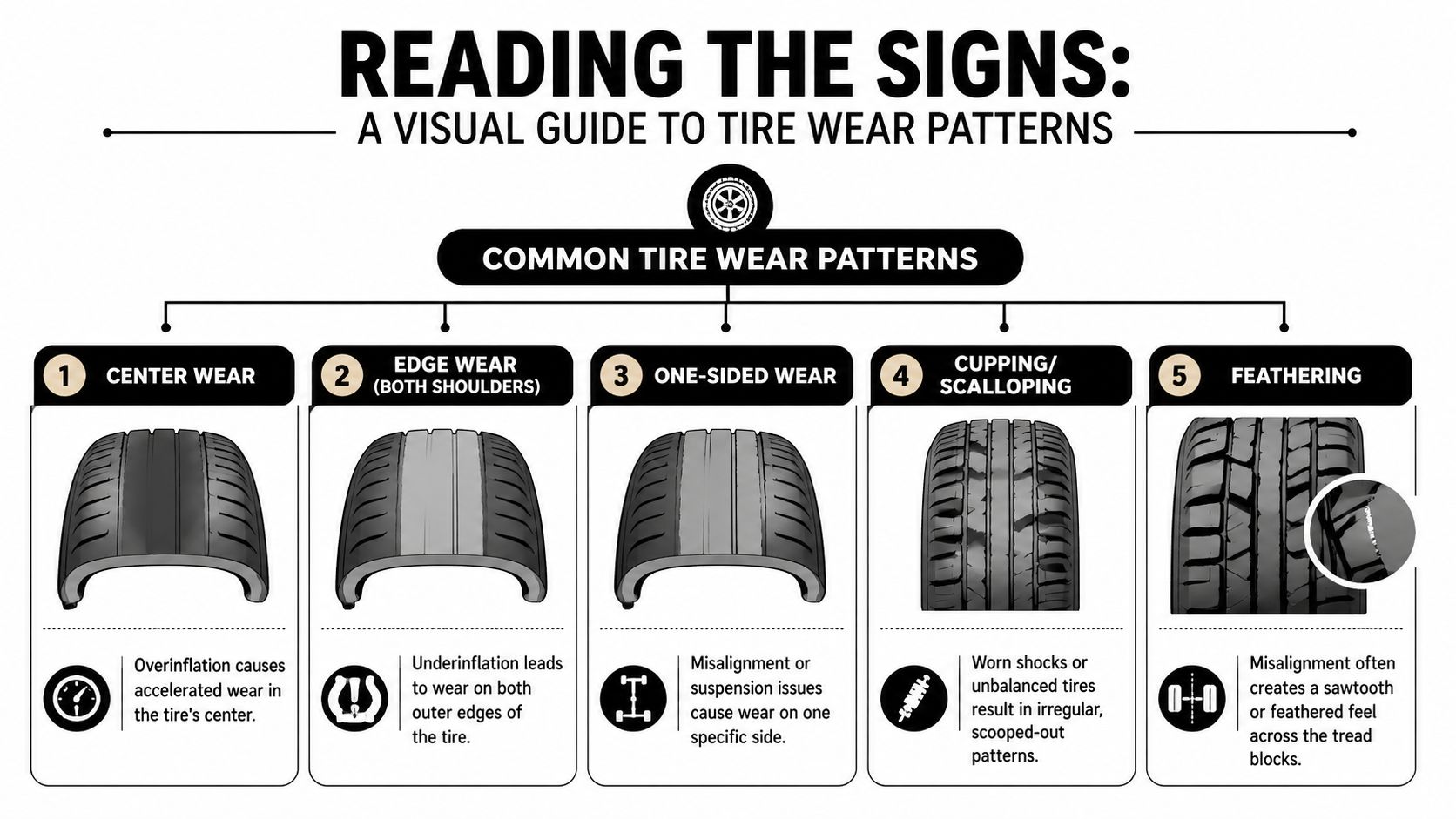
Reading the Signs A Visual Guide to Tire Wear Patterns
Your tires wear in patterns. Once you know what those patterns look like, you can often spot the problem before a warning light comes on or the ride gets rough.
Center wear
Look at the middle of the tread. If the center is wearing down faster than the edges, that’s center wear. Consider the action of walking on tiptoes. More pressure lands in the middle, so the center does most of the work.
Drivers sometimes miss this because the tire can still look decent from a few feet away. Up close, the center rib tells the story.
Edge wear on both sides
If both shoulders are more worn than the middle, that’s edge wear. It often looks like the tire is balding on both outer edges while the center still has life left.
This pattern is easy to picture if you think about a backpack overloaded on both ends. The outside edges carry too much of the strain. You might also notice the tire looks a little tired or flattened when parked.
One-sided wear
When only the inside edge or only the outside edge is wearing, that’s one-sided wear. One shoulder gets chewed up while the rest of the tread still looks usable.
This is one of the most important patterns to catch early because it usually points to a wheel angle problem, not just normal wear. Many drivers only see the outside of the tire and miss heavy inside shoulder wear completely.
Feathering
Run your hand lightly across the tread. If it feels smooth in one direction and sharp in the other, that’s feathering. The tread blocks develop a sawtooth feel.
Feathering often comes with a slight road noise or a steering feel that seems off but not dramatic. It’s one of those wear patterns that says the tire is being scrubbed as it rolls.
Cupping or scalloping
This pattern looks uneven and patchy, with scooped-out dips around the tread. Instead of a smooth, consistent surface, the tire has high and low spots.
Cupping often comes with a humming or thumping sound that gets louder at speed. Some drivers describe it as sounding like a bad wheel bearing when it’s a tire issue.
Quick pattern reference
| Wear Pattern | Appearance | Primary Cause |
|---|---|---|
| Center wear | Middle tread wears faster than shoulders | Overinflation |
| Edge wear (both shoulders) | Both outer edges wear faster than center | Underinflation |
| One-sided wear | Inner or outer shoulder wears much faster | Misalignment or suspension issue |
| Feathering | Tread blocks feel sharp one way, smooth the other | Alignment, often toe-related |
| Cupping/scalloping | Dips or wavy patches around tread | Worn suspension or wheel imbalance |
Garage check: Turn the steering wheel to expose the front tire tread and compare the inner edge, center, and outer edge. Don’t just glance at the sidewall.
The Prime Suspects Improper Inflation and Misalignment
A lot of uneven tire wear starts with two simple problems. The tire is carrying the wrong amount of air, or it is rolling at the wrong angle.
In Dallas, both happen all the time. One hard hit into a pothole on Central Expressway can knock alignment out. Weeks of stop-and-go traffic, curb contact, and long hot stretches of pavement can turn a small pressure mistake into a shortened tire life. For fleet managers, that same pattern repeats across every van, pickup, or service car in rotation, so a small maintenance gap becomes a real operating cost.
What bad tire pressure does to the tread
A properly inflated tire lays its tread flat on the road. That flat contact patch is what gives you even wear, predictable braking, and the mileage you paid for.
When pressure drops too low, the shoulders do more of the work. The center sags a bit, the sidewalls flex more, and the outer edges scrub away faster. When pressure is too high, the middle of the tread carries more load and wears down first. It works a lot like a shoe sole. If your weight stays concentrated on one strip instead of spread across the whole bottom, that strip disappears first.
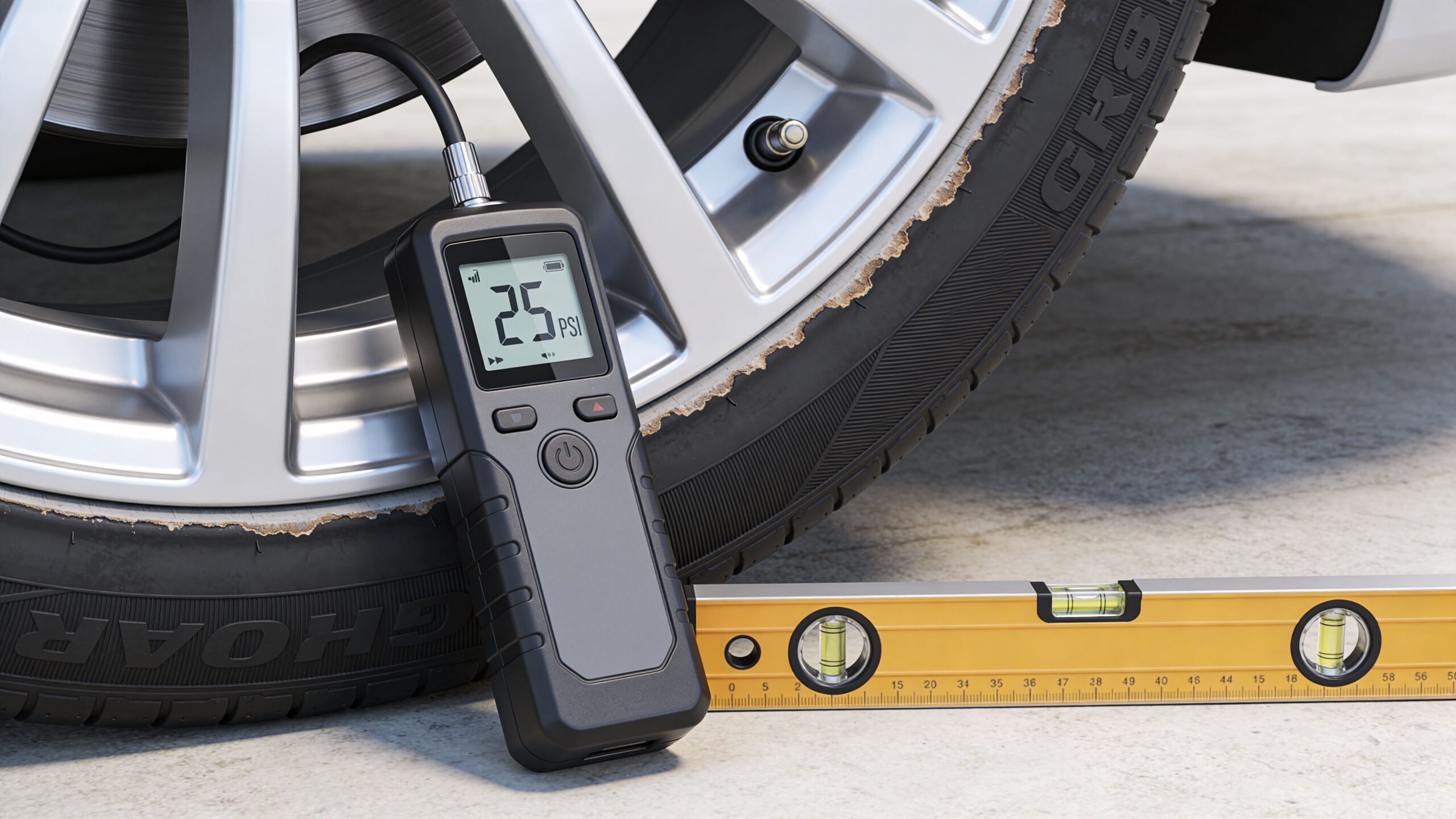
The pressure number that matters is the one on the driver’s door sticker or in the owner’s manual. It is not the maximum PSI molded into the tire sidewall. That sidewall number is the tire’s upper limit, not your vehicle’s target.
This catches Dallas drivers all the time. A tire can look fine in the driveway and still be low enough to wear badly, especially after temperature swings or a slow leak from road debris. Fleet vehicles have an added problem. Different drivers may notice handling changes at different times, so a pressure issue can stay in service longer than it should.
How misalignment scrubs a tire away
Alignment is just wheel positioning. The tires need to meet the road at the correct angles so they roll straight instead of dragging slightly sideways.
Two alignment settings cause a lot of tread trouble. Camber is the inward or outward tilt of the tire when you look at the vehicle from the front. Toe is whether the tires point slightly inward or outward when you look from above. If your shopping cart had one wheel pointed off to the side, it would scrub instead of rolling cleanly. A misaligned tire does the same thing every mile.
That is why one shoulder can wear out while the rest of the tread still looks usable. It is not just “old tire” wear. It is the rubber being ground off from one side because the wheel angle is off.
In real-world shop visits, misalignment often shows up after a pothole hit, curb strike, or worn steering part. If a loose steering component is part of the problem, a technician may also need to inspect items such as bad tie rod ends that can let alignment drift and chew up tread.
For commercial fleets, alignment problems deserve extra attention because the cost multiplies fast. One van with inner-edge wear is annoying. Ten vans doing it at once means more tire replacements, more downtime, and more fuel wasted from extra rolling drag.
Here’s a short visual if you want to see how alignment and tread wear connect in practical terms.
What drivers usually notice first
Pressure problems and alignment problems leave different clues.
- Pressure issues usually show up as wear on both outer shoulders, faster center wear, a softer feel, or fuel economy that slips for no obvious reason.
- Alignment issues often show up as pulling, an off-center steering wheel, feathering, or one inside shoulder wearing much faster than the rest.
- Both together can create a mixed pattern, which is common on vehicles that have gone too long between inspections.
If the car starts driving differently after a pothole, or if one tire looks newer in the middle than at the edges, check it early. Catching inflation or alignment trouble soon is much cheaper than replacing a tire that still should have had months of life left.
Secondary Causes Worn Suspension and Unbalanced Wheels
Sometimes the air pressure is correct and the alignment numbers still won’t stay put. That’s when you start looking harder at the hardware that holds the wheel in place.
Worn suspension parts
Shocks, struts, ball joints, bushings, and tie rods all help keep the tire planted at the proper angle. When these parts loosen or wear out, the tire can bounce, wobble, or change position as the vehicle moves down the road. That often creates cupping or irregular patchy wear.
A worn shock doesn’t always feel dramatic to the driver. The car may still seem drivable. But the tire can be skipping lightly over bumps instead of staying pressed evenly against the pavement. Every bounce leaves a mark in the tread.
If a technician aligns a car without catching a worn suspension part, the alignment may not hold. The tire wear comes back because the root problem never got fixed.
Unbalanced wheels
Wheel balance and wheel alignment get mixed up all the time, but they’re different jobs.
Alignment is about angles. Balance is about weight distribution around the wheel and tire assembly. If one part of the assembly is heavier, the wheel can vibrate at certain speeds. That vibration can contribute to uneven wear and road noise.
Here’s a simple way to separate them:
- Alignment problem usually shows up as pulling, off-center steering, feathering, or one-sided wear.
- Balance problem often feels like vibration at speed, especially through the steering wheel or seat.
- Suspension problem may show up as clunking, drifting, instability over bumps, or cupping.
A loose steering or suspension part can overlap with all of the above. That’s why a full inspection matters. If you’ve noticed wandering steering or uneven tread and want to understand one common culprit, this explanation of a bad tie rod and how it affects handling is worth a look.
How Your Dallas Commute Wears Down Your Tires
A typical Dallas workday can be hard on a set of tires. You leave the neighborhood, hit patched pavement, slow down for traffic on Central or LBJ, dodge a pothole too late, then turn into a parking lot with tight corners and rough entrances. By the end of that drive, your tires have been pushed, scrubbed, and jolted from several different angles.
That mix often creates uneven wear, not just normal wear.

Potholes and rough roads
Dallas roads can change a tire’s wear pattern fast. One hard pothole hit can nudge the alignment off just enough that the tire starts wearing more on one edge. In other cases, the impact stresses suspension parts, and the tread begins to show patchy spots or cupping over time.
A tire works best when it rolls flat and steady, like a shopping cart wheel that tracks straight. After repeated hits from broken pavement, it may stop rolling cleanly and start skimming, bouncing, or dragging slightly across the road. That small change is enough to leave a visible pattern in the tread.
This matters even more for pickups, vans, and work vehicles. A commercial fleet truck that spends all day on city streets, job sites, alleys, and delivery lots sees more impacts than a personal car driven mostly on the highway. For fleet managers, that means tire checks should be scheduled by mileage and route type, not just when a driver reports a problem.
Stop and go traffic leaves its own fingerprints
Steady highway driving usually wears tires more evenly than city commuting. Dallas traffic does the opposite. Frequent braking, quick takeoffs, lane changes, and tight turns into gas stations or office parks put extra scrub on the tread, especially on the front tires.
You can often feel that pattern before you fully see it. The tread may start to feel sawtoothed across the blocks, or the shoulders may wear faster from repeated turning and braking. If your route keeps you in traffic every day, regular tire rotation and alignment service becomes a money-saving habit, not just routine maintenance.
Smooth driving helps. Easier stops, gentler acceleration, and slower turns reduce the amount of tread being scuffed away on city streets.
Commercial vehicles wear differently from personal cars
Fleet vehicles usually have a tougher life. They carry changing loads, make more stops, climb curbs by mistake, and spend more time idling, turning, and restarting. That creates more chances for one tire to begin wearing differently from the others.
For an individual driver, uneven wear may mean replacing two tires earlier than expected. For a fleet manager, the same issue can spread across several vehicles and raise tire costs fast, especially if routes include rough industrial areas or construction-heavy parts of Dallas. A simple driver report about pulling, vibration, or new tire noise can catch a problem before it turns into a full set of prematurely worn tires.
Your Action Plan for Prevention and Repair
A good tire routine works like checking your roof after a hailstorm. You are not waiting for a leak. You are catching the small warning signs before they turn into a bigger bill.
That matters even more in Dallas. One hard pothole on Central Expressway or repeated curb contact during delivery stops can shorten tire life fast. For a family car, that usually means replacing tires early. For a fleet manager, it can mean the same avoidable wear pattern showing up across several vehicles.
A simple routine that prevents expensive surprises
Set a reminder once a month and do the check when the tires are cold. It only takes a few minutes, and it helps you spot a problem while the fix is still simple.
-
Check pressure with a gauge
Use the pressure listed on the driver’s door placard. The number on the tire sidewall is the maximum pressure, not the everyday target. -
Scan the full tread surface
Look at the inner edge, the center, and the outer edge. If one area is clearly lower than the others, the tire is telling you where the problem starts. -
Feel for roughness
Slide your hand lightly across the tread blocks. If it feels smooth one way and sharp the other way, that feathered pattern often points to an alignment issue. -
Listen during your normal drive
A new hum, thump, or droning sound can show up before uneven wear is obvious to the eye. -
Make a note after a hard hit
If you hit a pothole, curb, or road debris, pay attention over the next few days. A pull in the steering wheel or a fresh vibration is a strong clue that something shifted.
For fleets, add one more step. Ask drivers to report pulling, vibration, or tire noise at the end of the shift. That quick note can help catch one bad alignment before it chews through a whole set of tires.
Match the wear pattern to the next repair
Uneven wear is like a footprint. The shape points you toward the cause.
| What you notice | Likely next service |
|---|---|
| Both edges wearing | Tire pressure check and inspection |
| Center wearing | Pressure adjustment and tread inspection |
| Inside or outside edge wearing | Wheel alignment and suspension check |
| Feathering across tread blocks | Alignment inspection |
| Cupping or patchy dips | Suspension inspection and wheel balance check |
Rotation belongs in the plan too. It does not correct bad alignment or worn parts, but it helps spread normal wear across all four tires so one position is not taking the same beating month after month. If you want a clear schedule, this guide to tire rotation and alignment service explains how those two services work together.
When a driveway check is no longer enough
Once the wear pattern is easy to see, guessing gets expensive. A shop needs to measure what changed. That usually means checking inflation, inspecting steering and suspension parts, balancing the wheels, and measuring alignment angles with the proper equipment.
Kwik Kar Oil Change and Auto Care can handle that inspection work for sedans, SUVs, light trucks, and work vehicles.
Practical rule: Never replace an unevenly worn tire without finding the cause first. If the root problem stays in place, the new tire often starts wearing the same way.
When to Visit the Professionals at Kwik Kar
A Dallas pothole can turn a normal commute into a tire problem in one hit.
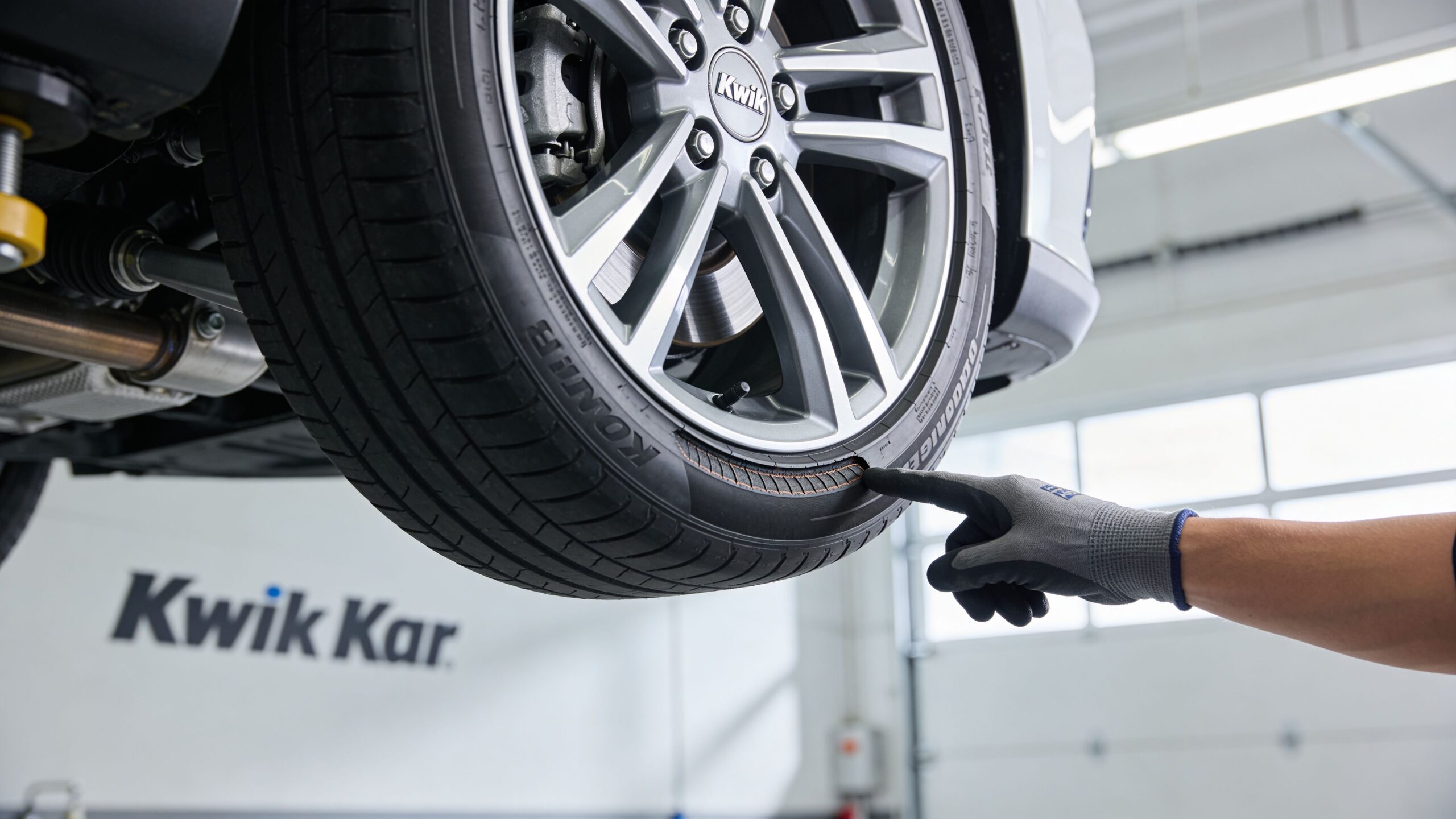
If your car suddenly pulls to one side on Central Expressway, vibrates once you get up to speed, or starts making a low droning noise that was not there last week, it is time to stop watching and start measuring. The same goes for one-sided tread wear, a tire that keeps losing air, sidewall bulges, exposed cords, or damage after hitting broken pavement. Those are not just tire-life issues. They are safety issues.
A good inspection needs more than a quick look in the parking lot. The technician should read the tread pattern, confirm air pressure, inspect steering and suspension parts, check wheel balance, and measure alignment angles with the proper equipment. Uneven wear works like a shopping cart with one bent wheel. You can still push it for a while, but it will keep fighting you and scrubbing rubber off in the wrong place.
Fleet vehicles need an even closer eye. If several vans or light trucks in the same operation show similar wear, that usually points to a repeatable cause such as route conditions, loading habits, pressure checks being skipped, or drivers hitting the same rough streets every day. In Dallas stop and go traffic, delivery vehicles and service trucks can chew through tires faster because they brake hard, turn often, and climb in and out of potholes all day.
EVs can add another wrinkle. Instant torque can wear tread differently than a gas sedan, especially if alignment is already slightly off. For commercial vehicles with dual rear tires, matching inflation side to side matters because one underinflated tire can end up carrying more than its share of the load.
For individual drivers, the rule is simple. If the tire looks different, the car feels different, or a pothole changed how it tracks down the road, get it checked soon. Catching the cause early is usually cheaper than buying a tire and then wearing out the replacement the same way.
Kwik Kar Oil Change and Auto Care handles inspection and diagnostic work for cars, SUVs, light trucks, and work vehicles. For fleet managers, that means looking for patterns across vehicles, not just fixing one tire at a time. For everyday drivers, it means finding out whether the problem is pressure, alignment, suspension wear, wheel balance, or a combination before the damage spreads. Kwik Kar Oil Change and Auto Care works on routine maintenance, diagnostics, alignments, and fleet service for Dallas drivers who want safer handling and longer tire life.