
When you hear "synthetic oil change," it's easy to think it's just a fancier, more expensive version of a regular oil change. But it's a whole lot more than that. It's a premium engine service that swaps out traditional, petroleum-based oil for a fluid that's been engineered from the ground up in a lab.
This process creates an oil that's purer and far more consistent, offering a level of protection and performance that conventional oil just can't match.
So, what really happens during a synthetic oil change? Think about it like this: a standard oil change is like getting a decent meal at a diner, while a synthetic oil change is like dining at a gourmet restaurant. Both will feed you, but the chef-prepared dish uses higher-quality, precisely selected ingredients for a vastly better result.
Synthetic oil is engineered at a molecular level to perform optimally under pressure. This isn't just about ticking a box for routine maintenance; it's a significant upgrade for your engine's long-term health. The global market for synthetic lubricants was valued at around USD 17.5 billion in 2022 and is still climbing, which tells you a lot about the industry's shift toward these advanced fluids. This explosive growth comes down to one thing: synthetic oil provides better viscosity control and resists breaking down under extreme heat and stress.
A synthetic oil change is a complete package, not just a simple fluid swap. It's designed to get the most out of your engine and extend its life. Here's what you can expect:
The real magic of synthetic oil is in its uniformity. The molecules are consistent in size and shape, which means less internal friction inside your engine. Less friction translates directly to better fuel efficiency, reduced wear on critical parts, and more reliable performance, especially in the tough stop-and-go traffic we see all over Dallas.
This advanced formula is exactly why you can go much longer between oil changes. If you're curious just how much further you can push it, check out our guide on the recommended synthetic oil change interval. At the end of the day, choosing this service is an investment in a lubricant designed to protect your engine from heat, sludge, and wear far more effectively than any conventional oil ever could.
To really get what a synthetic oil change is all about, it helps to understand how the oil itself is different from the traditional stuff. This isn't just about a fancy brand name or a higher price tag; the real distinction is happening at a molecular level, and it completely changes how the fluid protects your engine.
The core difference comes down to their origins. Conventional oil is refined from crude petroleum, while full synthetic oil is engineered from the ground up in a lab.
Think of it like this: imagine comparing a handful of rough, jagged stones to a handful of perfectly smooth, uniform marbles. The stones are like conventional oil—their inconsistent shapes and sizes create more friction and snag as they tumble past each other. The marbles, on the other hand, are like synthetic oil. Their identical size and flawless surfaces let them glide effortlessly, minimizing resistance and wear.
That analogy hits on exactly why synthetic oil performs so much better. Because it’s meticulously engineered, its molecules are pure and consistent. This uniformity delivers superior lubrication, cuts down on engine gunk, and keeps its protective qualities far longer than refined crude oil ever could.
When you pull into the shop for an oil change, you’ll generally have three choices. Each one strikes a different balance between performance and price, making them suitable for different vehicles and driving habits.
Conventional Oil: This is the old-school motor oil refined directly from crude. It offers basic lubrication and protection that's perfectly fine for many older, low-mileage cars with simpler engine designs. The downside is that it breaks down much faster under high heat and contains more natural impurities.
Synthetic Blend Oil: Just like the name implies, this is a hybrid mix of conventional and synthetic base oils. It gives you better protection and performance than conventional oil alone, but at a more budget-friendly price than going full synthetic. It's a solid middle-ground option for drivers looking for an upgrade without the full cost commitment.
Full Synthetic Oil: This is the top-tier performer, engineered for maximum protection and efficiency. It’s a rockstar in extreme temperatures—from scorching Dallas summers to chilly winter mornings—and resists breaking down under heat far longer. This is the oil that lets modern, high-performance engines run at their absolute best.
This graphic really breaks down the core qualities of synthetic oil.
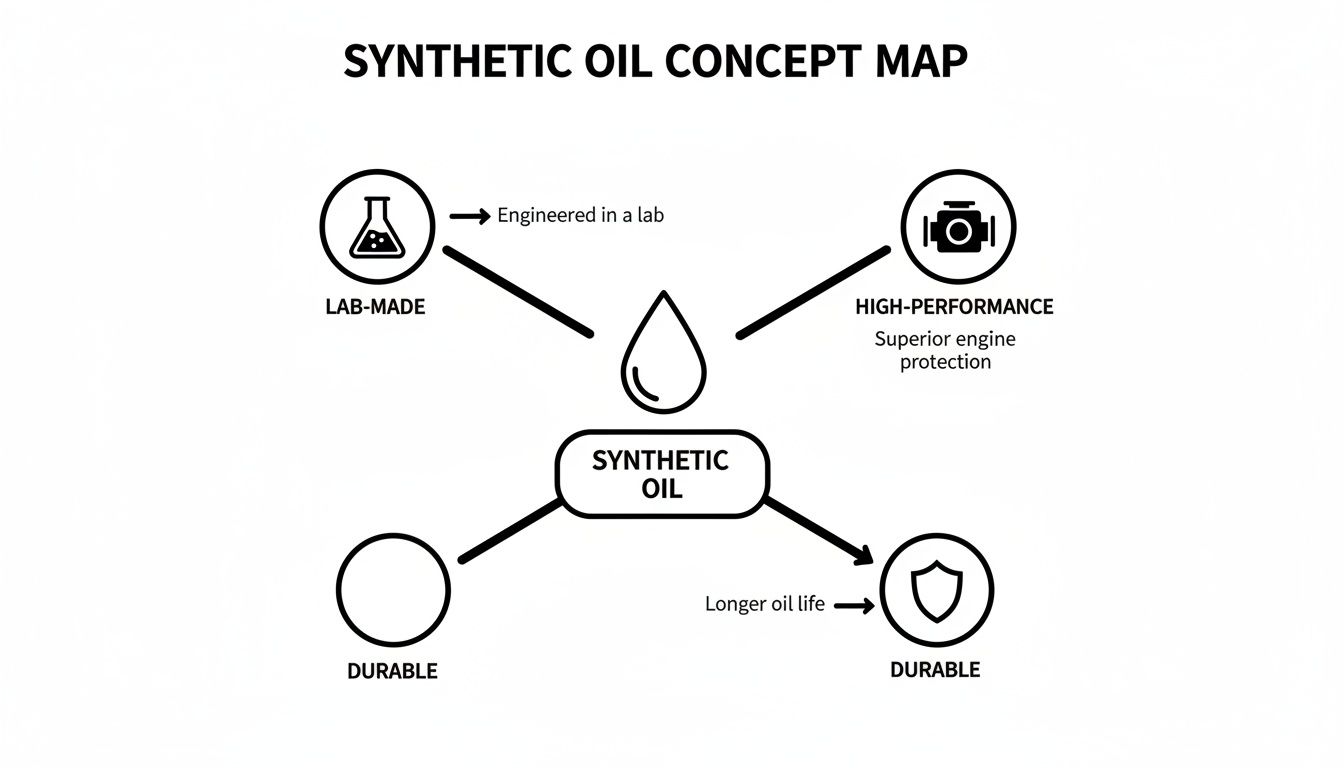
As you can see, the fact that it's lab-made is what gives it such high performance and durability—its key advantages over the other types.
To make the differences even clearer, here’s a quick side-by-side comparison.
| Feature | Conventional Oil | Synthetic Blend | Full Synthetic Oil |
|---|---|---|---|
| Origin | Refined from crude oil | Mix of conventional & synthetic | Chemically engineered in a lab |
| Purity | Contains natural impurities | Fewer impurities than conventional | Highest purity, uniform molecules |
| Performance | Basic, good for older engines | Improved protection & durability | Maximum performance & efficiency |
| Heat Resistance | Breaks down faster at high temps | Better resistance than conventional | Excellent stability in extreme heat |
| Cold Starts | Thicker in cold, slower flow | Flows better in cold than conventional | Flows easily, protects on startup |
| Oil Change Interval | 3,000-5,000 miles | 5,000-7,500 miles | 7,500-15,000 miles (or more) |
| Cost | Most affordable | Mid-range price | Highest initial cost |
This table shows how each oil type stacks up, balancing cost against performance and protection for your engine.
So, what’s the right call? It really depends on your specific vehicle, your driving style, and what your car's manufacturer recommends. While conventional oil gets the job done for some cars, the advanced engineering behind a full synthetic oil change offers benefits that are hard to ignore.
A full synthetic oil change isn't just a service; it's a preventative measure. The superior additives in synthetic oil actively clean your engine by preventing the formation of harmful sludge and deposits, which is a common issue with conventional oils over time.
This cleaner operation means much less wear and tear on your engine's critical parts, which can save you from some seriously expensive repairs down the road. For most modern vehicles, especially those with turbochargers or ones that see tough driving conditions, switching to synthetic is one of the smartest investments you can make in your car's long-term health.
Understanding the science behind synthetic oil is one thing, but how does all that technical jargon actually help you on your daily drive? The real value of a synthetic oil change becomes clear when you connect its superior engineering to the real-world demands on your vehicle—especially for drivers navigating the Dallas area.
This advanced lubricant offers practical, tangible benefits you’ll notice in your car's performance, your maintenance schedule, and even your wallet over time. Let's break down the four key advantages that make switching to synthetic a smart move for any driver.
Think of synthetic oil as a personal bodyguard for your engine's most critical parts. Its uniform molecules create a stronger, more resilient film over moving components, which dramatically cuts down on friction and wear. For anyone who’s ever been stuck in stop-and-go traffic on I-635, this means a whole lot less long-term stress on the engine.
This enhanced protection also wages a war against sludge and deposits. Synthetic oils are packed with powerful detergents and dispersants that keep your engine cleaner, preventing the nasty buildup that can choke performance and lead to expensive repairs down the road.
One of the most immediate perks is spending less time at the shop. Because synthetic oil resists breaking down so effectively, it lasts much longer than its conventional cousin. That means you can confidently go longer between oil changes.
This convenience translates directly to fewer appointments, less downtime for your car, and more freedom in your schedule.
Less friction doesn't just protect your engine; it helps it run more efficiently. When the internal parts move more freely, the engine uses less energy to do its job—and that means it burns less fuel. While the savings on a single tank might seem small, they can add up significantly over the life of your vehicle.
This isn't just a benefit for you, but part of a larger trend. The global shift toward synthetic lubricants is directly tied to automakers' goals of meeting stricter fuel-efficiency and CO₂ targets by reducing internal friction in modern engines.
Dallas weather can be completely unforgiving, with blistering summer heat and the occasional freezing winter morning. This is where synthetic oil really proves its worth.
During that intense Texas heat, conventional oil can thin out and lose its protective qualities. Synthetic oil maintains its viscosity, making sure your engine stays properly lubricated even on those 100°F+ days. On the flip side, it flows quickly during a cold start, providing immediate protection right when your engine is most vulnerable.
This is the number one question on every driver’s mind: does the higher price of a synthetic oil change actually pay off?
It's a fair question. The upfront cost is undeniably higher—often running between $65 and $125 per service. But looking at it as just another expense misses the bigger picture. It’s better to think of it as an investment in your engine’s health and your own time, one that often ends up saving you money in the long run.
Think of it less as a single purchase and more about your annual maintenance budget. A conventional oil change might look cheaper on the invoice, but its shorter lifespan means you'll be back at the shop more often. This is really about spending smarter, not just spending less on one visit.
Let's crunch the numbers for a typical driver covering about 15,000 miles a year. A conventional oil change is usually needed every 5,000 miles, which means you're looking at three services annually. A synthetic oil change, on the other hand, can easily last 10,000 miles or more.
As you can see, the total yearly cost is often very similar, and sometimes synthetic even comes out ahead. Plus, you gain a significant amount of time back by making fewer trips for maintenance.
The real value isn't just in the dollars and cents of the service itself. It's in the superior engine protection that helps you avoid far costlier repairs down the road. Better lubrication and cleaning action mean less wear and tear on critical components.
The economic argument for synthetic oil gets even stronger when you see how modern automakers are stretching out their recommended service intervals. A synthetic oil change might cost 30–50% more per visit, but because you can go 7,500–10,000 miles between changes, many drivers find their annual spend is the same or even lower.
This trend is a win-win. Individual car owners get to deal with fewer service interruptions, and commercial fleets can build more predictable and efficient maintenance schedules.
Ultimately, choosing synthetic oil is a strategic decision. It protects your vehicle, especially if you have a high-mileage engine that could use the extra care. Our complete guide on a high mileage oil change dives deeper into this topic. When you factor in fewer appointments and better engine longevity, that higher initial price often proves to be the smarter, more economical choice.
Plenty of bad information about synthetic oil is floating around, and it can easily steer you away from making the best choice for your vehicle. Persistent myths often create a lot of confusion, but getting to the facts is pretty simple. Let’s tackle some of the most common misconceptions head-on so you can feel confident about your next oil change.
One of the oldest myths is that switching to synthetic oil causes leaks in older cars. This idea dates back to a time when early synthetics could make engine seals shrink. That’s ancient history now. Modern synthetic oils are formulated with special seal conditioners that keep gaskets pliable and healthy, often helping to prevent leaks, not cause them.
If an older car does start leaking after a switch, it's not the new oil's fault. The synthetic oil is simply cleaning away years of sludge that was plugging a pre-existing leak—it just revealed a problem that was already there.
Another widespread belief is that once you go synthetic, you can never go back to conventional oil. This is completely false. Modern engine oils—whether they're synthetic, conventional, or a blend—are all designed to be compatible with each other.
You can switch back and forth between them at any oil change without a second thought. Just remember, if you do switch back to conventional, you’ll lose the superior performance and longer service intervals that synthetic oil provides.
The idea that synthetic oil is only for high-performance sports cars is another outdated notion. While it’s true that high-performance engines absolutely require it, the benefits—superior protection, better fuel economy, and longer engine life—are valuable for any vehicle. From a family SUV navigating Dallas traffic to a daily commuter sedan, every car can benefit.
Here's a quick reality check on these common myths:
Myth 1: Synthetic oil causes leaks in older cars.
Myth 2: You can’t switch back to conventional oil after using synthetic.
Myth 3: Synthetic oil is only for high-performance vehicles.
By clearing up this misinformation, it becomes easier to see that a synthetic oil change is a practical, smart upgrade for almost any driver looking to improve their vehicle's health and longevity.
Knowing synthetic oil is better for your engine is one thing, but seeing how that quality gets put to work during a professional service is what really counts. A top-tier synthetic oil change isn’t just about pouring new oil in. It's a careful process we've refined to get the most out of your engine and help it last longer, making sure every part gets the attention it needs.
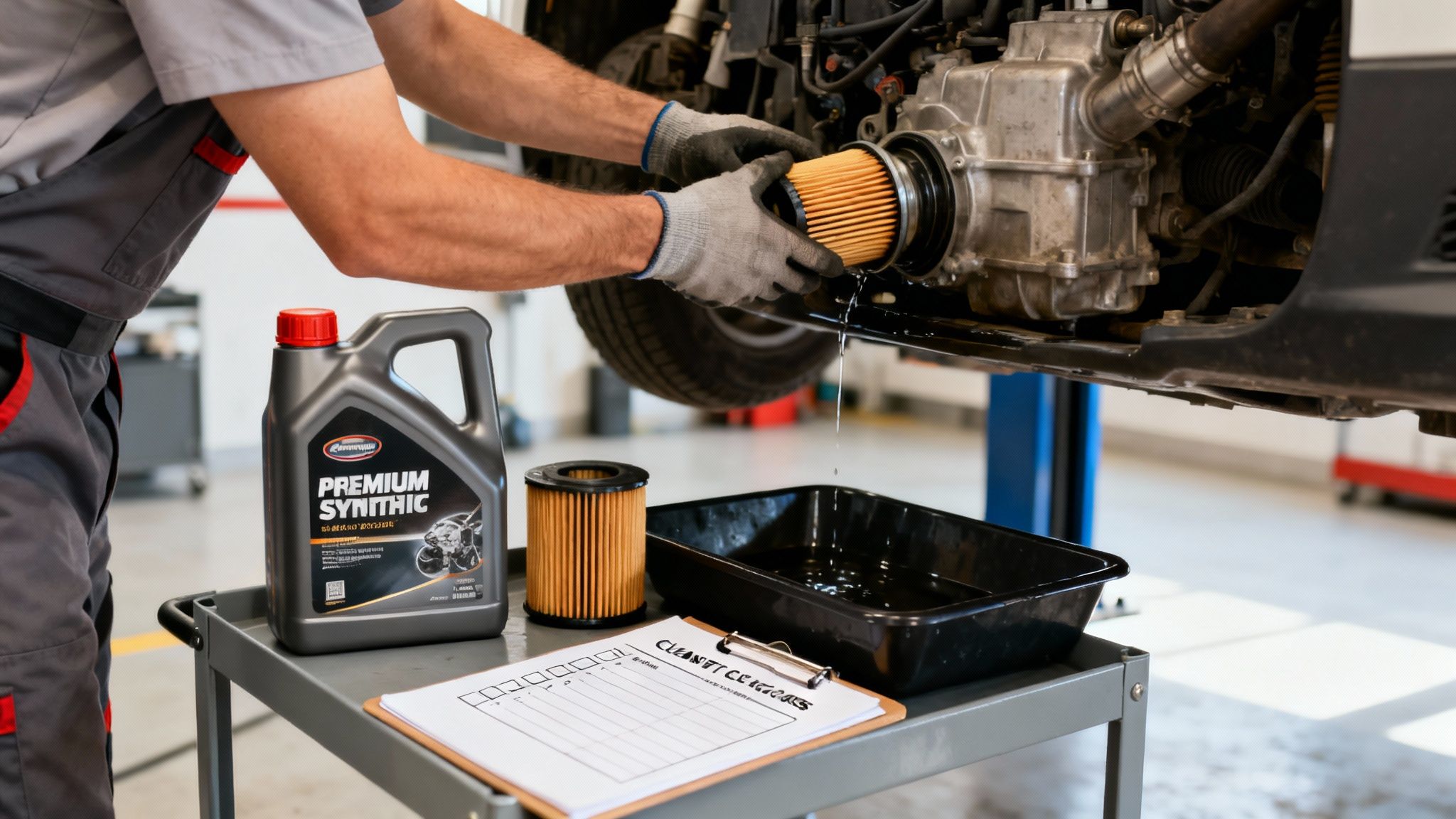
Here at Kwik Kar, we see this service as the foundation of good preventive maintenance. Our technicians are trained to handle each step with precision, starting with draining every last drop of old, dirty oil. Getting those harmful contaminants out is the only way to prevent unnecessary engine wear.
Our entire approach is built on doing things right and being completely transparent about it. We want you to pull out of our bay with total confidence, knowing your vehicle got comprehensive care. The heart of our synthetic oil change involves a few key steps that really separate a professional job from a basic one.
It all starts with picking the right filter. A premium oil filter is absolutely essential because synthetic oil is a powerful cleaner. It breaks down sludge and carbon deposits, and you need a filter that can effectively trap all that extra gunk. Our guide on the different types of oil filters dives deeper into why this small part plays such a huge role in your engine’s health.
Once we’ve installed a high-quality filter, we refill the engine with the exact grade and amount of full synthetic oil your car's manufacturer recommends. No guesswork here—just what your engine was designed for to ensure peak performance and protection.
Beyond just the oil change, every service we perform comes with a complimentary multi-point vehicle inspection. Our technicians will check your vehicle’s essential fluids, belts, hoses, and tire pressure to spot potential issues before they turn into major headaches.
This is an extra step we take as part of our commitment to your safety and your car's reliability. By pairing an expert synthetic oil change with a thorough inspection, we’re providing a complete maintenance solution that protects your investment and keeps you safe. We believe in offering a service that’s not just fast and convenient but also builds lasting trust through genuine quality and attention to detail.
Even after laying out all the benefits, you probably still have a few questions rolling around in your head about making the switch. That's completely normal. We've put together the most common questions we hear from drivers in our shop and answered them directly to help you feel confident about your decision.
Think of this as your quick-reference guide, reinforcing the most important takeaways.
Most modern cars are engineered to run on synthetic or synthetic blend oil right from the factory—it's what they need to meet today's performance and efficiency standards. The absolute best place to confirm this is your owner's manual.
But even if your manual doesn't strictly require it, any car that works hard will see huge benefits in engine protection and longevity from an upgrade. This is especially true for vehicles that have to deal with intense Dallas heat, endless stop-and-go traffic, or the strain of towing.
This is one of the biggest perks. Synthetic oil lasts a whole lot longer than conventional oil ever could. You can forget about that old 3,000-mile rule of thumb.
With a full synthetic oil, most automakers now recommend service intervals anywhere from 7,500 to 15,000 miles.
Your car's own oil life monitoring system is a fantastic guide for knowing precisely when it’s time for a change. If your vehicle doesn't have one, our expert technicians at Kwik Kar can give you a personalized recommendation based on your car and how you drive it.
Longer intervals simply mean fewer trips to the shop, which saves you both time and money over the course of a year.
Yes, you can mix them without causing any harm to your engine. In fact, that's pretty much what a synthetic blend is. If you're in a pinch and need to top off your oil, adding a quart of conventional is perfectly fine.
However, you have to remember that doing this dilutes the full synthetic, which dials back its superior performance and shortens its lifespan. To get the maximum protection and the longest time between services, you should always stick with a full synthetic oil change at your next appointment. This ensures your engine gets all the advanced benefits the oil was designed to deliver.
Ready to give your engine the superior protection it deserves? The expert technicians at Kwik Kar Oil Change and Auto Care are here to provide a professional, fast, and reliable synthetic oil change service. Schedule your appointment online today!