
A second opinion on auto repair is a diagnostic confirmation from an independent mechanic that either validates or challenges the first shop’s findings. Most car owners treat a repair estimate as final, but the auto repair industry has a well-documented diagnostic accuracy problem. Misdiagnoses happen even at reputable shops, not because of dishonesty, but because of incomplete testing, time pressure, and the genuine complexity of modern vehicles. Getting a second opinion protects your wallet, confirms the real problem, and gives you the confidence to approve or decline a repair with full information.
Why second opinion on auto repair matters more than you think
The core reason a second opinion matters is diagnostic error. AAA documents a case where a partial test led a shop to misdiagnose a timing chain problem when the actual cause was a faulty VVT solenoid. These two repairs are not remotely close in cost or complexity. That kind of gap is not unusual. It reflects the reality that auto diagnostics depend heavily on testing method, technician experience, and the time a shop is willing to invest in a single vehicle.
Second opinions in auto repair are not a statement of distrust toward your mechanic. They reflect the fact that testing quality and method differences between shops produce different conclusions. Two honest, skilled technicians can reach different diagnoses on the same vehicle. When that happens, the disagreement itself is useful information. It tells you that more evidence is needed before you commit to an expensive repair.
The financial case is equally clear. Second opinion costs of $50 to $100 on high repair estimates are financially sound decisions, especially when the original quote exceeds $500. Spending $75 to confirm or challenge a $1,200 repair is one of the highest-return decisions you can make as a car owner.

When should you get a second opinion on car repairs?
Not every oil change or brake pad swap requires a second look. But certain situations make a second opinion the smart move, not the cautious one.
- The repair estimate exceeds $500. At this price point, the cost of a second diagnostic is trivial compared to the potential savings or the risk of approving an unnecessary repair.
- The diagnosis is vague or hard to follow. If the technician cannot explain what test confirmed the problem, that is a red flag. A solid diagnosis comes with evidence, not just a conclusion.
- The problem keeps coming back. Recurring issues after a prior repair suggest the root cause was never correctly identified. A second opinion from a different shop can break that cycle.
- The repair affects safety or drivability. Brakes, steering components, suspension, and engine mounts are not areas where you want to gamble on a single opinion.
- You feel pressured to decide immediately. Legitimate shops give you time to think. Pressure tactics are a signal to slow down, not speed up.
Pro Tip: Before you leave the first shop, ask for a written copy of the diagnostic findings, including any fault codes pulled from the vehicle’s OBD system. This documentation is yours by right, and it gives the second shop a reference point without biasing their independent assessment.
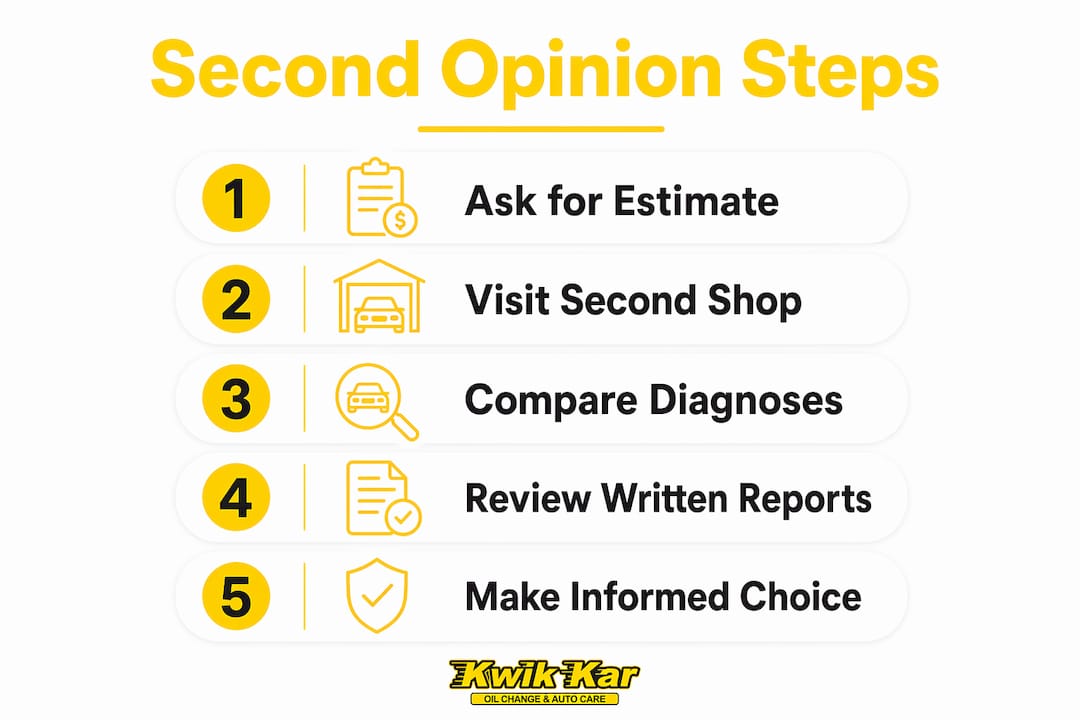
How to get a reliable second opinion on car repairs
Getting a useful second opinion requires more than just driving to another shop. The process matters as much as the destination.
- Do not share the first shop’s estimate. Withholding the first estimate prevents anchoring bias, where the second mechanic unconsciously adjusts their diagnosis to match or contrast the first. You want an independent assessment of your vehicle, not a reaction to someone else’s paperwork.
- Choose a shop with ASE-certified technicians. ASE certifications and transparent written estimates are the clearest signals that a shop operates with professional standards. Certification means the technician has passed standardized competency tests in specific repair categories.
- Ask for documented diagnostic evidence. Request fault codes, measurement readings, and photos of any damaged parts. Shops that provide diagnostic proof such as fault codes and photos build justified confidence in their recommendations.
- Compare the two diagnoses side by side. If they agree, you can proceed with confidence. If they disagree, ask both shops to explain the evidence behind their conclusion. Confirmation from two independent shops builds strong confidence. Disagreement should prompt you to ask for evidence, not to pick the cheaper option.
- Use RepairPal to verify pricing. RepairPal provides labor and parts cost ranges by zip code and vehicle, giving you a market baseline to evaluate both estimates objectively.
| Factor | First shop | Second shop |
|---|---|---|
| Diagnosis documented? | Ask for written fault codes | Confirm independently |
| ASE-certified technicians? | Verify before authorizing | Required for comparison |
| Itemized estimate provided? | Request before leaving | Compare line by line |
| Evidence shown (photos, specs)? | Ask specifically | Should be offered proactively |
| Pricing vs. RepairPal range? | Check after receiving estimate | Benchmark both quotes |
Pro Tip: Use the repair estimate comparison guide from Kwik Kar Oil Change & Auto Care to understand exactly what each line item on your estimate means before you approve any work.
Real-world examples showing how second opinions save money
The most compelling argument for second opinions is not theoretical. It is documented.
- A Motor1 report covers a case where a dealership quoted a customer $8,600 for a major repair. A second opinion from an independent shop identified the actual problem as a minor hose issue. The fix cost a fraction of the original quote. That single second opinion saved the owner thousands of dollars.
- The AAA timing chain case mentioned earlier is another clear example. A partial diagnostic test pointed to an expensive timing chain replacement. A second opinion with more thorough testing identified a VVT solenoid fault instead. The correct repair was significantly cheaper and addressed the actual problem.
“Getting a second opinion is generally wise before major or expensive repairs due to diagnostic complexity.” — AAA Car Doctor, May 2026
These are not edge cases. They represent a pattern that plays out in shops across the country every day. The importance of second opinion becomes obvious when you see how often the first diagnosis misses the mark on complex issues. A $75 diagnostic fee at a second shop is not an expense. It is insurance against a four-figure mistake.
Common red flags in auto repair estimates to watch for
Knowing when to seek a second opinion also means recognizing the warning signs in the estimate itself. Typical repair scams include vague explanations, pressure tactics, and non-itemized estimates. Here is what to watch for:
- No diagnostic evidence offered. If a shop tells you what is wrong but cannot show you the fault code, measurement, or physical evidence, the diagnosis is not confirmed. It is a guess.
- Estimates that seem unusually low or high. A suspiciously low quote may mean inferior parts or hidden labor charges. An unusually high quote may reflect unnecessary repairs or inflated labor rates.
- Pressure to approve work immediately. Phrases like “we need to start today” or “this is dangerous to drive” without supporting evidence are pressure tactics, not safety advice.
- Non-itemized estimates. A legitimate shop breaks down parts and labor separately. A single lump-sum number makes it impossible to verify what you are paying for.
- Reluctance to return old parts. Asking for your old parts back after a repair is a standard consumer protection practice. A shop that resists this request raises an obvious question about whether the part was actually replaced.
Verifying labor rates against resources like RepairPal or checking how auto repair pricing works gives you a factual baseline to evaluate any estimate you receive.
How second opinions help you choose a trustworthy mechanic
Getting multiple opinions on a significant repair is one of the most effective ways to identify which shops operate with honesty and which ones do not. The process of comparison reveals character.
- Shops that welcome second opinions and provide thorough documentation are signaling confidence in their work. That confidence is earned through accurate diagnostics, not marketing.
- Shops that discourage second opinions, refuse to provide written estimates, or cannot explain their diagnostic process are telling you something important about how they operate.
- Detailed repair records including fault codes, test results, part numbers, and software updates are also critical if you ever face a warranty dispute or lemon law situation. A shop that documents thoroughly is protecting you, not just covering itself.
Once you find a shop that provides written estimates, employs ASE-certified auto experts, and explains every line of the repair order, you have found a long-term service partner. That relationship is worth more than any single repair discount.
Pro Tip: When two shops give you conflicting diagnoses, do not default to the cheaper option. Ask both shops to walk you through the evidence. The shop that can show you the fault code, the measurement out of spec, or the photo of the damaged component is the one earning your trust.
Key takeaways
A second opinion on auto repair is the most cost-effective protection against misdiagnosis, unnecessary repairs, and overpriced estimates, and it works best when you withhold the first estimate and demand documented diagnostic evidence from both shops.
| Point | Details |
|---|---|
| When to get a second opinion | Any repair over $500, vague diagnosis, recurring problems, or safety-critical components. |
| How to keep it unbiased | Do not share the first shop’s estimate before the second mechanic assesses the vehicle. |
| What evidence to request | Ask for fault codes, measurement specs, and photos of damaged parts from both shops. |
| How to evaluate the results | Use RepairPal to benchmark pricing and compare itemized estimates line by line. |
| How to find a trustworthy shop | Look for ASE certifications, written estimates, and willingness to explain diagnostic findings. |
Our take on second opinions at Kwik Kar Oil Change & Auto Care
After years of working with car owners who arrive frustrated and confused by prior repair experiences, one pattern stands out clearly. The customers who feel most burned are not the ones who got bad advice once. They are the ones who approved expensive repairs without asking for the evidence first.
The most common scenario we see is a customer who received a large quote, felt uncertain, but approved the work anyway because they did not know they had options. A second opinion is not about doubting your mechanic. It is about understanding your vehicle well enough to make an informed decision. That distinction matters.
What we have learned from handling complex diagnostics is that the shops doing this right are not necessarily the most expensive or the most well-known. They are the ones who slow down, run the full diagnostic, and show the customer exactly what the data says. When two shops agree on a diagnosis with documented evidence, that agreement is worth more than any single opinion, no matter how confident the delivery.
The car owners who get the best outcomes are the ones who advocate for themselves with evidence. They ask for the fault codes. They request photos. They compare itemized estimates. They use tools like RepairPal. And when something does not add up, they get a second opinion before writing the check.
— Kwik Kar Oil Change & Auto Care
Get a transparent diagnosis at Kwik Kar Oil Change & Auto Care
If you are facing a repair estimate that does not feel right, or you simply want confirmation before approving costly work, Kwik Kar Oil Change & Auto Care provides the kind of evidence-based diagnostics that make second opinions genuinely useful.
Our ASE Certified Master technicians use current diagnostic tools and provide written estimates before any work begins. Kwik Kar holds certifications from both RepairPal and NAPA AutoCare, which means our diagnostic standards are independently verified. Whether you need a full auto repair service or a second opinion on a quote you received elsewhere, we give you the documentation and explanation you need to make a confident decision. Visit us in Dallas, TX, and leave with answers, not assumptions.
FAQ
When should you get a second opinion on a car repair?
Get a second opinion any time a repair estimate exceeds $500, the diagnosis is unclear, the problem keeps recurring, or the repair involves safety-critical components like brakes or steering. A $50 to $100 diagnostic fee is a sound investment against a potentially unnecessary large repair.
Does getting a second opinion mean you distrust your mechanic?
No. Second opinions reflect testing method differences between shops more than distrust. Two skilled technicians can reach different conclusions on the same vehicle, and comparing those conclusions with documented evidence leads to better outcomes.
Should you tell the second shop what the first shop said?
No. Withholding the first estimate prevents anchoring bias and gives the second mechanic the chance to assess your vehicle independently. Share the first shop’s findings only after the second diagnosis is complete.
What documentation should you request from each shop?
Request a written estimate itemizing parts and labor separately, the OBD fault codes pulled from your vehicle, any measurement readings out of specification, and photos of damaged components. Thorough repair documentation is also critical if a warranty dispute or lemon law claim arises later.
How do you find a trustworthy mechanic for a second opinion?
Look for shops with ASE-certified technicians, RepairPal or NAPA AutoCare recognition, and a clear policy of providing written estimates before work begins. Use resources like how to find a trustworthy mechanic to evaluate your options before committing to any shop.