



That sinking feeling when you turn the key and get nothing but a click… it's a frustration every driver dreads. Often, the culprit is a "parasitic drain"—a sneaky power leak from your car's electronics that saps the battery, even when the engine is off. This guide will walk you through how to test for a car battery drain and pinpoint the source, so you can tell the difference between a normal power draw and a real problem.
Why Your Car Battery Suddenly Dies
Have you ever left your car sitting overnight, only to come back to a completely dead battery? You're definitely not alone. This all-too-common headache is usually caused by a parasitic drain, a quiet, constant power draw that leaves your battery drained by morning.

It’s crucial to know that every modern car has some level of parasitic draw. Your onboard computers, security system, and even the clock and radio presets need a tiny, continuous trickle of power to remember their settings. This is perfectly normal and shouldn't drain a healthy battery.
The real trouble starts when a faulty component starts pulling more juice than it's supposed to. If you find your battery keeps dying without warning, it’s a big red flag that you have an excessive drain somewhere in the system.
Normal Drain Vs. Problematic Drain
So, what’s a normal amount of draw, and when does it become a problem? As a general rule, a newer vehicle can have a normal parasitic draw of 50 to 85 milliamps (mA). For older cars, anything under 50 mA is typically fine. A reading over 1 amp, however, is enough to kill a standard car battery overnight.
To help you figure out if your readings are cause for concern, here's a quick reference table.
Normal vs Problematic Parasitic Draw Levels
| Vehicle Type | Acceptable Draw (Milliamps) | Problematic Draw (Milliamps) |
|---|---|---|
| Older Vehicles (Pre-2000s) | Under 50 mA | 75 mA or more |
| Modern Vehicles | 50 – 85 mA | 100 mA or more |
| Vehicles with Advanced Tech | Up to 100 mA | 150 mA or more |
As you can see, what's considered "normal" depends heavily on your vehicle's age and technology. A higher reading is an immediate sign that a component is failing to shut down properly.
A few usual suspects are often behind a power drain that pushes your system into the red zone:
- Glove box or trunk lights that get stuck in the "on" position.
- Poorly installed aftermarket accessories, like custom stereos or alarms.
- Stuck relays that keep a circuit hot long after the car is off.
- Failing alternators with bad diodes that let current leak back out.
Prevention And Long-Term Care
Finding and fixing a drain is one thing, but preventing one is even better. If you know your car will be sitting for an extended period, understanding preventative measures like trickle charging for car batteries can be a game-changer. These devices deliver a slow, consistent charge that keeps the battery topped off without the risk of overcharging, ensuring your car is ready to go whenever you are.
How to Prepare for the Parasitic Draw Test
Getting this part right is everything. If you want an accurate reading for a parasitic draw test, you can't rush the setup. Messing up the prep work is a surefire way to get bogus numbers, sending you down a rabbit hole chasing a problem that isn’t even there.
Think of it like this: your car doesn't just instantly shut off. When you turn the key, a whole sequence of computers and modules begins powering down, one by one. To get a true reading, you have to let the car fall completely "asleep."
Gather Your Essential Tools
You won't need a professional-grade garage, but a few key tools are absolutely non-negotiable. Having them ready to go will make this whole process a lot smoother and, more importantly, safer.
- Digital Multimeter: This is your best friend for this job. You need one that can read DC amps (A) and, critically, can handle at least 10 amps of current. Using a multimeter with a lower amp rating will just blow its internal fuse, leaving you with no information.
- Wrench Set: You’ll need a wrench to get the negative battery terminal off. It’s usually an 8mm, 10mm, or 12mm nut. If you're in a bind, a small adjustable wrench can work too.
- Safety Gear: Don't skip this. Always put on safety glasses and a pair of gloves. The risk is small, but battery acid is no joke, and you never want to be caught off guard by an unexpected spark.
Pro Tip: If you can get alligator clips for your multimeter leads, do it. They clamp on and give you a secure connection, which is far better than trying to hold the probes steady by hand. If the connection breaks, you have to start the whole process over.
Let Your Car Go to Sleep
This is the single most common mistake people make. Right after you shut off the car and pull the key, its computers are still chattering away, saving settings and running their final shutdown checks before going into a low-power mode.
If you disconnect the battery too soon, you’ll measure all that activity and get a reading that looks like a massive electrical drain.
How long does it take? It really depends on your car's make and model, but waiting 30 to 60 minutes is a solid rule of thumb. During that wait, you can't do anything that might "wake up" the car. That means no opening doors, no clicking the key fob—nothing. Just shut it all down, close the doors, and give it some time.
Safely Disconnect the Battery
Once the car has had plenty of time to enter its sleep mode, it's time to disconnect the power. To keep yourself and your car's sensitive electronics safe, always disconnect the negative (-) battery terminal first. It’s almost always a black cable and will be marked with a "NEG" or a "-" symbol.
Use your wrench to loosen the nut on the terminal clamp. You only need to loosen it enough to be able to wiggle the cable off the battery post; you don't need to take the nut all the way off.
After the cable is free, make sure you position it somewhere it can't accidentally make contact with the battery post again. This is a simple but critical step to prevent sparks and protect your car’s computers from any voltage spikes. It ensures your whole test is safe and effective from the start.
Using a Multimeter to Measure Battery Drain
With your car prepped and settled into its low-power sleep mode, it's time for the moment of truth—getting a precise measurement of that parasitic draw. This is where your digital multimeter really earns its keep, letting you see exactly how much electricity is quietly slipping away when everything should be off.
Properly connecting the multimeter is absolutely critical. You're essentially inserting it directly into the circuit to measure the flow of current. Think of it like a water meter; you have to put it right in the pipeline to see how much is flowing through. This is what we call connecting in series.
Setting Up the Multimeter
Before you touch the battery, get your multimeter configured correctly. Start by plugging the black probe into the COM port. For the red probe, you'll want the port designed for higher current measurements, which is usually labeled 10A. Always start with this setting.
Next, turn the multimeter's dial to the DC Amps function. It's typically marked with an A and a straight line or simply DCA. Using the 10A setting provides a safe starting point, as some modules can cause a brief current spike when you first connect the meter.
These prep steps are simple but crucial. Don't skip them.
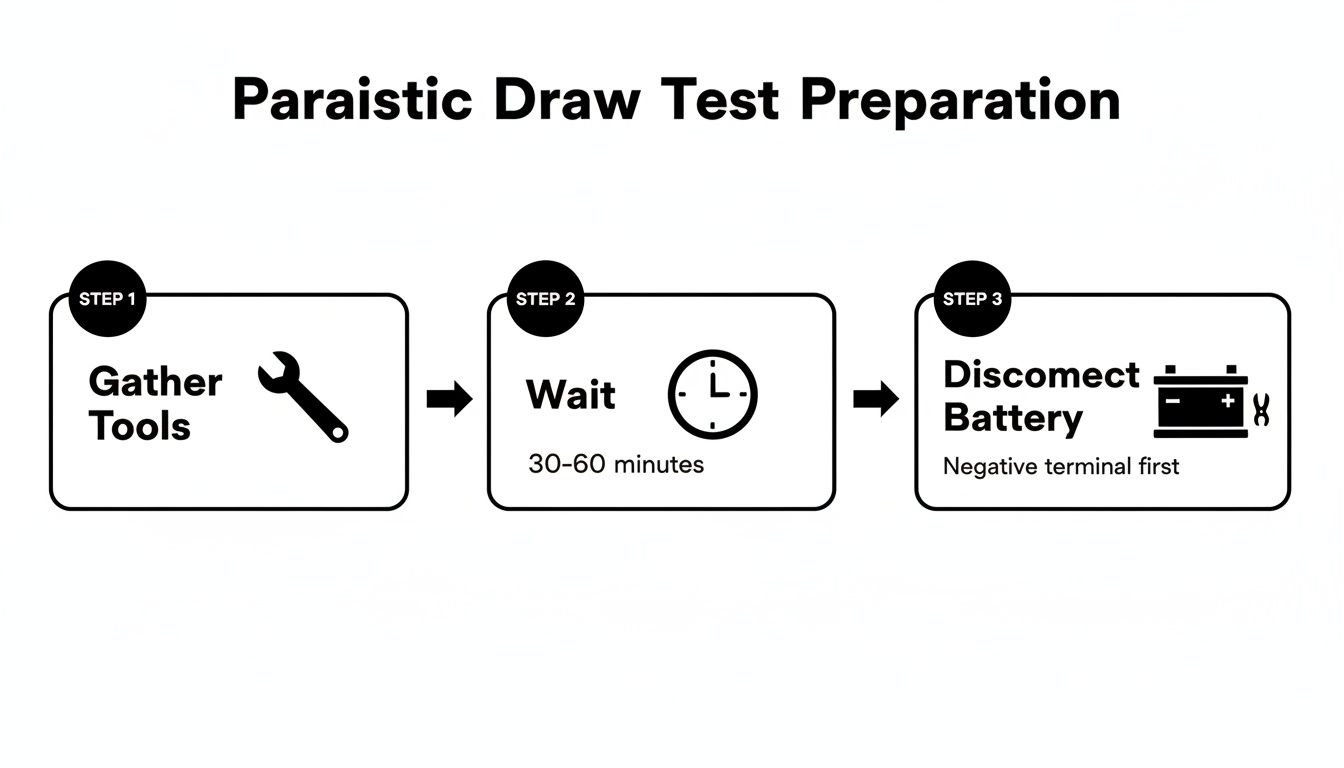
As you can see, the most important step is patience. Gathering your tools and pulling the terminal is quick, but waiting for the vehicle to go fully to sleep is non-negotiable for an accurate reading.
Connecting the Meter and Taking a Reading
Since you've already disconnected the negative battery cable, you'll now use your multimeter to bridge that gap. Securely connect one of the meter's probes to the negative battery post itself. Then, connect the other probe to the disconnected negative cable clamp. Your multimeter is now part of the circuit, and its display will show you the current draw in real-time.
You’ll almost certainly see an initial jump in the reading, maybe to 1 or 2 amps. Don't worry—this is normal. Connecting the meter can "wake up" a few of the car's computers. Just give it a minute or two for everything to go back to sleep and for the reading to stabilize.
Once the number settles, you have your baseline parasitic draw. Now, what do the numbers actually mean? The reading is in amps, but it’s easier to think about it in milliamps (mA).
- A reading of 0.04 on your meter is 40 mA. This is a great result and well within the normal range for most cars.
- A reading of 0.50 means a 500 mA drain. That’s a significant problem that could easily drain a healthy battery in just a day or two.
- A reading of 1.20 is a massive 1,200 mA (1.2A) drain. This is a severe issue that will kill your battery overnight, guaranteed.
If your final reading is below 0.085 amps (that's 85 mA), you're probably in the clear. If it’s higher, your next job is to play detective and find the circuit responsible for the excessive draw. Of course, this test assumes your battery is in good shape to begin with. For a deeper look at that, you can learn more about checking car battery health in our other guide.
Finding the Source of the Parasitic Drain
Okay, so you've confirmed your battery has a parasitic drain. That's the first hurdle. Now for the real detective work: figuring out what's causing it. Once you know your draw is higher than the acceptable 85 mA limit, your job is to pinpoint the exact circuit that’s secretly sipping power.
The classic way to do this is a simple but effective strategy called the "fuse pull test." With your multimeter still connected and displaying that high amp reading, you’re going to pull one fuse at a time. The moment you pull a fuse and see the meter drop back to a normal level—say, from 0.40A down to 0.03A—you’ve found your problem circuit.
The Systematic Fuse Pull Method
Most modern cars have at least two fuse boxes. You’ll usually find one under the hood and another inside the car, tucked away under the dash or in the driver's footwell. Your owner’s manual is your best friend here; it will show you exactly where they are and what each fuse protects.
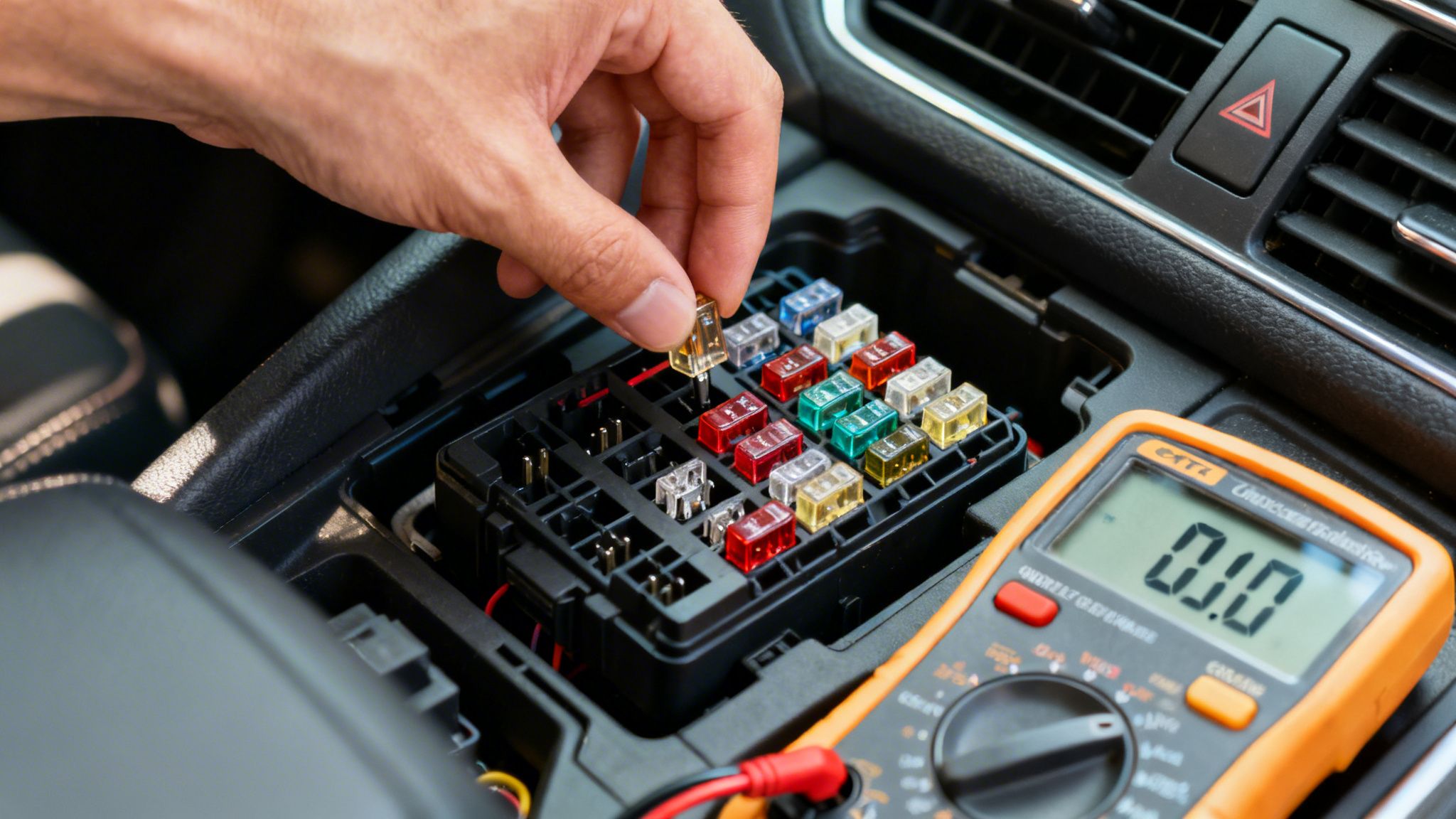
Grab a fuse puller tool (it makes life much easier) and start with one fuse box. Pull a fuse, then peek at your multimeter. If the reading is still high, pop that fuse right back into its slot and move on to the next one. You'll repeat this until, bingo, pulling one specific fuse causes that amperage reading to plummet.
From my experience, the usual suspects are often:
- Interior Lights: A glove box, trunk, or vanity mirror light with a faulty switch is a very common culprit.
- Radio/Audio System: Aftermarket stereos, especially if not installed perfectly, are notorious for staying partially powered on.
- Relays: A stuck relay for the fuel pump, AC, or another component can keep a circuit energized when it should be off.
- Power Seats or Mirrors: The control modules for these features can sometimes fail to go to sleep.
A Quicker Alternative: The Voltage Drop Test
Pulling dozens of fuses can get tedious, especially on newer cars packed with electronics. A much faster, and frankly more professional, method is the voltage drop test. This technique is great because you can test circuits without disconnecting anything, which prevents you from accidentally "waking up" any modules.
To do this test, set your multimeter to the DC millivolts (mV) setting. The battery stays connected normally—no need for the in-series setup from before. Just touch your meter's two probes to the tiny metal test points on the back of each fuse. A fuse on a circuit that’s completely off will read 0.0 mV.
If a circuit is actively drawing power, you'll see a small voltage reading across the fuse. Any reading above a few millivolts indicates that current is flowing through that circuit when it shouldn't be.
This is a fantastic way to quickly scan for "live" fuses. As a rule of thumb, a reading over 0.050 volts across a fuse is a big red flag that something is wrong. Extreme draws over 1 amp can drain a healthy battery overnight and are often caused by a bad control module or damaged wiring. You can find more in-depth info on how different draw sizes affect battery life from automotive resource sites like ALLDATA.
When a DIY Fix Isn't Enough
So you’ve pulled fuses, squinted at your multimeter, and maybe even followed a wire or two into the abyss, but that mysterious battery drain is still winning. It happens.
While the fuse pull test is a fantastic way to start diagnosing a parasitic draw, some electrical gremlins are just too good at hiding for a driveway diagnosis. Knowing when to hand the keys to a pro isn't giving up; it’s a smart call to save yourself a ton of time and frustration.
Some situations are notoriously tricky to solve without professional-grade equipment. If any of these sound familiar, it’s probably time to let a technician take a look.
- Intermittent Drains: This is the absolute most maddening problem. The battery is flat one morning but then works perfectly for the next three days. These on-again, off-again drains almost never appear during a test because, of course, the faulty part decides to behave when you're looking for it.
- Module Communication Errors: Modern cars are basically rolling computer networks. A Body Control Module (BCM) or another computer might not be shutting down completely, creating a steady drain that’s tough to trace. Pinpointing these requires advanced scan tools that can talk to each module individually and see what’s really going on.
- Complex Wiring Shorts: If a wire's insulation has rubbed thin and is making occasional contact with the car's metal frame, finding it with just a multimeter is like searching for a needle in a haystack. The short might only happen when you hit a bump or turn the steering wheel just so.
The Professional Diagnostic Toolkit
When you bring your vehicle to a shop like Kwik Kar, our technicians have access to tools that go far beyond a basic multimeter. For a really stubborn battery drain, we might break out an oscilloscope. This lets us see the electrical signals from different modules in real-time, catching split-second glitches a multimeter would completely miss.
We can also use thermal imaging cameras to scan the fuse box or specific components. These cameras instantly show "hotspots," which is a dead giveaway that a circuit is pulling current when it should be asleep. These tools change the game from guesswork to a precise, evidence-based hunt.
If you’re curious about what a full workup involves, you can learn more about a professional car diagnostic test and see how we track down these complex electrical issues.
The Impact of Driving Habits
Sometimes, the drain isn't a fault at all but a result of how you drive. A healthy battery sitting idle will naturally lose about 0.1 volts per month.
Short trips are especially hard on a battery. If your daily commute is under 10 minutes, the alternator never really gets a chance to fully replace the power used to start the engine. This constant state of under-charge can slash a battery’s lifespan from a normal 4-5 years down to just 2-3 years.
If you want to dig deeper, you can explore more about the factors that drain your car battery on CTEK.com. A professional service can check both your car's electrical system and your battery’s health to give you the full story.
Common Questions About Car Battery Drain
Even after you've run the tests, a few questions always seem to pop up. It's completely normal. Let's walk through some of the most common ones our technicians hear every day when they're tracking down a pesky battery drain.
Can a Bad Alternator Cause a Parasitic Drain?
You bet it can. In fact, a faulty alternator is one of the most frequent culprits we see for a major parasitic draw. Inside your alternator are components called diodes, which are supposed to act like one-way streets for electricity. When they go bad, that street opens up both ways, letting power leak right back out of the battery when the car is off.
This isn't a slow leak, either. A bad alternator diode can create a massive drain, often big enough to leave you with a dead battery overnight. If you've got a high amp reading you just can't track down, a professional alternator test is the next logical step to confirm if it’s the source of your troubles.
How Long Should I Wait for My Car to Go to Sleep?
This is where patience really pays off. Before you can get a true parasitic draw reading, all of your car’s computers and modules need to shut down and enter "sleep mode." This process can take anywhere from 30 to 60 minutes, depending on your vehicle's make and model.
Jumping the gun and testing too soon is a classic mistake. You'll see what looks like a major power draw, but it's just the normal shutdown sequence. It's a false alarm that can send you on a wild goose chase.
Remember, every time you open a door, press a button on the key fob, or otherwise interact with the car, you "wake up" the system. The sleep timer resets, and you have to start the waiting period all over again.
Why Does My New Battery Keep Dying?
Finding your brand-new battery dead is incredibly frustrating, but it almost always points to an underlying parasitic drain. A fresh, strong battery can often power through a small electrical leak for a few days or even a couple of weeks, masking the real issue. Eventually, though, the constant drain wins out.
Before you blame the new battery, it’s time to play detective. The problem isn't the battery itself; it's that something is secretly draining its power. Following the parasitic draw test in this guide is the best way to find out which circuit is the thief.
Is Pulling Fuses With the Battery Connected Safe?
Yes, pulling fuses one by one is the standard and safe procedure for isolating a faulty circuit. Just make sure your multimeter is already connected in series as described earlier. We strongly recommend using a simple plastic fuse puller—it’s the right tool for the job and helps you avoid accidentally damaging the fuse or the socket.
Whatever you do, don't use metal pliers. It's so easy for them to slip and bridge two terminals, creating a short circuit. That can fry sensitive electronics and turn your small battery drain into a much more expensive repair. This principle of careful, proper maintenance applies across different types of batteries. For a deeper dive into extending battery life, you can check out this guide to Mastering Golf Cart Battery Maintenance which shares some great insights.
If you’ve worked through these tests and are still scratching your head, or if you'd just rather have a professional handle it, Kwik Kar Oil Change and Auto Care is here to help. Our skilled technicians have the advanced diagnostic tools to find even the most stubborn electrical problems quickly. Schedule your appointment at https://www.kwikkarspringvalley.com and get back the peace of mind that comes with a reliable ride.