




A lot of drivers start looking up the cost of replacing belts on car after the same moment. The engine starts with a chirp, the squeal gets louder at idle, and suddenly every short trip feels like a gamble.
That sound does not always mean disaster. But it does mean you should find out which belt is involved, because one repair is usually manageable and the other can become a major engine bill if ignored. Around Dallas, I see this confusion all the time. People get quoted for a belt job and do not know whether they are paying for a visible accessory belt or a buried timing belt.
This guide clears that up in plain English. You will see what each belt does, why the pricing is so different, what changes the final estimate, and how owners of personal vehicles and fleet vehicles should think about preventive service.
Decoding the Squeal What Car Belt Replacement Really Costs
The squeal often starts on a cold morning. You back out of the driveway, turn the wheel, switch on the A/C, and the engine complains. At that point, many drivers type the same thing into their phone: how much does a belt replacement cost?

That is a fair question, but there is one catch. “Belt” can mean two very different parts. A serpentine belt runs accessories like the alternator, A/C compressor, and sometimes power steering. A timing belt keeps internal engine components synchronized. They are not priced the same, they do not fail the same way, and they do not carry the same risk.
A worn serpentine belt may announce itself with squealing, visible cracking, glazing, or a burning rubber smell. If that symptom sounds familiar, this guide to a serpentine belt squeal fix can help you narrow down what you are hearing before you schedule service.
Why quotes vary so much
Two drivers can ask for a belt quote on the same day and hear very different numbers. That happens because belt pricing depends on:
- Which belt the shop is talking about
- How easy the belt is to access
- Your exact engine layout
- Whether related parts need attention at the same time
A belt estimate only makes sense once the shop confirms which belt your vehicle has, where it sits, and what else has to come off to reach it.
For Dallas drivers, that matters even more because pricing can swing between compact sedans, full-size trucks, and fleet units that rack up miles quickly. A simple squeal can point to a basic maintenance item, or it can be the warning sign for a much bigger service decision.
Serpentine vs Timing Belts What's the Difference
The biggest pricing mistake I see is simple. People assume every belt under the hood is basically the same. It is not.
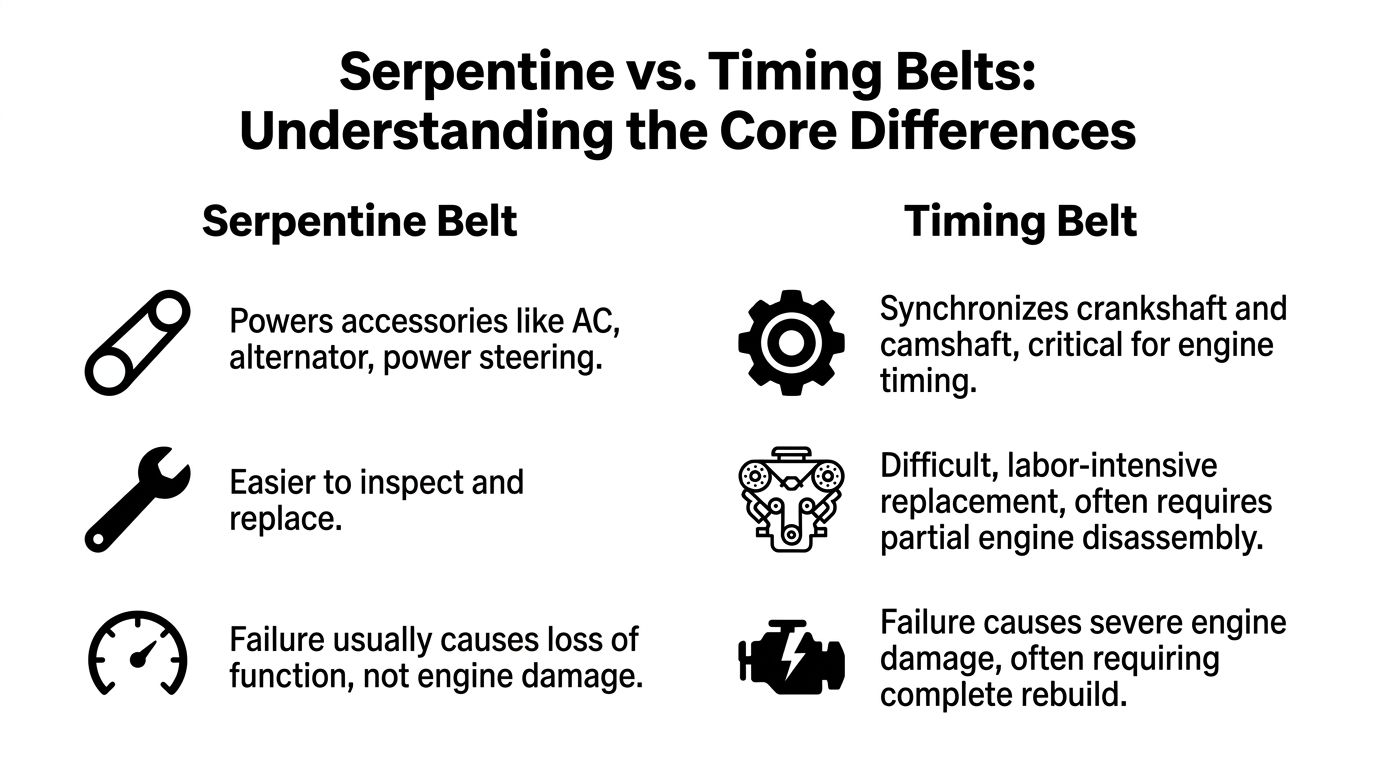
Think of the serpentine belt as the engine's helper
A serpentine belt is the long external belt you can usually spot once the hood is open. It snakes around pulleys and powers accessory systems. Depending on the vehicle, that can include the alternator, air conditioning compressor, and power steering.
When it fails, the engine may still be mechanically intact, but the car can quickly become undriveable because key systems stop working. You may lose charging, cooling support, or steering assist depending on the design.
The good news is access is usually straightforward. The belt is out in the open compared with internal engine components, so replacement is often simpler.
Think of the timing belt as the engine's metronome
A timing belt does a completely different job. It synchronizes the crankshaft and camshaft so valves and pistons move in the right sequence. That timing has to be exact.
This is why timing belt service costs more and carries more risk. The belt is buried behind covers and other components, and the mechanic has to work carefully to preserve engine timing during removal and installation.
Why the cost gap is so large
One underserved angle in belt pricing content is that many owners still do not know which bill they are looking at. According to RepairPal's serpentine belt estimator discussion, serpentine belts average $147 to $203 total, while timing belts can range from $367 to over $585 due to higher labor. The same source also notes that on interference engines, a failed timing belt can lead to over $2,000 in damage.
That difference makes sense once you understand the work involved:
- Serpentine belt service: Usually external, faster to inspect, and more accessible.
- Timing belt service: Internal, labor-heavy, and tied directly to engine synchronization.
- Failure consequences: A serpentine belt failure is disruptive. A timing belt failure can be destructive.
Interference versus non-interference matters
Consequently, timing belts are no longer just another maintenance line item. In an interference engine, valves and pistons occupy the same space at different times. If timing is lost, they can collide.
In a non-interference engine, belt failure is still serious because the engine stops running correctly, but the internal damage risk is lower. That is why timing belt maintenance should never be treated like an optional squeak fix.
If a shop says your car has a timing belt, ask one more question. Is the engine interference or non-interference? That answer changes the urgency.
Breaking Down Serpentine Belt Replacement Costs
For most drivers researching the cost of replacing belts on car, the repair they need is a serpentine belt. This is the common belt service, and the numbers are much easier to understand once parts and labor are separated.
What the typical bill includes
According to January 2026 data from JD Power's serpentine belt replacement guide, the average professional serpentine belt replacement costs between $109 and $203. In that same source, labor typically accounts for $85 to $124, while the belt itself costs $62 to $79.
That tells you something important. You are not just paying for a strip of rubber. You are paying for diagnosis, pulley routing, tension release, installation, and a check to make sure the belt tracks correctly after startup.
Vehicle size changes the quote
On a simple engine bay, access is easy and the price usually stays toward the lower end. On trucks or crowded transverse-engine layouts, the job may take more time.
JD Power gives a good example of how much model choice matters:
| Vehicle model | Serpentine belt replacement cost |
|---|---|
| Toyota Corolla | $104 to $148 |
| Chevrolet Silverado 1500 | $213 to $322 |
A compact car often has a simpler path to the belt. A truck may have more room overall, but larger accessory setups and different routing can still raise the bill.
What shops may also inspect
A belt replacement estimate may lead to a recommendation for nearby parts if the technician sees trouble during inspection. Common examples include:
- Belt tensioner: If the spring tension is weak, a new belt alone may not solve squeal or slip.
- Idler pulley: A noisy or rough bearing can shred a fresh belt.
- Accessory pulley alignment: Misalignment can wear the ribs unevenly.
Those extra parts are not automatically required. But if one of them caused the old belt to fail, skipping it can waste money because the new belt may start chirping again.
DIY can work on the right car
JD Power also notes that do-it-yourself serpentine belt replacement can reduce expenses to approximately $50, since the belt itself costs $25 to $75 and the job often uses basic hand tools in roughly about one hour. The same guide recommends replacing serpentine belts every 50,000 miles.
That makes serpentine belt service one of the more approachable maintenance jobs for hands-on owners. Still, the savings only count if you route the belt correctly and confirm the tensioner and pulleys are healthy.
If the old belt shows edge wear, frayed cords, or shiny glazing, inspect the pulleys before installing a new one. A new belt cannot fix a crooked pulley.
Why Timing Belt Replacement Is a Major Investment
A timing belt estimate shocks people because the number looks out of proportion to the part. The belt itself is not the whole story. The labor is.
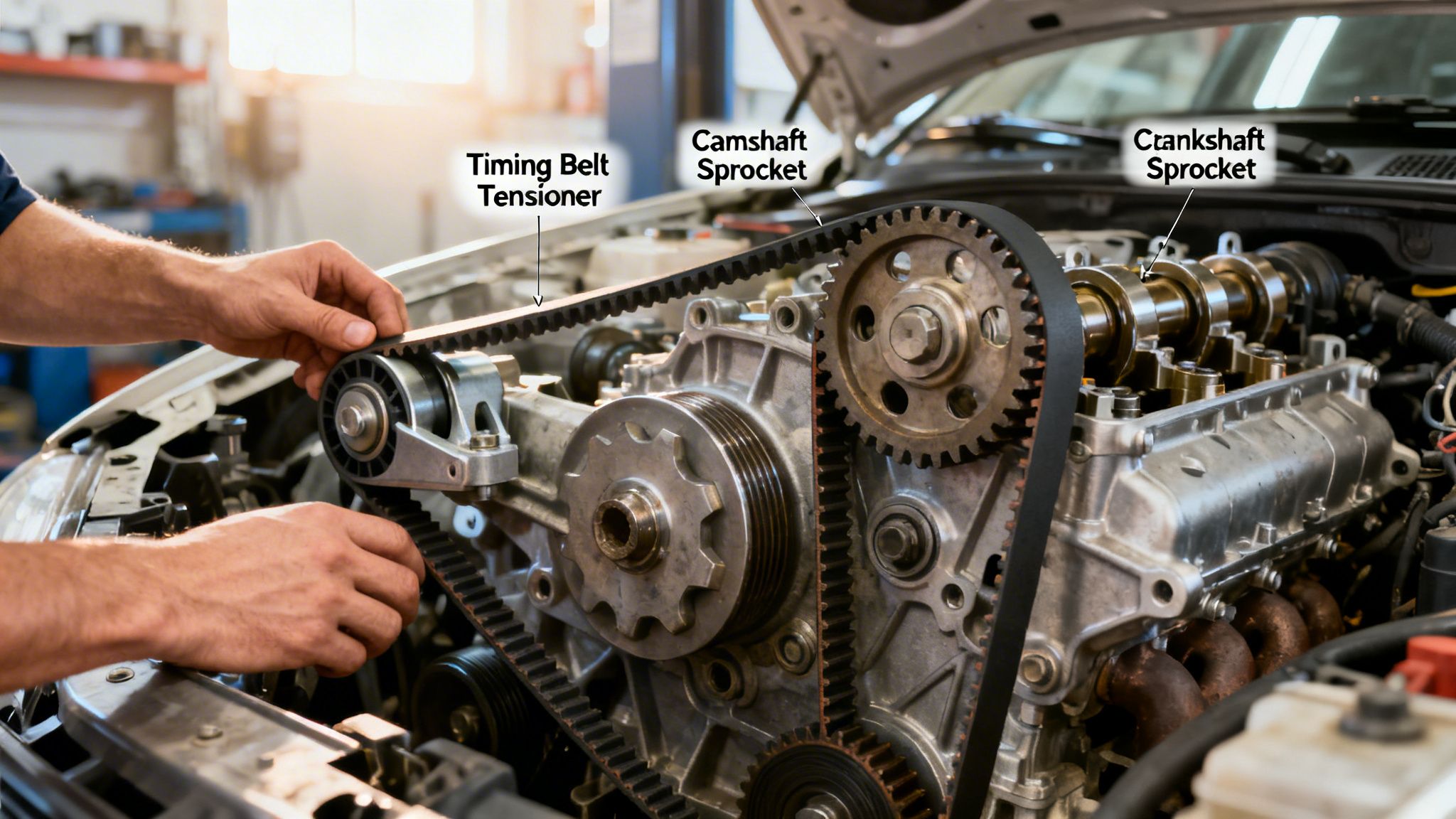
Most of the bill is access work
As of 2026, ConsumerAffairs' timing belt replacement cost guide reports that timing belt replacement typically costs $600 to $900, with an average around $800, and some luxury vehicles exceeding $1,700. That source also explains why the number climbs. The mechanic often has to remove multiple components and covers just to get to the belt.
This is not a pull-one-belt-off, slip-one-belt-on type of job. Timing marks must line up. Engine position matters. On many vehicles, the technician works in a cramped space where a small error can create a large problem.
Real examples show how labor drives the total
ConsumerAffairs gives two examples that explain the spread:
- Honda Civic: $343 to $411 total, with parts at $106 to $112 and labor at $237 to $299
- Land Rover Freelander: $1,505 to $1,734 total, with parts at $484 to $611 and labor at $1,021 to $1,123
It also notes that labor often represents 70 to 80 percent of the total cost. That ratio is the clearest reason timing belt service feels expensive. You are mostly buying skilled labor and careful engine access.
Why postponing this job can become far more expensive
A worn timing belt does not always scream for attention the way a serpentine belt can. That is part of the danger. Some timing belts fail with little warning.
If the engine is interference design, the risk rises fast. A failed belt can allow piston-to-valve contact, bending internal parts and turning preventive maintenance into a major engine repair. In practical terms, paying for the planned service is often the cheaper decision.
Timing belt service is one of the few maintenance jobs where “I’ll wait a little longer” can backfire hard.
What gets replaced while the area is open
Experienced shops often inspect or recommend related components during timing belt service. That is not upselling by default. It is common sense because labor overlaps heavily.
Typical “while-you’re-in-there” items may include:
- Tensioners
- Idler pulleys
- Seals
- Water pump, if the design places it in the same service area
Bundling those items can prevent paying similar labor again later. If a water pump sits behind the same covers, replacing it later may duplicate much of the original labor.
A visual walkthrough helps show why this job is so much more involved than an accessory belt replacement.
Dallas owners should think in maintenance windows
In a metro area where many people rely on daily commuting, putting off timing belt service can create a bad kind of surprise. The smart move is to plan the job before failure, especially if the vehicle is older, recently purchased used, or missing a clear maintenance record.
If the service history is uncertain, asking for an inspection and a maintenance review is usually better than guessing. Timing belts reward planning. They punish neglect.
Key Factors That Change Your Belt Replacement Price
No two belt quotes are identical because the job is shaped by more than the belt itself. When drivers compare estimates, the primary question is not “Who is cheapest?” It is “What exactly is included?”
The vehicle matters first
A small economy car and a larger SUV can have very different service access. Some engines leave plenty of room around the accessory drive. Others pack the front of the engine bay so tightly that even a basic belt swap takes patience.
Luxury and specialty models also tend to be less forgiving. Tight packaging, model-specific procedures, and pricier parts can all push a belt job upward.
Labor rate changes the final number
Dallas-area pricing can vary between repair facilities. A dealership often follows brand-specific labor structures and parts sourcing. An independent shop may offer a more practical price on the same general repair, especially on routine serpentine belt work.
That does not mean the cheapest quote is always the best value. A solid estimate should clearly separate:
- The belt itself
- Labor
- Any recommended related parts
- Any diagnostic time if the issue is not yet confirmed
If a quote feels vague, ask whether it includes the tensioner, pulleys, or any other component that may be driving the noise.
The condition of nearby parts can expand the job
Belts rarely wear in isolation. I have seen brand-new belts installed over rough idler pulleys, only for the noise to come right back. That is frustrating for the customer and preventable for the shop.
Three things commonly raise the scope:
| Cost factor | Why it matters |
|---|---|
| Tensioner wear | Weak tension allows slip and repeat squeal |
| Pulley bearing noise | A seized or rough pulley can damage the new belt |
| Leaks or contamination | Oil or coolant on the belt shortens belt life |
Timing belt jobs add a second layer of cost logic
For timing belts, access is the headline issue, but planning matters too. If the front of the engine is already opened, many owners choose to handle adjacent wear items at once. That increases the invoice today, but it can reduce repeat labor later.
A good belt quote explains what is mandatory, what is recommended, and what can reasonably wait. That transparency matters more than a low headline number.
Age and service history shape risk
On a used vehicle with thin records, belt service becomes part pricing and part risk management. If nobody can verify when a timing belt was last replaced, the estimate should be viewed in context. You are not just buying a new part. You are buying certainty.
That is especially true for fleet vehicles, where downtime causes scheduling headaches long before it shows up as a line item on a repair order.
DIY or Call a Pro Weighing Your Options
Some belt jobs are realistic for a careful do-it-yourself owner. Others are not. The smart choice depends on which belt you are dealing with, how comfortable you are around engine components, and how much risk you are willing to absorb.
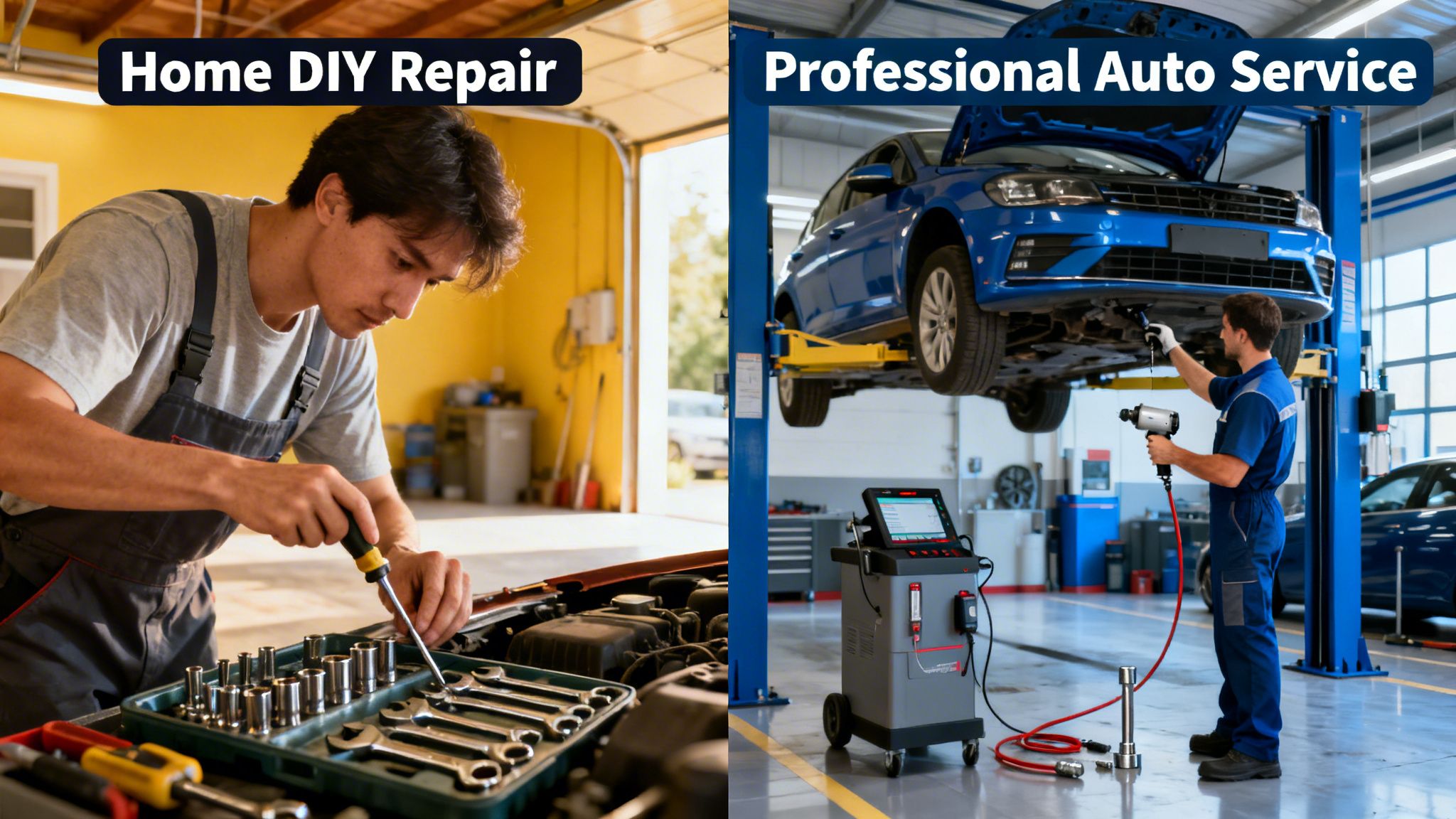
DIY makes more sense for serpentine belts
A serpentine belt is often the only belt job I would even place in the realistic DIY category for most owners. On many cars, the work is visible and straightforward if you have the correct routing diagram, a ratchet or serpentine belt tool, and enough room to release the tensioner safely.
DIY can be attractive if you are dealing with a single worn belt and no other obvious issues. It can also make sense if you are already comfortable checking pulleys, inspecting the tensioner, and confirming that the belt ribs sit cleanly in each groove.
Still, DIY gets risky when the problem is misdiagnosed. A squeal that sounds like “just a belt” can be:
- A weak tensioner
- A seized pulley bearing
- Belt contamination from a leak
- An accessory component dragging under load
If the engine also smells hot or you notice a sharp rubber odor, this article on why a car smells like burning rubber can help you understand whether the issue is likely belt-related or something more serious.
Professional service buys accuracy and backup
A trained technician does more than swap the part. Good shop work includes confirming the source of the noise, checking alignment, testing pulley smoothness, and making sure the replacement belt matches the exact engine setup.
That matters because the repair that “works” for a week is not a success. The repair that stays quiet and tracks properly is.
Timing belts are a different conversation
For timing belts, I do not view this as a casual DIY project for the average owner. The procedure is precise. The engine timing has to be set correctly. Access can be difficult. One mistake can bend valves or create a no-start condition.
A side-by-side view helps:
| Option | Best for | Main benefit | Main risk |
|---|---|---|---|
| DIY serpentine belt | Skilled owners with tools and routing info | Lower out-of-pocket cost | Misdiagnosis or incorrect installation |
| Professional serpentine belt service | Most daily drivers | Faster diagnosis and dependable fitment | Higher upfront spend |
| DIY timing belt | Very experienced hobbyists only | Personal labor savings | Serious engine damage if timing is wrong |
| Professional timing belt service | Nearly all owners | Correct setup and lower risk | Larger invoice |
If you are asking whether a timing belt is safe to do at home, that usually means it belongs in a professional bay.
Your Local Solution Kwik Kar Services in Dallas
Dallas drivers and fleet managers usually care about two things on belt service. They want the repair done correctly, and they want to avoid paying twice for the same problem.
For individual owners, belt work is most manageable when the diagnosis is clear. A proper inspection can separate a worn serpentine belt from a noisy pulley, a weak tensioner, or a larger front-engine service need. That is what keeps a simple repair from turning into repeat visits.
Why fleet operators should treat belts as a schedule item
For commercial vehicles, belt replacement is less about one invoice and more about uptime. According to YourMechanic's serpentine drive belt replacement page, preventive serpentine belt swaps every 60,000 miles can reduce vehicle downtime by 40% and related engine repairs by 70%. The same source notes that a single replacement might cost $150 to $300, and customized fleet programs can reduce this by up to 25%.
Those numbers matter for businesses running sedans, SUVs, and light trucks across Dallas. A belt failure does not just create a repair bill. It can disrupt routes, appointments, deliveries, and staffing.
What good local service should look like
A practical Dallas belt service partner should offer:
- Clear estimates: Separate labor, parts, and any related recommendations
- Routine inspection options: Catching wear before a roadside failure
- Support for mixed fleets: Sedans, SUVs, and work trucks do not all wear belts the same way
- Convenient scheduling: Useful for both commuters and business vehicles
Owners dealing with broader engine concerns can also benefit from a shop that handles related diagnostics and repairs in one place, including engine service and repair in Dallas.
Understanding the Local Advantage
In a busy market, convenience matters. So does consistency. A shop that can inspect belt condition during routine maintenance, explain what is urgent versus what can wait, and keep service records organized makes ownership easier.
That is especially useful for fleet managers. Preventive belt service works best when it is tracked, scheduled, and handled before the truck or SUV ends up on a hook.
Frequently Asked Questions About Car Belt Replacement
A lot of belt questions come up after the estimate is already in your hand. These are the ones I hear most often.
What are the warning signs of a failing belt
Common signs include squealing on startup, chirping while the engine is running, visible cracks, frayed edges, glazing, or a belt that looks shiny and hardened. You may also notice weak accessory performance, such as charging issues or A/C problems, depending on which belt is involved.
A timing belt is trickier because it may not always make obvious noise before failure. If the vehicle has an uncertain maintenance history, inspection and service records matter more than waiting for symptoms.
Can I drive with a bad belt
It depends on the belt and the condition. A damaged serpentine belt can leave you stranded quickly if it stops driving the alternator or other accessories. A timing belt problem carries much higher risk because engine timing is involved.
If the belt is making heavy noise, showing visible damage, or there is a burning smell, driving it further is usually a bad bet.
How often should belts be replaced
For serpentine belts, the verified guidance in the earlier cost section points to replacement every 50,000 miles based on the JD Power data already discussed above. Timing belt intervals depend heavily on the vehicle and engine, so the owner's manual or a model-specific service record should guide that decision.
Are serpentine belts and drive belts the same thing
Often, yes. Many people use serpentine belt, drive belt, and accessory belt to describe the same external belt that powers engine accessories. The exact wording changes by shop, manual, or customer habit.
Why does one shop quote a belt only and another quote extra parts
Because one belt failure can reveal another weak component. If a pulley bearing is noisy or the tensioner is weak, replacing only the belt may not fix the underlying problem.
Ask what the shop found physically. A good answer should mention actual inspection findings, not vague language.
Approximate 2026 Belt Replacement Costs for Popular Dallas Vehicles
The table below uses only verified figures available in the source material. Some vehicles may not have a timing belt figure listed because no verified model-specific timing belt cost was provided.
| Vehicle Model | Serpentine Belt Replacement Cost | Timing Belt Replacement Cost |
|---|---|---|
| Toyota Corolla | $104 to $148 | Not specified in verified data |
| Chevrolet Silverado 1500 | $213 to $322 | Not specified in verified data |
| Honda Civic | Not specified in verified data | $343 to $411 |
| Land Rover Freelander | Not specified in verified data | $1,505 to $1,734 |
What should I ask before approving the repair
Keep it simple and direct:
- Which belt is it? Serpentine or timing.
- What caused the issue? Belt wear, pulley problem, tensioner problem, or uncertain without teardown.
- What is included? Belt only, or related hardware too.
- What happens if I wait? This helps separate routine service from high-risk delay.
The best repair conversation is specific. “You need a belt” is not enough. “Your serpentine belt is cracked and the tensioner is still good” is useful.
Is preventive replacement worth it for fleets
Yes, especially when a missed route or disabled work truck costs more than the belt job itself. Fleet maintenance works best when belts are treated as scheduled service instead of emergency repair.
If your vehicle is squealing, showing belt wear, or overdue for inspection, Kwik Kar Oil Change and Auto Care can help you get a clear diagnosis and practical next steps. Dallas drivers and fleet managers can count on straightforward service, convenient scheduling seven days a week, and maintenance support that keeps cars, SUVs, and light trucks reliable on the road.