


You’re driving across Dallas, maybe heading down the Tollway, maybe just trying to get home before traffic gets worse. Then that little amber engine-shaped light pops on.
Your first thought is usually one of two things. “Is this serious?” or “Can I ignore it until the weekend?”
That reaction is completely normal. Most drivers don’t get a warning before the warning. The car feels fine, the engine sounds mostly normal, and suddenly the dashboard is asking for attention. It’s unsettling because the check engine light doesn’t tell you what’s wrong in plain English. It just tells you the car’s computer noticed something it doesn’t like.
At the shop, we see this every day. A customer walks in worried that the engine is about to fail, or frustrated because they already replaced a part and the light came right back on. Both situations are common. The good news is that a check engine light is usually manageable when you diagnose it correctly and handle it early.
The hard part is resisting guesswork.
A check engine light can point to something minor, something expensive, or something in between. The light itself isn’t a repair. It’s a clue. Good check engine light repair starts with understanding what the car is trying to say, then testing the system in a methodical way.
That Little Amber Light A Guide for Dallas Drivers
A lot of Dallas drivers have the same story. The light comes on during an ordinary trip. No smoke. No dramatic bang. Just a symbol on the dash that immediately raises your stress level.

Sometimes the car still drives normally. That almost makes it worse, because now you’re left making a judgment call without enough information. Should you keep driving? Should you stop right away? Is it a gas cap, a sensor, or the beginning of a bigger repair?
Here’s the reassuring part. A check engine light doesn’t automatically mean disaster. It does mean your car has stored information that needs to be read and interpreted properly.
Consider a smoke alarm as an analogy. The alarm matters, but the important question is what triggered it. Burnt toast and an electrical fire can both set off an alarm. Your next step shouldn’t be to tear random things apart. It should be to find the cause.
Practical rule: Treat the light as an early warning, not a verdict.
For Dallas drivers, that matters because short trips, long idling, heat, and heavy traffic all put stress on engine and emissions systems. For fleet vehicles, the stakes are even higher because one unresolved warning light can turn into downtime, missed routes, and scheduling headaches.
The main goal isn’t just to turn the light off. It’s to fix the reason it came on so it stays off.
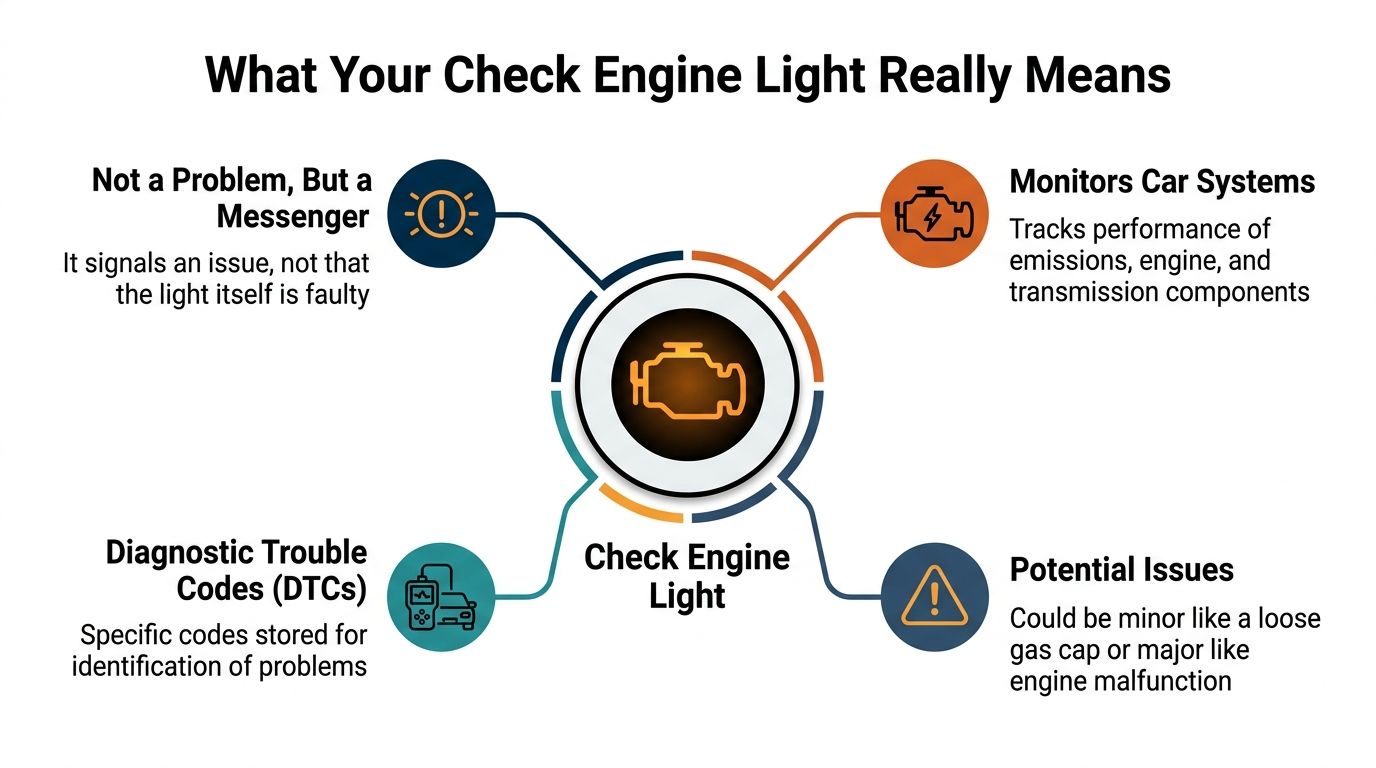
What Your Check Engine Light Really Means
The check engine light is a messenger from your vehicle’s On-Board Diagnostics system, often called OBD-II. The light doesn’t tell you that the engine itself has failed. It tells you the car’s computer detected a problem in one of the systems it monitors.
A good analogy is a fever.
A fever tells you something is wrong in the body, but it doesn’t tell you whether the cause is a minor virus, an infection, or something else. The check engine light works the same way. It points to a symptom. The technician still has to diagnose the cause.
What the system is watching
Your car uses sensors and control modules to keep tabs on things like:
- Air and fuel balance so the engine can run efficiently
- Ignition performance so combustion happens when it should
- Emissions equipment so the vehicle stays within design limits
- Transmission-related behavior that can affect how the powertrain operates
That last point surprises people. The light doesn’t only mean “engine.” The systems overlap. According to industry data, 10-15% of all check engine light-related service visits stem from intermittent or interlinked transmission problems, and those issues are often misdiagnosed without equipment that can analyze live data beyond simple code reading (industry data on intermittent transmission-related CEL visits).
Solid light versus flashing light
This distinction matters.
- Solid check engine light means the car has detected a fault that needs attention soon.
- Flashing check engine light means the problem is urgent. In many cases, that points to an active misfire severe enough to damage other components if you keep driving.
A steady light is like your car saying, “Please schedule a check.” A flashing light is your car saying, “Stop before this gets expensive.”
A code reader can show a stored fault. It cannot, by itself, explain why the fault happened.
Why one light covers so many problems
Drivers often expect a one-to-one answer. Light on equals one bad part. Modern vehicles don’t work that way.
The computer compares readings from multiple sensors. If one sensor reports something outside the expected range, the car stores a diagnostic trouble code, or DTC. That code is useful, but it’s not a final diagnosis. It’s more like a trail marker.
For example, a mixture-related code could come from a sensor problem, a leak, a fuel delivery issue, wiring trouble, or a mechanical condition changing the readings. The code tells the technician where to start. It doesn’t tell the whole story.
That’s why professional check engine light repair focuses on evidence, not assumptions.
Decoding the Most Common Trouble Codes
When customers hear “you have a code,” they often think the problem has already been solved. In reality, the code is the beginning of the conversation.
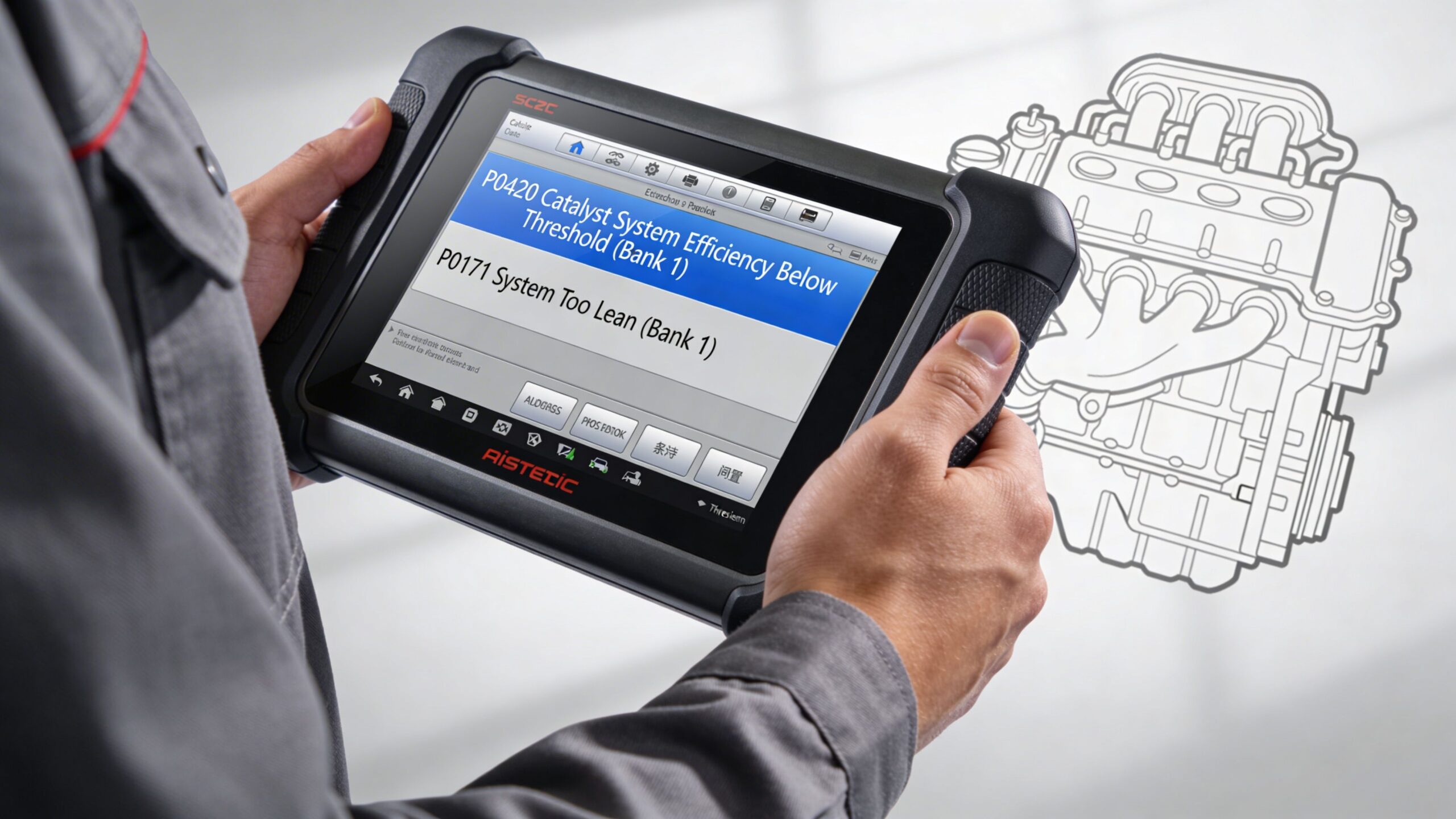
The most common fixes behind check engine lights are familiar ones. The 2025 CarMD Vehicle Health Index, which analyzed over 31 million vehicle repairs in 2024, found that common fixes included replacing oxygen sensors at an average cost of $254, replacing ignition coils and spark plugs at $400, and replacing mass air flow sensors at $323 (CarMD Vehicle Health Index repair data).
Those repairs connect to some of the codes drivers see most often.
P0420 and catalyst efficiency problems
One of the most talked-about codes is P0420, usually interpreted as a catalyst efficiency issue.
In plain language, the car thinks the catalytic converter isn’t cleaning exhaust gases the way it should. Many people hear that and assume the converter itself is definitely bad. Sometimes it is. Sometimes it isn’t.
Possible root causes can include:
- A failing catalytic converter
- A lazy oxygen sensor feeding misleading data
- Persistent misfires that overheated the converter earlier
- Fuel mixture problems that damaged the converter over time
Such guesswork leads to expensive outcomes. Replacing the converter without checking upstream causes can lead to the same warning coming back.
P0171 and air fuel mixture codes
A code like P0171 often means the engine is running too lean on one bank. “Lean” means there’s too much air relative to fuel.
That sounds straightforward, but there are several ways to end up there:
- Unmetered air entering through a leak
- A dirty or failing mass air flow sensor
- Fuel delivery issues
- Sensor readings that don’t match the engine’s actual activity
The symptom can look the same from the driver’s seat. Maybe a rough idle, maybe hesitation, maybe nothing noticeable at all. The code points to the condition, not always the failed piece.
P0300 and misfire codes
Misfire codes are another common category. P0300 is a random or multiple-cylinder misfire code. Variations in the same family can point to a specific cylinder.
These codes matter because the engine is telling you combustion isn’t happening consistently.
Common causes include:
- Worn spark plugs
- Weak ignition coils
- Fuel injector problems
- Air-fuel imbalance
- Mechanical issues inside the engine
If you want a deeper look at one common cause, this guide on a bad ignition coil helps explain how coil failure affects performance and warning lights.
Here’s a quick visual walkthrough before we go further.
EVAP codes and the no symptom problem
Some check engine light repairs involve the evaporative emissions system, often shortened to EVAP. These faults can be frustrating because the car may drive perfectly normally.
The system’s job is to contain fuel vapors. If it detects a leak or a control problem, the light can come on even when there’s no rough running, no noise, and no obvious drivability problem.
That’s one reason drivers get confused. The absence of symptoms doesn’t mean the warning is meaningless. It means the issue may be in a monitored system you can’t feel from behind the wheel.
A trouble code is like a street name, not a full address. It gets the technician into the right neighborhood.
The Kwik Kar Diagnostic Workflow
A parts-store scan can be useful for pulling a code. It usually stops there. Professional diagnosis goes further because the primary value is finding the reason behind the code.
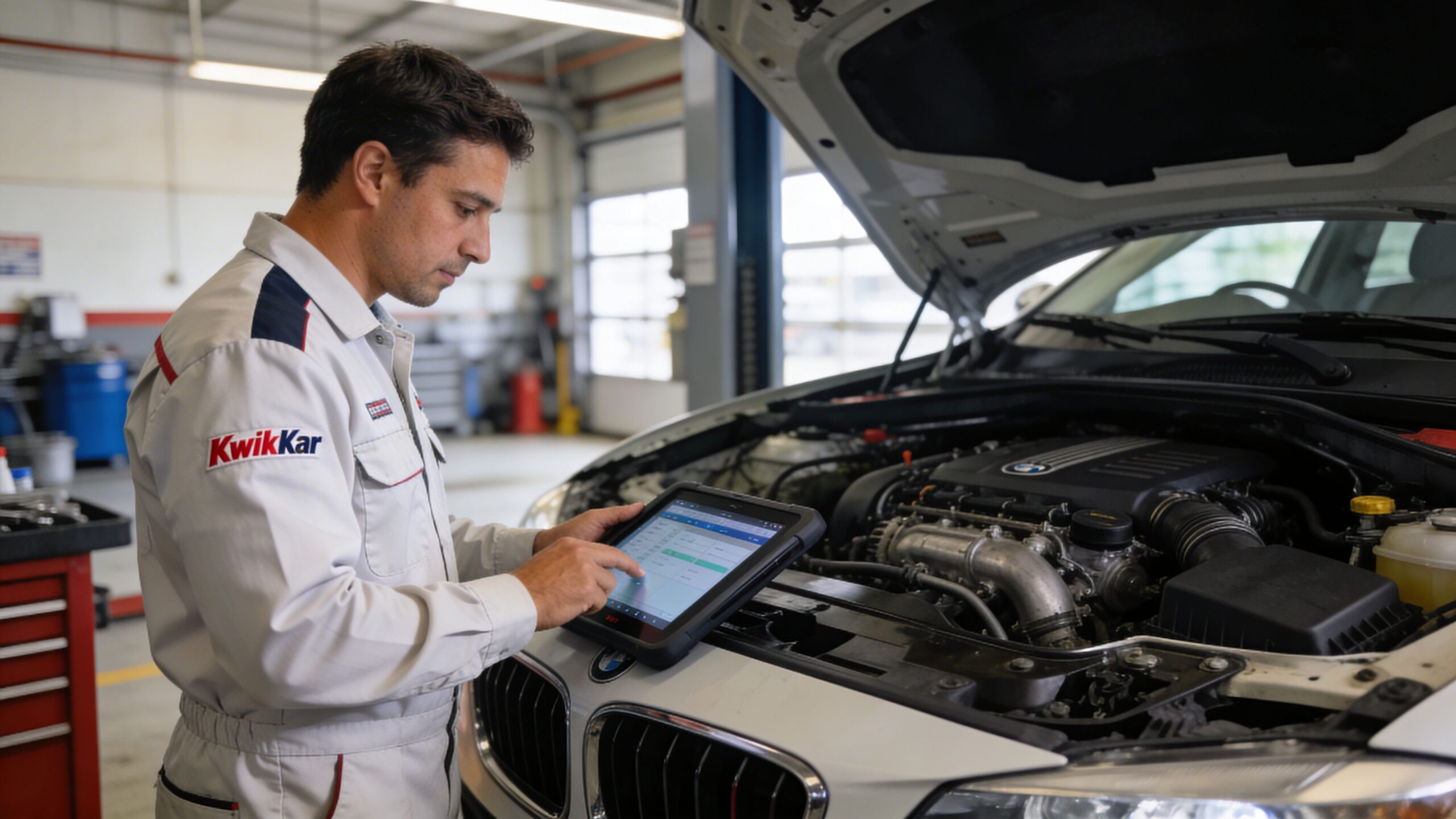
Step one starts with data, not parts
The first thing a technician does is connect a professional scan tool to the vehicle. That retrieves stored codes, pending codes, and supporting information.
One of the most useful pieces is freeze-frame data. That’s a snapshot of what the vehicle was doing when the fault set. Engine load, temperature, speed, and operating conditions can all help narrow the problem.
A code without context can send you in the wrong direction. A code with freeze-frame data gives you a scene to investigate.
Step two checks whether the code tells the whole story
Next, the technician looks for patterns.
A single code may seem simple, but modern vehicles often store related faults. One issue can trigger another. A sensor reading can be the victim of a different failure upstream. That’s why technicians review all available data before recommending a repair.
This is also where service information matters. Manufacturer procedures, wiring diagrams, and model-specific testing steps help prevent misdiagnosis.
For drivers who want to see how a shop approaches this process, this page on engine light diagnostic service shows what a structured inspection involves.
Step three uses eyes and hands, not just a scanner
The scanner is only one tool.
A proper check engine light repair workflow usually includes a visual inspection of:
- Vacuum lines and hoses for cracks or disconnections
- Electrical connectors for looseness, corrosion, or damage
- Wiring harnesses for rubbing or broken insulation
- Air intake components that may be leaking or contaminated
- Obvious signs of heat damage or fluid intrusion
This step sounds basic, but it prevents a lot of wasted time. A loose connector and a failed sensor can set very similar faults.
Step four tests the suspect, not the symptom
Once the technician has a likely direction, the next step is direct testing.
That may involve checking live sensor readings, commanding components on and off, measuring response, or comparing what the computer expects to what the system is doing. The point is to prove the failure before replacing anything.
Here’s where DIY guesswork usually goes wrong. A driver reads “oxygen sensor code,” replaces an oxygen sensor, and the light comes back. The original sensor may have been reporting a real problem caused by something else.
Step five confirms the fix
After repair, the job isn’t done until the technician verifies it.
That means clearing the fault, checking for proper operation, and making sure the original symptom doesn’t return. If the light stays off and the data looks normal, the repair is complete. If not, the process continues until the root cause is resolved.
Good diagnostics save money because they reduce the “parts cannon” approach of replacing components one after another and hoping one works.
Among local options, Kwik Kar Oil Change and Auto Care performs scan-based diagnostics and mechanical inspection for check engine light repair as part of its service lineup. The point isn’t just reading a code. It’s matching scan data with hands-on testing so the repair recommendation makes sense.
Typical Repair Types and Cost Ranges
The question most customers ask right after “what’s wrong?” is “what will this cost?”
That’s fair. Check engine light repair covers a wide range of problems, so the bill can vary a lot depending on what failed and whether the warning was caught early.
According to CarMD’s 2024 analysis, the average cost for a check engine light repair in the U.S. was $415.31, while the most common top-tier repair was catalytic converter replacement at an average of $1,348. The same analysis noted that the average vehicle age reached 12.6 years, which helps explain why more drivers are facing larger repairs on older vehicles (CarMD 2024 check engine light repair costs).
Why one warning light can lead to very different bills
A warning light doesn’t price the repair. The failed component, the labor involved, and any damage caused by delay do that.
An oxygen sensor is one kind of job. A catalytic converter is another. A misfire caused by worn ignition parts may be moderate if caught early, but it can become much more expensive if the problem damages other emissions components.
That’s why honest estimates follow diagnosis, not the other way around.
Common repairs drivers ask about
Here’s a practical summary of frequent check engine light repair categories.
| Repair | Common Cause | Estimated Cost Range |
|---|---|---|
| Oxygen sensor replacement | Sensor aging or inaccurate exhaust feedback | Around the commonly reported average of $254 |
| Ignition coils and spark plugs | Misfires, rough running, weak ignition | Around the commonly reported average of $400 |
| Mass air flow sensor replacement | Contaminated or failing airflow measurement | Around the commonly reported average of $323 |
| EVAP system repair | Vapor leak, purge issue, sealing fault | Varies by failed part and testing required |
| Catalytic converter replacement | Converter failure, often after unresolved upstream problems | Around the commonly reported average of $1,348 |
The table uses reported averages where verified data exists. EVAP work varies more because the root cause might be simple or more involved.
How to think about these repairs in plain language
Oxygen sensor replacement
An oxygen sensor helps the computer monitor exhaust content and adjust fuel delivery. When the sensor gets slow or inaccurate, the computer may overcorrect or set a fault.
This is often one of the more manageable repairs. It still needs proper testing because a sensor code can reflect another issue upstream.
Ignition coils and spark plugs
These parts create and support combustion. If they weaken, the engine can stumble, shake at idle, hesitate on acceleration, or set a misfire code.
The repair itself is usually straightforward once the technician confirms the fault. The important part is not waiting too long if the engine is actively misfiring.
Mass air flow sensor replacement
The mass air flow sensor measures incoming air so the computer can calculate fuel delivery. If that reading is wrong, the engine may run poorly or store mixture-related codes.
Sometimes contamination affects readings. Sometimes the sensor itself fails. Diagnosis separates those two possibilities.
EVAP system repairs
This category confuses drivers because the car may feel totally normal.
An EVAP repair can involve finding a leak in a hose, a valve issue, or another sealing problem in the vapor-control system. The symptom is often just the light. The diagnosis is the hard part.
If the concern turns out not to be a check engine issue but an anti-theft or no-start problem, a locksmith-focused resource like this guide on how to fix your car immobiliser problem can help you understand that separate system.
Catalytic converter replacement
This is the repair drivers hope they don’t need.
The catalytic converter handles emissions cleanup, and replacement tends to be expensive. Just as important, converters often fail after another issue has been ignored. A misfire, mixture problem, or faulty sensor can shorten converter life.
The expensive part is not always the first part that failed. It’s often the part that failed after the first warning was ignored.
Is It Safe to Keep Driving Your Car
The safest answer depends on two things. Is the light steady or flashing, and is the car showing other symptoms?
If the light is flashing, treat it as urgent. Pull over somewhere safe, shut the vehicle off, and arrange for help. Continuing to drive can turn a manageable repair into a much larger one.
If the light is solid, the next question is how the car feels.
When you should stop driving
Stop driving or drive only as little as necessary if you notice any of these along with the warning light:
- Rough running or strong shaking
- Loss of power when accelerating
- Overheating signs
- Stalling or hard starting
- Burning smells or unusual exhaust behavior
Those symptoms mean the warning isn’t just stored in the computer. The problem is affecting operation in a noticeable way.
When it may be reasonable to drive to the shop
If the light is solid and the car feels normal, it’s often reasonable to drive it to a repair facility. That does not mean put it off for weeks. It means skip the panic, but don’t skip the appointment.
Delay is one of the biggest reasons small problems become expensive ones. A recent study found that only 36.1% of vehicle owners get their check engine light inspected within the first week, and 25% never get it checked at all (survey on delayed check engine light inspections).
That delay matters for another reason. The same analysis reported that over 60% of check engine light repairs performed without proper diagnosis fail to resolve the issue permanently, which is exactly how drivers end up paying for the wrong part first.
One warning light can also affect inspection results
In Texas, drivers also need to think about emissions readiness and inspection-related issues. If you’re already dealing with a warning light and wondering how that may affect compliance, this explanation of a failed emission test can help clarify what typically happens next.
If the car is running badly, don’t “see if it clears up.” That gamble is where repair costs often climb.
A solid light is a prompt. A flashing light is a stop sign.
Preventive Maintenance to Keep the Light Off
The cheapest check engine light repair is the one you never need.
That doesn’t mean every warning light is preventable. Sensors age, electrical parts fail, and modern vehicles are complex. But many common causes get worse because maintenance was delayed or early symptoms were ignored.
Maintenance habits that help
A few simple habits go a long way:
- Stay on schedule with spark plug service because worn plugs can contribute to misfires and extra strain on ignition components.
- Keep up with oil changes because clean oil supports engine operation and helps avoid sludge-related problems that can confuse sensor readings and drivability.
- Pay attention to how the engine feels because rough idle, hesitation, or a drop in smoothness often shows up before a warning light.
- Ask for inspections during routine service so a technician can spot cracked hoses, loose connectors, and other visible issues before they trigger faults.
Why preventive care matters more on older vehicles
As vehicles age, materials harden, seals dry out, and electrical connectors see more heat cycles. That doesn’t mean an older car is unreliable by definition. It means small maintenance lapses matter more.
A neglected spark plug on an older vehicle is less forgiving than it would be on a newer one. A hose that’s beginning to crack can become a drivability problem faster in hard-use conditions like Dallas traffic and summer heat.
Listen for the small changes
Drivers often wait for dramatic symptoms. Many check engine problems begin subtly.
Watch for changes such as:
- A rougher-than-usual idle
- A stumble during acceleration
- Fuel smell around the vehicle
- Sluggish throttle response
- A warning light that comes and goes
None of those automatically mean major repair. They do mean your car is asking for attention.
Regular maintenance doesn’t eliminate every failure. It does catch a lot of problems before they multiply.
Schedule Your Check Engine Light Repair in Dallas
If your check engine light is on, the smartest move is to diagnose it before replacing anything. That’s how you avoid paying for parts based on a guess.
For Dallas fleet managers, this matters even more. Industry data noted that vehicle age is a major factor in check engine light issues, with 2007-2008 models being most prone to CEL problems, and that run-to-fail strategies can cost 2-3 times more than scheduled repairs in fleet settings (fleet-focused check engine light data). When a work vehicle goes down, the repair bill is only part of the cost. Downtime hits the schedule too.
If you’re dealing with a steady warning light, a flashing light, repeat codes, or fleet vehicles that need quick answers, professional diagnosis is the first step. Don’t guess, get answers. Schedule your diagnostic appointment at Kwik Kar today.
If your dashboard warning is on, get it checked before a small issue grows into a bigger repair. Kwik Kar Oil Change and Auto Care offers diagnostics, maintenance, and repair services for Dallas drivers and fleet vehicles, with scheduling options that make it easier to get a real answer instead of guessing.