

You’re usually not searching for bad tie rod symptoms on a calm day.
It’s more often after the steering starts feeling off on Central Expressway, the wheel doesn’t track straight after hitting a pothole, or the front tires suddenly show wear that wasn’t there a month ago. A lot of Dallas drivers notice the same problem in different ways. One hears a clunk while turning into a parking space. Another feels a light shimmy at speed. Someone else gets told they need an alignment again and wonders why it keeps happening.
The hard part is that tie rod problems can feel a lot like other steering and suspension issues. Worn ball joints, alignment trouble, and tire problems can all overlap. That’s where drivers get stuck, and where misdiagnosis starts costing money.
A tie rod issue is not something to guess at. It’s a steering part. If it’s worn, loose, or bent, the vehicle won’t respond the way it should. On Dallas roads with rough pavement and pothole hits, that matters fast.
Your Steering System's Critical Connection The Tie Rod
Think of your front steering system like an arm.
Your steering rack provides the push and pull. The steering knuckle is the hand that turns the wheel. The tie rod is the wrist connection that transfers motion while still allowing the suspension to move through bumps.
What the tie rod actually does
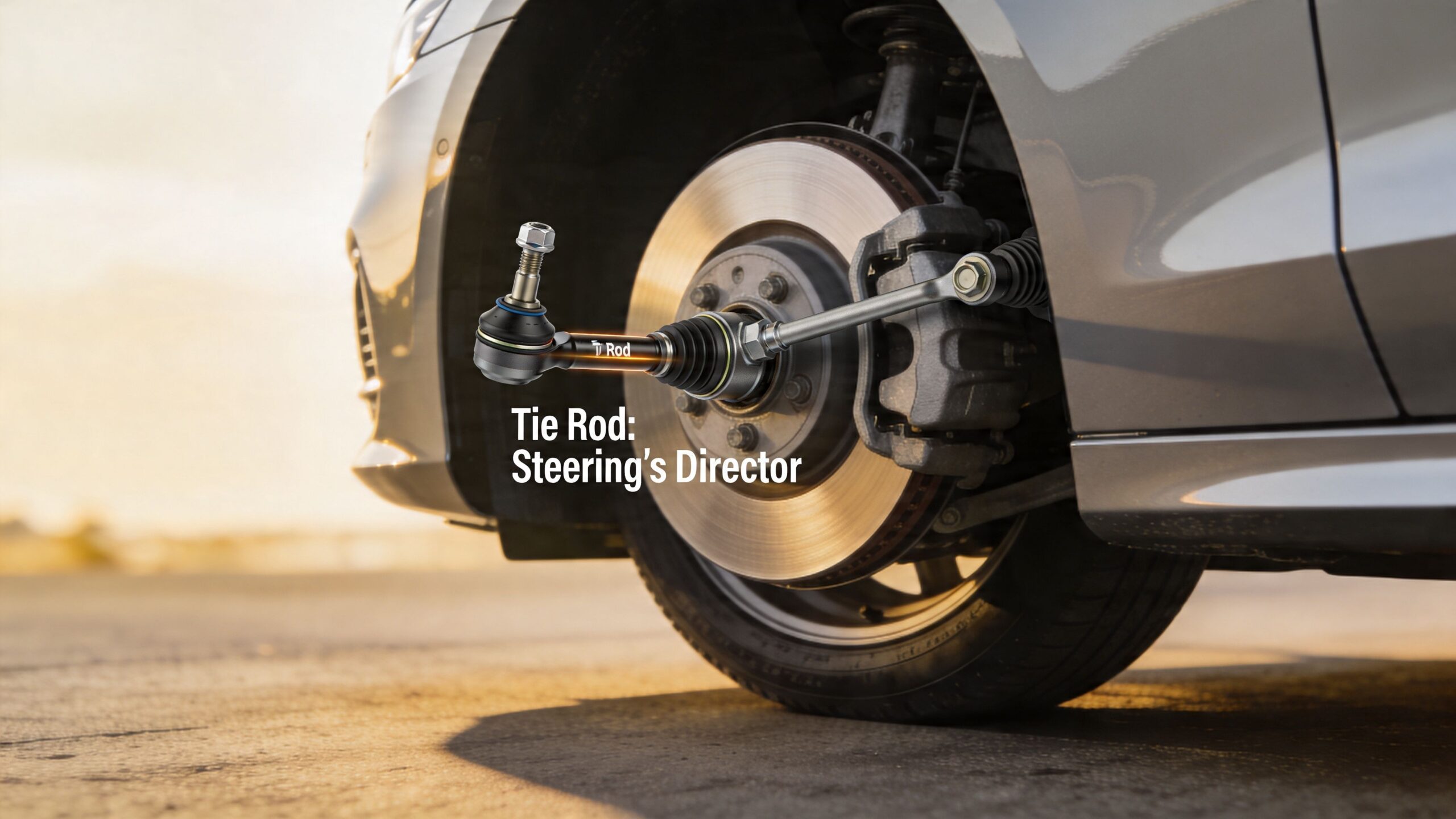
Each front wheel is steered through a tie rod assembly. That assembly usually includes an inner tie rod and an outer tie rod end.
The inner tie rod connects closer to the steering rack. The outer tie rod end connects to the steering knuckle. At the outer end, a ball-and-socket joint lets the wheel turn left and right while the suspension still moves up and down over rough pavement.
That flexible joint is why the part works so well when it’s healthy, and why it causes trouble when it wears out.
Why this part fails
Tie rods live in a rough environment. They handle repeated steering movement, road shock, and contamination.
According to a materials analysis of tie rod failure, structural failure often starts with material fatigue under cyclic stress and environmental corrosion. That same analysis notes that severe pothole impacts can generate forces that exceed 5,000 to 10,000 lbs in light truck applications, which can distort the part and speed up cracking. It also points out that a cracked boot can wear the joint out in weeks instead of years because grime mixes with grease inside the joint.
That boot matters more than most drivers realize. If the boot tears, dirt and moisture get in. Once that grease gets contaminated, the joint starts wearing from the inside.
Practical rule: If the protective boot is torn, treat it as an active steering problem, not a cosmetic issue.
Why the tie rod matters so much to control
A bad tie rod doesn’t just create noise. It changes how directly your steering input reaches the front wheels.
That’s why drivers often confuse it with electronic steering issues or a steering assist concern. Sometimes the symptom feels similar from the driver’s seat. If your steering warning signs seem broader than a worn component alone, this guide to a power steering assist fault can help you separate mechanical looseness from assist-system problems.
When the tie rod is solid, the car responds cleanly. When it’s loose, every steering input gets less precise.
That loss of precision is the first thing many drivers notice.
Recognizing the Symptoms of a Bad Tie Rod
Most drivers don’t discover a bad tie rod by looking at it first. They feel it.
The steering starts acting different in small ways, then bigger ones. What matters is connecting the sensation to the mechanical cause instead of dismissing it as “just needs an alignment.”
What you feel in the steering wheel
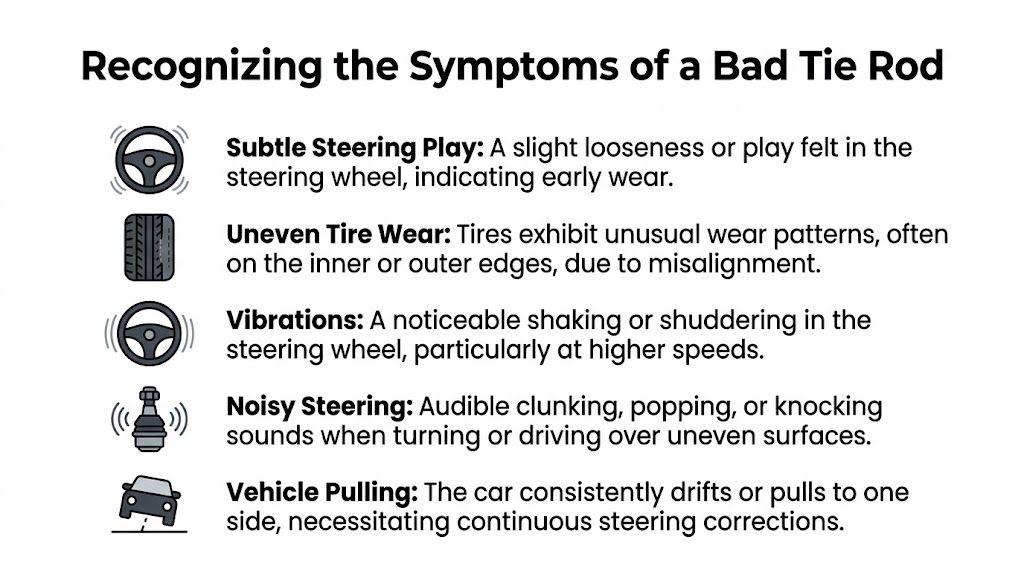
A worn tie rod end introduces play into the steering system. That often feels loose, floaty, or delayed.
You turn the wheel and the vehicle seems to respond a moment later. On the highway, the car may need constant small corrections to stay centered in the lane. That loose feeling is the steering system taking up slack before the wheel angle changes.
If the steering wheel also shudders while driving, don’t assume it’s only a tire balance problem. This breakdown of why a car shakes while driving explains how vibration symptoms can overlap.
What you hear during turns and bumps
Noise usually shows up after looseness has already started.
Common sounds include:
- Clunking on turns: The worn joint shifts under load.
- Popping over rough pavement: Slack lets the connection move when it shouldn’t.
- Squealing while turning: The steering system is no longer moving cleanly under proper alignment.
Those noises matter more when they happen together with vague steering or pulling.
What you see at the tires
Uneven front tire wear is one of the strongest clues.
A failing tie rod end disrupts wheel alignment geometry and can make the vehicle pull. According to RealTruck’s tie rod symptom guide, that misalignment can accelerate tire wear by 20% to 50%, especially at the inner or outer tread edges, because the toe angle keeps shifting as the suspension moves. The same source notes that more than 1/4 inch (6 mm) of play points to imminent failure and calls for immediate replacement.
Look for these wear patterns:
- Inner edge wear: Often tied to toe problems.
- Outer edge wear: Another common sign of steering geometry shifting.
- Feathering across the tread: The tire is being scrubbed instead of rolling straight.
Don’t judge tire wear by noise alone. A front tire can still look “okay” at a glance and be wearing abnormally across the edges.
What the vehicle does on the road
The vehicle may drift left or right even on a straight road.
That’s different from a brief pull caused by road crown. A bad tie rod tends to create a repeated, corrective-driving pattern. You keep feeding small steering inputs just to hold a line.
When those symptoms stack up together, the next step is a hands-on check.
How to Perform a Simple Tie Rod Check at Home
You can do a basic screening at home if you keep it simple and stay safe.
This won’t replace a full shop inspection, but it can help you tell the difference between a likely tie rod problem and another front-end issue.
Start with the dry park test
Park on level ground. Set the parking brake. If you’re checking by hand, make sure the vehicle is secure before touching the wheel.
Use this simple process:
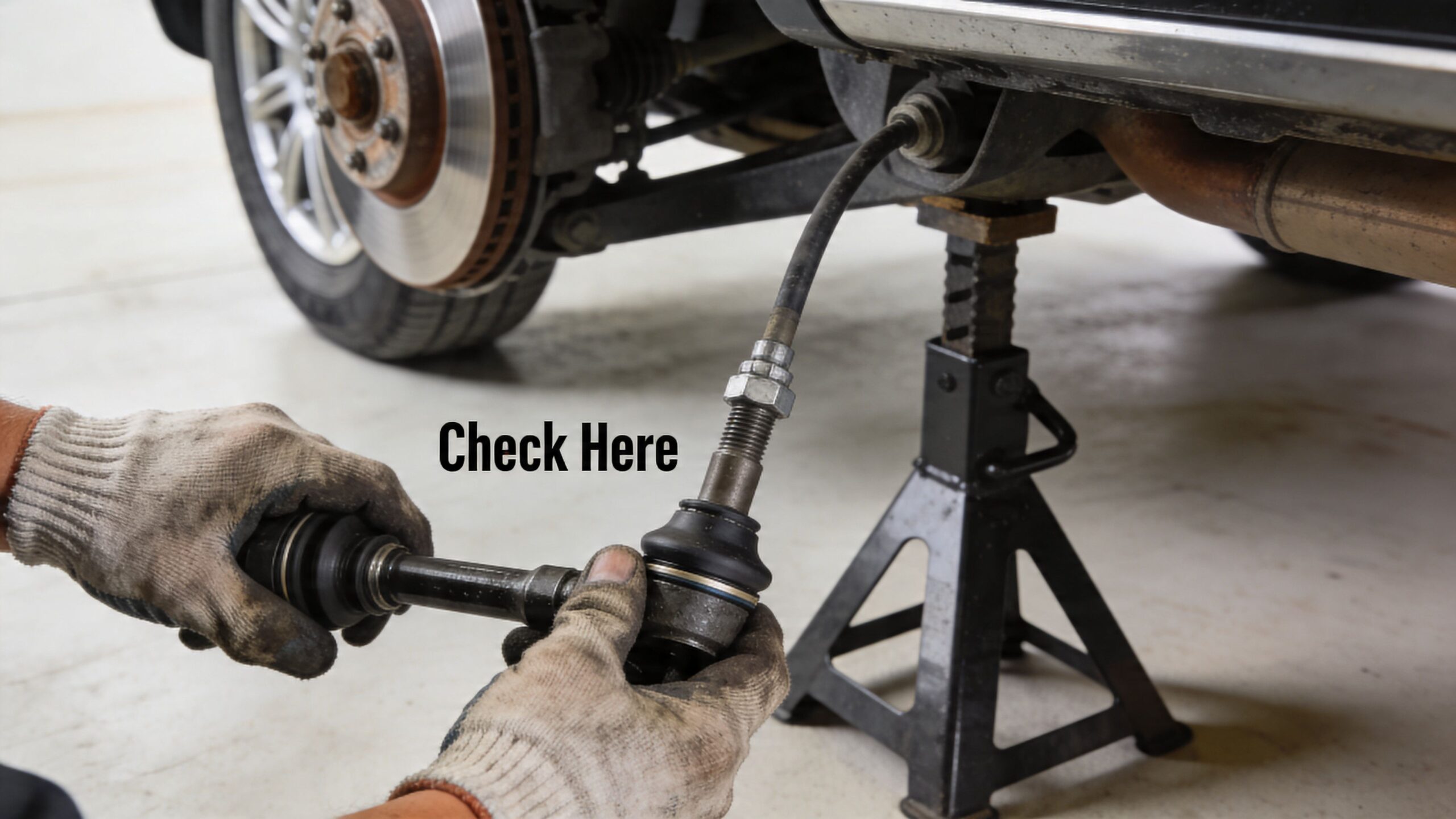
- Look at the front tire and outer joint area. If you can see a torn boot or grease pushed out around the tie rod end, that’s a strong warning sign.
- Grab the tire at the 3 and 9 o’clock positions. Push with one hand while pulling with the other.
- Feel for side-to-side looseness. A tie rod problem often shows up as horizontal play.
- Listen for a click or knock. Noise during this movement usually means the joint has wear.
- Compare both sides. One side often feels noticeably looser.
If the wheel shifts and you can feel slack before resistance, that points toward steering linkage wear.
How to tell a tie rod from a ball joint
Many people find this part confusing.
A common misdiagnosis is confusing a bad tie rod with a worn ball joint. According to CarParts’ bad tie rod end symptom guide, the key difference is the direction of play. A bad tie rod shows side-to-side looseness when the wheel is shaken horizontally, while a bad ball joint shows up-and-down movement. The same source notes that about 40% of “steering noise” questions in mechanic forums are misdiagnosed this way.
Use this quick comparison:
| Check | More likely tie rod | More likely ball joint |
|---|---|---|
| Wheel shaken side to side | Yes | Less likely |
| Wheel shaken up and down | Less likely | Yes |
| Torn boot near steering linkage | Common clue | Possible, but in a different joint location |
| Loose steering feel while driving | Common | Possible |
If you feel horizontal play, don’t ask for “just an alignment” first. Ask for a steering inspection.
Add a visual check
Turn the wheel enough to get a better view of the outer tie rod end.
Look for:
- Cracked or torn rubber boot
- Grease contamination with dirt stuck to it
- Rust buildup around the joint
- A joint angle that looks off after a pothole strike
A short visual demo can also help if you want to see the movement pattern before checking your own vehicle:
What not to do
Don’t crawl under an unsupported vehicle.
Don’t assume no noise means no problem. Some worn tie rods feel loose before they get loud. Don’t keep driving for weeks just because the steering issue seems minor. Steering wear tends to progress, not stabilize.
The Serious Risks of Driving with a Faulty Tie Rod
A bad tie rod is not in the category of “watch it for a while.”
It’s a steering part. If it fails, you can lose control of the wheel it’s supposed to guide.
The safety issue is direct
Tie rod failure poses a severe safety risk because a complete break can cause total loss of steering control, as explained in this tie rod risk and cost overview. That same source says driving with a severely worn tie rod is unsafe beyond 10 to 20 miles, because the joint can fail suddenly.
That’s the part drivers underestimate. The vehicle may still move. It may even feel “not too bad” at lower speed. But the risk isn’t gradual inconvenience. The risk is sudden separation.
Dallas traffic makes the consequences worse
On a quiet side street, a steering failure is dangerous.
At highway speed or in dense Dallas traffic, it can turn catastrophic fast. You don’t have room to compensate when the steering connection gives out. That’s why putting this repair off is a bad gamble.
Secondary damage adds up
Even before total failure, a loose tie rod keeps forcing other parts to work out of position.
That same GS Platinum overview notes that ignoring symptoms can damage tires, alignment components, and wheel hubs, adding hundreds to the repair bill. So the cost of waiting usually grows in two directions at once. Safety gets worse, and the repair gets more expensive.
What drivers should do instead
If the steering feels loose, the vehicle pulls, or you’ve confirmed wheel play during a basic check, limit driving and get it inspected.
If the tie rod is known to be severely worn, this is not optional. Arrange repair first. The vehicle should not stay in normal use.
Steering concerns move to the front of the repair list. Oil leaks can often wait a bit. A worn tie rod should not.
Tie Rod Replacement Options and Estimated Costs
Tie rods are replaced, not patched.
Once the joint has looseness, internal wear, contamination, or impact damage, the dependable fix is a new part followed by a proper alignment.
What gets replaced
The repair may involve the outer tie rod end, the inner tie rod, or both.
What determines that choice is the inspection. Some vehicles only need the outer end. Others have looseness deeper in the assembly, especially if contamination got past the rack boot area or the impact was strong enough to affect more than one connection.
Why the alignment matters
A tie rod directly affects toe setting.
Any time that part is replaced, the wheel alignment needs to be checked and adjusted. If a shop skips that step, you may leave with a new part but still wear the tires incorrectly. If you want a better sense of why that follow-up matters, this overview of tire rotation and alignment is worth reading.
Cost ranges Dallas drivers should expect
According to the verified cost ranges in the GS Platinum reference above, replacements generally run $100 to $300 per tie rod, or $60 to $400 overall depending on vehicle make, parts quality, and labor. Because pricing varies by vehicle and the repair may involve inner or outer components, it helps to look at the quote as a combination of parts, labor, and alignment rather than one flat number.
| Service | Sedan Cost Range | SUV/Light Truck Cost Range | Notes |
|---|---|---|---|
| Outer tie rod replacement | Within the verified overall range of $60 to $400 | Within the verified overall range of $60 to $400 | Vehicle design, labor access, and part quality affect the total |
| Inner tie rod replacement | Within the verified overall range of $60 to $400 | Within the verified overall range of $60 to $400 | Inner tie rods often take more labor than outer ends |
| One tie rod, parts and labor | $100 to $300 per tie rod | $100 to $300 per tie rod | Verified range from the GS Platinum reference |
| Total repair visit including related work | Within the verified overall range of $60 to $400 | Within the verified overall range of $60 to $400 | Final pricing depends on what failed and whether alignment is included |
What changes the final bill
A few trade-offs affect price:
- Vehicle type: SUVs and light trucks can take more labor depending on layout.
- Part choice: Better components usually cost more up front.
- Damage spread: A simple outer end is different from an impact that also affects other steering parts.
- Alignment need: This should be expected after replacement.
The cheapest quote isn’t always the best one. On steering work, correct diagnosis and proper installation matter more than shaving a little off the initial bill.
Why Dallas Drivers Trust Kwik Kar for Steering Repairs
Dallas is hard on steering components.
Potholes, broken pavement, curb strikes, and stop-and-go driving all add stress to parts that already live under constant movement. That’s one reason local diagnosis needs to be accurate. A vehicle that feels loose in the front end doesn’t always need the same repair, even when the symptoms sound similar.
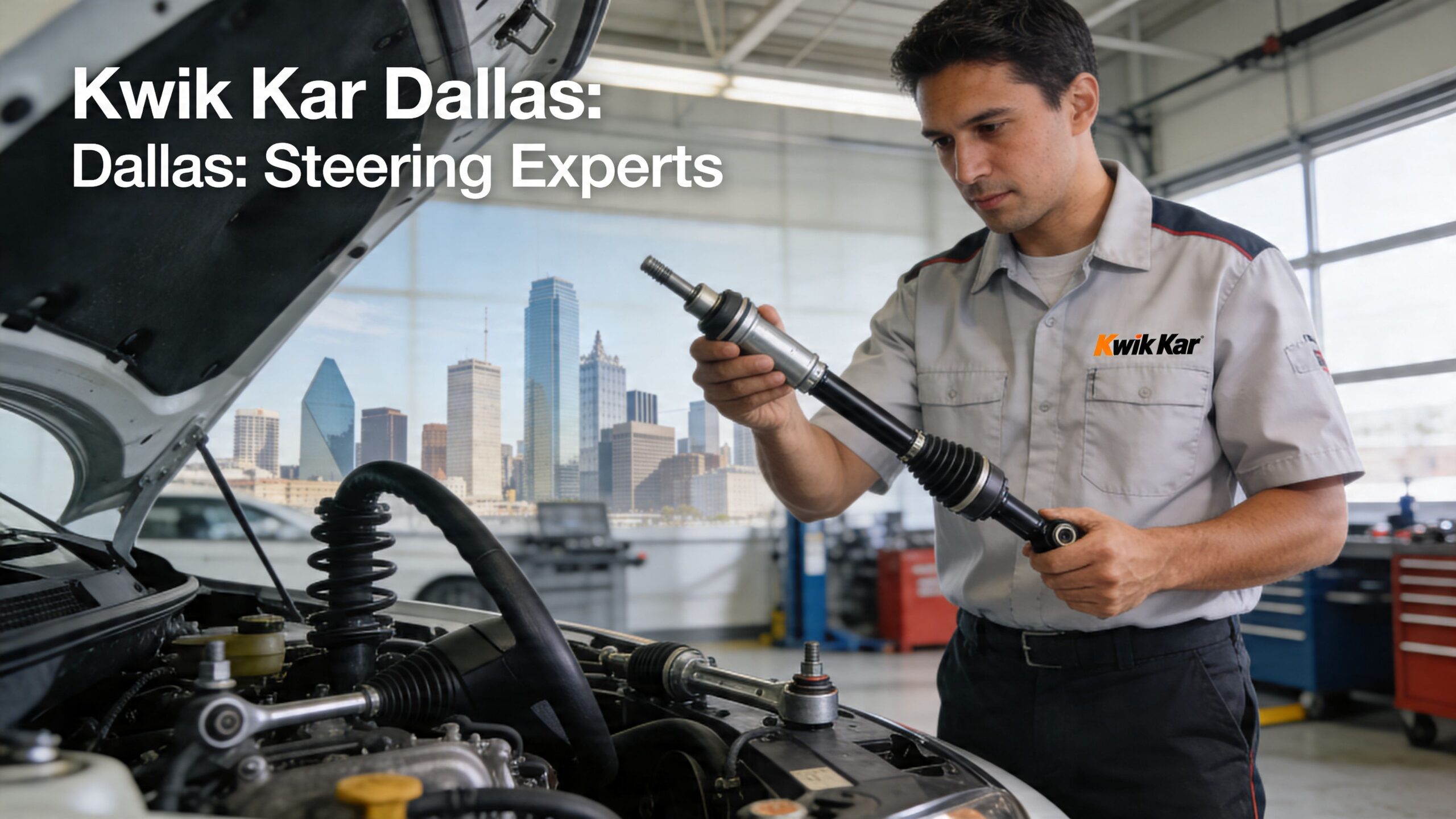
Local road conditions change the repair conversation
A projected 2025 pothole surge hit Texas hard, with Dallas reporting a 35% rise in complaints, according to this AutoZone tie rod symptom article. The same source says heavier EVs and SUVs can stress tie rods 15% more, and that quarterly inspections can save up to 30% on repairs by catching damage before it spreads.
For Dallas drivers, that means a steering inspection isn’t just for old vehicles. Newer, heavier daily drivers can punish front-end parts too.
What good steering diagnosis looks like
A reliable shop does more than confirm “front end noise.”
It checks the direction of wheel play, inspects boots, verifies whether looseness is in the tie rod or ball joint, and makes sure the final repair includes alignment correction. That avoids the expensive cycle of replacing the wrong part and still having the same pull, vibration, or tire wear.
Good steering work also means being honest about trade-offs:
- Replace only what failed when the rest is tight
- Recommend broader work when impact damage affected more than one component
- Use quality parts when the vehicle sees rough roads regularly
- Recheck alignment because the job isn’t finished without it
Accurate diagnosis saves more money than the lowest estimate on the first visit.
Why that matters for fleets and families
Fleet managers need uptime. Families need predictability.
Both need the same thing from a steering repair. Correct diagnosis, dependable parts, and a repair process that doesn’t send the vehicle back out with unresolved looseness. On Dallas roads, preventive inspections make sense because they catch torn boots, play, and impact damage before the problem turns into tire loss, repeat alignments, or a safety event.
If your steering has started to feel loose, noisy, or unstable, getting it checked early is the smart move.
If your car is showing signs of a bad tie rod, Kwik Kar Oil Change and Auto Care can inspect the steering system, pinpoint whether the problem is the tie rod, ball joint, or alignment, and help you fix it before it becomes a safety risk. With service available seven days a week, support for Dallas drivers and fleets, and a focus on clear communication, it’s a practical place to schedule a steering inspection when something feels off.