

You pull into a parking lot, turn the wheel hard, and hear a steady click, click, click from one front corner. Or maybe the car feels fine in town, but once you get up to speed, a vibration starts creeping through the floor. Most drivers hope it’s nothing.
It usually isn’t nothing.
An axle problem rarely fixes itself, and the longer it’s ignored, the fewer low-cost options stay on the table. The good news is that axle shaft repair doesn’t always mean replacing everything. Sometimes the right answer is a boot. Sometimes it’s a repair bearing. Sometimes full replacement is the only repair that makes sense. The difference comes down to wear, contamination, installation quality, and catching the problem before one damaged part takes others with it.
That Clicking Sound When You Turn Isn't Normal
A common version of this starts the same way. You back out, turn into a spot, and hear a popping or clicking noise that seems tied to steering input. Then it goes quiet on the straightaway, so it’s easy to put off.
That noise matters because the axle shaft is one of the parts that delivers engine power to the wheel. If it can’t do that smoothly, you’ll feel it in turning, acceleration, and sometimes basic drivability. A small noise can become a much larger repair if dirt gets into a joint, grease gets thrown out, or a worn surface starts damaging a new seal.

What drivers usually notice first
Many do not start by saying, “I think my axle shaft is failing.” They say things like:
- It clicks on turns
- There’s grease on the inside of my wheel
- The car vibrates when I accelerate
- It feels rough pulling out from a stop
Those are useful clues. They point a technician toward the joint, shaft, boot, or seal instead of guessing.
Practical rule: If the noise changes when you turn the wheel, don’t wait for your next major service. Get it checked while the repair options are still flexible.
If your car has started making other harsh sounds too, this guide to loud car noises and what they can mean helps separate axle-related symptoms from brake, suspension, and exhaust problems.
Why this gets serious fast
Axle issues tend to move in one direction. A torn boot lets grease out and contamination in. A dry joint wears quickly. A worn shaft surface can stop a seal from sealing. Then a simple fix turns into a larger parts-and-labor job.
That’s why the first symptom matters so much. Catching the problem early gives you choices. Waiting usually takes choices away.
What an Axle Shaft Is and Why It Matters
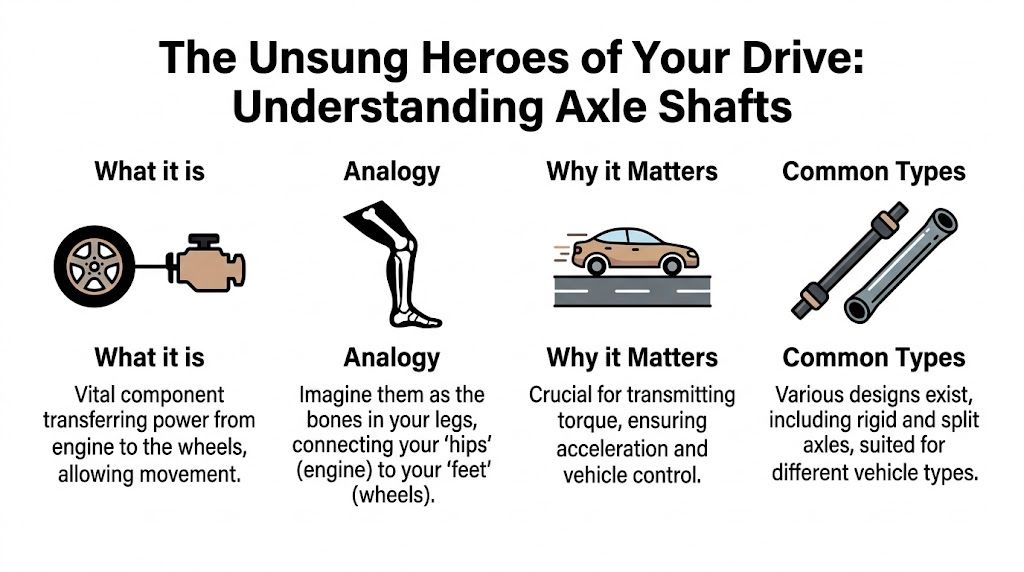
Think of the axle shaft as one of the car’s arm bones. Power starts at the engine and transmission, then travels through driveline components until it reaches the wheel. The axle shaft is the link that helps make that final handoff.
On many passenger cars, especially front-wheel-drive models, that shaft works with CV joints and rubber boots. The joints let the axle keep transferring power while the suspension moves up and down and while the wheels turn left and right. The boots keep grease in and road grime out. When the boot fails, the rest of the assembly is exposed.
The basic parts that matter to you
Here’s the simple breakdown a driver needs:
- The shaft itself carries rotational force.
- CV joints allow movement without binding.
- CV boots protect the grease-packed joint.
- Seals and bearings matter more on solid axle setups, especially on many trucks and rear-wheel-drive vehicles.
A front-wheel-drive car usually gives you more CV-joint-related symptoms, like clicking on turns. A truck or rear-wheel-drive vehicle may involve a different style of axle shaft and a different repair path, especially when the shaft surface where the bearing rides has worn down.
Front-wheel-drive and rear-wheel-drive aren’t repaired the same way
A lot of confusion comes from using “axle” as one catch-all term. In the shop, the repair strategy depends heavily on design.
On a typical front-wheel-drive vehicle, the conversation often centers on the CV axle assembly. If the joint has been contaminated or the shaft is bent, replacement is often straightforward. If the boot has just torn and the joint is still clean and tight, a smaller preventive repair may still be possible.
On many rear-wheel-drive trucks and some SUVs, the decision can involve the axle shaft surface itself. If the shaft where the bearing and seal ride is grooved or scored, a repair bearing may be an option instead of replacing the shaft.
The axle world is large enough that the global automotive axle and propeller shaft market reached approximately $32.63 billion in 2025, with steel holding 72.52% material share, and the aftermarket growing at 4.34% CAGR through 2030 as aging vehicles need more repair work, according to Mordor Intelligence's automotive axle and propeller shaft market analysis.
That broader market matters for one practical reason. There are more replacement and repair paths available today than many drivers realize.
Where specialized parts fit in
Not every axle-related part is for daily street repair, but understanding the hardware helps. In fabrication and suspension work, components like weld-on axle tabs show how much axle setups can vary once you move beyond stock applications. For everyday drivers, that same principle applies in a simpler way. The exact axle design on your vehicle determines what can be repaired, what should be replaced, and what parts will last.
Recognizing the Warning Signs of Axle Failure
Axle problems usually announce themselves through sound, feel, or visible mess. The trick is knowing which symptom means “schedule it soon” and which one means “don’t keep driving it like this.”

Clicking on turns
A rhythmic click or pop during a sharp turn is one of the most recognizable signs of outer CV joint wear. You’ll often hear it pulling into a parking space or making a U-turn.
That sound usually means the joint has worn enough that it no longer moves smoothly under load. If the boot failed earlier and grease escaped, contamination often did the rest.
Vibration under acceleration
A vibration that gets worse as speed rises or shows up under throttle points to a different kind of problem. The axle shaft may be worn, bent, or the inner joint may no longer be operating smoothly. This is the sort of symptom that drivers often misread as a tire issue.
If you want a plain-language refresher on how a CV axle shaft works, that overview is a useful companion to what you’re feeling from behind the wheel.
Grease on the inside of the wheel
This is the easiest clue to spot with your own eyes. If you see grease splattered inside the wheel or around the tire area, a CV boot may be torn.
That doesn’t automatically mean the whole axle assembly is ruined. Timing matters. According to Budget Transmission's explanation of common axle problems, catching a torn boot early can allow a boot-only replacement costing $150-$300, potentially avoiding a full axle assembly replacement that can run from $800 to over $1500.
A torn boot is one of the few axle problems where acting quickly can preserve the cheaper repair.
A quick self-check before you book service
Use this as a practical checklist:
- Listen during low-speed turns if the sound is rhythmic and repeats with wheel rotation.
- Look behind the wheel spokes for grease sling.
- Note when the vibration happens only on acceleration, only at speed, or all the time.
- Pay attention to recent changes after potholes, curb strikes, or driving with a split boot.
For a deeper symptom list, this article on signs of worn CV joints helps narrow down whether the problem is in the joint itself or somewhere nearby.
The Kwik Kar Diagnostic and Repair Process
Good axle shaft repair starts with not rushing to the parts counter. A clicking noise doesn’t always need the same fix, and a leaking axle seal doesn’t always mean the same failure happened on every vehicle.
First comes inspection, not assumptions
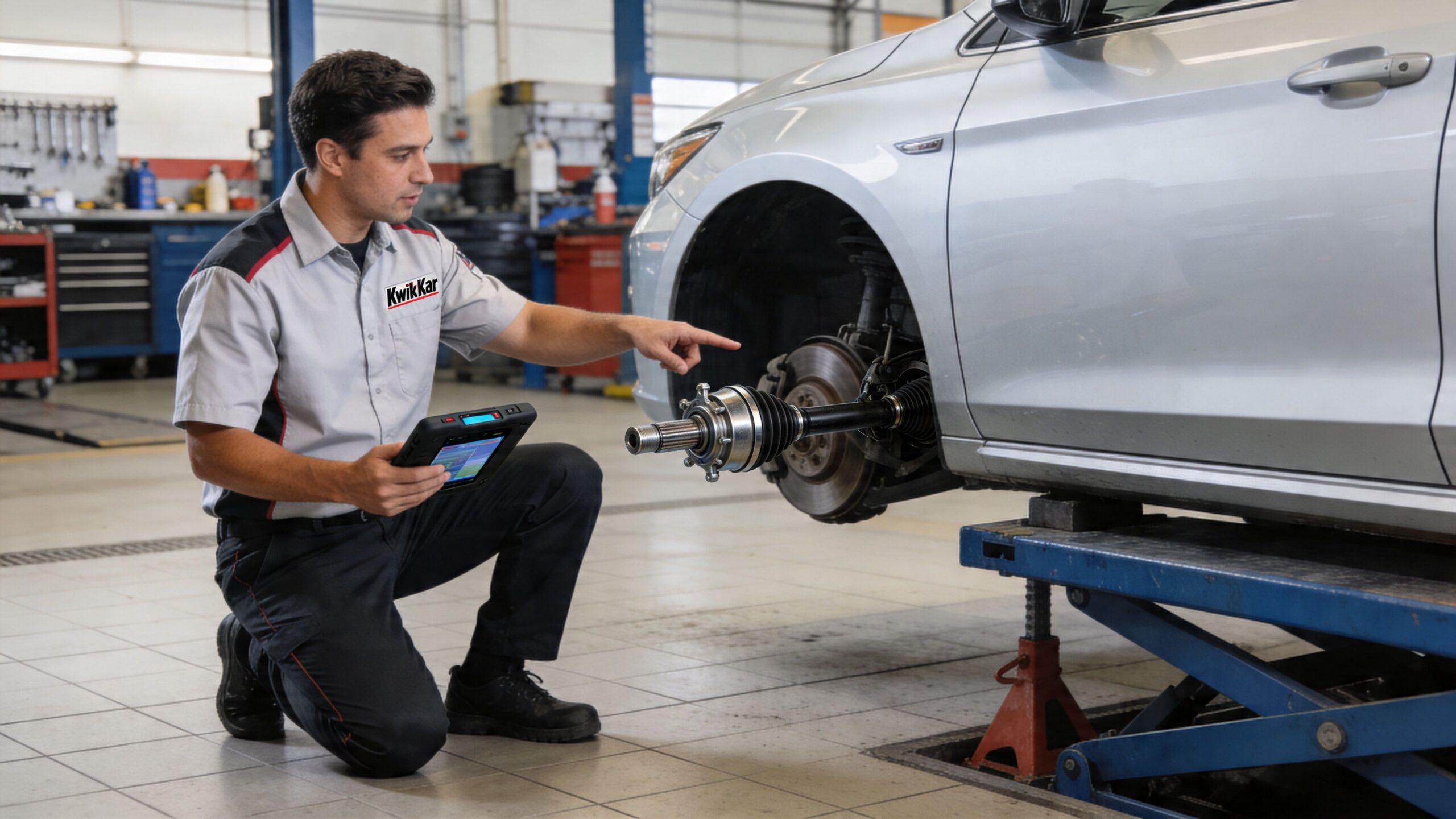
A proper inspection usually starts on the lift. The technician checks for torn boots, grease loss, looseness in the joints, visible shaft damage, and leakage around the seal area. On solid axle applications, shaft surfaces where the bearing and seal ride need a close look because grooves and scoring can change the repair plan.
Then comes the part some shops skip or shorten. The symptoms need to line up with the physical evidence. If a driver reports vibration under load, the test drive and inspection should support that before anyone recommends replacement.
When a repair bearing is the smart choice
Axle shaft repair gets more interesting than many customers expect.
If the axle shaft surface has worn where the bearing and seal normally ride, full replacement isn’t always the only solution. Repair bearings from manufacturers such as SKF and BCA are designed to reposition the bearing and seal onto an unworn section of the shaft. That can restore proper contact without replacing the entire shaft, provided the shaft and housing meet the application requirements.
According to Genuine Parts Company's axle repair bearing technical guide, this method can reduce costs by 60-70% versus a new OEM shaft, where the shaft may cost $500-$1200 per side, and in fleet use it has extended service life by 50,000-100,000 miles.
That doesn’t make a repair bearing the automatic choice. It works when the wear pattern, housing depth, and shaft condition support it. It is not the right move when the shaft has broader damage, rust in the wrong place, fitment issues, or the housing won’t accept that style of bearing correctly.
Shop-floor reality: The best repair is the one that addresses the real wear point. Replacing a seal without fixing the grooved shaft behind it usually means the leak comes back.
What has to be right during installation
A lot of comeback axle work has nothing to do with the part itself. It comes from damage during installation.
Fine cleanup of the shaft surface matters. Seal positioning matters. Pressing force has to go where the manufacturer says it goes. On repair bearings, seating depth and housing fit are not details you can wing. On CV axle work, damaged splines, poor alignment during installation, or a disturbed sealing surface can create a leak or drivability issue that shows up later, not immediately.
Here’s a short video that helps visualize how axle service comes together in the bay:
The decision framework that actually works
A solid axle shaft repair decision usually follows this logic:
- Boot only if caught early and the joint is still clean and serviceable.
- Full CV axle replacement when the joint is noisy, contaminated, or the shaft is compromised.
- Repair bearing when the shaft has localized bearing-surface wear and the housing/application allow it.
- Full shaft replacement when wear, corrosion, or fitment rules out a lasting repair.
What doesn’t work is forcing the cheapest option onto the wrong failure. That’s how drivers end up paying twice.
Understanding Axle Shaft Repair Costs and Timelines
Cost depends on what failed, how early it was caught, and what kind of vehicle you drive. A torn boot caught early is a different conversation than a worn shaft, damaged joint, or leak caused by a grooved bearing surface.
For full axle shaft replacement, RepairPal's 2026 axle shaft replacement cost estimator puts the average cost between $974 and $1,094, with labor estimated at $239 to $351 and parts at $735 to $743. The same estimator notes that vehicle-specific pricing can vary widely, with a Ford F-150 axle shaft replacement around $599.
Where the price changes
Three variables drive most of the estimate:
- Vehicle design affects part cost and labor access.
- Extent of damage changes whether you’re discussing a boot, a repair strategy, or full replacement.
- Single-side versus additional related work can shift the total once the vehicle is inspected.
A truck, SUV, and compact sedan can all have “axle problems” while needing very different labor and parts.
Estimated Axle Shaft Replacement Costs 2026
| Vehicle Type | Estimated Cost Range |
|---|---|
| Many vehicles overall average | $974 to $1,094 |
| Ford F-150 example | Around $599 |
That table is intentionally conservative because broad, model-by-model pricing wasn’t provided in the verified data. In practice, the exact estimate comes from the vehicle, the axle design, and what the inspection finds.
What to expect on timing
There isn’t one universal clock for axle shaft repair. Some jobs move quickly once the diagnosis is confirmed. Others take longer because the technician has to verify wear patterns, inspect seals and housing surfaces, or determine whether a repair bearing is appropriate.
If you want the repair to last, time spent on inspection is not wasted time. It’s what prevents replacing the wrong part.
For customers, the most useful question isn’t “How fast can this be done?” It’s “What failed, and what has to be corrected so I’m not back with the same leak or noise?”
Preventive Maintenance and Fleet Considerations
The cheapest axle repair is usually the one you never let turn into a breakdown. Most axle failures give some warning first. A cracked boot, a light grease leak, a small vibration, or a fresh seal seep can all be found before the vehicle strands anyone.
A simple owner checklist
You don’t need a shop lift to catch the early signs. During routine service, ask for a driveline look-over and keep an eye on a few basics:
- Check CV boots during oil changes for cracks, tears, or grease sling.
- Pay attention after potholes or curb hits because a driveline complaint sometimes starts right after impact.
- Don’t ignore fresh leaks around axle seals or the inside of the wheel.
- Ask what surface the new seal rides on if the vehicle has a history of repeat leaks.
That last point matters more than most drivers realize. A new seal installed over a worn or damaged surface may not stay dry for long.
Why installation quality matters so much
Improper installation is one of the hidden cost multipliers in axle work. According to Tomorrow's Technician's CV axle diagnostic and service tips, premature seal failure and leaks often trace back to rushed work, including poor shaft cleanup, incorrect seal positioning, or damage during installation.
That means the key question isn’t just whether the old part was bad. It’s whether the replacement was installed with enough care to prevent a comeback.
Fleet vehicles need a different mindset
Fleet managers usually don’t struggle with whether axle issues are real. They struggle with timing. Pull a vehicle too early and you lose service time. Wait too long and a manageable shop repair turns into downtime, towing, rescheduling, and driver frustration.
For fleets, scheduled inspections make axle work easier to manage because the goal is early discovery. Torn boots, wear at sealing surfaces, and developing leaks are far easier to address on a planned schedule than after a roadside failure. A structured fleet preventive maintenance program is useful for that reason. It gives operators a repeatable way to catch driveline issues before they become expensive interruptions.
Why Dallas Drivers Trust Kwik Kar for Axle Repairs
Dallas drivers need straight answers. If the axle can be repaired properly, that should be explained clearly. If replacement is the only repair that will hold up, that should be explained just as clearly.
That’s what good axle shaft repair comes down to. Know the symptom. Inspect the actual wear. Choose the repair that fits the damage. Then install it carefully enough that the vehicle doesn’t come back with the same leak, vibration, or noise.
For local drivers, trust usually comes from consistency. Clear communication, solid diagnostics, transparent pricing, and careful workmanship matter more than flashy language. The same is true for fleet operators who need predictable service and fewer comebacks.
A clicking turn, grease on the wheel, or a new vibration is worth checking early. Catch it soon enough, and you may still have options that save time, money, and hassle.
If your vehicle is showing signs of axle trouble, Kwik Kar Oil Change and Auto Care can help you get a clear diagnosis and a practical repair plan. Whether you drive a daily commuter, an SUV, a light truck, or manage a fleet in Dallas, the team can inspect the issue, explain your options, and help you avoid the repeat failures that come from rushed installation or incomplete repairs.