




You turn the key before work, the engine drags, the dash flickers, and now you’re deciding whether you need a jump, a charger, or a new battery. That’s a common Dallas problem, especially after a stretch of hard summer heat or the first cold morning that hits after months of high temperatures.
A battery voltage chart helps take the guesswork out of that moment. It gives you a quick way to match a voltage reading to battery condition, but the chart only helps if you know what battery you have, how to test it correctly, and what real-world conditions can distort the reading. That matters whether you drive a daily commuter, a family SUV, or manage work trucks that can’t afford downtime.
Your Guide to Understanding Car Battery Health
You get in the car for the morning drive across Dallas, turn the key, and the engine hesitates longer than it should. By afternoon, after the car has been sitting in a hot parking lot, it barely cranks. That pattern usually starts before the battery fully fails.
Battery health is not just about whether the car starts today. It is about how much reserve the battery still has, how it handles heat, and whether the voltage stays high enough to support the starter and onboard electronics under real use. For a Dallas commuter, that can mean avoiding a no-start after work. For a fleet manager, it can mean catching a weak battery before it takes a truck out of service.
The fastest basic check is battery voltage. A resting voltage reading gives you a quick picture of charge level and helps separate a battery that is low from one that is aging, undercharged, or ready for further testing. Technicians use a voltage chart for that first pass because it is quick, repeatable, and useful when the test is done correctly.
What the chart helps you answer
A battery voltage chart is a screening tool. It does not confirm every failure on its own, but it gives you a strong starting point for the questions that matter in the shop and in the driveway:
- Is the battery charged enough to start the vehicle reliably
- Is it discharged from sitting, short trips, or a parasitic draw
- Is the battery getting weak even though the car still starts
- Could the charging system be part of the problem
One reading never tells the whole story.
A battery can show acceptable voltage and still fail under load, especially in North Texas heat, where high temperatures speed up internal wear and fluid loss. That is why good diagnosis starts with voltage, then adds battery type, test conditions, charging system checks, and in many cases a proper load or conductance test.
For Dallas drivers, a little hesitation at startup is worth checking early. For commercial vehicles, waiting for a hard failure costs time, towing money, and missed work. A voltage chart helps you make a smarter first call, whether that means charging the battery, testing it further with a multimeter, or bringing it in for a professional battery and charging-system inspection.
Why Voltage Is a Critical Health Indicator
A Dallas driver sees this all the time in summer. The car starts fine after work, then drags the next morning after sitting in a hot parking lot. Voltage is often the first clue that the battery is losing reserve, even before it turns into a no-start.
Voltage shows the battery’s electrical potential at that moment. In shop terms, it tells you whether the battery has enough available pressure to wake up the starter, support the ignition and fuel systems, and keep the vehicle’s electronics stable during crank. That matters because modern cars do not just need enough power to spin the engine. They also need clean, steady voltage so modules, sensors, and communication networks stay online while the starter pulls heavy current.
A weak battery can still power dome lights, the radio, or the dash. That does not mean it is healthy. Starting the engine is the true test of whether the battery can hold voltage under stress.
Why steady voltage matters in real service work
Automotive batteries are built around six lead-acid cells connected in series, with each cell contributing about 2 volts. That is why a healthy 12-volt battery at rest usually reads above 12.6 volts, not exactly 12.0. Once that resting voltage falls, available charge drops, and the margin for reliable starts gets thinner.
In North Texas, that margin disappears faster than many drivers expect. Heat speeds up internal battery wear, and frequent short trips around Dallas can leave the battery undercharged because the alternator never gets enough drive time to fully recover what the starter used.
For commercial fleets, voltage checks are even more useful. A truck or service van that starts today with a borderline battery may still fail on the next stop, after liftgates, telematics, interior lighting, or long idle periods pull the charge down further.
What low or unstable voltage looks like on the vehicle
Low voltage usually shows up as drivability complaints before it shows up as a dead battery:
- Slow cranking: The engine turns over with less speed and more strain.
- Module resets or warning messages: Screens flicker, clocks reset, or random battery and communication faults appear.
- Weak accessory performance: Power windows slow down, blower speed drops, and lights dim more than they should.
Those symptoms do not prove the battery is bad by themselves. They do tell you the battery and charging system need to be checked correctly.
At Kwik Kar, I treat voltage as the opening measurement, not the final answer. It helps separate a battery that needs a full charge from one that has lost capacity, and it tells fleet managers which vehicles need attention before they miss a route. That is why voltage matters. It gives you an early, useful health signal you can act on safely.
The Ultimate 12V Battery Voltage Chart
A Dallas driver can see a battery start fine in the morning, then struggle after the car sits in a hot parking lot all afternoon. That is why a voltage chart helps, as long as you use it as a quick field reference instead of a final diagnosis.
The chart below works best with the battery at rest, after surface charge has dissipated and with no charger or major electrical load connected. If you test right after driving, charging, or repeated start attempts, the number can look better or worse than the battery’s true condition.
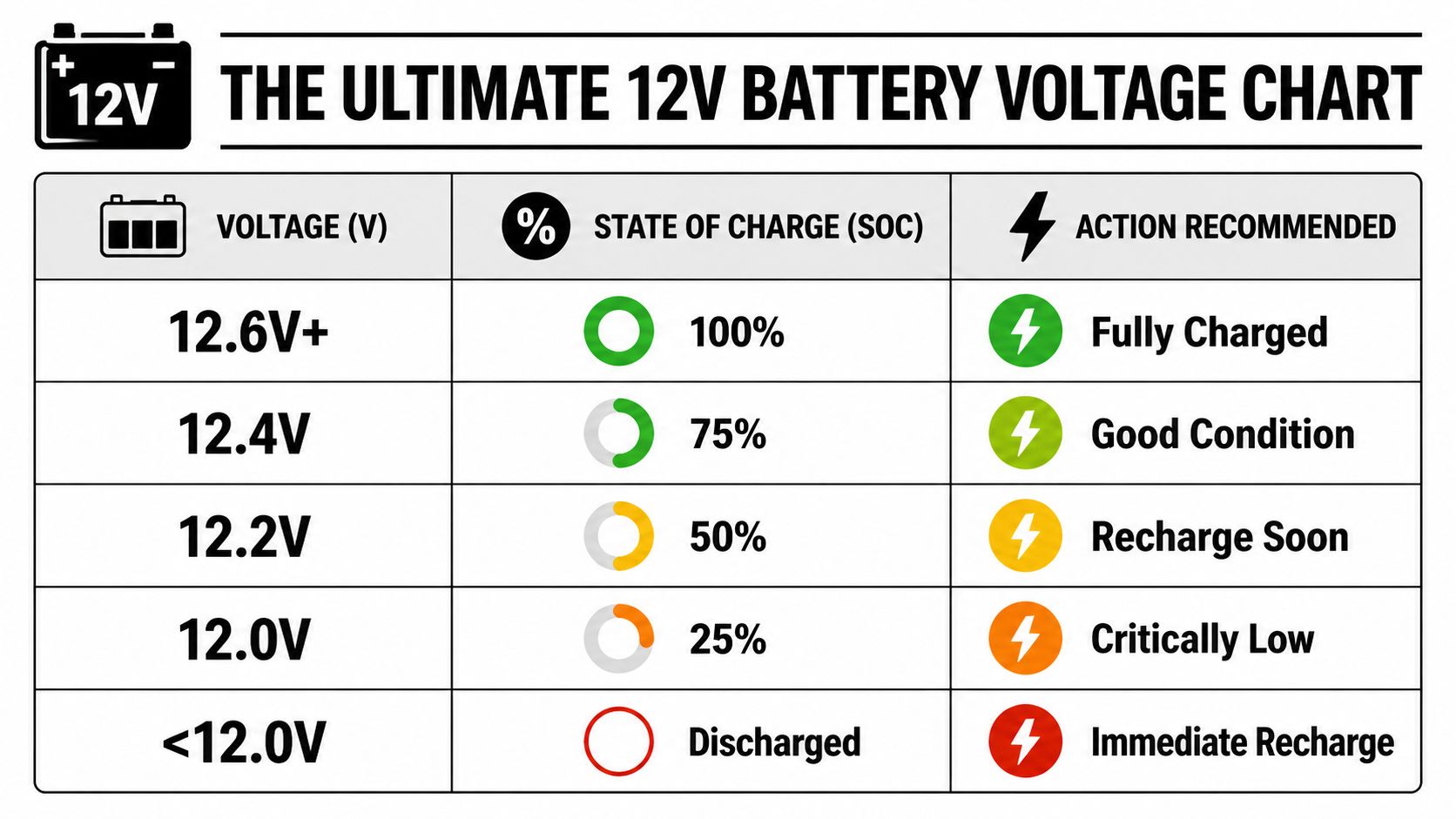
12V battery voltage vs state of charge at rest
| State of Charge | Flooded Lead-Acid Voltage | AGM Voltage | LiFePO4 Lithium Voltage |
|---|---|---|---|
| 100% | 12.6 to 12.7V | 12.75 to 12.85V | 13.6V |
| 75% | 12.40V | Slightly higher than flooded at the same state of charge | Above 13V in much of its discharge curve |
| 50% | 12.20V | 12.30V | Still holds relatively high voltage compared with lead-acid |
| 25% | 12.00V | Slightly above flooded at the same state of charge | Often remains much higher than lead-acid until late discharge |
| 0% usable capacity | 11.85 to 11.90V | 11.95 to 12.00V | 10.0V |
Use the chart by matching the reading to the correct battery chemistry first. A 12.2V reading on a flooded battery points to a partially discharged battery. On a lithium battery, that same number can indicate a very different condition.
A few practical reference points help:
- Flooded lead-acid at 12.6 to 12.7V: fully charged or close to it
- Flooded lead-acid at 12.20V: roughly half charged
- Flooded lead-acid at 12.00V: low enough to charge and investigate before trusting it
- AGM slightly above flooded at the same charge level: normal for that design
- LiFePO4 near 13.6V: full, with a flatter voltage curve than lead-acid
For DIY owners, the chart helps answer a simple question. Charge it first, test it further, or replace it. For fleet managers, it helps flag units that may still start now but are more likely to fail after repeated stops, idling, liftgate use, or long accessory time on a Texas route.
Identifying Your Car's Battery Type
A voltage reading only means something if it matches the battery chemistry under the hood. I see this mistake often in Dallas. A driver checks 12.2 volts on a hot afternoon, compares it to the wrong chart, and either buys a battery too soon or keeps one that is already weak. In Texas heat, that bad call usually shows up a few days later at a fuel stop, on a school pickup run, or first thing Monday morning in a work truck.
The first job is simple. Read the battery label before judging the number on the meter.
Flooded lead-acid
Flooded lead-acid is the traditional starting battery found in many older vehicles and basic replacement setups. Some still have removable caps. Others look sealed, but they are still conventional lead-acid inside.
These batteries are less forgiving of chronic low charge, especially in short-trip driving. In Dallas traffic, a vehicle that makes repeated short runs with the A/C blasting may never fully recover the energy used at startup. If the battery is flooded lead-acid, that matters because resting voltage drops more predictably as charge drops.
AGM batteries
AGM stands for absorbent glass mat. It is still a lead-acid battery, but the construction is different. AGM batteries handle vibration, accessory load, and repeated cycling better than a standard flooded battery, which is why many start-stop vehicles and higher-demand electrical systems use them.
Check for labels such as:
- AGM
- Absorbent Glass Mat
- VRLA
- wording that identifies the battery as sealed or start-stop compatible
An AGM battery usually rests a little higher than a flooded battery at the same state of charge. That small difference matters. If you use a flooded chart on an AGM battery, you can misread a healthy battery as low or miss an early charging problem.
Lithium and LiFePO4
Lithium starter batteries are still uncommon in everyday commuter cars, but they do show up in performance vehicles, specialty builds, and some equipment applications. If the case says LiFePO4 or lithium, use the lithium chart from earlier in the article. Lead-acid reference points do not apply cleanly.
Lithium batteries also behave differently in the field. They can hold higher voltage through much of the discharge cycle, which makes quick checks less intuitive for DIY owners. For a fleet manager, that means voltage alone may not tell the full story if the vehicle has nonstandard equipment or an aftermarket battery setup.
Trust the label on the battery, not a guess based on the vehicle alone.
Quick field check
Before testing, confirm the battery type with a few basic checks:
- Read the top sticker or side label. Chemistry is usually printed clearly.
- Check for start-stop equipment. Many of those vehicles require AGM.
- Look at the replacement date and brand. A previous owner or shop may have installed a different type than the factory battery.
- Match the charger to the battery. AGM and lithium batteries can require different charge profiles.
- For fleet units, standardize battery types where possible. Mixed battery chemistries make voltage checks, charging decisions, and replacement planning harder across multiple vehicles.
If the battery type is unclear, stop guessing. At the shop, we verify the battery, test the charging system, and check for draw or heat-related stress before recommending replacement. That saves a lot of Dallas drivers from replacing the wrong part.
How to Test Battery Voltage with a Multimeter
A digital multimeter is one of the most useful tools you can keep in a garage or service truck. Used correctly, it gives you a clean voltage reading in a minute or two. Used carelessly, it gives you bad information or creates a short circuit you don’t want.

What you need before testing
Keep it simple:
- Digital multimeter: Set it to DC volts.
- Eye protection: Batteries can vent gas or have corrosive residue around the terminals.
- Gloves: Helpful if terminals are dirty or corroded.
- Clear access to the battery posts: Test the actual posts if possible, not just a corroded cable clamp.
Step-by-step testing process
- Turn the vehicle off completely. Headlights, blower motor, and accessories need to be off.
- Let the battery rest if possible. Right after driving, surface charge can make the reading temporarily high.
- Set the multimeter to DC volts. Make sure the range is appropriate for a 12V battery.
- Touch the red probe to the positive terminal. That’s the terminal marked with a plus sign.
- Touch the black probe to the negative terminal.
- Read the display and compare it to the correct battery voltage chart.
Avoid the most common bad reading
The biggest DIY mistake is checking voltage immediately after the engine has been running and assuming that number reflects battery condition. It often doesn’t. The battery may still hold a temporary surface charge from the alternator.
If you can, let the vehicle sit for a while before testing. If you can’t, be cautious about overinterpreting a high reading right after shutdown.
Shop advice: Test clean, exposed battery posts whenever possible. Corroded terminal connections can make a healthy battery look suspect, or a weak connection look like a battery problem.
A visual walkthrough can help if you haven’t used a meter before.
Safety points that matter
A battery can produce sparks fast if you short across the terminals with a tool or probe. Keep metal jewelry, loose ratchets, and stray leads away from the top of the battery.
Don’t force the probes into awkward positions. If the battery is tucked under trim, under a seat, or in the trunk with a remote jump post setup, use the correct access points. If the setup is confusing, stop and verify before testing.
Interpreting Voltages Beyond the Resting State
A Dallas driver leaves work in 100-degree heat, the truck starts fine, then cranks slow the next morning. A resting voltage check might look acceptable and still miss the underlying problem. Battery diagnosis gets more accurate when you look at what voltage does during cranking, while charging, and after the vehicle sits.
During engine cranking
Cranking is where a weak battery usually shows itself. Voltage will drop when the starter pulls heavy current, but the pattern matters more than one snapshot on the meter.
On a typical 12-volt system, a sharp drop into the low range during cranking points to low battery capacity, high internal resistance, or excessive starter draw. If the reading falls hard and the engine labors, treat that as a warning sign, not a final diagnosis. I see this often on higher-mileage vehicles around Dallas where the battery is marginal, the cable connections have some corrosion, and the starter is pulling more current than it should.
Recovery matters too. A battery that bounces back quickly after crank is telling a different story than one that stays dragged down.
While the engine is running
Running voltage checks the charging system, not just the battery. In most passenger vehicles, you want to see a normal charging range from the alternator and voltage regulator. If you consistently see a low charging reading, the battery may never get fully replenished during short trips. If the reading stays too high, the system may be overcharging and cooking the battery over time, which is especially hard on batteries already dealing with Dallas heat.
For a clearer explanation of what normal charging behavior looks like on the road, review these battery charging basics.
One caution for DIY checks. Some newer vehicles vary charging voltage on purpose based on temperature, load, and fuel-saving strategy. A single running-voltage number does not always tell the whole story.
After the car sits
In these cases, pattern failures show up. The battery may charge back up after a drive, test fair at rest, and still leave you stuck after sitting overnight or through a weekend.
Common clues include:
- Starts normally after driving, then cranks slow after sitting
- Needs repeated jump-starts even though the battery was recently charged
- No-start complaints that come and go without a clear pattern
- Fleet vehicles that fail after idle time between routes, not during active use
In those cases, the problem may be parasitic draw, a weak battery with poor reserve capacity, or both. For commercial fleets, that distinction matters because replacing batteries without checking key-off draw can waste money and still leave vehicles unreliable.
A voltage chart shows battery condition at the moment of testing. It does not show what the vehicle pulled from the battery overnight.
That is why a proper diagnosis includes context. Cranking voltage helps identify starting weakness. Charging voltage checks alternator performance. Sit-time behavior exposes drain problems and reserve-capacity issues that a simple resting reading will miss.
How Dallas Weather Affects Your Battery Readings
Dallas weather is hard on batteries, and heat does more long-term damage than most drivers realize. People often blame winter because that’s when the car won’t start, but in North Texas, summer usually does the damage first and winter exposes it.
High heat speeds up chemical aging inside the battery. In a flooded battery, it can also contribute to fluid loss and internal wear. The battery may still start the car for a while, but reserve strength drops. Then a cooler morning arrives, the starter load goes up, and the weak battery finally shows itself.

What heat changes
In the shop, batteries that lived through a long Texas summer often show one of two patterns. Either they’re plainly weak, or they still show a decent resting voltage but don’t hold up when tested under load.
That’s the trap. A simple voltage check may look acceptable while the battery’s actual starting ability has already dropped.
What cold changes
Cold weather reduces battery performance and increases the effort needed to crank the engine. So a battery that was barely getting by in warm weather can feel much worse on a cold morning.
Use common sense with readings:
- A morning reading can be lower than you expected
- A battery on the edge may fail suddenly after a temperature swing
- Heat-aged batteries often collapse when the weather changes
For fleet managers, seasonal checks matter more than waiting for a complaint. Delivery vans, service trucks, and company sedans all lose productivity when battery issues show up during dispatch instead of during scheduled maintenance.
When a Multimeter Is Not Enough
A multimeter tells you voltage. It does not tell you the whole health story. That distinction saves people from replacing the wrong part, or worse, trusting the wrong battery.
A battery can show a strong resting reading and still fail under actual starting demand. That happens when internal condition has deteriorated but the battery still retains enough surface or open-circuit voltage to look healthy in a basic test.

What professional testing adds
Professional battery diagnosis usually includes more than a meter reading. Depending on the vehicle and complaint, technicians may use:
- A load test: This checks whether the battery can hold voltage when current demand rises.
- A charging system analyzer: This looks at alternator and regulator performance.
- Connection and cable checks: High resistance at terminals can mimic battery failure.
- Drain testing: For vehicles that repeatedly die while parked.
If the car keeps going dead after sitting, a focused process matters more than random part replacement. This overview of testing car battery drain is a good example of why voltage alone doesn’t solve every battery complaint.
Why guesswork gets expensive
Owners often replace the battery first because it feels like the obvious move. Sometimes that fixes it. Sometimes the underlying problem is a weak alternator, a poor terminal connection, or a parasitic draw.
That’s where a shop-level approach helps. A service facility such as Kwik Kar Oil Change and Auto Care can run a battery test, charging-system test, and connection inspection together, which is a more reliable path than reading one voltage number and hoping it tells the full story.
A good voltage reading doesn’t clear a battery. A bad voltage reading doesn’t always convict it. The battery has to be tested in context.
If the symptoms are repeat failures, intermittent no-starts, or unexplained warning lights, a multimeter is a screening tool. It isn’t the final judge.
Decisive Signs You Need a New Car Battery
There comes a point when charging and retesting stop making sense. The goal isn’t to squeeze one more week out of a failing battery. It’s to avoid getting stranded.
Use this decision checklist
Replace the battery or schedule a full battery evaluation if you have several of these signs at once:
- Slow crank every morning: The engine turns over, but it sounds heavy and reluctant.
- Repeated jump-starts: If you keep needing a jump, the battery or charging system needs real diagnosis.
- Resting voltage in the failure range: For a standard lead-acid battery, a resting voltage below the discharged threshold points to a battery that’s out of usable capacity, as covered earlier.
- Battery case problems: Swelling, leaks, or heavy corrosion are physical red flags.
- Electrical symptoms at idle: Dimming lights or unstable accessories can point to low voltage or charging issues.
Don’t ignore the warning light
A battery warning light on the dash does not automatically mean the battery itself is bad. It can also indicate a charging-system problem. If you want a plain-language breakdown of what that light can mean, this article on diagnosing a battery warning light is a useful reference.
Think in patterns, not one symptom
One slow start after the car sat for a long time isn’t enough to condemn a battery. A pattern is different. If the same symptoms repeat over days, especially after charging, take that seriously.
Watch for combinations such as:
- Normal start after a jump, then weak start the next day
- Voltage seems acceptable, but cranking remains sluggish
- Battery warning light plus weak starts
- Intermittent no-start after parking
The practical answer is simple. If the battery can’t reliably do its job, it’s already costing you time. For fleet vehicles, it also costs schedule reliability and dispatch confidence.
Essential Battery Maintenance and Safety Tips
Battery maintenance doesn’t have to be complicated, but it does need to be consistent. Most starting problems tied to the battery come down to three basics: charge condition, terminal condition, and safe installation.
Safe handling first
Always treat the battery like an active electrical component, not a harmless box under the hood.
Keep these rules in mind:
- Wear eye protection: Corrosion and battery residue are not something you want in your eyes.
- Remove metal jewelry: Rings and bracelets can create a dangerous short.
- Work in a ventilated area: Batteries can release gas, especially during charging.
- Avoid crossing tools over the terminals: One accidental short is enough to damage components or create sparks.
Terminal cleaning that actually helps
Corroded terminals can block current flow and create symptoms that look like a weak battery. Cleaning them often improves starting performance if the battery itself is still sound.
A basic cleaning approach:
- Shut the vehicle off fully.
- Disconnect the negative cable first.
- Disconnect the positive cable after that.
- Clean corrosion from terminals and cable ends carefully.
- Reconnect positive first, then negative last.
- Make sure the clamps are tight and the battery is secure.
Clean terminals don’t fix a bad battery, but dirty terminals can make a good battery act bad.
What to inspect during routine service
Look over the battery every time you’re already under the hood for oil or fluid checks.
Focus on:
- Loose hold-downs: Vibration shortens battery life.
- Cracked or swollen case: Replace, don’t keep testing.
- Corroded connections: Clean and recheck.
- Damaged cables: Frayed or heat-damaged cables affect performance.
For DIY owners, these steps help prevent surprises. For fleet managers, putting battery inspection into routine service reduces the number of vehicles that fail at the first stop of the day instead of in the bay.
Professional Battery Services for Dallas Drivers and Fleets
A Dallas driver can leave work in 100 degree heat, stop for fuel, and come back to a slow crank that was not there that morning. A fleet manager can have three vans start fine all week, then lose one on the first route because a marginal battery finally gives up under heat and repeated short trips. In both cases, a voltage reading is only the starting point. The next step is finding out whether the battery is weak, the alternator is undercharging, or cable resistance is hiding the actual problem.
That matters in North Texas because heat shortens battery life and exposes weak charging systems fast. A battery can still show a number that looks acceptable at rest, then fall on its face under load. On fleet vehicles, repeated idling, power accessories, and frequent stops add another layer. You need testing that matches how the vehicle is used.
What professional service should cover
A proper battery visit should check the full starting and charging system, not just print a pass or fail slip. That usually includes:
- Battery state and condition testing
- Load or conductance testing
- Starter draw and cranking performance checks
- Alternator output and charging-voltage checks
- Terminal, cable, and hold-down inspection
- Battery replacement matched to the vehicle’s size, rating, and electrical demand
Battery type also changes the testing process. Standard flooded lead-acid, AGM, EFB, and lithium-based systems do not behave the same way, and they should not be charged or evaluated the same way either. That is especially important on newer vehicles, hybrids, and commercial units with auxiliary batteries or higher electrical loads.
Why fleets need a tighter process
For a personal vehicle, a battery problem is an inconvenience. For a fleet, it turns into missed stops, late technicians, rescheduled deliveries, and extra service calls.
The fix is consistency. The vehicles that stay on the road usually have scheduled inspections, recorded test results, and replacement decisions based on trend, not guesswork. If one truck starts slower than the rest, that vehicle should be checked before it becomes a no-start in a customer driveway or at the first jobsite of the day.
For Dallas-area drivers and fleet operators who are already at the replacement stage, professional battery replacement services should include correct battery selection, terminal service, memory protection when needed, and confirmation that the charging system is supporting the new battery.
If your car has started slower lately, if the battery light has come on, or if you want the system checked before the next heat wave exposes a weak link, schedule service with Kwik Kar Oil Change and Auto Care. Our team checks battery condition, charging performance, and related electrical faults so you can make a clear repair decision based on test results, not guesswork.