




You’re probably doing what most drivers do. You glance at the tread, maybe kick the tire once, and if nothing looks obviously wrong, you move on with your day.
That makes sense. Tread is easy to see. Tire age isn’t.
A tire can look decent on the outside and still be old enough to be a safety problem. That’s why the date code on tires matters so much. It acts like a born-on date. If you know where to look and how to read it, you can tell whether your tires are reasonably fresh, getting older, or far past the point where you should trust them on a Dallas freeway in summer heat.
A lot of drivers never check this. Some have never been shown how. Others see the DOT code on the sidewall and assume it’s just factory information that doesn’t matter to them.
It does matter. More than is commonly understood.
Your Tires Have an Expiration Date You Might Be Ignoring
You can have plenty of tread and still have a tire that’s aging out.
That catches people off guard because we’re trained to think about wear, not time. If the grooves still look deep, the tire feels “good.” But tread depth only tells one part of the story. A tire also ages from the inside as the rubber and internal structure change over time.

Think of a tire like a pair of running shoes left in the closet for years. The soles may still look usable, but the material can harden, dry out, and lose the flexibility it once had. Tires do something similar. The outside may look serviceable while the inside is no longer as trustworthy as it used to be.
Why drivers miss this
Drivers often check tires in one of these moments:
- Before a road trip: You look for low air, nails, or worn tread.
- During an oil change: You hope the shop lets you know if something is off.
- When inspection time rolls around: You want the car to pass and move on.
What usually gets skipped is the age check. That’s the quiet risk.
Practical rule: If you don’t know how old your tires are, you don’t fully know what condition they’re in.
A tire can age even if you don’t drive much
This surprises Dallas drivers who put very few miles on their vehicle. Low mileage sounds protective, and in some ways it is. But time still affects rubber. So does heat, storage, sunlight, and regular flexing.
That means the family SUV that mostly sits in the garage, the spare-use pickup, and the weekend car all still need an age check. A tire doesn’t have to be bald to be unsafe.
The good news is that the check is simple once you know what you’re looking for. You don’t need special equipment. You just need to find the DOT code and understand the last few digits.
What Is the Tire DOT Number
The DOT number works like a tire’s born-on record. If you are standing in a Dallas service bay looking at the sidewall, that long string of letters and numbers is the label that tells you where the tire came from and, most importantly for safety, when it was made.
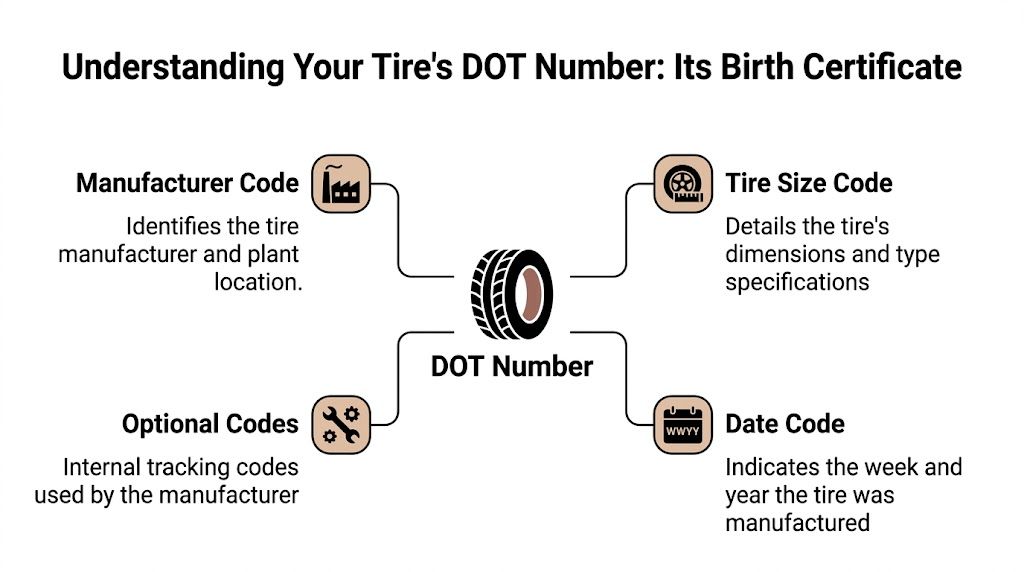
The letters DOT mean the tire carries a Department of Transportation Tire Identification Number, often shortened to TIN. That identifier helps manufacturers, shops, and drivers trace a tire for recalls, defects, and age checks. For Dallas drivers, the practical value is simple. It helps you tell the difference between a fresh tire and one that has already been aging on a shelf.
What the full code includes
The full TIN has several parts. As explained in Tire Agent’s overview of DOT tire codes, the groups identify the plant, the tire size, the manufacturer’s internal type code, and the date of manufacture.
| Part of the TIN | What it means |
|---|---|
| Group 1 | Plant code |
| Group 2 | Tire size code |
| Group 3 | Tire type or manufacturer code |
| Group 4 | Date code |
If your goal is tire age, Group 4 is the part that matters most.
That point clears up a common confusion. Many drivers see the full DOT string and assume every character has something to do with the age. It does not. The date is only the last portion, which is why a tire can look like it has a long, confusing serial number when you really only need the final digits to answer the safety question.
Why the date code matters so much
The DOT system began in the early 1970s under federal rules that required tires to carry an identification number so buyers could be notified about defective or noncompliant tires, according to the Tire Agent source above.
Older tires used a three-digit date code. The first two digits showed the week, and the last digit showed the final number of the year. That was not very helpful years later because one code could point to several possible decades. A tire marked 229 could have been made in 1979, 1989, or 1999.
That confusion is part of why drivers still get tripped up today, especially when they buy used vehicles, check a spare, or run across new old stock tires that were manufactured years ago but sold much later.
Starting in 2000, the date portion changed to four digits. That made the code much easier to read in real life. A code like 0121 means the first week of 2021. A code like 3422 means the 34th week of 2022.
Why this small code has real safety value
This number is not just there for a recall database. It gives you a quick reality check.
A tire can look new, have decent tread, and still be older than many drivers realize. That is the hidden problem with inventory that sat in storage before being installed. The DOT date helps you catch that. For a Dallas driver dealing with heat, highway speeds, and sudden summer storms, knowing the tire’s actual age is a much more useful starting point than judging it by appearance alone.
How to Find and Read the Date Code on Your Tires
The date code on tires is usually easier to find than people expect. The hard part is knowing what you’re looking for.
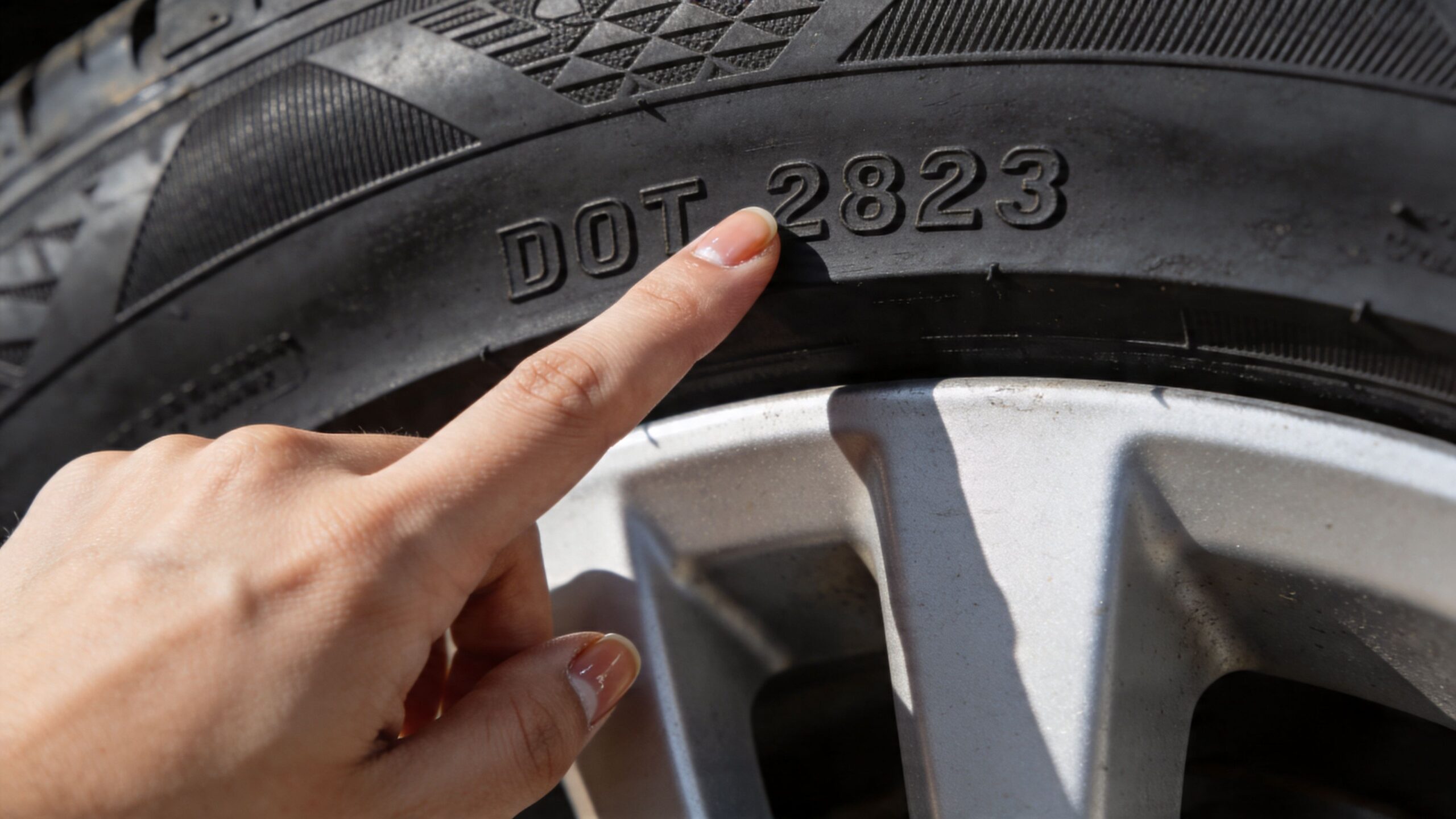
Start by crouching next to one tire and looking at the sidewall. Find the letters DOT. After that, you’ll see a string of letters and numbers. The last four digits of that full DOT sequence are the tire’s manufacturing date on modern tires.
Where to look first
On some tires, the full DOT code is easier to see on one side than the other. Michelin notes that tires made after 2009 must show the full TIN on the outboard sidewall and a partial TIN, without the date, on the inboard side. If you don’t see the date code right away, you may need to roll the vehicle slightly or look from a different angle.
Use this quick search method:
- Find the letters DOT on the sidewall.
- Read the full string that follows.
- Look at the last four digits of the complete code.
- Ignore the earlier characters if your goal is age only.
If your tire is dirty, wipe the sidewall with a rag first. Road grime can make those molded numbers harder to spot.
How to read a modern four digit code
Modern date codes use a simple week-year format.
| Code | Meaning |
|---|---|
| 0121 | First week of 2021 |
| 3422 | 34th week of 2022 |
| 4714 | 47th week of 2014 |
| 3524 | 35th week of 2024 |
So if you find 2524, that means the tire was made in the 25th week of 2024.
Confusion often arises when people expect a regular calendar date, like month and year. Instead, the tire date code uses week first, then year. That’s why 2524 doesn’t mean “25th month,” of course. It means week 25, year 2024.
If you remember just one thing, remember this. The format is WWYY, not month and year.
A short walk-through can help if you want a visual example while standing by your car:
What if you see only three digits
If the date code has three digits, the tire was made under the older system used before 2000. That old code is ambiguous because the last digit only shows the year within a decade.
A code such as 229 could point to the 22nd week of 1979, 1989, or 1999. In real-world terms, that means any tire with a three-digit date code is already too old to trust on a passenger vehicle today.
That’s especially important for:
- Classic cars
- Trailers
- Used spare tires
- Old farm or utility equipment
- Vehicles that sat for years
Check all four, not just one
Drivers sometimes read one tire and assume the set all matches. Don’t do that.
Read every tire individually. Tires get replaced one at a time all the time after flats, damage, or uneven wear. You may find one tire that’s much older or newer than the others, which can change how the vehicle handles and whether replacement makes sense now or soon.
If you’ve never checked before, do it today. Once you know how, it usually takes less than a minute per tire.
The Hidden Dangers of an Aging Tire
A tire can have decent tread and still be living on borrowed time.
The date code matters because rubber changes as it gets older, even if the tire has not been driven much. Heat, oxygen, sunlight, and long periods of sitting all dry the rubber out and make it less flexible. A simple way to picture it is a rubber band left in a drawer for years. It may look usable until the day it stretches, hardens, and snaps.
That is why tire age confuses so many drivers. The problem often starts inside the tire, where you cannot see it during a quick walk-around in the driveway.
Why an old tire can pass a quick glance
An aging tire may still have tread blocks that look fine. It may even hold air normally. What changes first is often the tire’s ability to flex, absorb heat, and keep its internal layers bonded together under stress.
On Dallas roads, that matters. Summer pavement gets hot. Highway speeds add heat. Potholes, rough expansion joints, and sudden braking ask a lot from the tire all at once. An older tire has less reserve strength for those moments.
You may notice clues such as:
- Fine cracks in the sidewall or between tread blocks
- A stiffer ride or harsher response over bumps
- Small bulges or uneven shape
- Vibration at speed
- Separation between layers that is not obvious until the tire is under load
Sometimes there is no dramatic warning at all.
What aging feels like in the real world
Drivers usually expect a bad tire to look obviously worn out. Age does not always work that way. A tire can seem normal during short errands, then struggle during the exact conditions that raise risk most: a long highway drive, a hot afternoon, a hard stop, or a quick lane change.
That is also why "new" can be misleading. In real supply chains, tires can spend long stretches in warehouses or on shelves before they ever reach your car. They may be unused, but they are not freshly made. For Dallas drivers, that means the date code is a safety check, not just a trivia number stamped into the sidewall.
If your vehicle has started shaking, pulling, or feeling unsettled at speed, tire age is one item to check along with balance, alignment, and wheel damage. This local guide on why your car is shaking when you drive explains those symptoms in plain language.
In the worst cases, a weakened tire becomes part of a crash investigation. If that ever happens, a resource on uncovering the cause of your crash can help you understand how investigators look at mechanical factors, including tire-related issues.
Tread depth and tire age are two different checks
Tread answers one question. How much rubber have you used up?
The date code answers another. How long has this tire been aging since it was made?
You need both. A tire can have enough tread left for traction on paper and still be a poor bet because the rubber and internal structure have aged out. That is the hidden danger. Drivers often look at the grooves, see meat left on the tire, and assume they are safe. The born-on date can tell a very different story.
Replacement Rules and Your Tire Inspection Checklist
By the time you’ve found the date code, the next question is obvious. When is a tire too old?
There isn’t one single rule that settles every situation, because storage conditions and real-world use matter. But there are practical age ranges drivers can use to make good decisions.
A workable age guide
The broad rule many drivers follow is to treat 6 years as a serious inspection point and 10 years as an absolute outer limit. Earlier in this guide, we covered why the newer four-digit date code made it much easier to identify tires moving toward that age range.
If you’re looking at a tire and doing the mental math, use this simple framework:
| Tire age | What to do |
|---|---|
| Newer tire with no visible issues | Keep monitoring condition and pressure |
| Approaching the caution range | Inspect more carefully for cracking, bulges, and uneven aging |
| Around the replacement benchmark many drivers use | Have a technician evaluate whether replacement makes more sense than continued use |
| At the absolute outer limit | Replace it regardless of tread appearance |
That’s not fear talking. It’s common-sense maintenance.
The new old stock question
Many buyers get uneasy. You buy “new” tires, then notice the date code shows they weren’t made yesterday.
That can happen because of global shipping, warehousing, and inventory cycles. As noted in a Good Sam community discussion about acceptable DOT date codes for new tires, tires that are 1-2 years old may still be sold as new, and a tire with the code 3524 was made in the 35th week of 2024 but may sit for 12+ months before sale.
That doesn’t automatically make the tire bad. Storage matters. A properly stored tire is different from one that sat in poor conditions. But the date code still matters because it tells you what you’re starting with.
Buying advice: Ask to see the DOT date code before installation if tire freshness matters to you.
Your at home inspection checklist
Use this whenever you rotate tires, wash the car, or get ready for a longer drive.
- Read every date code: Don’t assume all four match.
- Look for sidewall cracking: Fine lines can be an early warning.
- Watch for bulges: A bubble in the sidewall is a stop-driving issue.
- Check color and texture: Rubber that looks unusually dry or chalky deserves attention.
- Notice mismatched ages: A mixed set isn’t automatically wrong, but it calls for closer evaluation.
- Ask about storage if buying tires: “New” on the invoice doesn’t always mean newly manufactured.
If you want a broader maintenance routine around the vehicle, this vehicle inspection checklist is a useful companion to your tire age check.
One more practical reminder
Don’t forget the spare.
A spare tire can sit untouched for years. That makes it one of the easiest tires to overlook and one of the most disappointing to discover is too old when you need it.
Kwik Kar's Tire Safety Support for Dallas Drivers
A date code check is simple, but a trained eye still helps.
Most drivers aren’t crawling around the driveway every month with a flashlight, and that’s understandable. Tire safety is one of those jobs that fits naturally into routine service. When a technician already has the vehicle in for maintenance, it’s a smart time to look at tire age, visible cracking, overall condition, and whether the set appears evenly matched.
That matters even more for busy households with multiple cars. It matters a lot for fleet vehicles that spend more time on the road and can’t afford preventable downtime from a tire issue that should’ve been caught earlier.
What a professional tire check helps catch
A technician can quickly spot things that drivers often miss:
- An old tire with decent tread
- One replacement tire that doesn’t match the age of the others
- Sidewall damage that blends in with dirt
- A spare tire that hasn’t been checked in years
For fleet managers, proactive checks are even more useful. A vehicle may be technically rolling just fine today, but tire age problems tend to show up at the worst possible time, during highway driving, on a delivery schedule, or when a driver is far from the shop.
Where to get help
If you’d rather have someone handle the inspection, professional tire services can help you evaluate age, wear, condition, and replacement timing in one visit.
That gives you a more complete picture than looking at tread alone. And it removes the guesswork if the code is hard to read, the tire is old enough to raise concern, or you’re trying to decide whether a “new” tire on the shelf is fresh enough for your comfort.
Frequently Asked Questions About Tire Date Codes
Is it okay if all four tires have different date codes
Not ideal, but not automatically unsafe.
What matters is how different they are in age, condition, and wear. A small difference can happen after a single tire replacement. A large age spread deserves closer attention because older rubber may behave differently than newer rubber, especially in heat and rain.
I’m buying new tires and the code is from last year. Should I worry
Not automatically.
A tire can be sold as new even if it was manufactured earlier and then stored in inventory. The important thing is to ask questions, read the code yourself, and make sure you’re comfortable with the age of the tire you’re paying for.
Why is the format so confusing
Because it isn’t written the way dates are typically expected to appear.
That’s not just your impression. Human factors research from North Carolina State University found that zero out of 83 participants correctly identified tire date codes in common DOT formats, as discussed in this review of tire date decoding research. People commonly mistake the numbers for a regular month-year style date, which they aren’t.
If the DOT code has always looked confusing to you, you’re in very good company.
Does the date code matter more than tread
They matter in different ways.
Tread shows wear from driving. The date code shows age since manufacturing. A tire can have weak tread and be unsafe. A tire can also have decent tread and be too old to trust.
Should I check the spare too
Yes.
Drivers forget the spare all the time. It may have almost no miles on it, but that doesn’t mean it’s young. If it’s old, it may not be the reliable backup you think it is.
If you’d like a technician to check your tire age, tread, and overall condition during routine maintenance, Kwik Kar Oil Change and Auto Care can help. It’s an easy step that can catch an aging tire before it turns into a roadside problem.