




Dallas heat has a way of exposing a weak A/C fast. The drive starts out normal, then a few stoplights later the vents are pushing air that feels more “not hot” than cold. You turn the fan higher, lower the temp all the way, and start wondering whether a can of refrigerant from the parts store will solve it before the afternoon gets worse.
Sometimes it will help. Sometimes it won’t. And sometimes it cools the cabin for a short stretch, then leaves you right back where you started because the actual problem was never the charge itself.
That’s the part many drivers miss about an air conditioning recharge. A recharge can restore cooling if the system is low and everything else is working. But weak A/C can also come from a leak, bad airflow, clutch trouble, electrical faults, or compressor problems. In Dallas, where your A/C isn’t a luxury for much of the year, knowing the difference can save money and prevent a bigger repair.
Is Your A/C Just Low on Refrigerant
Individuals typically don’t start by asking technical questions. They are prompted by discomfort. Your car was cold last month, now it takes forever to cool down, and the air coming out of the vents feels weak on the hottest part of the day.
That’s when the DIY recharge kit starts looking attractive. It’s sitting on the shelf with a gauge attached, the label promises colder air, and the job looks simple enough to do in the driveway. I get the appeal. If the system is only slightly low and there isn’t another fault hiding in the background, an air conditioning recharge can bring the vent temperature back down.
The catch is that warm air is a symptom, not a diagnosis.
A lot of drivers search for one cause when the A/C starts fading. In reality, there are several common reasons a system stops cooling well. If you want a broader rundown before you grab a can, this guide on how to fix car AC blowing warm air is a useful place to compare what low refrigerant looks like versus airflow, compressor, or electrical issues.
What a recharge can and cannot do
A recharge can help when the system is low enough to lose cooling performance, but still intact enough to operate normally. It cannot repair a leaking hose, a damaged condenser, a failed compressor clutch, or a control problem.
Practical rule: If adding refrigerant is the only fix you ever perform, and the cooling keeps fading, you’re probably treating the symptom and not the failure.
That’s the mindset a technician uses in the shop. Before adding anything, the better question is whether the system is low because of normal misunderstanding, or low because refrigerant escaped from somewhere it shouldn’t have.
Signs You Need a Recharge vs Symptoms of a Deeper Problem
One of the biggest misconceptions in automotive A/C work is that refrigerant gets “used up” like gasoline. It doesn’t. Refrigerant is not a consumable like fuel. In a properly sealed system, it should not need routine recharging. If your vehicle needs frequent recharges, it almost certainly has a leak that requires professional repair to provide a lasting solution according to this HVAC explanation of closed-system refrigerant loss.
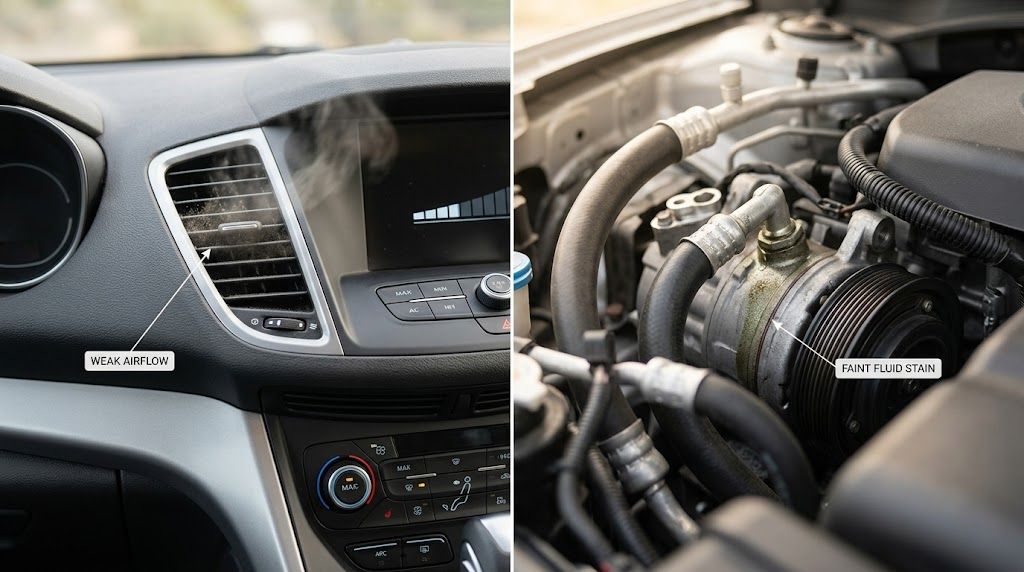
That matters because the symptoms tell a story.
Signs that point more toward low refrigerant
Low refrigerant usually shows up as a gradual decline. The A/C still works, just not as well as it used to. Cabin cooling takes longer. The air may be cool at highway speed and less impressive at idle. The compressor may still engage, but the performance feels weak and inconsistent.
That kind of slow fade is why people reach for a recharge kit first.
Signs that suggest something else is wrong
Other symptoms should make you slow down and rethink the plan:
- Sudden loss of cooling: If the air went from cold to warm quickly, that leans more toward a leak, electrical issue, or component failure than a minor low-charge condition.
- A/C clutch never engages: If the compressor clutch doesn’t come on at all, adding refrigerant may not solve anything.
- Strange noises with the A/C on: Clicking, squealing, or grinding from the engine bay can point to compressor or pulley trouble.
- Musty or foul smell from the vents: That’s often an airflow or contamination issue inside the HVAC box, not only a charge problem. If your vents smell bad along with weak cooling, this guide on why a car AC smells can help narrow it down.
- Visible oily residue on A/C parts: Refrigerant leaks often leave oily traces around hoses, fittings, or the condenser.
For a simple comparison from another cooling system context, RVupgrades.com’s AC repair tips are worth a look because the logic is similar. Weak cooling can come from more than one source, and airflow problems often get mistaken for refrigerant problems.
If the cooling problem came on fast, or the system makes noise, stop assuming “just needs a recharge.”
Your DIY Air Conditioning Recharge Toolkit
A recharge goes better when the tools give you real information. The wrong can or a flimsy gauge can push the system past “low” and into overcharged, and that creates a new problem you did not start with.
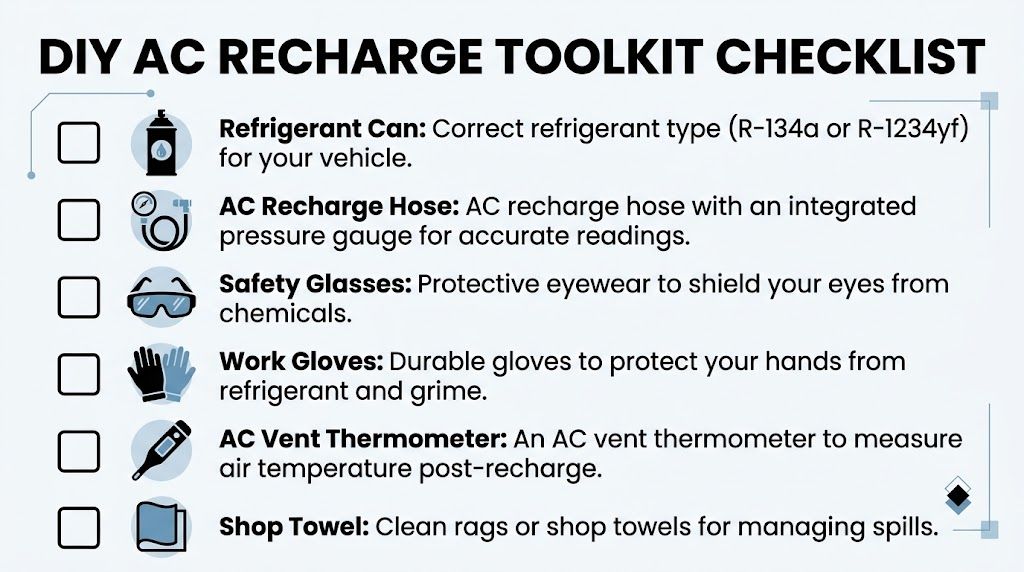
What you need on hand
Keep the kit simple and correct for your vehicle:
- Correct refrigerant type: Use the refrigerant listed on the underhood sticker or in the service information. Guessing here can damage the system and make later repairs more expensive.
- Recharge hose with gauge: A gauge is the bare minimum for a DIY recharge. AutoZone’s recharge guidance notes that pressure readings are more useful in warmer weather, and that charging should follow the vehicle’s pressure information instead of guesswork.
- Safety glasses and gloves: Refrigerant can injure skin and eyes fast.
- Shop towels: Good for wiping fittings and keeping dirt away from the service port.
- Vent thermometer: Helpful for checking vent temperature before and after, so you know whether the recharge changed anything.
One tool makes the biggest difference.
Don’t cheap out on the gauge
In the shop, I have seen plenty of systems get into trouble because somebody charged by feel. Vent air felt a little cool, so they kept adding. Then head pressures climbed, cooling dropped at idle, and the original complaint got worse.
A basic gauge does not replace professional manifold readings or leak testing. It does help you avoid blindly topping off a system that may already be near range. For a DIY job, that matters.
Skip products that promise too much
Be careful with cans that include sealers or vague “stop leak” claims. They sound like a shortcut, but they can contaminate equipment and make proper repair harder later. If the system has a leak, the lasting fix is still finding the leak and repairing it.
That is the trade-off with DIY recharge kits in general. They can restore cooling if the charge is slightly low. They do not explain why the refrigerant got low in the first place.
How to Recharge Your Car AC System Safely
Doing a basic air conditioning recharge at home is possible, but precision matters. Too little refrigerant won’t solve the problem. Too much can create a different one.
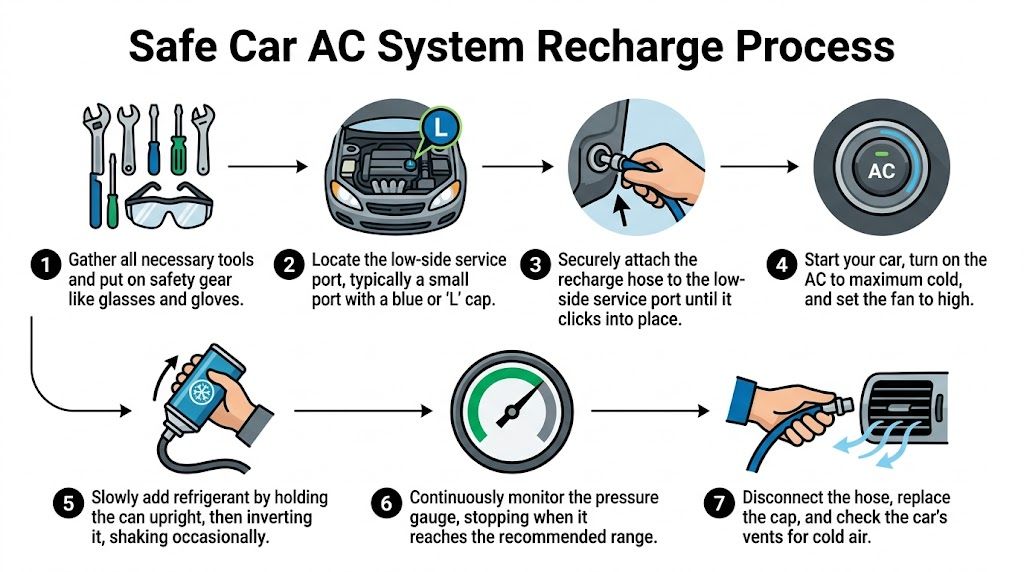
Start with the right conditions
Work with the car parked on level ground in a ventilated area. Put on gloves and eye protection before you touch any fittings. Confirm that the outside temperature is warm enough for a meaningful pressure reading, and make sure you’re using the refrigerant your vehicle calls for.
Then inspect before you connect anything. If you see obvious damage, oily residue around fittings, or signs the belt-driven compressor has another issue, don’t rush into adding refrigerant.
Find the low-side port only
The recharge hose connects to the low-pressure service port. That’s the side used for charging. Many ports are marked with an “L” cap, and the fitting sizes are usually designed to help prevent mistakes, but don’t rely on assumption alone.
Clean the port cap area before attaching the coupler. Dirt at the service port has a way of turning a small job into a contamination problem.
Shop advice: If you aren’t completely certain you’ve found the low side, stop there and verify it. Misidentifying ports is one of the easiest ways to create trouble.
Set the car up for an accurate reading
Start the engine. Turn the A/C to maximum cold and set the blower on high. Open the doors or windows if needed so the system stays loaded while you check pressure and cooling behavior.
Attach the hose securely and read the gauge before adding anything. If the reading already looks abnormal, especially if it’s much higher than expected, don’t keep going just because the cabin isn’t cold.
A visual walkthrough can help if you want to see the professional process for evacuation, vacuum, and exact refill. This video shows why a proper service goes beyond squeezing in more refrigerant.
Add refrigerant slowly and monitor constantly
Add refrigerant in short bursts, then let the system stabilize before judging the result. Don’t race the needle into the “green” because the label made it look simple. Pressure changes as the system responds, and patience prevents mistakes.
Field guidance shows why caution matters. Improper refrigerant charge is a common issue, with one study finding 72% of serviced air conditioners had incorrect levels. Overcharging is particularly risky as it can create excessive pressure, reduce efficiency, and cause catastrophic damage to the compressor according to NREL’s charging and airflow guidance.
Watch for improvement at the vents while checking the gauge. If cooling starts to return and pressure reaches the recommended band for the current conditions, stop. More refrigerant does not mean more cold.
Know when to quit the DIY attempt
Stop the job if any of these show up:
- Gauge behavior doesn’t make sense: The pressure is already high, jumps erratically, or doesn’t respond the way you’d expect.
- The compressor short-cycles: Rapid on-off cycling often means the system needs diagnosis, not blind adding.
- Cooling doesn’t improve: If the gauge changes but cabin air doesn’t, the problem may not be charge-related.
- The system sounds unhappy: New noises after charging are a warning sign, not something to ignore.
Once you’re done, disconnect the hose carefully, reinstall the cap, and recheck vent temperature and overall performance after a short drive.
When the DIY Recharge Is Not Enough
A DIY recharge usually tells you one of two things. Either the system was slightly low and now cools better, or the recharge exposed that the problem is larger than a can of refrigerant can solve.

The temporary-fix pattern
If your A/C gets cold after a recharge and then warms up again days or weeks later, that’s the classic leak pattern. It’s the same logic as airing up a tire that has a nail in it. You can restore function for a while, but you haven’t repaired the reason it lost pressure.
The EPA is direct on this point. Recharging a vehicle’s A/C without first repairing leaks is not a permanent solution. Proper service involves not just a top-off but leak repair followed by a correct recharge to ensure long-term reliability and prevent repeated failures, as explained in the EPA’s vehicle A/C recharge guidance.
Clues that call for diagnosis
At that point, continuing to buy more refrigerant usually wastes money. Professional diagnosis makes more sense if:
- The air turned warm again quickly
- The pressure looked wrong before you even started
- The compressor cycles rapidly or won’t stay engaged
- You hear knocking, grinding, or squealing
- You suspect a condenser, hose, seal, or evaporator leak
A recharge that doesn’t last is evidence. Treat it like a clue, not a failure on your part.
There are also times when reducing cabin heat load helps while you sort out the repair. If your car spends long hours in direct sun, these car cooling solutions and window tinting ideas can make the interior more manageable, but they won’t replace fixing the A/C system itself.
If your car is down, you’re juggling work, or you need quick diagnosis without waiting around all week, options for same-day auto repair near me can be a practical next step.
Why Dallas Drivers Trust Kwik Kar for AC Service
A Dallas A/C system can seem fine on a mild morning, then struggle in stop-and-go traffic at 102 degrees. That is where careful diagnosis matters. A quick top-off can bring vent temps down for a while, but if the charge dropped because of a leak, the underlying problem is still there.
Outside research lines up with what technicians see in the bay. Analysts in the Purdue review of refrigerant charge performance found that improper refrigerant charge is common and can hurt cooling performance. In Texas heat, small errors show up fast.
What proper A/C service looks like
Good A/C service starts with verification. Pressures get checked against ambient conditions. Vent temperature gets measured. The technician looks at compressor operation, condenser airflow, and signs of dye or oil residue that point to a leak. If the system needs service beyond a simple correction, the refrigerant has to be handled the right way, the system evacuated, and the charge set to spec.
That level of accuracy matters even more on daily drivers that idle in school pickup lines, delivery vehicles that stay on the road all afternoon, and work trucks that cannot afford repeat breakdowns.
Why the local piece matters
Dallas drivers put A/C systems through a different kind of stress. Long idle times, hot pavement, high cabin heat load, and heavy summer traffic expose weak fans, marginal compressors, and slow leaks that might go unnoticed in cooler climates.
For a complete solution, drivers can learn more about automotive air conditioning repair and recharge service at Kwik Kar Spring Valley.
If your vents are blowing warm air, the smart move is to find out whether your car needs a simple air conditioning recharge or leak diagnosis and repair. Kwik Kar Oil Change and Auto Care helps Dallas drivers with diagnostic A/C service, routine maintenance, and same-day repair support when available. Schedule a visit online or call the shop to get the system checked before the next heatwave turns a manageable problem into a more expensive one.