



A certified auto technician is a professional who has passed standardized ASE (Automotive Service Excellence) exams and met verified hands-on experience requirements to prove competency in vehicle repair. Understanding what does certified auto technician mean gives you a real advantage when choosing where to take your car. The ASE is a national nonprofit organization that sets the professional standard for automotive service across the United States. Certification is not a formality. It signals that a technician has demonstrated field-tested skills under rigorous, nationally recognized benchmarks.
What does certified auto technician mean in terms of ASE requirements?
ASE certification requires two distinct things: passing a computer-based exam and proving real work experience. To qualify, a technician needs two years of hands-on experience in automotive service, or one year of experience combined with a two-year training program or degree. That combination matters because it separates technicians who have only studied theory from those who have actually worked on vehicles.
The registration and testing process has clear costs. ASE registration runs $43 per session, and each individual exam costs approximately $59 as of mid-2026. These fees apply per test, and most technicians pursue certification across multiple specialty areas. The financial commitment alone reflects how seriously the industry treats the process.
Documentation is where many candidates stumble. Incomplete proof of experience can invalidate passing scores, even after a technician has already passed the exam. Employment history and education credentials must align precisely with ASE’s eligibility criteria. Getting this wrong means starting over.
Pro Tip: Gather your employment records and training transcripts before registering for any ASE exam. Submitting incomplete documentation after passing can cost you the certification entirely.
- Confirm you meet the experience threshold (two years hands-on, or one year plus a qualifying degree).
- Collect all employment records and training documentation before registering.
- Register for your exam session through the ASE portal and pay the $43 session fee.
- Schedule and pay for each individual specialty exam at approximately $59 per test.
- Submit your experience verification to ASE after passing to receive official certification.
How does the auto technician certification process work?
The ASE certification process uses computer-based tests organized by specialty area. Each exam covers a specific system, such as engine repair, brakes, electrical systems, or heating and air conditioning. Technicians choose which areas to test in based on their experience and career goals.

One practical advantage of the process: you do not have to wait until you have completed all your experience hours before sitting for an exam. Passing scores are banked for up to two years while you accumulate the required work experience. This means a technician fresh out of a training program can take the exam while the material is still sharp, then complete the experience requirement before the scores expire.
Achieving ASE Master Automobile Technician status is the highest level of recognition. It requires passing all eight A-series core tests, which cover engine repair, automatic transmission, manual drivetrain, suspension and steering, brakes, electrical systems, heating and air conditioning, and engine performance. Passing all eight proves broad competency across the full scope of automotive service.
Certification does not last forever. ASE certifications expire every five years, and technicians must recertify to stay current with changes in vehicle technology. This ongoing requirement keeps certified professionals up to date rather than coasting on credentials earned years ago.
- Computer-based exams are available in multiple specialty areas, each tested separately.
- Scores from passed exams are held for up to two years while experience is completed.
- Master Technician status requires passing all eight A-series exams.
- Recertification is required every five years to maintain active status.
- About one-third of technicians fail their first ASE exam attempt, reflecting the genuine difficulty of the tests.
Pro Tip: If you are preparing for ASE exams, take the tests immediately after completing your training program. Banked scores give you a two-year window to finish your experience hours without retesting.
How does ASE certification differ from being an uncertified mechanic?
The word “mechanic” and “technician” are often used interchangeably, but the difference between a certified technician and an uncertified mechanic is meaningful. Certification signals verified technical competency. An uncertified mechanic may have years of experience, but no independent body has tested and confirmed that knowledge against a national standard.
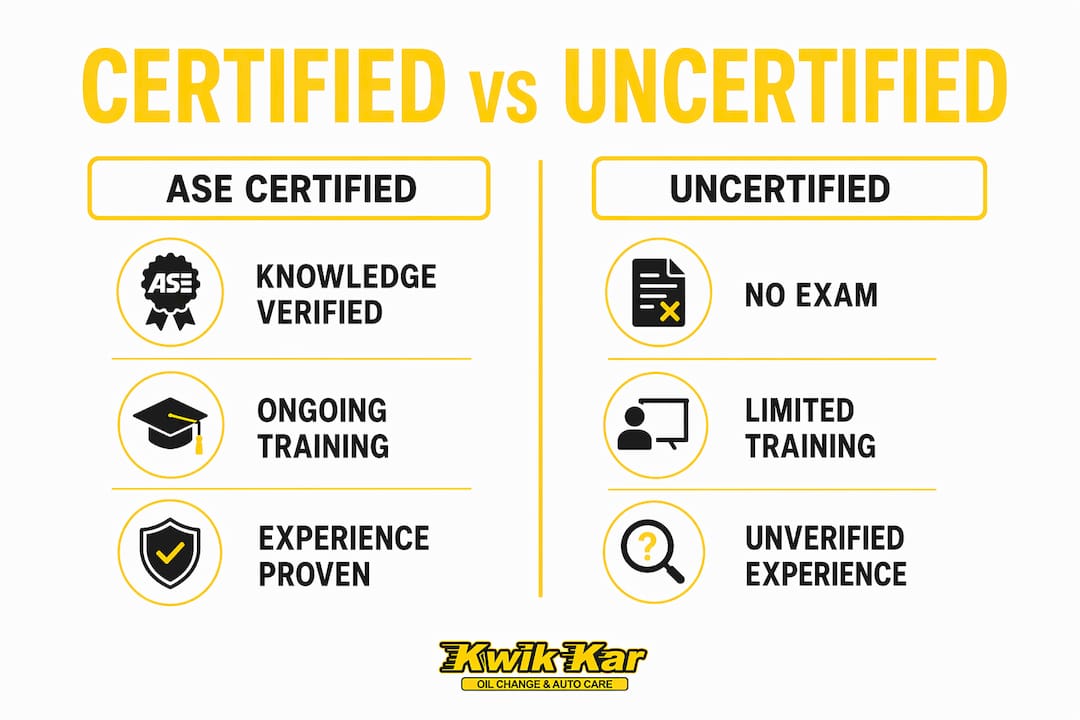
| Category | ASE Certified Technician | Uncertified Mechanic |
|---|---|---|
| Knowledge verification | Passed standardized national exams | No independent verification |
| Experience requirement | Documented and confirmed by ASE | Self-reported, unverified |
| Technology training | Ongoing recertification required | No formal update requirement |
| Consumer trust signal | ASE blue and white seal displayed | No standardized trust indicator |
| Diagnostic capability | Trained in advanced electronic systems | Varies widely by individual |
Modern vehicles are far more complex than those from two decades ago. Certified technicians receive ongoing training to keep pace with advanced diagnostics and electronic systems that now control nearly every vehicle function. An uncertified mechanic working on a modern vehicle without that training faces a real knowledge gap.
ASE certification validates field experience and technical knowledge beyond what any classroom program alone can confirm. It is described in the industry as “proof of craft,” meaning the credential confirms real-world ability, not just the ability to pass a written school exam. That distinction matters when your car needs a correct diagnosis the first time.
Why does ASE certification matter for vehicle owners?
ASE certification gives you a reliable way to evaluate a technician before handing over your keys. The ASE blue and white seal acts as a third-party trust indicator recognized across the United States. When you see it displayed at a shop, it means at least one technician there has met a nationally standardized competency benchmark.
The stakes are higher than they used to be. Vehicle complexity is driving certification from a preference to a necessity. Modern cars rely on interconnected electronic systems that require specialized diagnostic tools and training to service correctly. A misdiagnosis on a modern vehicle can cascade into multiple expensive problems.
- The ASE seal confirms a technician has passed rigorous, nationally recognized exams.
- Certified shops attract customers who prioritize quality and accountability.
- Recertification requirements mean certified technicians stay current with new vehicle technology.
- Certification reduces the risk of repair errors caused by outdated knowledge or unverified skills.
- Over 250,000 professionals currently hold active ASE certification nationwide, making it the industry’s dominant competency standard.
Choosing a shop with ASE certified technicians is a practical decision, not just a preference. You are selecting a professional whose knowledge has been tested by an independent organization with no financial stake in the outcome. That independence is what makes the credential credible.
Key Takeaways
A certified auto technician is defined by passing ASE exams and meeting verified experience requirements, making ASE certification the most reliable competency standard for vehicle owners to use when choosing a repair shop.
| Point | Details |
|---|---|
| ASE certification defined | Technicians must pass computer-based exams and document two years of hands-on experience. |
| Exam banking allowed | Passing scores are held for up to two years while experience requirements are completed. |
| Master Technician status | Requires passing all eight A-series ASE exams across core automotive systems. |
| Recertification every five years | Active certification requires renewal to keep pace with evolving vehicle technology. |
| Consumer trust signal | The ASE blue and white seal is a nationally recognized indicator of verified technician competency. |
What we have learned from working with certified technicians every day
Certification is not a piece of paper you frame and forget. At Kwik Kar Oil Change & Auto Care, we have seen firsthand what separates a technician who holds active ASE credentials from one who does not. The difference shows up in how quickly a problem gets diagnosed correctly, and how rarely a customer comes back with the same issue.
The recertification requirement is the part most customers do not think about. Every five years, our technicians have to prove they are still current. That is not a formality. Vehicle technology changes fast enough that knowledge from five years ago can be genuinely outdated on a 2024 or 2025 model. The recertification cycle forces real learning, not just credential maintenance.
One thing I would tell any vehicle owner: do not assume certification is standard at every shop. ASE certification is voluntary. Shops choose whether to hire and maintain certified staff. When you find a shop that prioritizes ASE credentials, that choice reflects a commitment to accountability that goes beyond marketing language.
The exam failure rate tells you something important. Roughly one in three technicians fails their first ASE attempt. These are not easy tests. When a technician passes and maintains certification, you are dealing with someone who earned it. That matters when your car’s safety systems are on the line.
— Kwik Kar
Certified service you can count on at Kwik Kar Oil Change & Auto Care
Kwik Kar Oil Change & Auto Care employs ASE Certified Master technicians who bring verified expertise to every service appointment. Every repair starts with a personalized diagnostic and a written estimate before any work begins, so you know exactly what is being done and why.

Kwik Kar Oil Change & Auto Care is also recognized by RepairPal and NAPA AutoCare, adding independent third-party validation to the ASE credentials our team holds. Whether your vehicle needs routine maintenance or a complex repair, you can schedule your appointment with confidence that a certified professional will handle it. Take advantage of our $30 off maintenance service with a free inspection to get started.
FAQ
What does ASE stand for in auto technician certification?
ASE stands for Automotive Service Excellence. It is a national nonprofit organization that develops and administers standardized certification exams for automotive service professionals across the United States.
How long does ASE certification last?
ASE certifications are valid for five years. Technicians must recertify before expiration to maintain active status and stay current with changes in vehicle technology.
Can a technician take the ASE exam before finishing their experience hours?
Yes. Technicians can sit for ASE exams before completing the full experience requirement, and passing scores are banked for up to two years while they accumulate the necessary work hours.
What is the difference between a mechanic and a certified technician?
A certified technician has passed standardized ASE exams and had their experience independently verified. An uncertified mechanic may have practical skills, but no independent body has tested or confirmed their knowledge against a national standard.
What is ASE Master Automobile Technician status?
ASE Master Automobile Technician is the highest ASE designation. It requires passing all eight A-series exams covering engine repair, brakes, electrical systems, transmission, and other core automotive systems, plus meeting the full experience requirement.