

Mobile payment auto service is the process of using digital wallets, NFC technology, and secure pay-by-link methods to pay for automotive repairs and services quickly and securely. The industry term for this category is contactless payment processing, and it covers everything from tapping your phone at a service counter to receiving a secure text link and paying your invoice remotely. At Kwik Kar Oil Change & Auto Care, these systems are part of how modern auto care should work: fast, transparent, and built around your convenience.
What is mobile payment auto service and how does it work?
Mobile payment auto service uses two primary methods: in-person NFC tap payments and remote pay-by-link transactions. Both replace the traditional card swipe with a faster, more secure process that fits naturally into how auto shops operate today.
In-person tap payments work through Near Field Communication, the short-range wireless standard built into most smartphones. When you hold your phone near a payment terminal, your device transmits a temporary Device Account Number and a one-time cryptogram. That cryptogram cannot be reused for future transactions, even if someone intercepts it. Digital wallets like Apple Pay and Google Pay handle this process automatically after you authenticate with biometrics.
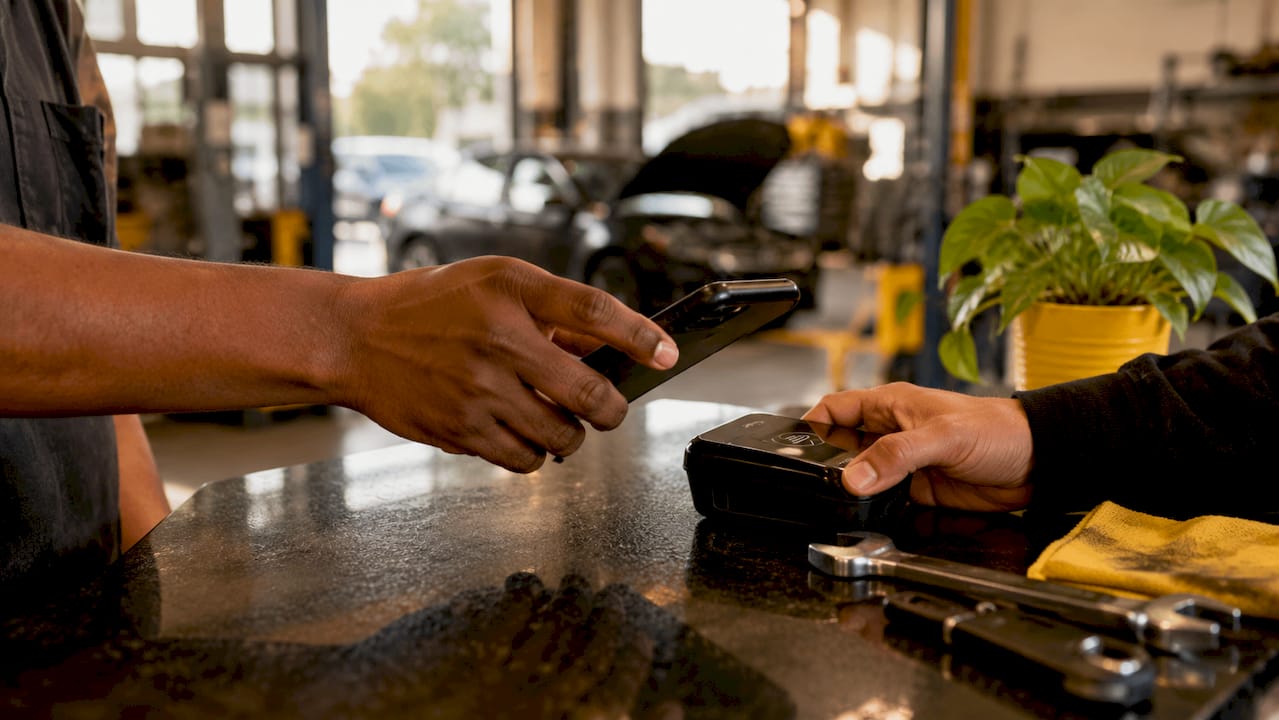
Pay-by-link is the remote version. Your shop sends a secure payment link via SMS or email after completing your service estimate or invoice. You review the charges, confirm the amount, and pay from your phone without ever entering a card number manually. This method works especially well for customers who authorize work remotely or want to pay before picking up their vehicle.
Here is the typical transaction flow for an in-person tap payment:
- The technician or service advisor presents the total on a payment terminal or mobile reader.
- You unlock your phone using FaceID or a fingerprint scan.
- You hold the phone within a few centimeters of the terminal.
- The NFC chip transmits the encrypted Device Account Number and cryptogram.
- The processor verifies the cryptogram and approves the transaction, usually in under one second.
- You receive a digital receipt instantly.
Biometric authentication reduces manual entry time from 5–10 minutes to under one minute. That time savings adds up fast in a busy shop with multiple customers checking out simultaneously.
Pro Tip: If your auto shop offers pay-by-link, use it to review your invoice before you arrive for pickup. You can confirm every line item and pay in advance, making your pickup a 60-second stop.
What are the benefits of mobile payments for auto service customers?
Mobile payment services deliver concrete advantages for both customers and the shops serving them. The benefits go well beyond simple convenience.
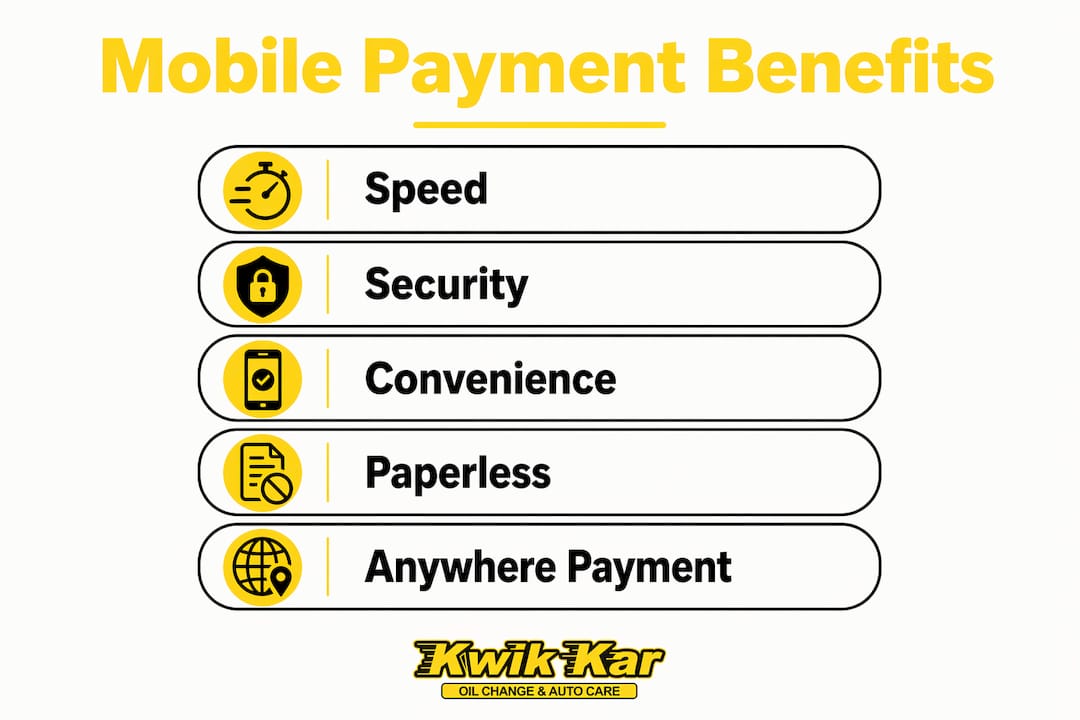
For customers, the most immediate gain is speed. Contactless tap payments process faster than chip card inserts, and pay-by-link eliminates the need to stand at a counter at all. You can authorize and pay from your couch while the shop finishes your oil change.
Security is the second major benefit. Tokenization replaces your card number with a unique digital identifier, so the merchant never sees or stores your actual bank data. This is a fundamental improvement over card swipes, where your full card number passes through the merchant’s system.
For auto shops, the business case is equally strong:
- Revenue protection: Auto shops operating on cash-only or limited payment systems lose $200–$400 monthly in missed or delayed transactions. Mobile-ready systems can increase revenue efficiency by more than 10%.
- Faster checkout: Shorter payment lines reduce customer frustration and free up staff time.
- Integrated records: Payment data connects directly to invoicing and service history, reducing paperwork errors.
- Remote authorization: Customers can approve estimates and pay deposits without visiting the shop, which speeds up the repair process.
- Fewer declined transactions: Automotive-specific payment processors handle the deposit and split-tender workflows that standard retail processors often flag as risky.
Mobile payment platforms reduce checkout friction and manual paper processes, enabling payments anywhere from vehicle pickup to remote invoicing. That flexibility directly improves the customer experience at every touchpoint.
How do security and technology protect your payment in auto service?
The security architecture behind mobile payments is more sophisticated than most customers realize. Three layers work together to protect every transaction.
Tokenization is the foundation. When you add a card to Apple Pay or Google Pay, your actual card number is never stored on your phone or transmitted to the merchant. Instead, a unique Device Account Number takes its place. Tokenization prevents fraud by ensuring the merchant never accesses your real bank data, even if their system is compromised.
Cryptographic authentication adds a second layer. Each tap payment generates a one-time cryptogram tied to that specific transaction. Stolen data from one transaction is worthless for any future purchase.
Biometric verification closes the loop. FaceID and fingerprint scanning authenticate the transaction on your device before any data is transmitted. This step is absent in a standard card swipe, where anyone holding your card can complete a purchase.
“Tap-to-Phone technology, approved by EMVCo, allows standard smartphones to accept compliant contactless payments without any additional hardware, transforming how mobile automotive businesses handle onsite payments.”
Beyond customer-facing security, the payment infrastructure matters too. Automotive merchant accounts are built to handle deposit payments, split tenders, and delayed completion workflows that are common in auto service. Standard retail processors often treat these transaction patterns as high-risk, leading to holds or declines. An automotive-specific account reduces those friction points and improves funding predictability for the shop.
One more technology worth knowing: SoftPOS, also called Tap-to-Phone. This software turns a standard smartphone into a payment terminal without any Bluetooth dongle or card reader attachment. For mobile mechanics working at your driveway or parking lot, SoftPOS eliminates the need for costly hardware while maintaining full EMVCo compliance.
How do auto shops implement mobile payment systems in practice?
Implementation looks different depending on whether a shop is a fixed location or a mobile service provider. Both models benefit from the same core technology, applied in different ways.
Fixed auto shops like Kwik Kar Oil Change & Auto Care typically use countertop NFC terminals integrated with their shop management software. When a service advisor closes a repair order, the payment terminal pulls the invoice total automatically. The customer taps, the transaction posts, and the payment record links to the service history without any manual entry.
Mobile mechanics and detailers rely on SoftPOS apps or compact mobile card readers that pair with a smartphone. These setups require no permanent infrastructure and work anywhere with a cellular signal.
The table below shows how different payment workflows apply across common auto service scenarios:
| Service scenario | Payment method | Key benefit |
|---|---|---|
| Oil change at fixed shop | NFC tap at counter | Under 1-second checkout |
| Remote estimate approval | Pay-by-link via SMS | Customer authorizes without visiting |
| Deposit on major repair | Pay-by-link or in-app | Secures work order before parts are ordered |
| Mobile detailing at home | SoftPOS on smartphone | No hardware required |
| Split payment on large repair | Automotive merchant account | Handles partial payments without holds |
Backend workflow integration is the part most customers never see but benefit from directly. When payment, invoicing, booking, and service records all connect in one system, errors drop and your service history stays accurate. That accuracy matters when you need warranty documentation or want to track maintenance intervals.
Pro Tip: When choosing an auto shop, ask whether their payment system connects to their service records. Shops with integrated systems can pull your full vehicle history instantly, which speeds up every future visit.
You can learn more about how auto shops handle payment and financing options in Kwik Kar’s guide on auto repair financing.
Key Takeaways
Mobile payment auto service is the most secure and efficient way to pay for automotive work, combining NFC technology, tokenization, and biometric authentication into a single tap or link.
| Point | Details |
|---|---|
| Core technology | NFC and pay-by-link handle both in-person and remote auto service payments. |
| Security advantage | Tokenization ensures merchants never store your real card number, reducing fraud risk significantly. |
| Speed improvement | Biometric authentication cuts payment time from up to 10 minutes to under one minute. |
| Revenue impact | Shops adopting mobile payments can recover $200–$400 monthly in previously lost transactions. |
| Hardware-free option | SoftPOS technology lets mobile mechanics accept contactless payments using only a smartphone. |
The shift I see happening in auto payment technology
At Kwik Kar Oil Change & Auto Care, we have watched payment expectations change faster in the past few years than in the previous decade. Customers who once handed over a card without a second thought now expect to tap their phone, get a text link, or pay before they even walk through the door. That shift is not a trend. It is a permanent change in how people manage their finances.
What concerns me about how some shops approach this is the tendency to bolt on a payment app without connecting it to anything else. A standalone payment terminal that does not talk to your invoicing system or service records creates more work, not less. The real value of mobile payment systems comes from integration, not just acceptance.
I also think the security conversation is underappreciated. Most customers assume mobile payments are convenient but risky. The opposite is true. Tokenization and one-time cryptograms make a tap payment significantly harder to exploit than a card swipe. Shops that explain this to customers build trust quickly.
The next wave will be predictive. Shops will send payment links before the customer even asks, tied to appointment reminders and pre-authorized estimates. Customers who understand how these systems work will be better positioned to use them confidently and choose shops that handle their data responsibly.
— Kwik Kar
Convenient auto care with mobile payment options at Kwik Kar
Kwik Kar Oil Change & Auto Care accepts mobile payments for every service, from quick oil changes to full diagnostic repairs. Whether you tap your phone at the counter or pay via a secure link before pickup, the process is fast and your payment data stays protected.
Our ASE Certified Master technicians provide transparent estimates before any work begins, so you always know what you are paying and why. You can review your invoice, approve the work, and pay remotely without a single phone call. Ready to experience auto care built around your schedule? Schedule your appointment online, or browse our full auto repair services to see everything we offer in Dallas, TX.
FAQ
What is mobile payment auto service?
Mobile payment auto service is the use of digital wallets, NFC technology, and secure pay-by-link methods to pay for automotive repairs and services. It replaces physical card swipes with contactless taps or encrypted online payment links.
Is it safe to use mobile payments at an auto shop?
Mobile payments are safer than traditional card swipes because tokenization replaces your card number with a one-time digital identifier. The merchant never stores your actual bank data, and biometric authentication prevents unauthorized use.
What is pay-by-link in auto service?
Pay-by-link is a remote payment method where the shop sends you a secure URL via SMS or email. You click the link, review your invoice, and pay without entering your card number manually or visiting the shop.
Do I need special hardware to accept mobile payments as a mobile mechanic?
No. SoftPOS technology, approved by EMVCo, turns a standard smartphone into a contactless payment terminal. Mobile mechanics can accept payments on-site without purchasing additional hardware.
Why do auto shops need automotive-specific payment processors?
Auto service involves deposits, split tenders, and delayed payments that standard retail processors often flag as high-risk. Automotive merchant accounts are built for these workflows, reducing transaction holds and improving cash flow for the shop.