



Most cases of a car jerking while accelerating trace back to one of four systems: ignition misfires, fuel delivery failures, sensor or throttle faults, or transmission and drivetrain problems. Before you replace a single part, your first move should be to read the OBD-II codes — either with your own scanner or at a shop — because guessing at parts instead of diagnosing with data is the most expensive mistake you can make.
Here are four things you can do right now:
- Scan for OBD-II codes. Many auto parts stores offer a free code scan. Write down every code, even pending ones.
- Check whether the check engine light is flashing or steady. A flashing light almost always signals an active misfire and means the situation is more urgent.
- Note exactly when the jerk happens. From a dead stop? Under hard throttle? During a gear change? That pattern narrows the suspect list fast.
- Do a quick smell and sound check. Burning smell, grinding, or a sudden drop in power changes the urgency level immediately.
Key Takeaways
A car jerking while accelerating almost always traces to ignition, fuel delivery, sensor, or transmission faults — and a data-driven diagnostic is the fastest, least expensive path to the correct fix.
| Point | Details |
|---|---|
| Diagnose before replacing parts | OBD-II codes and live data identify the faulty system; guessing wastes money and often fails to fix the problem. |
| Match symptom timing to the cause | Jerks from a stop suggest transmission or clutch; jerks under hard load suggest fuel delivery; random jerks suggest misfires. |
| Know when to stop driving | A flashing check engine light, burning smell, or violent bucking means tow the car, not drive it to the shop. |
| Repair costs vary widely | Spark plugs and filters can cost under $200; torque converter or catalytic converter repairs can reach $2,500 or more. |
| Kwik Kar Oil Change & Auto Care | ASE-certified technicians perform scan, live-data test drive, and targeted system tests with a written estimate before any repair. |
Table of Contents
- Why does your car jerk when accelerating? Common causes explained
- Quick DIY checks you can do in under 10 minutes
- How a mechanic properly diagnoses the root cause
- Is it safe to keep driving when your car shudders during acceleration?
- Typical U.S. repair costs and how long fixes take
- When should you call a mechanic, and what should you ask?
- How Kwik Kar Oil Change & Auto Care diagnoses acceleration problems
- The part most drivers skip — and why it costs them
- Accurate diagnostics, real repairs, no guesswork
- Sources
- FAQ
Why does your car jerk when accelerating? Common causes explained
Symptom timing is your most reliable diagnostic clue: a jerk from a dead stop points to a different system than a jerk at highway speed or mid-shift. Here is a cause-by-cause breakdown.
Engine misfires (spark plugs and ignition coils)
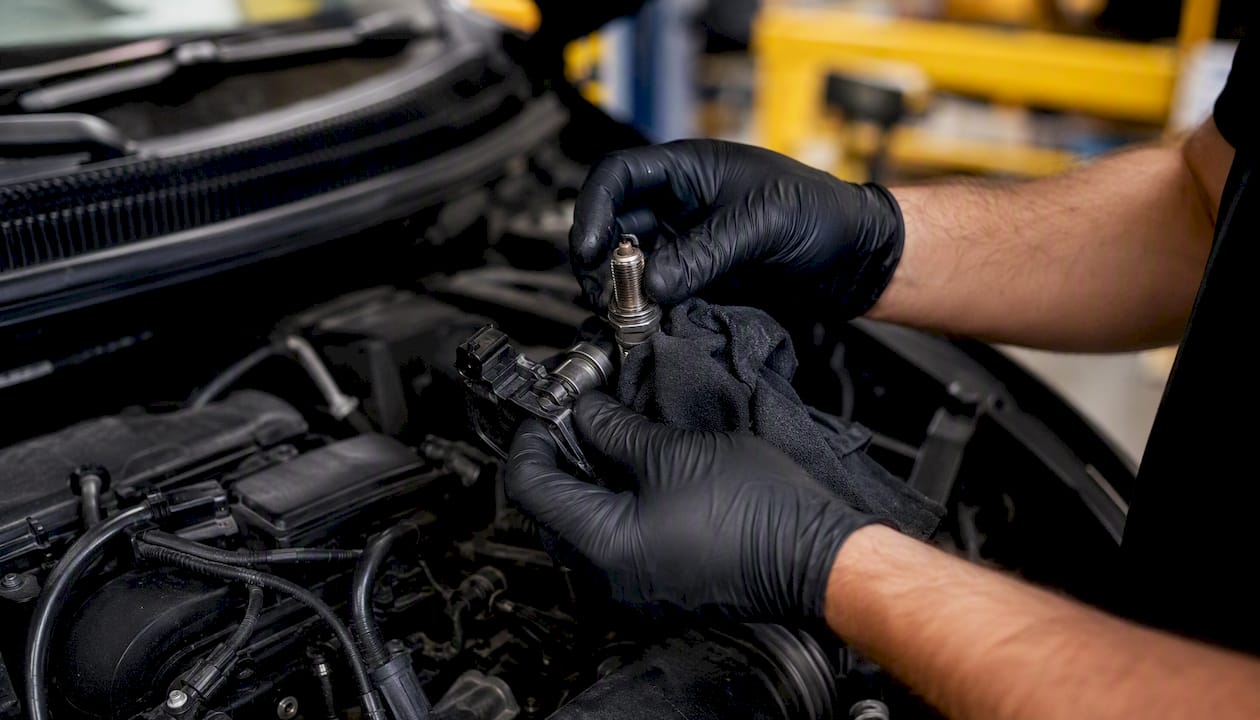
Engine misfires are the most common cause of jerking during acceleration, and they usually feel like a random stumble or shudder at any speed. Worn spark plugs or a failing ignition coil cause one or more cylinders to fire inconsistently. The OBD-II codes P0300 through P0312 identify which cylinder is misfiring. A flashing check engine light almost always means an active misfire severe enough to damage the catalytic converter.
Fuel delivery problems (pump, filter, injectors)
Clogged injectors, a failing fuel pump, or a restricted fuel filter typically produce hesitation under heavy load — merging onto a highway, climbing a hill, or flooring the throttle. You may notice the car pulls fine at low speeds but stumbles when you demand more power. No codes may appear early on, so a fuel-pressure test under load is often the only way to confirm this.
MAF sensor and throttle body contamination
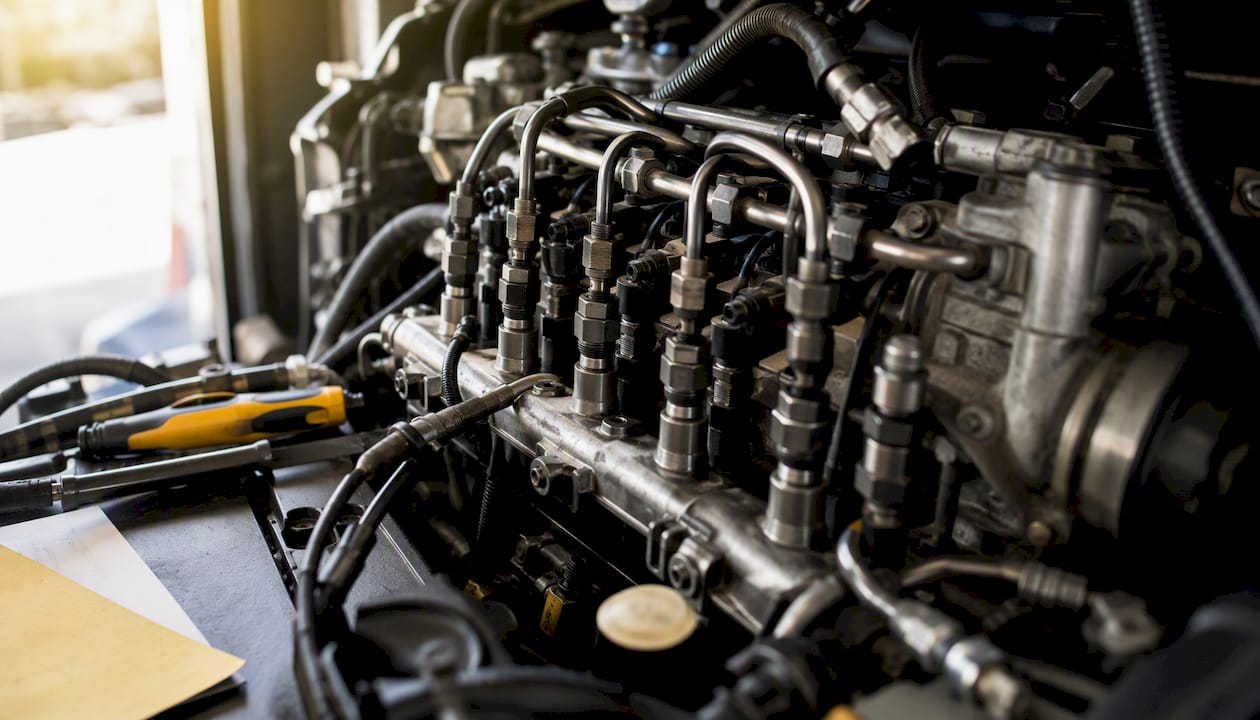
A dirty mass airflow (MAF) sensor sends incorrect airflow data to the engine control unit (ECU), causing mistimed fueling right when you press the gas. A dirty throttle body restricts airflow in a similar way. Both issues tend to produce hesitation at light-to-moderate acceleration and are often resolved with a cleaning before any parts need replacing. Code P0102 (MAF sensor low) is a common flag.
Transmission and torque converter issues (automatics)
Transmission-related jerking happens at specific shift points or during torque-converter lockup, not randomly. Watch for RPM climbing without a matching increase in speed, delayed gear changes, or a shudder that feels like driving over rumble strips at highway cruise. Burnt-smelling transmission fluid is a serious warning sign. Check fluid level and condition first before assuming internal damage.
Clutch problems (manuals)
On a manual, a worn or slipping clutch causes a lurch or shudder when you release the pedal, especially under load. If the engine revs but the car doesn’t accelerate proportionally, the clutch is the first suspect.
Vacuum leaks
An unmetered air leak downstream of the MAF sensor throws off the air-fuel ratio, causing a lean stumble. You may notice rough idle alongside the acceleration hesitation. Code P0171 (system too lean, bank 1) or P0174 often appears.
Worn engine mounts
Deteriorated engine mounts allow the engine to shift under load, creating a physical jolt or shudder that can feel like a drivetrain problem. This is more of a vibration than a true power interruption.
| Cause | When it happens | Typical OBD-II code | Quick fix possible? |
|---|---|---|---|
| Spark plugs / ignition coils | Random, any speed | P0300–P0312 | Yes, if plugs are due |
| Fuel pump / filter / injectors | Under hard load, uphill | None early; — later | Filter yes; pump/injectors need testing |
| MAF sensor / throttle body | Light-to-moderate throttle | P0102 | Often yes (cleaning) |
| Vacuum leak | Idle + acceleration | P0171, P0174 | Depends on leak location |
| Transmission / torque converter | At shift points, highway cruise | P0700 | Fluid change first; otherwise shop |
| Clutch (manual) | Clutch release under load | None typically | No — worn clutch needs replacement |
| Engine mounts | Any load, vibration-type | None typically | No — shop replacement |
Cold weather and altitude both affect this symptom. Cold starts stress fuel delivery and ignition systems, so jerking that disappears once the engine warms up often points to a sensor or injector that is marginal but not yet fully failed. High altitude leans out the air-fuel mixture, which can expose a borderline MAF sensor or fuel pump that performs adequately at sea level.
Quick DIY checks you can do in under 10 minutes
These checks are safe to do in a parking lot and give you useful information before you book a repair.
- Read OBD-II codes. Plug a Bluetooth OBD-II adapter (such as an OBDLink MX+ or Veepeak) into the port under your dash, or visit an auto parts store for a free scan. Write down every code, including pending ones. Even a code that seems unrelated can point toward the faulty system.
- Inspect the engine air filter. Pull the air filter housing and hold the filter up to light. A heavily clogged filter restricts airflow and can cause hesitation. This is a two-minute check and a cheap fix if the filter is dirty.
- Listen for the fuel pump prime. Turn the key to the ON position without cranking the engine. You should hear a brief hum from the rear of the car for one to two seconds. No sound at all can indicate a failing pump. Do this with the radio off.
- Look for obvious vacuum leaks. With the engine idling, listen for a hissing sound near the intake manifold, throttle body, or brake booster hose. A cracked or disconnected vacuum line is often visible on inspection.
- Check spark plug accessibility. On many four-cylinder engines, spark plugs are easy to reach. If you can remove one safely, look for fouling, heavy deposits, or a cracked electrode. A plug that looks very different from the others is a strong clue.
- Inspect wiring near the throttle body and MAF sensor. Look for connectors that have worked loose, cracked insulation, or corrosion. A loose MAF connector is a surprisingly common cause of engine hesitation when speeding up.
- Check transmission fluid (automatics). With the engine warm and running (on most vehicles), pull the transmission dipstick. Dark brown or black fluid with a burnt smell is a red flag.
Pro Tip: Write down the exact conditions when the jerk occurs: your speed, the gear, the engine temperature (cold or warmed up), whether you were going uphill, and whether it was a light press or hard press on the gas. This pattern is the single most useful piece of information you can hand a technician — it cuts diagnostic time significantly.
How a mechanic properly diagnoses the root cause
A data-driven diagnostic follows a clear sequence. Skipping steps or jumping straight to parts replacement is what turns a $150 repair into a $600 one.
| Diagnostic step | What it checks | Key data points |
|---|---|---|
| OBD-II code scan + misfire counters | Identifies affected cylinder or system | P0300–P0312, P0171, P0700, P0102 |
| Live-data test drive under load | Watches fuel trims, MAF readings, RPM vs. throttle | Short/long fuel trims, misfire counts live |
| Fuel pressure test under load | Confirms pump output and injector flow | Pressure drop under hard throttle |
| Injector balance test | Identifies weak or clogged injectors | Per-injector flow comparison |
| Vacuum smoke test | Finds unmetered air leaks | Smoke escaping from intake or hoses |
| Transmission fluid check + shift test | Rules out fluid condition and solenoid faults | Fluid color, smell, shift timing |
OBD-II codes P0300–P0312, P0171, P0174, P0700, and P0102 are the most common codes tied to acceleration jerking. Reading them first focuses every subsequent test. A technician who skips the scan and goes straight to parts is not following ASE diagnostic standards.
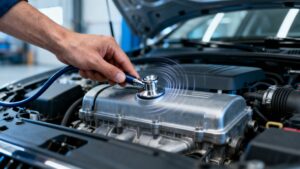
Live data is where the real picture emerges. A car diagnostic scan that captures live data under the actual driving conditions that trigger the jerk is the fastest route to the correct repair.
For transmission concerns, the test drive matters as much as the fluid check. A technician should reproduce the shift-point shudder or torque-converter lockup symptom under load, not just check the fluid level in the bay.
Is it safe to keep driving when your car shudders during acceleration?
The answer depends on which symptoms you have.
Stop driving immediately if you notice:
- A flashing (not steady) check engine light
- Violent jerking or bucking that affects your ability to steer
- A burning smell from the engine bay or underneath the car
- Transmission slipping heavily — RPM surging while speed drops
- Sudden, significant power loss on the highway
Short, careful driving to a nearby shop is generally reasonable if:
- The check engine light is steady (not flashing) and the jerk is mild
- The car drives normally at low speeds and only hesitates under hard throttle
- There is no smell, no noise, and no loss of steering control
Even when short-distance driving seems safe, avoid hard acceleration, stay off highways, and keep speeds low. Two things escalate quickly if you ignore them: an active misfire damages the catalytic converter within a short period of driving, and a slipping transmission accelerates internal wear with every mile. Neither problem gets cheaper with time.
Typical U.S. repair costs and how long fixes take
A basic tune-up runs roughly $80–$500 depending on the vehicle and parts needed. Diagnostic fees at most shops range from $75 to $150, and reputable shops apply that fee toward the repair if you proceed. Many auto parts stores offer a free OBD-II code scan, though that scan alone does not replace a full diagnostic with live data and a test drive.
The cost gap between catching a problem early and ignoring it is significant. A $30 fuel filter or $120 set of spark plugs, replaced when codes and symptoms first appear, can prevent a $2,000+ catalytic converter replacement or a transmission rebuild.
When should you call a mechanic, and what should you ask?
Call a mechanic immediately if you have any of the red-flag symptoms listed above. For milder symptoms, you can drive carefully to a shop within a day or two — but don’t put it off for weeks.
When you call or arrive, ask these specific questions:
- “Can you read the OBD-II codes and show me the live data?” A shop that offers to show you the data builds trust and confirms they are diagnosing, not guessing.
- “Will you road-test the car under the same conditions to reproduce the problem?” Reproducing the symptom under load is how a technician confirms the root cause, not just the code.
- “Do you test fuel pressure and injector balance?” These tests are necessary to rule out fuel delivery as the cause, especially when no codes are present yet.
- “What is your diagnostic fee, and does it apply toward the repair?” Most reputable shops credit the diagnostic fee if you approve the work.
- “Can I get a written estimate before any work begins?” This is a reasonable request at any shop and protects you from surprise charges.
A reputable shop should complete a full diagnostic — scan, test drive, and targeted system tests — within two to four hours. Visiting a qualified mechanic shop with this information in hand means you spend less time explaining and more time getting answers.
How Kwik Kar Oil Change & Auto Care diagnoses acceleration problems
Kwik Kar Oil Change & Auto Care’s diagnostic workflow for car stuttering while driving follows a structured, data-first sequence: OBD-II scan and misfire counter review, a test drive under load with live-data capture, targeted fuel-pressure and injector testing, ignition component checks, and transmission fluid and solenoid evaluation where indicated. You receive a written estimate before any repair begins.
Trust signals that matter here: Kwik Kar Oil Change & Auto Care holds ASE certification and RepairPal recognition, which means technicians meet verified competency standards and pricing is benchmarked against fair-market rates. Transparent estimates, diagnostic reporting, and warranty coverage on completed repairs are standard.
Pro Tip: When you book your diagnostic appointment, tell the service advisor the exact conditions that trigger the jerk — speed, temperature, load, and whether the check engine light is on. That information lets the technician plan the right test drive from the start and shortens your wait time.
Current promotional offers include a $30 off maintenance service with free inspection and a $45 off mechanical repair coupon, which can reduce the cost of a diagnostic visit or a first repair.
The part most drivers skip — and why it costs them
The conventional advice on car repair has always been: identify the symptom, then replace the most likely part. That approach made sense when scan tools cost thousands of dollars and only dealers owned them. Today, a basic OBD-II reader costs less than $30, and a professional live-data diagnostic at a shop costs less than most unnecessary parts replacements.
What drivers consistently underestimate is how much a single misread symptom costs. A car that shudders under hard acceleration gets new spark plugs. The shudder continues. Then a coil. Still there. Then a fuel injector service. At that point, $600 has been spent, and a $120 fuel-pressure test on day one would have pointed straight to a failing pump. The pattern repeats constantly in repair shops.
The smarter approach is to treat the symptom pattern as data, not a guess. Where exactly does the jerk happen? What speed, what load, what temperature? That information, combined with live OBD-II data from a test drive that reproduces the problem, narrows a list of eight possible causes down to one or two in under an hour. That is what ASE-certified diagnostics actually deliver — not just a code readout, but a confirmed, reproducible fault under real conditions.
Kwik Kar Oil Change & Auto Care is positioned as a diagnostic partner, not a parts counter. The difference shows up in the estimate: you see what was tested, what was found, and what the repair addresses — before you approve anything.
Accurate diagnostics, real repairs, no guesswork
When your car is shuddering during acceleration and you need answers fast, Kwik Kar Oil Change & Auto Care delivers a full diagnostic workflow — scan, live-data test drive, fuel and ignition system checks, and a written estimate — performed by ASE-certified technicians who work on both domestic and import vehicles. You know exactly what is wrong and what it will cost before a single repair begins.
That transparency is the real value. No surprise charges, no parts replaced on a hunch, and no return visits for the same symptom. Current promotions include $30 off a maintenance service with free inspection and $45 off mechanical repair work, so your first diagnostic visit costs less than you might expect. Schedule your engine diagnostic appointment at Kwik Kar Oil Change & Auto Care today and get a clear answer on what is causing your car to jerk.
Sources
The guidance in this article draws on published diagnostic resources and Kwik Kar Oil Change & Auto Care’s own service standards. The sources below are reliable starting points for deeper reading.
- Car jerks when accelerating : r/mechanic
- Car Jerks When Accelerating: 10 Causes by Speed + When It Happens
- Car Jerks When Accelerating? 5 Common Causes and How to Fix Them – Car Basics Hub
- Car Jerking When Accelerating: Causes & Fixes | AmpAuto
- Car Jerks When Accelerating: What’s the Problem?
FAQ
Is it bad to drive a car that jerks when accelerating?
It depends on the severity. A mild jerk with a steady check engine light can tolerate a short, careful drive to a shop, but a flashing check engine light, burning smell, or violent bucking means you should stop and tow the vehicle to avoid catalytic converter damage or transmission failure.
Is car jerking a transmission problem?
Not always. Engine misfires are the most common cause, but transmission issues do produce jerking specifically at shift points or during torque-converter lockup, often accompanied by RPM surging without a matching speed increase. An OBD-II scan and test drive under load will distinguish between the two.
Why does my car jerk when I press the gas?
The most likely causes are a misfire from worn spark plugs or a failing ignition coil, a fuel delivery fault (weak pump, clogged filter, or dirty injectors), or a dirty MAF sensor or throttle body sending incorrect data to the ECU. Reading OBD-II codes first narrows the list quickly.
Can a dirty air filter cause my car to jerk?
A severely clogged air filter restricts airflow enough to cause hesitation and stumbling during acceleration, particularly under hard throttle. It is one of the quickest and cheapest checks to rule out before moving on to more involved diagnostics.
How much does it cost to fix a car that jerks when accelerating?
Costs range widely depending on the cause. Spark plugs and a throttle body cleaning can run $80–$200, while a fuel pump replacement typically costs $300–$700. Transmission or catalytic converter repairs can reach $2,500 or more, which is why early diagnosis matters.