


Most wheel bearing replacements run $300 to $500 per wheel at an independent shop, parts and labor combined. That’s the range you should expect for a typical passenger car with a serviceable bearing. Hub assemblies, common on many modern SUVs and trucks, push the total higher because the part itself costs more. Your exact price depends heavily on vehicle type, drivetrain, and whether your shop charges dealer labor rates.
TL;DR:
- Replacing a wheel bearing at an independent shop typically costs between $300 and $500 per wheel, with luxury and AWD vehicles often exceeding $900.
- Hub assemblies, common on many modern vehicles, tend to be more expensive but reduce labor time compared to serviceable bearings, which need more work to install.
- The total cost depends heavily on vehicle type, drivetrain, the parts used, and regional labor rates, with dealer prices often over $300 higher than independent shops.
- DIY replacement is possible with parts costing $20 to $550, but requires specialized tools like a hydraulic press and torque wrench, along with technical skill to avoid failures.
- A professional diagnosis prevents unnecessary repairs, as noise and wheel play signals can be mistaken for other issues, and accurate estimates should break down parts, labor, and warranty terms clearly.
Table of Contents
- Wheel Bearing Replacement Cost by Vehicle Type
- What Affects the Price of a Wheel Bearing Replacement?
- Should You Replace a Wheel Bearing Yourself or Hire a Shop?
- How Do You Get a Reliable Wheel Bearing Repair Quote?
- Can You Still Drive on a Bad Wheel Bearing?
- Kwik Kar’s Take on Diagnosing Wheel Bearing Noise
- Get a Transparent Wheel Bearing Estimate Today
- Sources
- FAQ
Wheel Bearing Replacement Cost by Vehicle Type
The national averages hide a lot of variation once you factor in what you actually drive. AutoZone’s cost breakdown puts front wheel bearing replacement between $250 and $500 per wheel installed, and Kelley Blue Book lands on a similar national average near $350 per wheel. Luxury and AWD vehicles push past both figures.
Here’s roughly what to expect by category:
- Economy sedan (Civic, Corolla, Elantra): $250–$400 per wheel, mostly a serviceable bearing job with lower labor hours.
- Midsize SUV (CR-V, Rogue, Escape): $300–$550 per wheel, often a hub assembly on at least one axle.
- Full-size truck (F-150, Silverado, RAM 1500): $350–$650 per wheel, heavier hub units and sometimes 4WD sensor wiring add time.
- Luxury or AWD vehicle (Audi Q5, BMW X3, Subaru Outback): $450–$900+ per wheel, driven by pricier OEM parts and complex hub designs.
Component data backs this up in more granular terms. A comprehensive cost breakdown shows bearing kits alone typically run $20 to $260, while hub assemblies range from $120 to $550. Labor commonly adds 1.5 to 5 hours depending on how the assembly is pressed or bolted in. Stack those together and total installed prices span roughly $200 to $1,100.
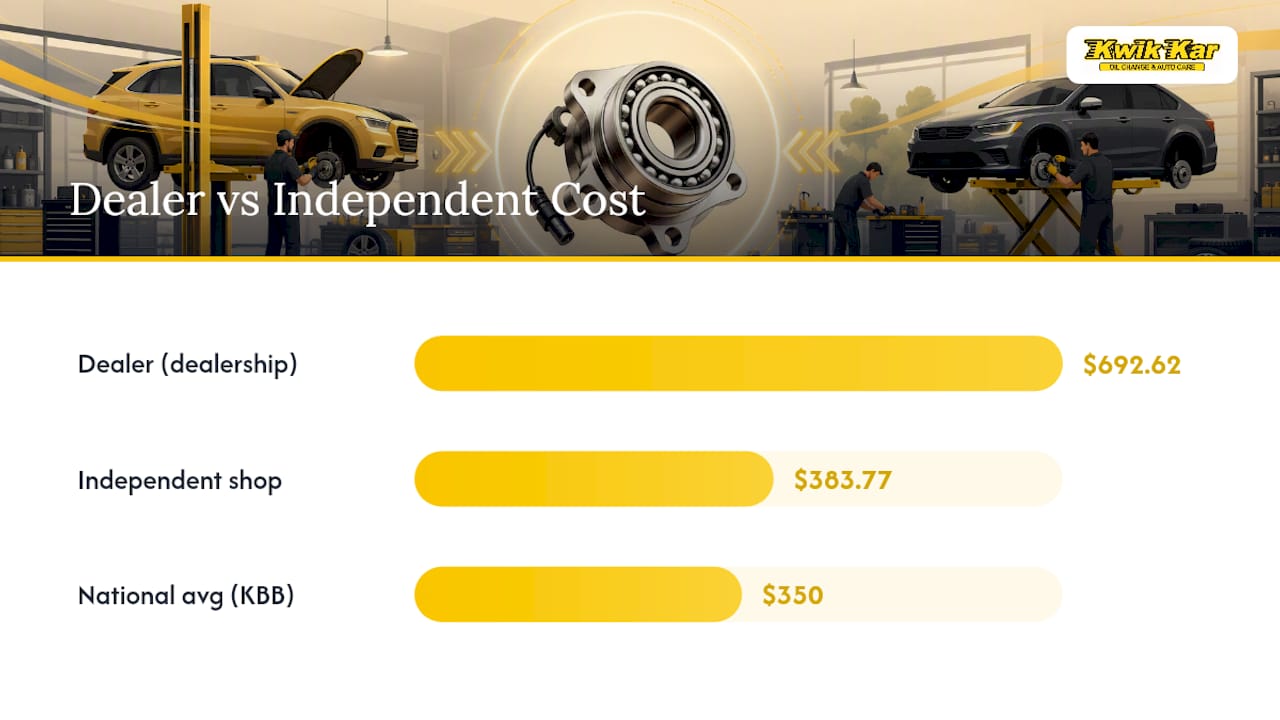
Dealers tend to charge more than independent shops for the identical job. Car Talk documented a real case where one vehicle’s bearing replacement cost $692.62 at a dealership versus $383.77 at an independent shop, a difference of over $300 for the same repair. Regional labor rates explain a good chunk of that gap, but dealer overhead and OEM-only parts policies matter too.
What Affects the Price of a Wheel Bearing Replacement?
Two vehicles with the same symptom can land on very different invoices. The biggest swing factor is whether your car uses a hub assembly or a serviceable bearing. Hub assemblies cost more upfront in parts, but they often reduce labor time since technicians bolt in a complete unit rather than pressing a bearing into the knuckle. Serviceable bearings cost less as a part but demand more labor.
Other factors that move your quote up or down:
- Make, model, and drivetrain. AWD and 4WD vehicles often have more components tied into the hub, adding labor hours.
- Additional parts. ABS wheel speed sensors, wheel studs, and axle seals sometimes need replacement alongside the bearing.
- Alignment. Front-end work occasionally throws off alignment, adding a separate line item.
- Shop labor rate. Hourly rates vary by region and shop type, and labor rate is often the single biggest driver of price differences between two quotes for the identical job.
- Part quality and warranty. OEM parts cost more than aftermarket but usually carry longer warranty coverage.
Should You Replace a Wheel Bearing Yourself or Hire a Shop?
DIY parts alone for a bearing kit run roughly $20 to $260, and a hub assembly can cost $120 to $550 before labor. That sounds like real savings until you account for the equipment involved. Pressing a bearing out of a knuckle requires a hydraulic press or specialized puller most home garages don’t own, plus a torque wrench calibrated to the exact spec your manufacturer requires for hub nuts, which is often well over 100 foot-pounds.
Here’s how the tradeoffs typically break down:
- Parts-only DIY saves the most money but demands the right tools and several hours of work, sometimes a full afternoon for a stubborn press-in bearing.
- Improper installation risk is real. A bearing pressed in crooked or a hub nut torqued incorrectly can fail within weeks and take other components with it.
- Warranty exposure matters if your vehicle is still under factory coverage. DIY suspension work can complicate a warranty claim on a related failure later.
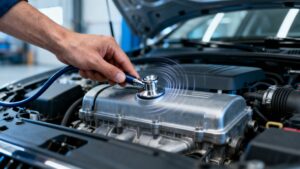
- Professional diagnosis earns its cost when the noise is ambiguous. Shops sometimes use tools like chassis ears during a road test to isolate bearing noise from brake or CV joint noise before recommending a replacement.
Pro Tip: If you’re hearing wheel noise but aren’t sure it’s the bearing, don’t guess and start ordering parts. A short diagnostic road test costs far less than replacing the wrong component.
How Do You Get a Reliable Wheel Bearing Repair Quote?
A trustworthy estimate breaks down parts and labor separately, not as one bundled number. Ask the shop for the part brand (OEM versus aftermarket), the estimated labor hours, and the hourly rate being applied. Those three numbers let you compare quotes apples to apples instead of guessing at what’s driving the difference.
Also ask directly:
- Is this a hub assembly or a serviceable bearing kit?
- Will alignment be needed afterward, and is that included in the quote?
- Is there a diagnostic fee, and does it get credited toward the repair if you proceed?
- What’s the warranty on parts and labor?
Getting at least two independent quotes in writing protects you from the kind of gap Car Talk documented between dealer and independent pricing. If your car needs alignment work as part of the job, that’s a separate cost worth understanding on its own before you approve the repair.
| What to ask | Why it matters |
|---|---|
| Parts vs. labor breakdown | Reveals whether you’re paying for a hub assembly or bearing kit |
| Labor hours and hourly rate | Lets you compare shops on equal terms |
| Diagnostic fee policy | Some shops waive the fee if you proceed with the repair |
| Warranty terms | OEM parts often carry longer coverage than aftermarket |
Can You Still Drive on a Bad Wheel Bearing?
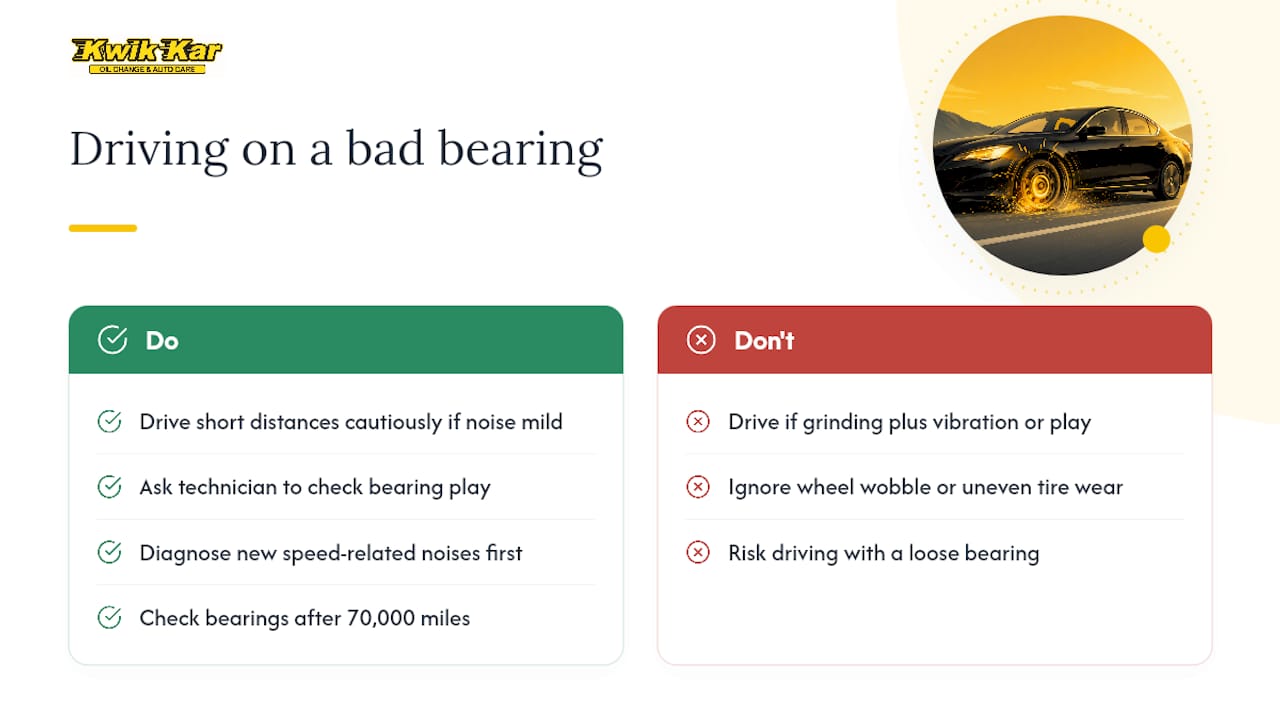
A failing bearing announces itself with a humming or growling noise that gets louder as speed increases, often changing pitch when you turn. Other signs include a wheel that wobbles when you rock it by hand, uneven tire wear on one side, and an ABS light that comes on because the sensor rides on the same hub.
You can drive short distances cautiously if the noise is mild and consistent, but a bearing that’s loose enough to produce wheel play needs attention fast. A wheel bearing that fails completely can let the wheel separate from the vehicle, which is why any grinding noise combined with vibration or play means you should stop driving and get the car towed rather than risk it.
Bearings typically last many tens of thousands of miles under normal conditions, though potholes, water crossings, and towing shorten that lifespan. Ask your technician to check bearing play during routine service visits, especially past 70,000 miles. If your front end shakes when braking or you hear a new noise that changes with speed, it’s worth diagnosing the exact source before assuming it’s the bearing.
Kwik Kar’s Take on Diagnosing Wheel Bearing Noise
Guessing at wheel bearing noise wastes money on both ends, either paying to replace a part that wasn’t the problem or delaying a repair that was genuinely urgent. Our ASE Certified Master technicians run a proper diagnostic pass, including road tests and hands-on wheel play checks, before recommending a repair.
Every estimate at Kwik Kar Oil Change & Auto Care breaks down parts and labor in writing before we touch your vehicle, so you approve the number, not a surprise. Most wheel bearing jobs turn around the same day, and our RepairPal and NAPA AutoCare recognition backs the warranty coverage behind the work.
— Kwik Kar
Get a Transparent Wheel Bearing Estimate Today
Dealer markups and unclear line items are two of the biggest complaints drivers have about bearing repairs, and they’re exactly what Kwik Kar Oil Change & Auto Care is built to avoid. Our ASE Certified and RepairPal accredited technicians diagnose the actual source of your wheel noise before quoting any repair, so you’re never paying to replace a part that wasn’t the problem.
You’ll get a written estimate showing parts, labor hours, and warranty terms before any work starts, whether your vehicle needs a serviceable bearing or a full hub assembly. Visit our full auto repair services page to see what’s included, or call your local Kwik Kar location to schedule a diagnostic and get a same-day quote.
Sources
Beyond shop quotes, a few sources help verify what you’re being told. Check NHTSA’s recall database if your hub noise might be tied to a manufacturer service action. SAE publishes the technical standards bearings are engineered against, and AutoZone and Car Talk offer solid cost benchmarks for comparison.
- How Much Does a Wheel Bearing Replacement Cost? – AutoZone
- How much to replace wheel bearing – Car Talk
- Wheel bearing cost guide for U.S. buyers – Cost Insider
- Wheel Bearing Replacement Prices & Cost Estimates – KBB
FAQ
Can I still drive with a bad wheel bearing?
You can drive short distances cautiously with a mild, consistent hum, but any grinding noise combined with wheel play or vibration means you should stop and have the vehicle towed instead of risking wheel separation.
Is fixing a wheel bearing a big job?
It’s a moderate repair, typically requiring several hours of labor depending on whether your vehicle uses a bolt-in hub assembly or a pressed serviceable bearing, and most shops complete it same-day.
How much does it cost to replace a wheel bearing at AutoZone?
AutoZone sells bearing kits and hub assemblies for DIY installation, with parts alone typically ranging from $20 to $260 for a kit or $120 to $550 for a hub assembly; professional installation adds labor on top of those parts costs.
What is the lifespan of a wheel bearing?
Most wheel bearings last many tens of thousands of miles under normal driving conditions, though rough roads, water crossings, and heavy towing can shorten that significantly.