



Use the viscosity grade your vehicle manufacturer specifies, since that number is matched to your engine’s clearances and oil pump design. The short technical difference: 5W-30 runs slightly thicker at operating temperature, while 5W-20 stays thinner and can support better fuel economy in engines built for it. Both grades fall under SAE J300, and both can carry API or ILSAC performance marks, but only your owner’s manual tells you which one belongs in your engine. If you’re ever unsure, the technicians at Kwik Kar Oil Change & Auto Care can confirm the right grade during a quick visual check.
TL;DR:
- The number after W measures viscosity at operating temperature, but API or ILSAC marks indicate performance standards that the SAE grade alone does not cover.
- A top up with thicker oil rarely harms an engine designed for a lighter grade, but repeated use may affect fuel economy or warranty coverage.
- EPA testing found viscosity can produce fuel economy changes measured in percentages, with results varying by vehicle, test cycle, and oil formulation.
- Towing, heavy loads, or sustained heat may support a thicker grade only when the manual approves it; routine commuting usually does not justify switching.
Table of Contents
- What the numbers mean: ‘5W’, ‘20’ and ‘30’ explained
- Practical differences: engine protection, heat, and fuel economy
- Is it safe to use 5W-30 instead of 5W-20?
- How to choose the right grade for your vehicle
- Kwik Kar technician perspective: what we check during an oil-grade recommendation
- Environmental impact differences between 5W-20 and 5W-30 oils
- The pragmatic rule most owners should follow
- Book an oil-grade check at Kwik Kar Spring Valley
- FAQ
- Sources
What the numbers mean: ‘5W’, ‘20’ and ‘30’ explained
The “W” in 5W-20 or 5W-30 stands for winter, and it describes how well the oil flows during a cold start, not the outside temperature you drive in. The number after the W (20 or 30) measures kinematic viscosity at 100 degrees Celsius, which is roughly engine operating temperature. A lower number means thinner oil at that heat; a higher number means thicker oil.
SAE J300 is the standard that sets these rheological limits, meaning it defines flow behavior, not oil quality or additive performance. Two oils can carry the same SAE grade and still differ in how well they protect against wear, which is why the API and ILSAC marks on the bottle matter just as much as the viscosity number.
Before buying, take a minute to check these three spots:
- Oil filler cap: usually stamped with the manufacturer’s recommended grade.
- Owner’s manual: lists the primary grade and any approved alternatives for different climates.
- Oil bottle label: shows the SAE grade alongside API and ILSAC certification marks.
Viscosity grade tells you how the oil flows. It does not tell you whether the oil meets your engine’s wear-protection or emissions-system requirements.
Practical differences: engine protection, heat, and fuel economy
At operating temperature, 5W-30 forms a slightly thicker film between moving parts than 5W-20. In engines designed with wider tolerances or higher loads, that extra body can mean a sturdier cushion under heat and stress, which is one reason older engines and some truck or towing applications call for 5W-30.
5W-20 stays thinner at the same temperature, which reduces internal friction and lets the oil pump work a little less to circulate it. Manufacturers that specify 5W-20 typically designed the engine’s clearances and oil pump around that thinner flow from the start, so the fuel economy benefit only applies when the engine was built for it.
Research shows fuel economy differences between viscosity grades tend to be modest and situational. EPA laboratory testing found that oil viscosity can produce percent-level changes in fuel economy, with the size of the effect varying by vehicle, test cycle, and oil formulation. In other words, the gain you might see from a lighter grade is real but small, and it shows up differently on the highway than in stop-and-go city driving.
Engine design also shapes which grade makes sense:
- Gasoline direct injection (GDI) and turbocharged engines often face low-speed pre-ignition (LSPI) risks that specific oil formulations are built to resist.
- Timing-chain wear is another factor some automakers address by pairing a particular viscosity with an updated additive package.
- Older, higher-mileage engines sometimes benefit from the extra film thickness of 5W-30 as internal clearances widen over time.
Is it safe to use 5W-30 instead of 5W-20?
Drivers usually reach for the “wrong” grade in a handful of situations: an emergency top-up when only one viscosity is on the shelf, a shop that stocks a different grade, or an assumption that a milder climate makes the switch harmless.
Here’s how to think through it:
- Check if the swap is temporary or permanent. A single quart of 5W-30 in an engine that calls for 5W-20 rarely causes immediate harm, but making it a habit is different.
- Know your engine type. Modern engines with tight clearances, GDI systems, or LSPI-sensitive designs are built around the manufacturer’s exact grade, and straying from it can affect protection or fuel-system behavior.
- Understand the tradeoffs. Using a thicker oil than specified can slightly reduce fuel economy and change oil pressure characteristics, while using a thinner oil than specified in a high-load engine can reduce the protective film under heat.
- Watch for warranty language. Some manufacturer warranties reference the specified viscosity grade, so a documented, repeated deviation could complicate a claim.
If you’ve already run the wrong grade for an oil change interval, keep an eye on oil pressure readings and any new engine noise, and have a technician check the oil condition at your next visit.
Pro Tip: Keep a small bottle of your manufacturer-specified grade in your trunk so you’re never stuck topping off with whatever a gas station happens to carry.
How to choose the right grade for your vehicle
Picking the correct oil doesn’t require guesswork. A short checklist settles it almost every time.
- Step 1: Open your owner’s manual or check the oil filler cap for the SAE grade the manufacturer specifies, along with any approved alternates for extreme climates.
- Step 2: Confirm the bottle you’re buying carries the right performance marks, such as ILSAC GF-6A or API SP, before you consider substituting a different viscosity.
- Step 3: Factor in how you drive. Towing, heavy loads, or sustained high-heat driving may justify the thicker option when your manual lists it as an approved alternative; routine commuting usually doesn’t.
- Step 4: If you’re still unsure, especially with a used vehicle or incomplete service history, bring it to an ASE-certified technician for a tailored recommendation rather than guessing from an online forum. Our guide on 0W-20 versus 5W-30 walks through a similar comparison if your manual lists a low-viscosity option.
Kwik Kar technician perspective: what we check during an oil-grade recommendation
When you bring your vehicle in for an oil-grade check, we start with the owner’s manual and your oil-life monitor reading, then review your service history to see what’s been used before. From there, a visual and digital inspection of the oil’s condition tells us whether the current grade has been doing its job.
- We check the manufacturer’s listed grade and any approved alternates for your climate or driving style.
- We review your service history for consistency in viscosity grade over time.
- We assess your typical driving use, since towing or stop-and-go city routes can tip the recommendation toward a thicker grade when the manual allows it.
- We confirm the oil meets current API and ILSAC performance standards, not just the SAE number.
We often see older or higher-mileage engines do better on 5W-30 when the manual permits it, while most newer gasoline engines are built around 5W-20 for fuel economy. Bring your maintenance records on your next visit and ask us to verify your grade.
Pro Tip: If your service history shows mixed viscosity grades across past oil changes, flag it for your technician so we can check for any signs of inconsistent protection.
Environmental impact differences between 5W-20 and 5W-30 oils
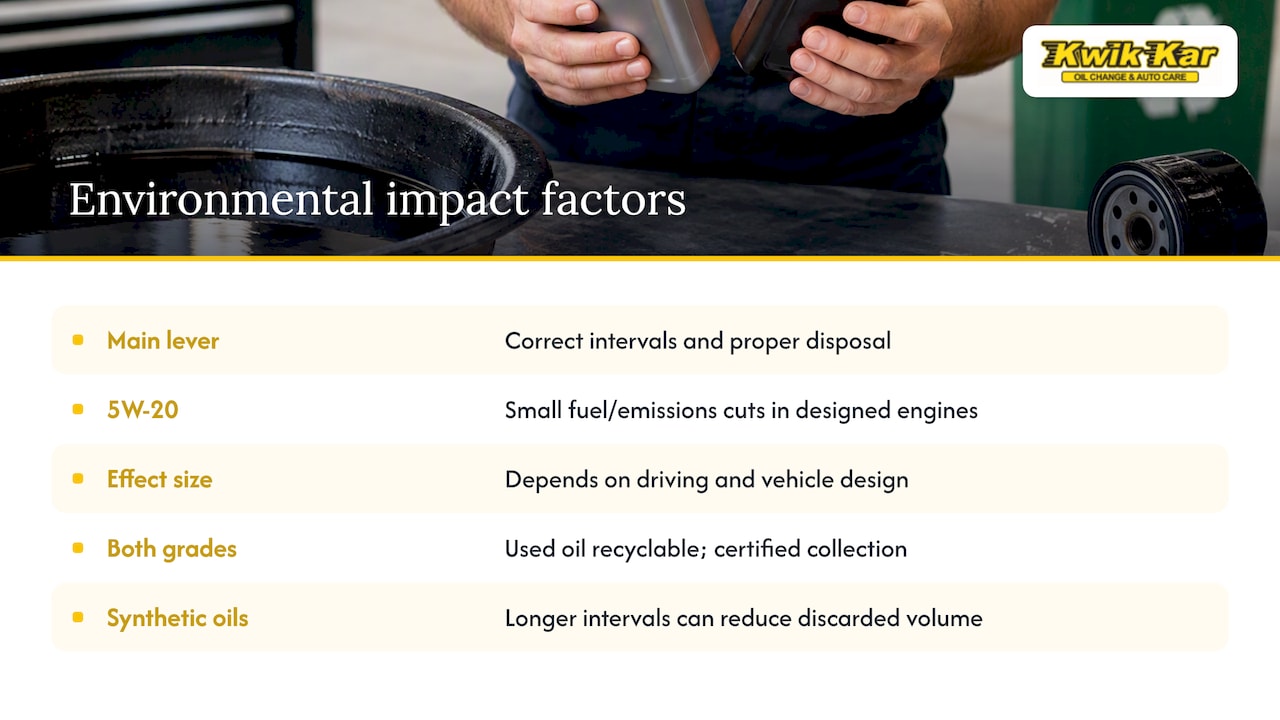
Viscosity grade has a smaller environmental footprint story than most drivers expect, and it ties mostly back to fuel consumption and oil volume rather than the oil itself being “greener.” Because 5W-20 reduces internal friction slightly in engines designed for it, the modest fuel economy gains documented in EPA testing translate to a small reduction in fuel burned and emissions produced over the life of the vehicle, though the effect size depends heavily on driving conditions and vehicle design.
Beyond fuel use, both grades require the same disposal care. Used motor oil of either viscosity is classified as a recyclable material, and responsible disposal at a certified collection point keeps it out of soil and waterways regardless of whether it started as 5W-20 or 5W-30. Synthetic formulations, which dominate both grades today, also tend to last longer between changes than older conventional oils, which can modestly reduce the total volume of oil used and discarded over a vehicle’s lifetime. Our breakdown of synthetic versus conventional oil covers that distinction in more detail if you’re weighing oil type alongside viscosity grade.
The bigger environmental lever isn’t the grade you choose. It’s following the correct interval and disposing of used oil properly.
The pragmatic rule most owners should follow
Our honest take: stop treating this as a 5W-20 versus 5W-30 debate and treat it as an owner’s manual lookup. When in doubt, use the grade your manufacturer specifies, full stop. If you tow, haul, or drive in sustained high heat and your manual lists 5W-30 as an approved option, lean toward it; otherwise, stick with the lighter grade your engine was designed around. For any vehicle with gaps in its service history, a quick shop check beats a guess every time.
— Kwik Kar
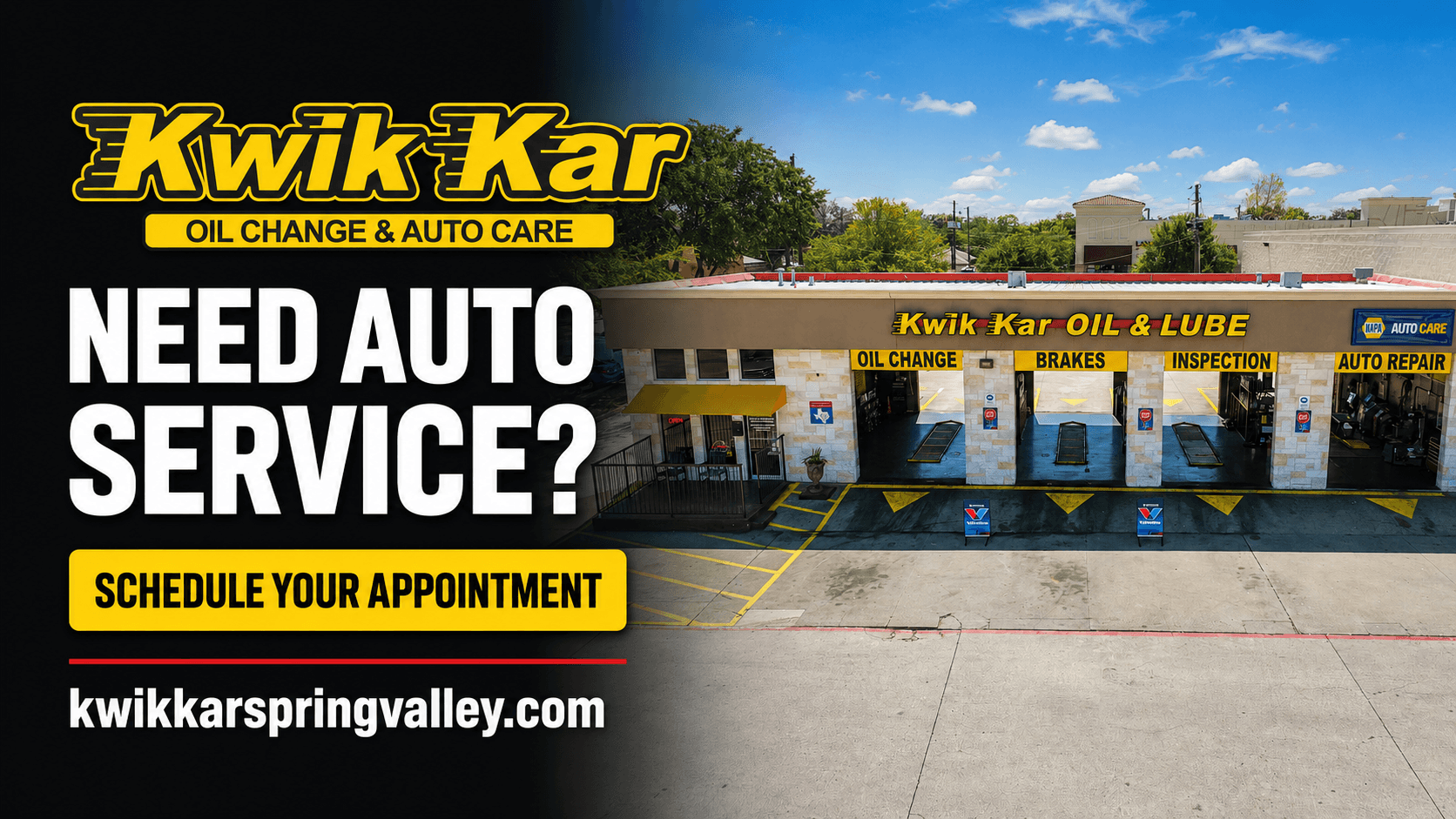
Book an oil-grade check at Kwik Kar Spring Valley
If you’re not sure which grade your vehicle needs, or you just want a second set of eyes before your next oil change, our technicians can help confirm it. A visit includes a manual and oil-cap check, a visual and digital inspection of your current oil’s condition, and a straightforward recommendation with no guesswork attached.
- Transparent estimates before any work begins.
- Oil-grade verification paired with your scheduled oil change.
- Service history review so recommendations fit your specific engine.
Schedule your oil change or full diagnostic visit with our Spring Valley Road team and drive off knowing your engine is running on the right oil.
FAQ
How often should I change my oil?
Oil-change intervals vary by vehicle and driving conditions, so follow your owner’s manual and oil-life monitor. Driving habits like short trips, towing, or extreme heat can shorten the interval between oil changes. Our guide on oil change benefits covers how intervals shift based on driving conditions.
Can I use 5W-30 instead of 5W-20 in my Honda Pilot?
Only if your Honda Pilot’s owner’s manual lists 5W-30 as an approved alternate for your model year and climate. Many modern Pilot engines are designed around 5W-20 for fuel economy and emissions performance, so a permanent switch without manual approval isn’t advised. Check your filler cap or manual before changing grades.
What cars use 5W-30 oil?
Vehicles that use 5W-30 typically include older engines, certain trucks and SUVs built for towing, and some engines designed with wider clearances for a thicker operating-temperature film. The only reliable way to confirm it is to check your specific owner’s manual or oil filler cap, since recommendations vary by model and year.
Is 10W-30 oil better than 5W20 oil?
Neither grade is universally “better,” since each is formulated to match a specific engine’s cold-start and operating-temperature needs under SAE J300. Viscosity at cold start and operating temperature varies by grade, and the right choice depends entirely on what your manufacturer specifies for your engine.
Does using the wrong oil grade void my warranty?
It can, if your warranty documentation ties coverage to following the manufacturer’s specified maintenance requirements, including viscosity grade. Using an approved alternate listed in your owner’s manual is generally fine, but a documented pattern of using an unapproved grade could complicate a claim.
Sources
- En
- The Effect of Engine Oil on Particulate Matter, Emissions and Fuel Economy in Gasoline and Diesel Vehicle
- Latest Oil Categories | API | American Petroleum Institute | API