



Your car starts using more gas than usual. Idle gets a little rough at stoplights. Then the check engine light comes on, and now you’re wondering whether this is a minor sensor issue or the start of a much bigger repair bill.
A faulty o2 sensor often creates exactly that kind of uncertainty. It’s a small part, but it has a direct effect on fuel control, emissions, drivability, and whether your vehicle is ready for inspection. The trouble is that the warning signs can overlap with other problems, so guessing usually costs more than diagnosing.
Most drivers don’t need a deep electronics lesson. They need clear answers. What does the sensor do? Which symptoms matter? When is replacement sensible? And when does that dashboard light point to something else entirely?
This is the practical version. If you’re in Dallas and trying to decide whether to keep driving, scan the codes yourself, or bring the vehicle in for testing, this guide will help you make that call with less guesswork. If your light is already on, a professional check engine light diagnostic is usually the fastest way to separate a sensor fault from a wiring, exhaust, or catalyst problem.
That Check Engine Light Is Trying to Tell You Something
The check engine light isn’t very specific. It turns on for problems that range from a loose gas cap to a real fuel-control issue. That’s why drivers often make the same mistake twice. First, they ignore it because the car still runs. Then they react only after mileage drops, the engine starts stumbling, or inspection time gets close.
An oxygen sensor is one of the more common reasons that light shows up. It lives in the exhaust stream and reports what’s happening after combustion, which gives the engine computer the feedback it needs to adjust fuel delivery. When that signal becomes slow, biased, or dead, the computer starts making decisions with bad information.
What drivers usually notice first
The earliest clue usually isn’t dramatic. It’s the kind of change you second-guess for a week.
- Fuel stops come sooner: You didn’t change your route, but the tank empties faster.
- Idle quality changes: The engine feels uneven at red lights or when parked with the A/C on.
- Throttle response gets lazy: Pressing the pedal produces hesitation or sputtering instead of a smooth pull.
- The warning light stays on: That’s the vehicle asking for diagnosis, not a reset.
A sensor problem rarely announces itself with one perfect symptom. It usually shows up as a pattern.
Don’t treat the light as the diagnosis
A code reader can point you in the right direction, but it doesn’t prove the sensor itself is bad. Codes tied to oxygen-sensor activity can also come from wiring faults, exhaust leaks, fuel mixture problems, or a catalyst issue. That distinction matters because replacing parts based on the code name alone is how drivers waste money.
If your vehicle is running differently and the light is on, the smart move is to treat it as a decision point. Check the basics, pay attention to drivability, and get the fault verified before you authorize parts.
How Your O2 Sensor Manages Your Engine's Efficiency
An O2 sensor works like the engine’s nose. It “sniffs” the exhaust and tells the computer whether the engine is burning too rich or too lean. That feedback is what keeps the engine near the ideal 14.7:1 air-to-fuel ratio, and a healthy sensor does that by switching rapidly between 0.1V and 0.9V as conditions change, as explained in this oxygen sensor waveform overview.
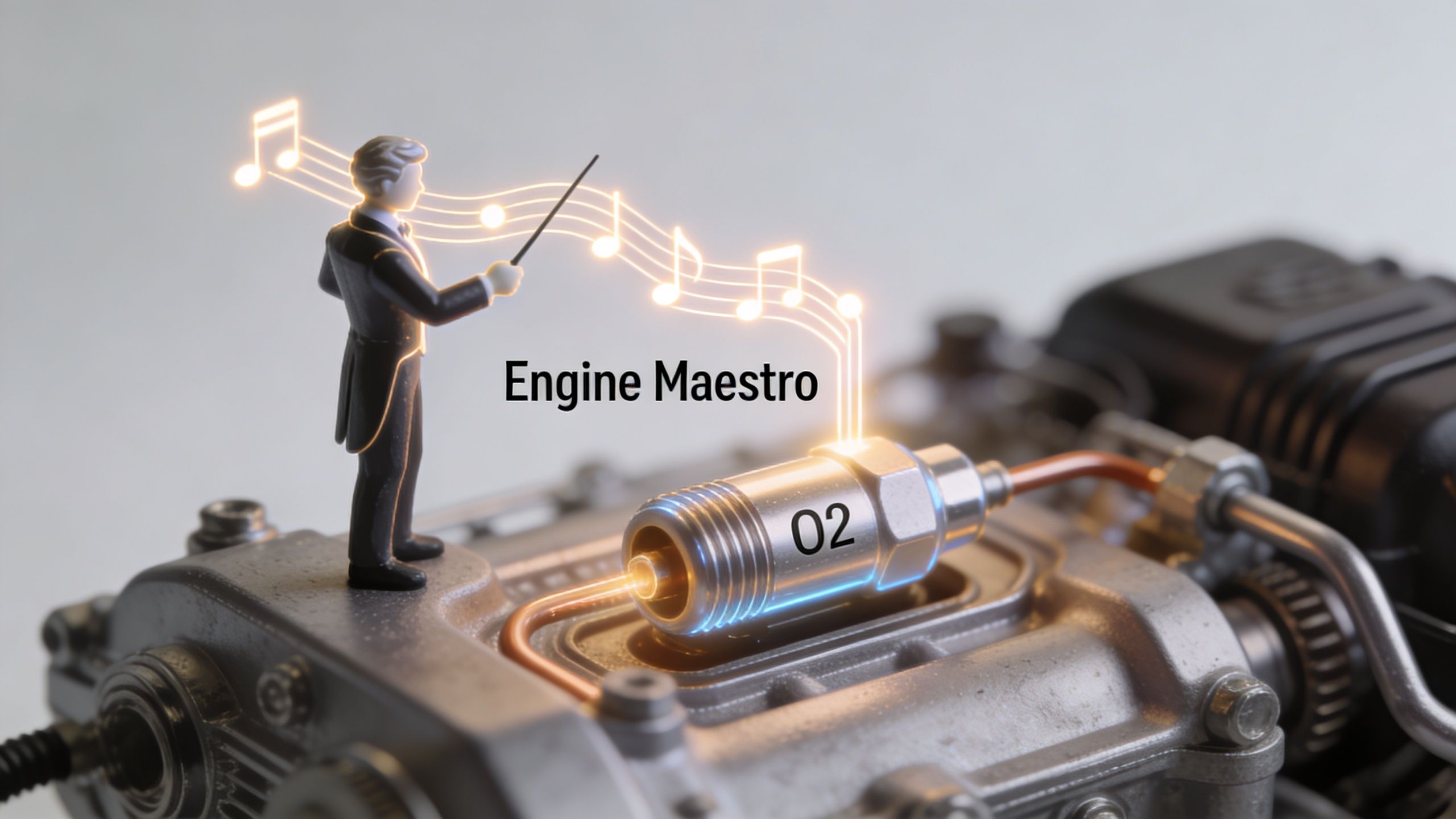
When that feedback loop works, the computer can trim fuel in real time. The engine runs cleaner, responds better, and wastes less gas. When the signal stops switching normally, the computer falls back on less accurate control, and that’s when efficiency starts slipping.
Upstream and downstream sensors do different jobs
Many drivers hear “oxygen sensor” and assume there’s just one. Most modern vehicles use more than one, and the position matters.
| Sensor location | Main job | What happens if it fails |
|---|---|---|
| Upstream sensor | Helps control the air-fuel mixture before the catalytic converter | Fuel control gets inaccurate, drivability can suffer |
| Downstream sensor | Monitors catalytic converter performance after exhaust passes through it | The computer may flag converter-efficiency problems |
The upstream sensor is the one that most directly affects how the engine runs. It’s the fast-feedback sensor the computer relies on for mixture correction. If it reports the wrong thing, the engine may run rich or lean.
The downstream sensor is more of a monitor. It checks whether the catalytic converter is doing its job. A bad downstream signal doesn’t always mean the converter itself failed, but it can trigger codes that send people in the wrong direction.
Why this matters in real life
If you understand which sensor does what, code descriptions make more sense. A fuel-trim complaint points you toward the sensor that controls mixture. A catalyst-efficiency code raises a different question: is the converter weak, or is the monitoring sensor lying?
Practical rule: A sensor is small, but its job is not. It’s part of the control system, not just a warning device.
That’s why the right repair starts with understanding the role of the sensor in that location, not with replacing every sensor on the exhaust.
Common Symptoms of a Faulty O2 Sensor
You pull out for the morning commute in Dallas, the check engine light is on, the car feels a little flat, and you notice the fuel gauge dropping faster than usual. That combination gets ignored all the time because the vehicle still starts and drives. Then inspection time comes around, and a problem that looked minor turns into a failed test and a repair decision you have to make quickly.
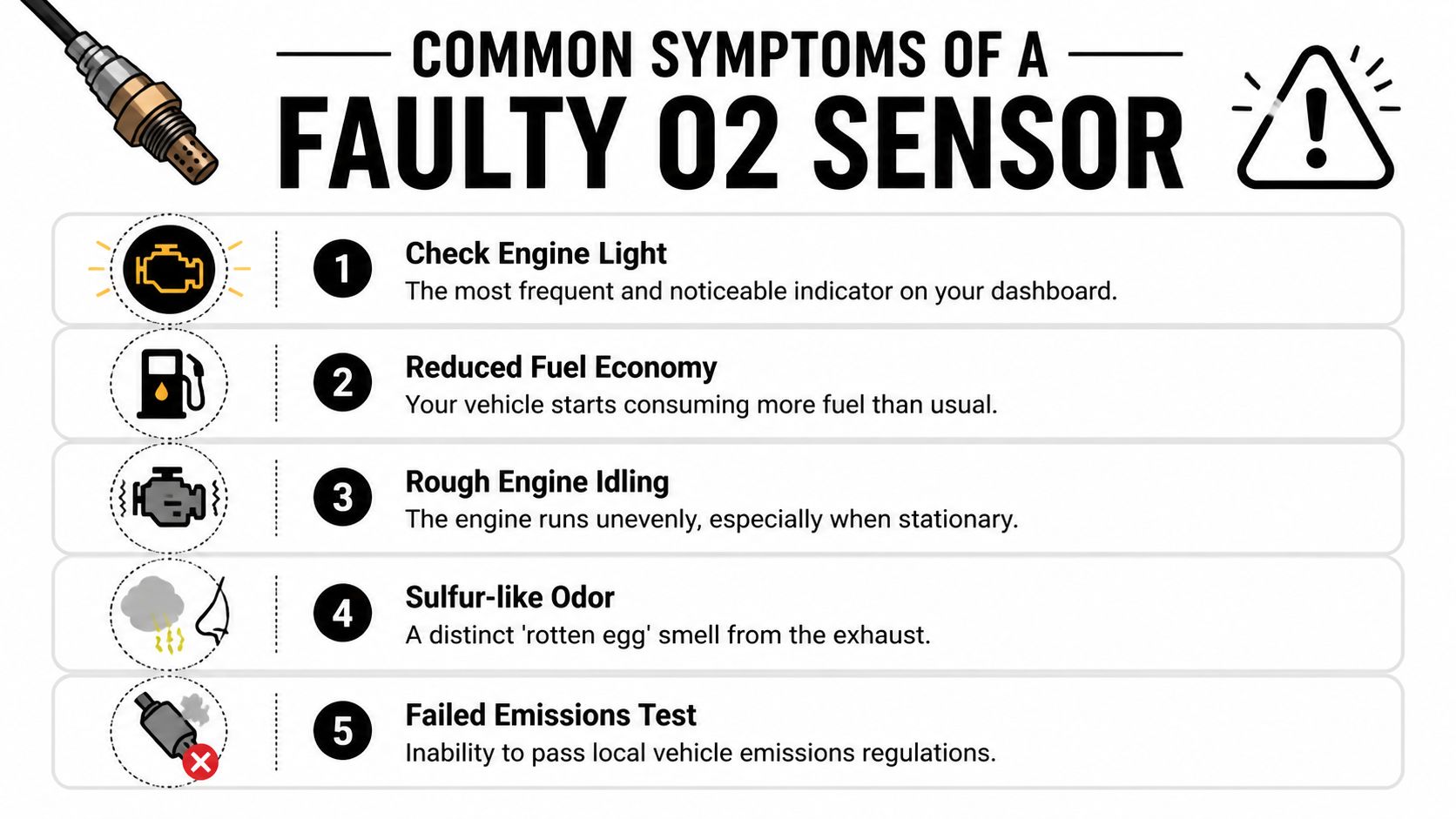
A faulty O2 sensor often shows up as a pattern, not one dramatic breakdown. The U.S. Department of Energy explains that oxygen sensors help the engine computer manage the air-fuel mixture for fuel economy and emissions, so when the signal goes bad, both can suffer (FuelEconomy.gov oxygen sensor guide).
The symptoms drivers notice most
Here are the signs that show up most often in the shop:
- Check engine light: This is usually the first clue. Common related codes can include sensor-circuit, heater-circuit, or fuel-mixture faults.
- Lower gas mileage: A bad reading can cause the engine to run richer than it should, which means more fuel burned on the same trip.
- Rough idle: The engine may shake, stumble, or hunt at a stoplight.
- Sluggish or uneven acceleration: Some vehicles hesitate when you pull away or feel inconsistent under light throttle.
- Stronger exhaust smell: If the mixture is off, the exhaust can smell heavy, sharp, or sulfur-like.
- Failed emissions or readiness problems: In Dallas, that can matter fast when state inspection is due.
The fuel economy complaint is one I hear a lot with aging upstream sensors. Drivers rarely notice it on day one. They notice it after two or three fill-ups, when the car suddenly seems more expensive to live with.
Rough idle and hesitation get attention sooner because they affect confidence behind the wheel. If a car feels unreliable in traffic, that matters, even if it still runs.
What these symptoms do and do not prove
These signs point toward an O2 sensor problem, but they do not confirm it by themselves. A vacuum leak, wiring damage, exhaust leak, or ignition problem can create some of the same complaints.
That is why pattern recognition matters.
If the check engine light comes on, fuel economy drops, the idle gets unstable, and the vehicle is due for inspection, an O2 sensor issue moves higher on the list. If there is only one symptom and the car otherwise runs clean, the cause may be somewhere else.
A good rule for Dallas drivers is simple. Do not wait for the car to get much worse before checking it. An oxygen sensor problem can start as an annoyance, then turn into a drivability complaint, wasted fuel, or an inspection failure at the wrong time.
How Professionals Diagnose an O2 Sensor Fault
A professional diagnosis goes further than pulling a code and reading the label. The code tells you what system complained. It does not tell you whether the sensor failed, the heater circuit opened, the wiring is damaged, or the exhaust stream is fooling the computer.
That difference matters most with P0420. A downstream O2 sensor fault can trigger that code and get mistaken for a failed catalytic converter, but confirming the sensor is indeed the cause can prevent an unnecessary repair that costs over $1500, according to Delphi’s oxygen sensor failure and replacement tips.
What a technician actually checks
The first step is usually scan data, not parts replacement. A technician reads stored and pending codes, then looks at live sensor activity. The goal is to see whether the signal behaves normally under real operating conditions.
A healthy sensor should respond. A lazy or fixed signal stands out quickly on a graph.
- Live voltage pattern: The sensor should change in a way that matches engine conditions.
- Heater-circuit status: A sensor may fail because it can’t heat up properly, especially on cold start.
- Fuel-trim behavior: This shows whether the computer is adding or subtracting fuel aggressively.
- Related faults: Wiring damage, connector corrosion, and exhaust leaks can all distort the reading.
Why live data beats guessing
The best technicians don’t just ask, “Is there an O2 code?” They ask, “Does the sensor signal make sense compared to fuel trim, engine load, and the other bank?” That’s how you avoid replacing the wrong part.
For example, a downstream sensor that looks flat might be faulty. It might also be showing a broader catalyst issue. On the other hand, a downstream sensor that mimics upstream activity too closely can point the diagnosis in a different direction. That’s why the graph matters.
Proper diagnosis is less about the code name and more about whether the signal, circuit, and exhaust behavior agree with each other.
The common misdiagnosis
The expensive mistake is replacing a catalytic converter before proving the downstream sensor and its circuit are working correctly. Converter replacement is a serious repair. It shouldn’t be based on a shortcut.
A shop with scan tools, electrical testing capability, and exhaust-system experience earns its keep. Kwik Kar Oil Change and Auto Care is one local option that performs diagnostic work for check engine light issues, which is the kind of testing needed when an O2-related code could point to more than one root cause.
O2 Sensor Replacement Cost and DIY Risks
You get the diagnosis, then the next question is practical. How much is this going to cost, and is it worth trying at home?
In most shops, O2 sensor replacement can range from a fairly routine repair to a more involved job, depending on the vehicle, which sensor failed, and how hard it is to remove. Some sensors come out in minutes. Others have spent years heat-cycling in the exhaust and fight every turn.

What you’re paying for
The part itself is only one piece of the bill. Labor often depends on sensor location, access, corrosion, and whether the technician needs extra time to confirm the fault before installing anything.
That matters because an O2 sensor code does not always mean the sensor is the only problem. If a connector is damaged, the heater circuit has an issue, or the exhaust has a leak near the sensor, replacing the part alone can waste money.
Here’s the trade-off in plain terms:
| Option | Upside | Risk |
|---|---|---|
| DIY replacement | Lower out-of-pocket cost if the diagnosis is correct and access is good | Wrong sensor, damaged threads, broken wiring connector, light comes back on |
| Professional service | Testing, correct part selection, proper installation, and post-repair verification | Higher upfront cost |
Where DIY jobs usually go sideways
I’ve seen plenty of drivers handle a simple sensor replacement without trouble. I’ve also seen a straightforward Saturday job turn into an exhaust repair because the old sensor seized in place or the threads got damaged during removal.
The common mistakes are predictable:
- Choosing the wrong sensor: Upstream and downstream sensors can look similar but do different jobs.
- Rounding off or seizing the sensor: Heat and rust can lock it into the exhaust bung.
- Damaging the connector or harness: Tugging on the wire instead of the sensor body creates a new electrical problem.
- Fixing the code, not the cause: A fuel mixture issue, wiring fault, or exhaust leak can trigger the same complaint.
- Skipping the final check: Clearing the warning light does not confirm the repair worked.
If you want to see what the job involves before deciding, this guide on how to change an oxygen sensor gives a useful overview.
A quick visual can also help you judge whether the job fits your tools and experience.
The practical trade-off
DIY makes sense when the diagnosis is already confirmed, the sensor is easy to reach, and the threads are likely to come out cleanly. It makes less sense when the code points to a circuit issue, access is tight, or the vehicle has other symptoms that could lead you away from the sensor itself.
For Dallas drivers, there is also a timing issue. If you need the car for commuting, school drop-offs, or inspection season, one correct repair is usually cheaper than buying tools, replacing the wrong part, and losing another day to the same check engine light. A shop such as Kwik Kar Oil Change and Auto Care can help when the decision is less about swapping a part and more about avoiding a second repair bill.
Why Timely Repair Matters for Dallas Drivers
Ignoring a faulty o2 sensor usually doesn’t save money. It just delays the cost until the side effects become harder to miss. You keep buying extra fuel, the engine may keep running rich or lean, and emissions readiness becomes a problem at the worst possible time.

EPA in-use emissions data shows why this matters. Vehicles with faulty O2 sensors exceeded federal standards for hydrocarbons and carbon monoxide by an average of three times, and failure rates reached 9% in some vehicle types, as documented in the EPA’s O2 sensor emissions durability data.
The Dallas consequence drivers care about
For local drivers, one practical concern rises to the top. Inspection trouble. If the engine light is on or emissions output is too high, you may not pass when it’s time to renew.
That’s why waiting rarely helps. A sensor fault can start as a drivability annoyance and end as a scheduling problem, especially if you need the vehicle daily for commuting, family use, or delivery work. If your car has already run into testing issues, this overview of a failed emission test can help you understand what to do next.
Why quick action protects more than emissions
An engine that’s fueled incorrectly can do more than waste gas. It can also put added stress on the catalytic converter, which is the part nobody wants to replace unless it’s proven necessary.
For fleet operators, the issue is even more practical. One unresolved sensor problem can mean downtime, failed inspections, and preventable operating cost. For individual drivers, it often comes down to this: fix the feedback problem early, or risk paying for what the bad feedback damages next.
A small sensor problem is one of the few repairs that’s often cheaper precisely because you handled it early.
Dallas heat, stop-and-go driving, and inspection requirements don’t leave much room for “I’ll deal with it later.” If the light is on and the symptoms fit, getting the vehicle tested is the smart call.
If your vehicle is showing the signs of a faulty O2 sensor, Kwik Kar Oil Change and Auto Care can help you move from guesswork to a clear repair decision. Whether you need a check engine light diagnosis, emissions-related troubleshooting, or routine maintenance to keep your car inspection-ready, the shop handles sedans, SUVs, light trucks, and fleet vehicles with practical, day-to-day service in mind.