


A power steering leak can turn a routine drive into an expensive repair fast, since a dry pump can suffer permanent damage in minutes. If your reservoir sits below the MIN line or fluid looks reddish and low, top it off with the correct fluid, avoid holding the wheel at full lock, and schedule a diagnosis. What that diagnosis costs to fix depends entirely on where the leak starts, from a loose fitting to a failing rack.
TL;DR:
- The most common leak sources are high-pressure hoses and fittings, which are prone to cracks and loosening from heat cycling and pressure stress.
- Diagnosing the leak accurately with UV dye or pressure tests is essential to prevent overpaying for unnecessary parts like the rack or pump.
- Continuing to drive with a low fluid level risks internal pump damage, often resulting in much higher repair costs.
- Repair costs vary widely based on the leak location, from under $100 for reservoir or cap fixes to over $2,500 for full rack replacements.
- Regular fluid service every 50,000 to 75,000 miles helps extend component life, but professional diagnosis remains crucial for cost-effective repairs.
Table of Contents
- Signs of a Power Steering Leak: Sounds, Steering Feel, and Puddles
- Where Power Steering Leaks Usually Start
- Is It Safe to Keep Driving With a Power Steering Leak?
- How to Find and Diagnose a Power Steering Fluid Leak
- Power Steering Leak Repair Costs by Location
- Preventing a Power Steering Leak Before It Starts
- Our Take: Why Diagnosis Should Always Come Before Repair
- Book Your Power Steering Diagnosis in Dallas
- Sources
- FAQ
Signs of a Power Steering Leak: Sounds, Steering Feel, and Puddles
A whining or moaning noise when you turn the wheel, especially at low speeds or full lock, is usually the first clue something is wrong with the pump. Steering that feels heavier than usual, particularly on cold mornings or during parking-lot maneuvers, often means the system is losing hydraulic assist because fluid is escaping somewhere in the lines.
Look under the front of the car for reddish or brown spots on the pavement. A burnt or slightly sweet odor near the engine bay, sometimes described as a “marshmallow” smell, points to fluid contacting a hot surface like the exhaust or engine block.
- Whining or groaning when turning: often a pump seal or belt issue
- Sudden heavy steering: could mean the pump is losing prime or running low on fluid
- Reddish or brown puddles under the front axle: classic leak evidence, not oil or coolant
- Burnt smell near the engine: fluid dripping onto a hot component
A pressure hose failure is one of the most frequent causes of these symptoms, since that line handles the highest fluid pressure in the entire system and takes the most heat cycling over time.
Where Power Steering Leaks Usually Start
Power steering systems have a handful of predictable weak points, and knowing which one is failing helps you understand what the repair will actually involve. High-pressure hoses take the brunt of the wear because they cycle between low and high pressure every time you turn the wheel, and that repeated flexing combined with underhood heat eventually cracks the rubber or loosens the crimped fittings. Return hoses and their clamps fail less dramatically but still account for a large share of slow leaks.
Pump shaft seals wear out over time, and a wet shaft paired with a persistent whine usually signals the seal, or the whole pump, needs attention. Rack-and-pinion seals are a different animal. Fluid pooling inside the steering boots often means the rack itself is leaking internally, which can also affect steering precision.
- Hoses and fittings: the most common failure point, driven by pressure cycling and heat
- Pump shaft seal: wet shaft plus whine often means pump seal or pump replacement
- Rack seals: fluid in the boots, sometimes paired with looser steering feel
- Reservoir and cap: cracked plastic, degraded O-rings, or a loose fitting, usually the cheapest fix
If your dashboard has flagged a related warning, our guide to power steering assist faults breaks down what those alerts actually mean.
Is It Safe to Keep Driving With a Power Steering Leak?
Short-term driving is possible only if the reservoir stays above the MIN mark and the steering assist feels predictable from one turn to the next. The moment fluid drops further or the wheel suddenly feels heavier, stop treating it as a minor annoyance. Running the pump without enough fluid causes near-instant internal damage, turning what might have been a $150 hose repair into a $700 pump replacement.
- Check the reservoir level and fluid color before you drive anywhere.
- Top off with the manufacturer-specified fluid if the level is low but stable.
- Avoid holding the wheel at full lock for extended periods, which stresses a weak pump.
- Watch for smoking, grinding, or a sudden loss of assist. Pull over and call for a tow if any of these happen.
Pro Tip: Keep a small bottle of the correct power steering fluid in your trunk. Grabbing the wrong fluid type at a gas station can damage seals faster than the leak itself.
How to Find and Diagnose a Power Steering Fluid Leak
Pinpointing the exact leak location saves money, because misdiagnosis is the single biggest reason people overpay for this repair. A shop that assumes it’s the rack when the real problem is a $40 hose fitting has just cost you hundreds of dollars for nothing.
- Check the reservoir before and after a short drive. Note the fluid color and level against the MIN/MAX markers. A drop after 10 to 15 minutes of driving confirms an active leak rather than old residue.
- Do a visual clean-and-drive check. Wipe down suspected areas, drive the car, then inspect again for fresh wetness around hoses, the pump, and the rack boots.
- Have someone turn the wheel while the engine idles. Watch the hoses and fittings for seepage as the system pressurizes, since some leaks only show under load.
- Use a UV dye kit. Adding UV dye to the reservoir costs roughly $20 to $30 and can reveal the exact leak point under a UV light in about 20 minutes, since the dye glows brightly wherever fluid has escaped.
- Escalate to a professional pressure test if the dye test is inconclusive. A shop can pressurize the system and isolate leaks that only appear at higher operating pressure.
Shops sometimes misattribute a puddle to the rack simply because fluid dripping from a higher hose runs down and pools near the bottom of the engine. A dye test or pressure test prevents that kind of expensive guesswork.
Pro Tip: If you’re already dealing with fluid on the ground and you’re not sure which system it’s from, compare the color and smell against a transmission leak before assuming it’s power steering. Our transmission fluid leak guide walks through the differences.
Power Steering Leak Repair Costs by Location
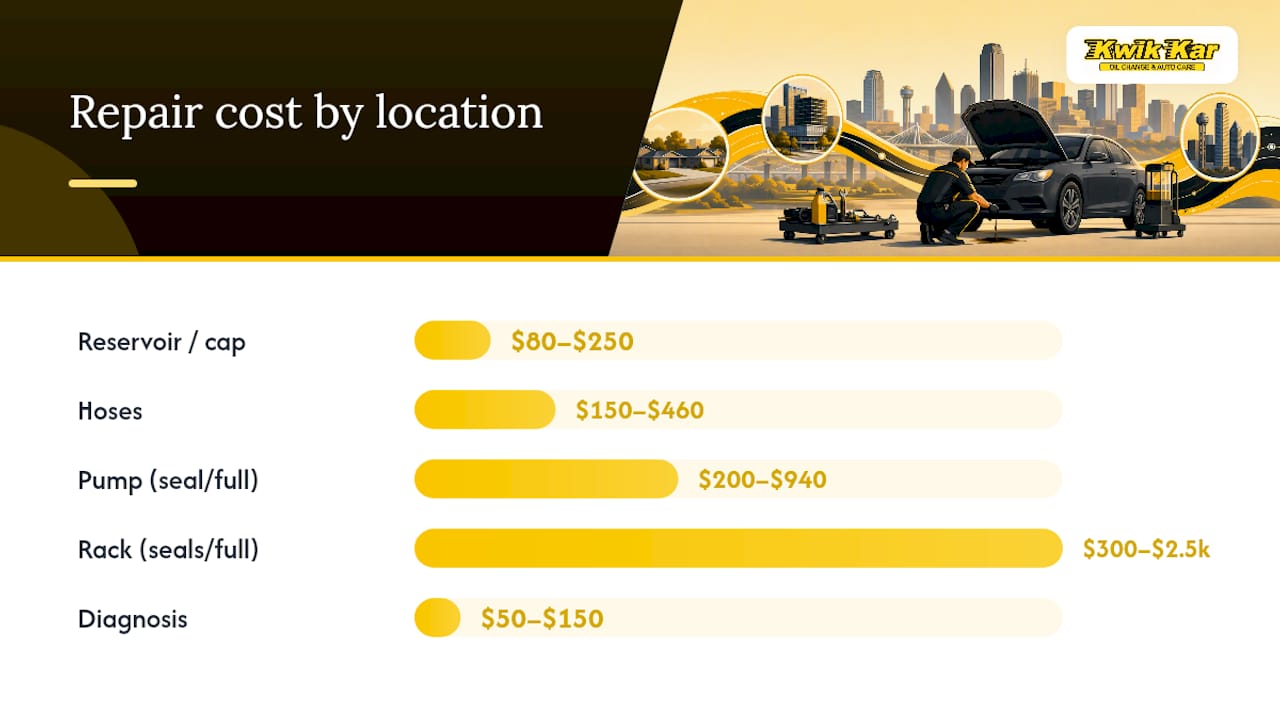
Repair cost tracks almost entirely with where the leak lives, not with how bad the symptoms feel. A cracked reservoir cap and a failing rack can produce the same puddle on your driveway, yet one costs under $100 and the other can run into the thousands.
- Reservoir or cap: typically $80 to $250, often on the low end if it’s just an O-ring or cap replacement
- Hoses: roughly $150 to $460 or more, depending on which hose and how hard it is to access
- Pump seal or full pump: $200 on the low end for a seal-only job, up to $940 for a complete pump replacement
- Rack seals or full rack replacement: $300 for seals alone, but $800 to $2,500 or more for a full rack, plus an alignment afterward
Diagnosis itself usually runs $50 to $150, and many shops credit that fee toward the repair if you move forward with them. Always ask whether that applies before agreeing to the diagnostic charge.
Hose replacement is one of the more DIY-friendly jobs on this list if you’re comfortable working near pressurized lines, but pump and rack work belongs with a professional shop that has the right tools and can properly bleed the system afterward. A rack replacement also requires an alignment check, which adds to the total but protects your tires and handling. Ask about remanufactured pump options too. Reman units typically cost 20 to 30 percent less than new OEM parts and usually carry a warranty. For more on why two shops might quote wildly different numbers for the same repair, our breakdown of why repair estimates vary explains the labor and parts factors at play.
Preventing a Power Steering Leak Before It Starts
Fluid service every 50,000 to 75,000 miles, or per your manufacturer’s schedule, keeps seals from hardening and cracking prematurely. That single habit extends component life significantly compared to a system that’s never serviced.
- Ask your technician to inspect hoses, clamps, and the reservoir during every oil change
- Replace hoses showing cracking or bulging before they fail on the road
- Keep the serpentine belt in good condition, since it drives the pump
- Avoid holding the wheel at full lock for long stretches, especially in cold weather
- Use only the fluid type your manufacturer specifies
- Treat stop-leak additives as a short-term patch at best, since they can gum up components over time rather than fix mechanical wear
Our Take: Why Diagnosis Should Always Come Before Repair
Our ASE-certified master technicians run UV dye tracing and professional pressure tests before recommending any parts. That sequence matters because a guessed repair on a power steering system is one of the easiest ways to spend $800 on a rack when the real problem was a $150 hose. We provide line-itemed estimates so you see exactly what you’re paying for, and diagnostic fees are often credited toward the repair when you move forward with us. Our process is built to get the diagnosis right the first time.
— Kwik Kar
Book Your Power Steering Diagnosis in Dallas
If you’re seeing fluid spots under your car or hearing that telltale whine when you turn, waiting rarely makes the repair cheaper. Kwik Kar Oil Change & Auto Care on Spring Valley Road provides Dallas drivers a straightforward path: an ASE-certified technician runs a proper diagnostic, hands you a transparent, line-item estimate before any work begins, and lets you decide with real numbers instead of guesswork.
Our team can trace the leak with UV dye or a pressure test, then walk you through repair options for the specific component involved, whether that’s a hose, a pump seal, or something more involved. Explore our full auto repair services to see everything we cover beyond steering systems, and check out our current maintenance coupon and free inspection offer if you’re due for a broader checkup. Call or stop by our Spring Valley Road location in Dallas to get a diagnostic appointment on the books before a small leak turns into a pump or rack replacement.
Sources
- A/C Pro Universal Oil Dye (AutoZone product page / reference)
- Power Steering Fluid Leak: Repair Costs by Leak Location (Pulscar)
- Power steering repair cost guide (MechanicsRated)
- HowStuffWorks: Diagnosing power steering fluid leak
FAQ
Can I still drive with a power steering leak?
You can drive short distances cautiously if the reservoir stays above the MIN line and steering feels predictable, but continued driving with dropping fluid risks pump damage and sudden loss of steering assist.
How much does it usually cost to fix a power steering leak?
Costs range from around $80 for a reservoir or cap repair up to $2,500 or more for a full rack replacement, with hoses and pump work falling in between depending on the leak location.
Where is the most common place for a power steering leak?
High-pressure hoses and their fittings fail most often because they handle constant pressure cycling and engine heat, making them the leading source of leaks in most vehicles.
How do I fix my power steering leak?
Start by locating the leak with a visual check or a UV dye kit, then match the repair to the source: tighten or replace fittings and hoses yourself if you’re comfortable, or bring it to an ASE-certified shop like Kwik Kar Oil Change & Auto Care for pump or rack work that needs specialized tools and an alignment afterward.