



Shocks and struts both control how your car’s springs bounce, but they are not the same part. A shock is a damper that only controls spring and suspension movement. A strut does that job too, and it also works as a structural piece of the suspension that supports the spring and helps hold the wheel in position. Which one sits at each wheel depends on how your vehicle was built, and Monroe notes that every wheel has one or the other, so a car can have struts in front and shocks in back.
This guide explains the difference in plain terms, how to tell which one your car has, what worn ones feel like, what replacement typically costs, and how North Dallas driving wears them down.
TL;DR
- Shocks are dampers. Struts are dampers that also carry the spring and act as part of the suspension’s structure and steering pivot.
- Every wheel has one or the other. Many cars have struts in front and shocks in back, but your vehicle’s layout decides.
- Typical life is 50,000 to 100,000 miles, shorter on rough roads or with heavy loads.
- Warning signs: bouncing after bumps, nose dive when braking, leaning in turns, a loose-feeling steering wheel, and oil leaking from the unit.
- Replace them in pairs on the same axle, and ask about an alignment afterward.
Table of Contents
- What does a shock absorber do?
- What does a strut do?
- Struts vs shocks: the differences side by side
- How can you tell which one your car has?
- How do you know if you need new shocks or struts?
- Can you keep driving on bad struts or shocks?
- How long do shocks and struts last?
- How much does it cost to replace shocks or struts?
- Should you replace shocks and struts in pairs or all four?
- What happens during a suspension inspection and replacement?
- Our perspective: don’t shop by the part name
- Get your suspension checked in North Dallas
- FAQ
- Sources
What does a shock absorber do?
Your springs support the car’s weight and soak up bumps. Left alone, a spring would keep bouncing after every dip in the road. The shock absorber is a hydraulic damper that settles that motion. Inside is a piston moving through oil (some units also use gas), and the resistance of that oil turns the spring’s bouncing energy into heat.
A shock is not a structural part. It does not hold up the car. If you disconnected one, the spring and the rest of the suspension would still carry the weight, but the car would bounce, wallow and lose control far sooner. Shocks are found at the rear of many passenger cars and at all four corners of many trucks and older body-on-frame vehicles.
What does a strut do?
A strut combines the damper with other jobs. In the most common design, the strut body holds the coil spring, mounts to the vehicle body at the top through a strut mount and bearing plate, and attaches to the steering knuckle at the bottom. That makes it a load-bearing part of the suspension. In front, the whole assembly pivots when you steer.
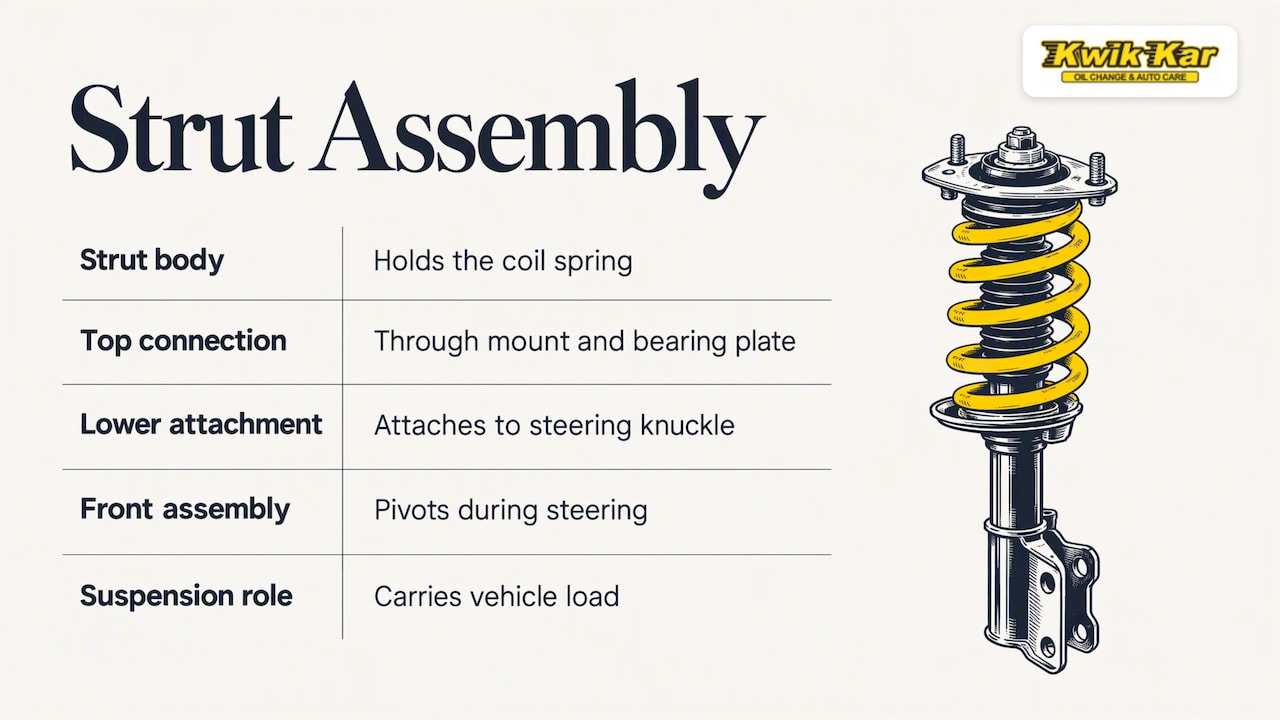
Because a strut is part of the geometry that positions the wheel, a worn one can affect more than ride comfort. It can change how the car tracks, how the tires wear and how stable it feels on the highway. That is also why alignment is usually part of the conversation after a strut job.
Struts vs shocks: the differences side by side
| Shock absorber | Strut | |
|---|---|---|
| Main job | Dampens spring movement | Dampens spring movement and supports the spring |
| Structural role | No, it does not carry the vehicle’s weight | Yes, part of the suspension structure |
| Steering role | None | Front struts act as a steering pivot |
| Typical location | Rear of many cars, all corners of many trucks | Front of many cars, sometimes rear as well |
| Parts involved | Damper, mounting hardware | Damper, spring, strut mount, bearing plate |
| Alignment needed after replacement | Usually not | Usually yes |
| Relative cost | Lower | Higher, especially as a complete assembly |
One caution on the old rule of thumb that trucks use shocks and unibody cars use struts. It is a decent starting guess, not a guarantee. Plenty of SUVs and trucks have front struts, and some cars have shocks at the rear and struts at the front. Look at your vehicle rather than assuming.
How can you tell which one your car has?
There are three practical ways.
- Look at the rear and front wheels. If you can see a coil spring wrapped around the damper body and the top of the unit disappears into the body or strut tower, it is a strut. If the damper is a slim tube separate from the spring, it is a shock.
- Check the owner’s manual or a parts lookup for your exact year, make and model.
- Ask the shop to show you. A good shop can point at the part on your car during an inspection.
Many drivers also hear the terms mixed together. Some shops quote “shocks and struts” as a single line item because the work is similar. If a quote says “struts,” ask whether it is the strut cartridge alone or a complete assembly with spring, mount and bearing plate, because complete assemblies cost more than the strut by itself.
How do you know if you need new shocks or struts?
Worn dampers rarely fail all at once. They fade, and most drivers adapt to the change without noticing. Here is what to watch and feel for.
Symptoms you can feel while driving
- Extra bounce after bumps. The car keeps rocking once or twice after a dip or expansion joint.
- Nose dive under braking. The front end drops hard when you stop, and stopping feels longer.
- Body roll or wallowing in corners. The car leans or sways on highway ramps and lane changes.
- Vague steering or drifting at highway speed. AutoBuffy points to this as a more serious sign of worn struts because the strut is part of the steering pivot.
- Clunks or knocks over bumps, which can point to a worn mount or loose hardware.
Symptoms you can see
- Oil film or wetness on the damper body. KYB lists a heavy fluid leak, a bent piston rod, or a cracked or broken mounting bracket as signs of mechanical failure that call for replacement.
- Uneven or cupped tire wear.
- A damaged or corroded unit, or a spring that sits at an odd angle.
A light film of oil can be normal on an older unit, while a wet, dripping body is not. This is where an inspection earns its keep.
Symptoms that look like something else
Bouncing, shaking and pulling have many causes. Worn tires, bad alignment, a failing wheel bearing, worn ball joints or brake problems can feel similar. If your steering wheel shakes mainly when you brake, read our guide on what makes the front end shake when braking, because rotors and calipers are a more common culprit than dampers. When a symptom has several possible causes, a proper diagnosis beats guessing at parts.
Can you keep driving on bad struts or shocks?
For a short time, usually yes, but you are accepting a safety trade. Modern stability systems such as ABS, traction control and electronic stability control depend on the tires staying in firm contact with the pavement, and Ford notes that worn shocks can compromise that contact. Worn suspension has been linked to 15% to 20% longer braking distances, and the same source warns that driving on worn struts causes steering instability at high speed and speeds up wear on parts such as control arm bushings and ball joints.
That last point is the money argument. A worn damper is rarely the only thing it damages if ignored.
Some conditions mean stop driving and get the car looked at promptly:
- A strut or shock that is bent, binding, disconnected or missing. State inspection guidance, such as the Utah Department of Public Safety’s 2025 manual, treats those conditions as grounds for rejection, along with loose, broken or missing mounting hardware and wear in the upper mount.
- A loud clunk or a wheel that seems to lean or move strangely.
- Steering that suddenly feels loose.
If you are not sure how bad it is, have a technician check it before the next long highway trip.

How long do shocks and struts last?
Kelley Blue Book puts typical life at 50,000 to 100,000 miles, depending on road conditions, vehicle load and how fast you take speed bumps and potholes. That is a wide range, and your driving matters more than the odometer.
In North Texas, a few habits shorten the interval:
- Stop-and-go traffic on corridors like Dallas North Tollway, Central Expressway and LBJ Freeway means constant braking and weight transfer onto the front dampers.
- Rough pavement and construction zones, along with the road wear that follows seasonal temperature swings.
- Heavy loads, such as a loaded truck bed, a roof box on a family road trip or towing.
- Summer heat, which is hard on rubber bushings, mounts and seals around the damper.
We will not put a mileage on your car beyond what the manufacturer says. Your owner’s manual and the inspection results are the best guide, and a visual check at each oil change is a cheap way to catch leaks early.
How much does it cost to replace shocks or struts?
It depends on the vehicle, the parts and whether you are doing one axle or all four. Car Talk reports a typical U.S. range of $500 to $2,500 for a pair, with luxury cars costing more and dealers using original-equipment parts charging roughly 25% to 50% more than local shops using aftermarket parts.
What moves the price:
- Strut or shock. Struts generally cost more, partly because there is more to the job.
- Loaded assembly or bare strut. A complete assembly with spring, mount and bearing plate costs more up front but can save labor and avoid reusing a tired spring or mount.
- Vehicle type. Trucks, SUVs, luxury models and cars with electronic or air suspension cost more.
- Alignment. Lemonade notes that an alignment is likely after strut replacement, and some shops include it while others charge separately. Ask which applies to your quote. Our guide to alignment pricing explains what to expect.
- Related parts. Mounts, bearings, bushings and ball joints may be worn at the same time.
Two habits keep costs honest. First, replace in pairs: it is standard practice to do both sides of an axle together so the suspension behaves evenly. Second, get a written estimate that separates parts, labor and alignment. ConsumerAffairs advises getting multiple quotes and confirming whether you need a full component replacement or a cheaper fix such as a bushing or ball joint.
We do not publish a flat price for suspension work, because it depends on your exact vehicle and what the inspection finds. We give you an estimate before any work begins.
Should you replace shocks and struts in pairs or all four?
Always in pairs on the same axle. A new damper on one side and an old one on the other makes the car handle unevenly, pulling or leaning differently left and right.
Replacing all four at once is not required, but it can make sense if:
- Your vehicle has high mileage and all four units show wear or leaks.
- You are already paying for an alignment and want to do the job once.
- You tow, haul or drive a lot of highway miles and want consistent handling front to back.
If only the front or only the rear is worn, a pair is a reasonable and honest repair. The technician should tell you which, based on what they see.
What happens during a suspension inspection and replacement?
We keep it simple and visible.
- Conversation. You tell us what you feel: the bounce, the noise, the dive when braking.
- Road test and inspection. A technician checks for leaks, damaged mounts, worn bushings, tire wear patterns and loose hardware.
- Digital vehicle inspection. We can share photos and video of what we find, so you see the leaking strut or cracked mount yourself.
- Estimate before work. You get the recommended repair, any optional items and the cost, and nothing proceeds without your approval.
- Repair. Parts are replaced in axle pairs, with related wear items addressed if they are part of the problem.
- Alignment check and test drive, since suspension work can change how the wheels sit.
You can read more on our shocks and struts service page.
Our perspective: don’t shop by the part name
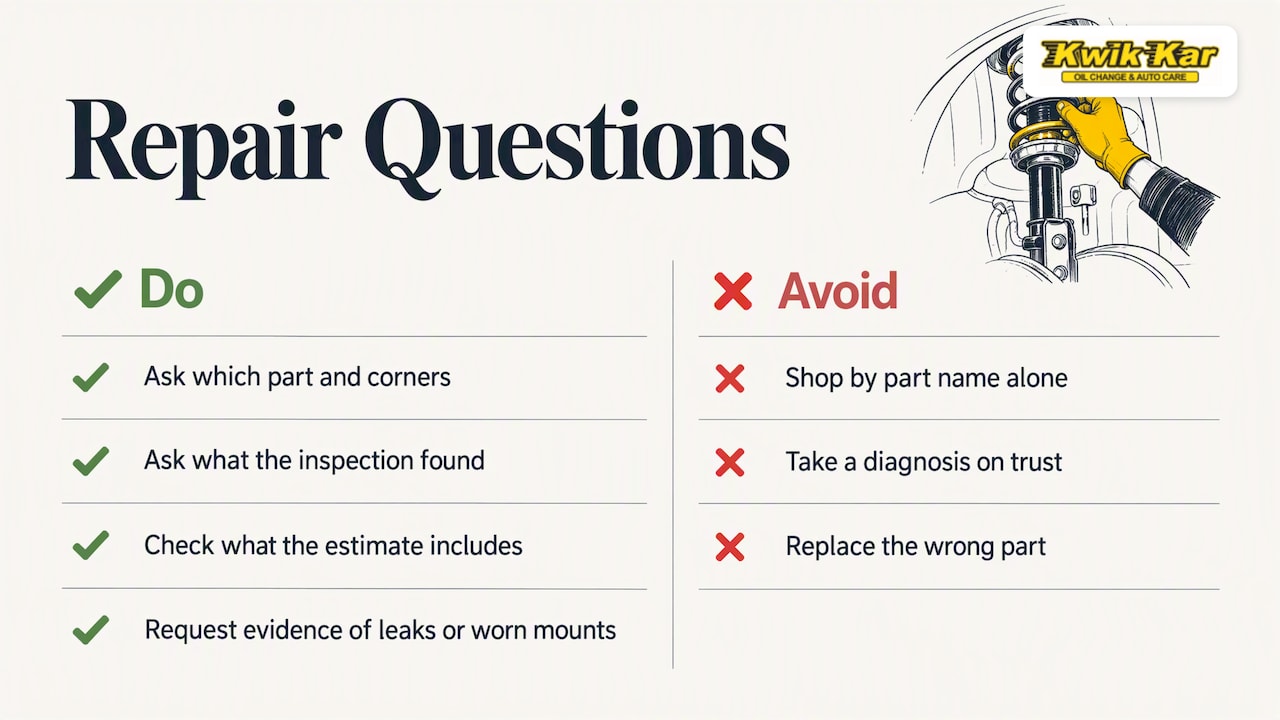
The most common confusion we see is a customer who was told “you need struts” at one shop, “you need shocks” at another, and has no idea which is right. Usually both shops are describing the same family of repair using different words, or the cars’ layouts really do differ. The useful question is not “shocks or struts?” but “which part, which corners, what did you see, and what does the estimate include?”
We are a family-owned shop with nearly 30 years of local experience, and our ASE-certified technicians would rather show you the leak or the worn mount than ask you to take our word for it. We also tell you when a symptom is likelier to be tires, brakes or a wheel bearing, because replacing the wrong part is the most expensive repair of all. If a suspension repair qualifies, our 24-month/24,000-mile warranty applies subject to its terms.
— Kwik Kar
Get your suspension checked in North Dallas
If your car bounces, dives or drifts, we can inspect the suspension at 8280 Spring Valley Rd, Dallas, TX 75240, serving drivers from Far North Dallas, Addison, Richardson and Farmers Branch. See everything we handle on our full auto repair services page, or schedule an appointment and tell us what you are feeling. You will get an estimate before any work starts.
FAQ
Are shocks and struts the same thing?
No. Both dampen spring movement, but a strut also supports the spring and forms part of the suspension’s structure, and at the front it acts as a steering pivot. Shops sometimes use the words loosely, so ask which part your quote covers.
Is it better to have shocks or struts?
Neither is better in general. Your vehicle was designed for one or the other at each wheel, and the right replacement is the type your car uses, in a quality that suits how you drive.
Do I need an alignment after replacing struts?
Usually yes, because struts are part of the geometry that positions the wheel. Shocks typically do not require one. Ask whether alignment is included in your estimate, since some shops bundle it and others charge separately.
How often should shocks and struts be replaced?
There is no single interval, but 50,000 to 100,000 miles is a common range for wear. Rough roads, heavy loads and lots of stop-and-go driving shorten it. Have them inspected if you notice bounce, nose dive or leaks, and follow your manufacturer’s guidance.
Can I replace just one strut or shock?
It is better to replace both on the same axle. A mismatched pair makes the car handle unevenly, which defeats the purpose of the repair.
Sources
- Difference Between Shocks & Struts, Monroe
- Do I Need New Shocks, KYB
- Bad Shock Absorber Symptoms, AutoBuffy
- How to Replace Your Own Struts, Family Handyman
- How to Maintain the Shocks and Struts, Ford
- Utah Department of Public Safety, 2025 Inspection Manual
- Car Shocks and Struts: Signs They Are Worn Out, Kelley Blue Book
- How Much Does It Cost To Replace Shocks or Struts, Car Talk
- Strut Replacement Cost, Lemonade
- Car Suspension Repair Cost, ConsumerAffairs