



If you’ve ever asked a mechanic for a tune-up and felt unsure what you were actually asking for, you’re not alone. The term “what is a tune-up” gets searched thousands of times a month by drivers who sense their car needs attention but aren’t sure what that means in practical terms. The honest answer is that the tune-up meaning in cars has changed dramatically over the past three decades. What used to mean adjusting carburetors and distributor points now means something entirely different, and understanding that difference can save you real money while keeping your vehicle running at its best.
Table of Contents
- Key Takeaways
- What a tune-up actually meant (and what it means now)
- What tune-up services include on modern vehicles
- The real benefits of a tune-up
- Tune-up costs and timing in 2026
- How to plan your vehicle’s tune-up schedule
- My take on tune-up misconceptions
- Keep your vehicle in top shape with Kwik Kar
- FAQ
Key Takeaways
| Point | Details |
|---|---|
| Tune-ups have evolved | Modern tune-ups focus on scheduled maintenance and diagnostics, not old mechanical adjustments. |
| Services vary by vehicle | A tune-up checklist differs by make, model, mileage, and driving conditions, not a one-size-fits-all fix. |
| Diagnostics prevent surprises | Computer scans identify problems before they cause breakdowns, replacing costly guesswork. |
| Maintenance pays for itself | Every dollar spent on preventive maintenance returns $3 to $10 in avoided repair costs. |
| Follow manufacturer schedules | Your owner’s manual, not general rules, determines the right intervals for your specific vehicle. |
What a tune-up actually meant (and what it means now)
To understand where we are today, it helps to know where the term came from. Early gasoline engines used carburetors, mechanical ignition distributors, and breaker points. All of these required periodic physical adjustment to keep an engine running smoothly. Mechanics would literally “tune” the engine by setting ignition timing, adjusting the air-fuel mixture, and replacing worn contact points. The result was a noticeable improvement in performance, much like tuning a musical instrument that had drifted out of pitch.
That world no longer exists in mainstream automotive service. No modern car requires ignition timing adjustments or carburetor tuning. Fuel injection, electronic ignition, and onboard computers handle all of that automatically. Spark plugs now last far longer than they used to, and many components that once needed frequent replacement are designed to last the life of the vehicle.
What changed the game was the introduction of computer-controlled engines in the 1980s and 1990s. Once a car’s engine management system could self-correct fuel mixture and ignition timing in real time, the old mechanical tune-up became irrelevant. Today, a tune-up is a collection of scheduled maintenance tasks and inspections tailored to your specific vehicle, not a single defined service.
Here is what that shift means for you in practical terms:
- The old tune-up was reactive. Something ran rough, so you adjusted it.
- The modern tune-up is proactive. You replace wear items and scan for problems before symptoms appear.
- The services included vary significantly by vehicle age, mileage, and manufacturer requirements.
Pro Tip: When a shop asks what kind of tune-up you want, the best answer is your current mileage and the last time you had major maintenance. That gives a technician the information needed to build a service plan that actually fits your car.
What tune-up services include on modern vehicles
Think of a modern tune-up as a scheduled wellness check for your vehicle. The actual content of tune-up services explained varies, but most fall into two broad categories: replacing wear items on a mileage schedule and running diagnostics to catch problems early.
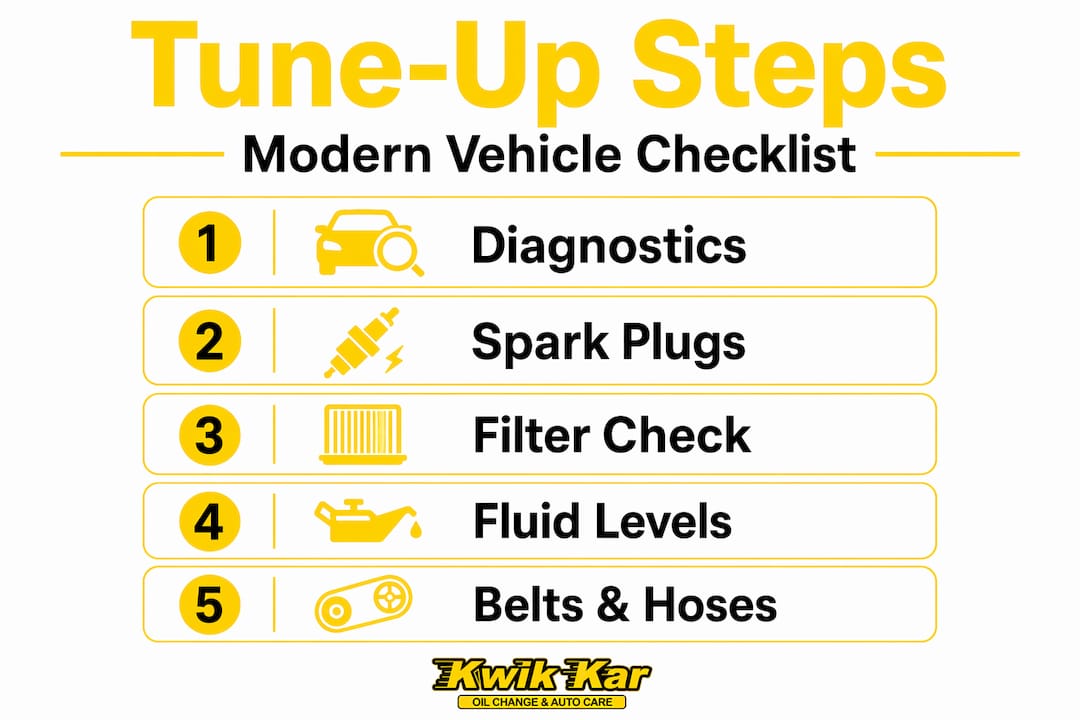
A standard tune-up checklist typically covers:
- Spark plugs: Still the most common tune-up item. Modern iridium or platinum plugs last between 60,000 and 100,000 miles, so replacement intervals are far longer than the 12,000-mile standard of older vehicles.
- Air and cabin filters: A clogged air filter directly reduces engine efficiency and fuel economy. Cabin filters affect air quality inside the car.
- Fuel filters: Not all vehicles make these accessible, but when they do, replacement keeps the fuel system clean.
- Belts and hoses: Visual inspection catches cracking and wear before a belt snaps or a hose fails on the highway.
- Battery and charging system: A quick voltage test identifies a battery that is approaching the end of its life, not one that has already died.
- Fluids: Coolant, brake fluid, power steering fluid, and transmission fluid all degrade over time and need periodic attention.
- Oil change: Often included as part of a broader service visit.
The element that separates modern tune-ups from older ones is the diagnostic scan. Diagnostics pinpoint issues before symptoms appear, replacing the guesswork of replacing parts until performance improves. A scan tool reads fault codes stored by the engine control module, identifying sensors, emissions components, or system failures that a visual inspection would miss entirely.
| Service Item | Typical Interval | Notes |
|---|---|---|
| Spark plugs | 60,000 to 100,000 miles | Varies by plug type and manufacturer |
| Engine air filter | 15,000 to 30,000 miles | More often in dusty environments |
| Synthetic oil change | 7,500 to 15,000 miles | Check your owner’s manual |
| Coolant flush | Every 30,000 to 50,000 miles | Often overlooked, critical for engine health |
| Timing belt | 60,000 to 100,000 miles | Chains typically do not need replacement |
Pro Tip: Ask your technician whether your vehicle uses a timing belt or a timing chain. Ignoring timing belt replacement can cause catastrophic engine damage, but many drivers don’t realize their car has one until it’s too late.
The real benefits of a tune-up
One of the most common objections to getting a tune-up is cost. The counter to that is simple math. Routine maintenance costs around $800 to $900 per year on average. A single transmission repair can run $3,000 or more. An engine replacement can exceed $6,000. Skipping the maintenance does not save money. It shifts smaller, predictable costs into larger, unpredictable ones.
The benefits of a tune-up go beyond avoiding catastrophic failures. Here is what regular maintenance actually delivers:
- Better fuel economy: Worn spark plugs cause misfires and incomplete combustion, which wastes fuel. Fresh plugs and a clean air filter can noticeably improve miles per gallon.
- Stronger performance: Engines running on degraded fluids and worn components work harder to produce the same output. Maintenance restores that efficiency.
- Extended vehicle life: Preventive maintenance extends vehicle lifespans beyond 200,000 miles. Vehicles that reach high mileage reliably almost always have documented maintenance histories.
- Higher resale value: A car with service records sells for more than one without. Buyers pay a premium for documented care because it reduces their risk.
Proper maintenance prevents catastrophic failures and adds real longevity to your vehicle. Every dollar you invest in scheduled service has the potential to return $3 to $10 in avoided repair costs, extended vehicle life, and preserved resale value.
The peace of mind is worth something too. A vehicle that has been maintained on schedule is far less likely to leave you stranded, and far less likely to produce a repair estimate that ruins your month.
Tune-up costs and timing in 2026

Knowing what to expect financially takes the stress out of scheduling service. Costs depend on what your vehicle actually needs at a given mileage point and where you take it.
A basic tune-up focused mainly on spark plug replacement runs $40 to $180. A comprehensive tune-up that includes diagnostics, fluid checks, filter replacements, and a full inspection typically falls in the $200 to $800 range, with some vehicles on the higher end depending on parts and labor. Luxury or high-performance vehicles with specialty components will often exceed that upper figure.
One of the most widespread maintenance myths still costing drivers money is the 3,000-mile oil change. Modern vehicles with synthetic oil have intervals of 7,500 to 15,000 miles. Following the old 3,000-mile rule on a car that doesn’t need it means paying for two or three extra oil changes per year with no benefit. You can explore the specifics of synthetic oil intervals to understand exactly how modern lubricants work and how to stop overpaying.
Estimated tune-up costs by service level:
| Service Level | Typical Cost Range | What’s Included |
|---|---|---|
| Basic | $40 to $180 | Spark plugs, basic inspection |
| Standard | $150 to $400 | Plugs, filters, fluids, battery check |
| Comprehensive | $200 to $800+ | All above plus diagnostics, belts, full inspection |
The key number to keep in mind: a typical tune-up including oil change, tire rotation, and standard inspections often comes in under $500 for most everyday vehicles.
How to plan your vehicle’s tune-up schedule
Knowing what a tune-up covers is useful. Knowing how to apply that knowledge to your specific vehicle is where it becomes practical. Here is a straightforward process for getting your maintenance on track:
- Open your owner’s manual. The manufacturer’s maintenance schedule is the only reference that accounts for your specific engine, transmission, and component specifications. Generic advice on the internet, including well-meaning articles like this one, cannot replace it.
- Use a digital maintenance portal if available. Many newer vehicles include onboard maintenance monitors that track oil life, tire pressure, and service reminders in real time. These systems are more accurate than calendar-based guessing.
- Watch for early warning signs. Rough idling, reduced fuel economy, difficulty starting, or a check engine light are signals your vehicle may need attention before the next scheduled interval. A diagnostic scan can identify the root cause quickly.
- Choose a shop with certified technicians. ASE certification and affiliations with organizations like RepairPal indicate a shop that has passed objective competency evaluations, not just self-reported expertise.
- Request an estimate before any work begins. A reputable shop gives you a written estimate and explains what they found and why each service is recommended. This protects you from unnecessary work.
- Track your service history. Keep receipts or use a maintenance app. This documentation protects resale value and helps any technician give you accurate recommendations at future visits.
My take on tune-up misconceptions
I’ve seen the same pattern repeat itself more times than I can count. A driver comes in and says they want a tune-up, expecting some kind of general fix for a vague concern. What they actually need is a structured conversation about where their vehicle is in its maintenance cycle, what wear items are due, and whether the onboard computer is flagging anything.
The word “tune-up” has survived decades past its literal meaning because it still captures the idea of bringing something back to its best condition. That part is still accurate. What I’ve learned is that the biggest mistake car owners make is treating maintenance as optional until something breaks. The vehicles I’ve seen reach 200,000 miles and beyond almost always belong to drivers who followed their schedules and didn’t skip service because it felt inconvenient.
My honest recommendation: stop thinking about tune-ups as a single event and start thinking about them as a rolling schedule. Check your mileage, pull up your owner’s manual, and find out what is actually due. If you’re not sure, a shop with real diagnostic capabilities will tell you exactly where you stand without selling you services you don’t need. The car maintenance checklist we maintain covers the key checkpoints worth tracking.
Diagnostics changed everything in this industry. The shops that still guess at problems by replacing parts until something improves are costing their customers real money. Push for data. Ask what the scan showed. That one habit will protect you more than any single service.
— Kwik Kar
Keep your vehicle in top shape with Kwik Kar

At Kwik Kar Oil Change & Auto Care, we bring modern diagnostics and certified expertise to every service visit. Our ASE Certified Master technicians handle both domestic and import vehicles, using current tools to give you an accurate picture of your car’s condition, not a guess. We provide written estimates before any work begins, so you stay in control of your maintenance decisions. Whether you’re due for a basic oil change or a full auto repair service that covers diagnostics, spark plugs, filters, and fluid checks, we build a service plan around your vehicle’s actual needs. Visit our Dallas auto care center to schedule your next service and keep your vehicle running reliably for years to come.
FAQ
What is a tune-up in modern cars?
A tune-up today is a scheduled maintenance service that typically includes spark plug replacement, filter changes, fluid checks, belt inspections, and a diagnostic scan. It is no longer a single mechanical adjustment but a tailored set of services based on your vehicle’s mileage and manufacturer schedule.
How often should you get a tune-up?
The interval depends on your specific vehicle. Spark plugs on most modern cars last 60,000 to 100,000 miles, while oil changes with synthetic oil are recommended every 7,500 to 15,000 miles. Always follow your owner’s manual rather than outdated general guidelines.
What does a tune-up include as a standard checklist?
A standard tune-up checklist covers spark plugs, air and cabin filters, battery condition, belts and hoses, fluid levels, and a diagnostic scan for fault codes. More comprehensive services may also include a fuel system inspection, tire rotation, and coolant flush.
How much does a tune-up cost in 2026?
A basic tune-up focused on spark plugs runs $40 to $180. A comprehensive service including diagnostics, filters, and a full inspection typically costs $200 to $800 or more, depending on the vehicle and what is due at that mileage.
Is a tune-up worth it if your car seems fine?
Yes. Many issues caught during a tune-up, such as a failing battery, worn belts, or stored fault codes, show no noticeable symptoms until they cause a breakdown. Preventive maintenance consistently costs less than emergency repairs, and every dollar spent returns an estimated $3 to $10 in long-term value.