


Early vehicle diagnostics save money, improve safety, and keep your car performing at its best. By reading live sensor data and fault codes before a small issue becomes a breakdown, you avoid emergency labor, protect your ADAS systems, and preserve fuel economy. Here is what proactive scanning delivers:
- Early fault detection before a minor issue escalates into a major failure
- Lower repair costs by shifting from emergency fixes to planned, scheduled maintenance
- Preserved fuel economy by catching fuel-trim drift, misfires, and sensor errors early
- Extended component life for brakes, transmission, and engine parts
- ADAS and braking system readiness through calibration checks that keep safety electronics responsive
- Fewer roadside breakdowns and the towing bills that come with them
- Pre-trip and pre-inspection confidence so you know the car is ready before you need it
- Better resale value backed by documented service and diagnostic records
The OBD-II standard, required on all U.S. vehicles since 1996, makes this level of vehicle health monitoring accessible to every driver, whether through a shop scan tool or a personal Bluetooth reader.
Key Takeaways
Early vehicle diagnostics are the most cost-effective maintenance decision most drivers can make, converting potential failures into planned repairs before emergency costs and safety risks accumulate.
| Point | Details |
|---|---|
| Scan at least annually | Most drivers benefit from a baseline diagnostic once a year, plus immediate scans after any warning light or symptom. |
| Catch faults in the P-F window | Diagnosing a fault during the potential-failure window prevents tow-in costs and emergency labor rates. |
| ADAS calibration matters | Sensor drift in ADAS and braking systems can increase accident risk without triggering an obvious warning. |
| DIY vs. professional | Basic OBD-II readers work for simple triage; ADAS, transmission, and intermittent faults require professional-grade tooling. |
| Kwik Kar Oil Change & Auto Care | ASE-certified technicians provide full-system diagnostics with written estimates and same-day turnaround in the Dallas area. |
Table of Contents
- What are the benefits of early vehicle diagnostics?
- How does your car’s diagnostic system actually find problems?
- The real-world benefits of catching car problems early
- How often should you run a diagnostic scan?
- What does a diagnostic visit cost, and what does it include?
- DIY OBD-II scanning versus professional diagnostics
- Why predictive maintenance changes the math on car ownership
- A technician’s perspective on why early diagnostics matter
- Kwik Kar Oil Change & Auto Care: professional diagnostics you can count on
- Sources
- FAQ
What are the benefits of early vehicle diagnostics?
The core benefit is simple: catching a problem while it is still cheap to fix. A marginal misfire code caught in week one costs a spark plug set. Left unread for three months, the same misfire can wash oil off cylinder walls, foul catalytic converters, and turn a $60 repair into a $1,200 one.
Consumer guidance consistently shows that early diagnostics detect minor transmission, exhaust, and ignition problems before they become costly failures. The advantages of car diagnostics extend beyond the repair bill: verified sensor calibration keeps your ADAS lane-keeping and automatic emergency braking working as designed, and a clean fuel system delivers the MPG the manufacturer rated your vehicle for.
How does your car’s diagnostic system actually find problems?
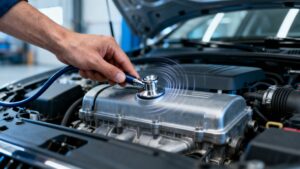
Your vehicle’s Engine Control Unit (ECU) collects data from dozens of sensors every second: oxygen levels, coolant temperature, throttle position, wheel speed, and more. When a reading falls outside its programmed range, the ECU stores a Diagnostic Trouble Code (DTC) and, for emissions-related faults, triggers the check-engine light.
The OBD-II port, located under the dashboard on the driver’s side, gives technicians and scan tools direct access to those codes and to live data streams. JD Power explains that a standard diagnostic test scans these components and systems for errors, making it a practical baseline for seasonal or symptom-driven checks.
Modern telematics systems go further. Instead of waiting for a threshold to be crossed, they track trends over time. That trend-based approach is what separates predictive maintenance from simple code reading.
How a diagnostic scan works, step by step:
- Data collection — the scan tool connects to the OBD-II port and pulls live sensor readings and stored DTCs.
- Code and metric detection — the tool flags any parameter outside the manufacturer’s specification.
- Interpretation — a technician (or the driver) reads the codes and cross-references them with live data to identify the root cause.
- Action — a repair plan is created, prioritized by safety impact and cost.
The real-world benefits of catching car problems early
Early fault detection stops small problems from compounding
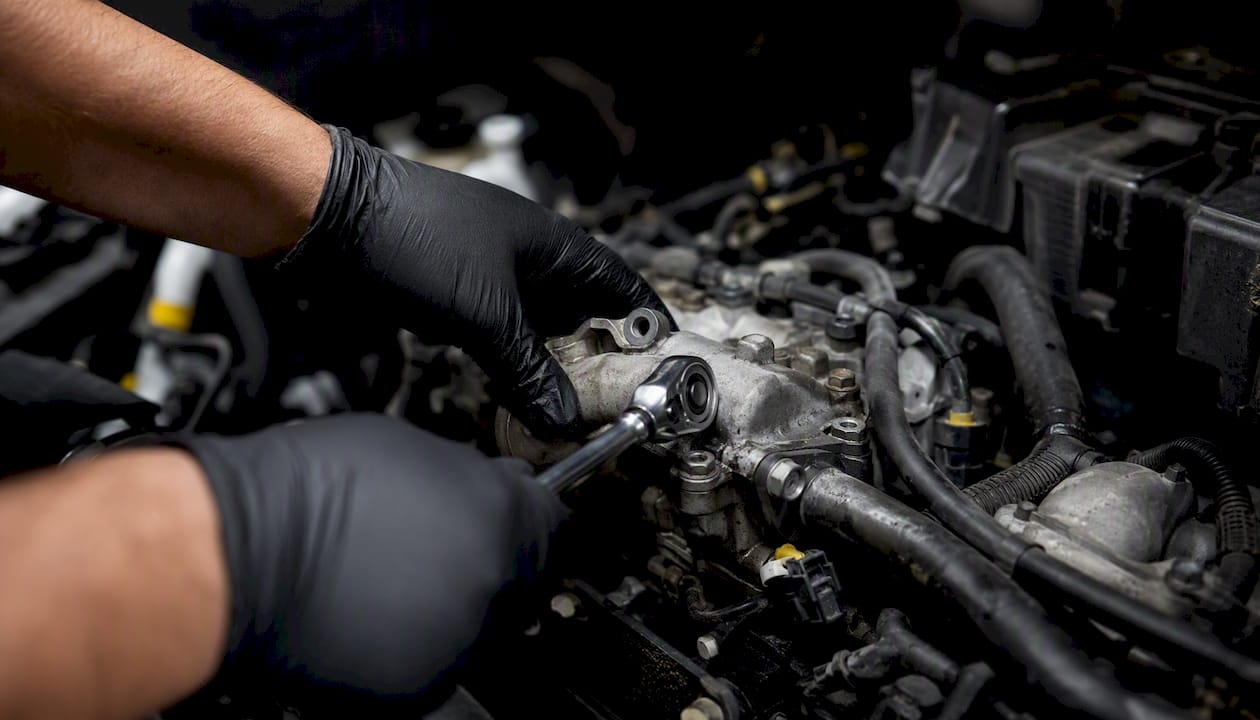
Vehicles rarely fail suddenly. There is almost always a P-F interval, the window between a potential failure and a functional one, during which a sensor, component, or system is degrading but still operational. Research on the P-F interval shows that catching failures in this window prevents expensive tow-ins and emergency labor. A technician who spots rising coolant temperature variance over three consecutive scans can replace a thermostat for under $100 rather than a blown head gasket for $2,000 or more.
Fuel economy and emissions stay on target
A faulty oxygen sensor, a clogged injector, or a misfiring cylinder all force the engine to burn more fuel to maintain power. Catching these faults early restores the combustion efficiency the manufacturer designed in. Fewer unburned hydrocarbons also means your vehicle stays within emissions limits, which matters at inspection time.
ADAS and braking systems stay calibrated
Research from the ADPA confirms that proactive diagnostic maintenance keeps ADAS and electronic braking systems calibrated and responsive. Unnoticed sensor drift in a radar or camera module can degrade lane-keeping assist or automatic emergency braking without triggering an obvious warning. A diagnostic scan that includes ADAS system checks catches that drift before it becomes a safety liability.
Statistic to know: Consumer guidance and shop data consistently show that planned, diagnostic-driven repairs tend to cost less than emergency repairs for the same underlying fault, because scheduled labor rates are generally lower and parts can usually be sourced without rush pricing.
Pro Tip: Log every DTC you pull, even codes that clear on their own. A code that appears once and disappears is easy to dismiss, but the same code appearing three times over two months is a pattern that points to a real, developing fault.
How often should you run a diagnostic scan?
The practical baseline: for most drivers, at least annual scans plus any time a specific trigger occurs. Drivers with high mileage and fleet vehicles benefit from more frequent scans because wear rates accelerate and the cost of a missed fault is higher.
Seasonal and symptom-driven checks are the most common recommendation from shop professionals. A scan before winter and before summer road trips catches issues that temperature extremes tend to expose.
Recommended cadence:
- Annual baseline for most owners, ideally at the same time as an oil change or state inspection.
- Seasonal scans (spring and fall) for drivers in climates with extreme temperature swings.
- Quarterly scans for vehicles over 100,000 miles or any vehicle in fleet service.
- Pre-trip scans before any drive over 200 miles.
- Post-repair scans after any significant work to confirm codes are cleared and no new faults appeared.
Scan immediately if you notice any of these triggers:
- Check-engine light or any dashboard warning light
- ADAS warning (lane-keep, collision alert, or camera fault indicator)
- Noticeable drop in fuel economy
- Unusual vibration, hesitation, or rough idle
- Pre-sale or pre-inspection preparation
- Any new sound that was not there last week
What does a diagnostic visit cost, and what does it include?
A professional diagnostic scan at a shop typically costs a moderate fee for a standard code read and live-data review, though complex drivability or ADAS diagnostics can cost more depending on the time required. That fee is almost always applied toward the repair if you proceed with the work. Understanding how car maintenance costs are calculated helps put that number in context: a $100 diagnostic that prevents a $900 emergency repair is not a cost, it is a return.
| Service component | What it covers |
|---|---|
| OBD-II code read | Retrieves all stored and pending DTCs from every module |
| Live-data tracing | Reviews real-time sensor values to find root causes |
| System-specific tests | Checks ABS, airbag, ADAS, transmission, and emissions modules |
| Test drive (if needed) | Reproduces intermittent symptoms under real driving conditions |
| Written estimate | Documents findings and repair costs before any work begins |
What a full diagnostic visit typically includes:
- Complete DTC retrieval across all vehicle modules (not just the powertrain)
- Live-data review of fuel trims, O2 sensor response, and ignition timing
- Sensor calibration check for ADAS and safety systems
- A written estimate with prioritized repair recommendations
- Clear explanation of which codes are safety-critical versus maintenance items
Proactive diagnosis shifts repairs from emergency rates to scheduled labor. Parts sourced without urgency cost less, and the technician can address multiple related issues in a single visit rather than billing separate diagnostic fees for each return trip.
DIY OBD-II scanning versus professional diagnostics
A basic Bluetooth OBD-II reader (tools like the Veepeak or FIXD connect to your phone for $20–$80) is genuinely useful for reading and clearing simple powertrain codes. If your check-engine light comes on and you want to know whether it is a loose gas cap or something serious before driving to a shop, a DIY scan gives you that triage information quickly.
Professional diagnostics are a different level of capability. Shop-grade scan tools access every module in the vehicle, not just the powertrain ECU, and they can run bidirectional tests that command components to activate so a technician can verify function directly. Understanding what a check-engine light actually means is a good starting point, but interpreting the data behind it accurately requires training and experience.
When professional diagnostics are the right call:
- Any ADAS-related code (camera, radar, or ultrasonic sensor calibration requires OEM-level tooling)
- Intermittent misfires that do not produce a consistent code
- Transmission fault codes, which require live pressure and solenoid testing
- Any code that returns after you have already replaced the part it points to
- Pre-purchase inspections on used vehicles
Pro Tip: Before your shop visit, use your phone to record a short video of the symptom (a rough idle, a vibration at highway speed) and note exactly when the code appeared. That 60-second clip can cut diagnostic time significantly and reduce your bill.
Why predictive maintenance changes the math on car ownership
Research published in the Engineering Proceedings journal shows that predictive maintenance using AI/ML and trend modeling shifts vehicle care from fixed-interval servicing to condition-based actions, reducing total cost of ownership for many systems. The key concept is trend. A single sensor reading tells you where the vehicle is right now. A trend line tells you where it is going and when it will cross into failure territory.
Enhanced diagnostics combining OBD-II, telematics, and analytics reduce unnecessary part swaps and improve repair accuracy by giving technicians the full picture rather than a single snapshot. A shop that tracks your vehicle’s fuel-trim history across three visits can spot a slow injector leak months before it triggers a DTC.
What predictive maintenance delivers in practice:
- Converts unexpected failures into planned, lower-cost maintenance events
- Reduces emergency labor and towing costs
- Improves parts availability because replacements can be ordered in advance
- Supports accurate repair estimates because the root cause is identified before work begins
The limitation is data access. Predictive algorithms need consistent, high-quality sensor data over time. That means regular scans, not just a one-time check when the light comes on.
Pro Tip: Ask your shop whether they track trend data across visits. A shop that maintains a diagnostic history for your vehicle can spot developing faults that a one-time scan would miss entirely.
A technician’s perspective on why early diagnostics matter
ASE-certified technicians recommend early diagnostics because it makes every repair faster, more accurate, and less expensive for the customer. When a vehicle arrives with a documented code history and a clear symptom timeline, the technician spends less time chasing the fault and more time fixing it. Fewer unnecessary parts get replaced, the repair estimate is more accurate from the start, and the customer leaves with confidence that the actual problem was solved.
Shop-side trust signals that matter when choosing where to get your diagnostics done:
- ASE certification confirms the technician has passed standardized competency tests for the systems they are diagnosing
- RepairPal and NAPA AutoCare affiliation indicates the shop meets third-party standards for pricing fairness and repair quality
- Written estimates before work begins so you know the cost and scope before authorizing anything
- Advanced scan tooling that accesses all vehicle modules, not just the powertrain
Kwik Kar Oil Change & Auto Care: professional diagnostics you can count on
Skipping the guesswork on your vehicle’s health is exactly what Kwik Kar Oil Change & Auto Care is built for. While a DIY reader gives you a code number, Kwik Kar’s ASE-certified technicians give you a complete picture: what the code means, what caused it, what it will cost to fix, and which issues need attention now versus later. That transparency, before any work begins, is what makes the difference between a shop visit that solves the problem and one that creates new questions.
Kwik Kar’s diagnostic services include OBD-II code reading across all vehicle modules, live-data tracing, ADAS calibration checks, full system inspections, and written estimates with prioritized repair recommendations. RepairPal and NAPA AutoCare affiliations back the shop’s commitment to fair pricing and quality work. Fast turnaround means most diagnostic visits are completed the same day.
Schedule your engine diagnostic appointment at Kwik Kar Oil Change & Auto Care and get a clear, written answer about your vehicle’s condition today.
Sources
- The benefits of vehicle repair and maintenance on safety and sustainability
- Predictive Maintenance and Predictive Repair of Road Vehicles—Opportunities, Limitations and Practical Applications
- What is a car diagnostic test? Costs, Duration & Free Options
- What is a Car Diagnostic Test? Costs, Duration & Free Options
FAQ
What are the main benefits of a car diagnostic?
Early diagnostics detect faults before they escalate, lower repair costs by enabling planned maintenance, preserve fuel economy, and keep safety systems like ADAS and electronic braking calibrated and responsive.
How often should you get a diagnostic on your car?
Most drivers benefit from at least one professional diagnostic scan per year, with immediate scans after any warning light, unusual symptom, or noticeable drop in fuel economy. High-mileage vehicles and fleet cars benefit from quarterly checks.
What does a full car diagnostic test include?
A full diagnostic visit typically covers OBD-II code retrieval across all vehicle modules, live-data tracing, ADAS and safety system checks, a test drive if needed to reproduce symptoms, and a written estimate before any repair work begins.
How much does a car diagnostic test cost?
Professional diagnostic scans generally run for a moderate fee at a shop, with the fee often applied toward the repair if you proceed. That cost is typically far less than the emergency labor and parts costs of a failure caught too late.
When should I go to a professional instead of using a DIY scanner?
Take your vehicle to a professional for any ADAS-related code, intermittent misfires, transmission faults, or any code that returns after you have already replaced the part it pointed to. DIY readers are useful for basic triage but lack the bidirectional testing and module access that shop-grade tools provide.