

The single most important rule when you hear a strange sound from your car: match what it sounds like to when it happens, and you’ll know which system to suspect and whether you can keep driving. GEICO’s consumer guidance puts it plainly — modern cars are engineered to run quietly, so a new noise is almost always a signal worth acting on.
Use this 60-second check before you do anything else:
- What does it sound like? Grinding, squealing, clicking, humming, hissing, rattling, knocking, thumping, or clunking.
- When does it happen? At idle, while accelerating, during braking, when turning, or at a steady highway speed.
- One immediate action: If you hear metal-on-metal grinding from the brakes, a loud engine knock, or you’ve lost normal steering feel, pull over safely and call for a tow. For everything else, drive carefully to the nearest ASE-certified shop for a proper diagnosis.
ASE-certified technicians are trained to isolate noise sources using road tests, visual inspections, and measured checks. Kwik Kar Oil Change & Auto Care employs ASE-certified technicians and provides written estimates before any work begins, so you know exactly what you’re dealing with before committing to a repair.
Key Takeaways
Matching the sound to when it happens is the fastest way to identify unusual car noises and decide whether you need to stop driving, head to a shop today, or schedule routine service.
| Point | Details |
|---|---|
| Sound + condition = likely system | Match what you hear (grind, click, hum, knock) to when it happens (braking, turning, idle, speed) to narrow the cause. |
| Urgent stop-driving sounds | Metal-on-metal brake grinding, loud engine knock, loss of steering, or steam from the hood require a tow, not a drive. |
| Wheel bearing vs. tire noise | Bearing hum follows vehicle speed and shifts with steering; tire noise changes with road surface and sounds more rhythmic. |
| Record and describe precisely | A phone video of the noise under the exact driving condition cuts diagnostic time and cost at the shop. |
| Kwik Kar Oil Change & Auto Care | ASE-certified technicians, written estimates before work begins, and a free inspection with qualifying service. |
Table of Contents
- 1. How to identify unusual car noises by sound and cause
- 2. Simple tests to figure out where the noise is coming from
- 3. Which noises mean you should stop driving right now
- 4. What a shop will do and what repairs typically cost in the U.S.
- 5. How to record the noise and what to tell your mechanic
- 6. Why a certified shop is the right next step for a noisy car
- 7. What technicians wish you knew before bringing in a noisy car
- Kwik Kar Oil Change & Auto Care: fast diagnostics, clear pricing, and a straightforward next step
- Sources
- FAQ
1. How to identify unusual car noises by sound and cause
The list below maps each sound to its most likely system and tells you how urgent the situation is. For each one, “urgent” means pull over or do not drive further; “next-day” means book an appointment within 24 hours; “routine” means schedule at your next service window.
1. Brake squeal (high-pitched, on braking)
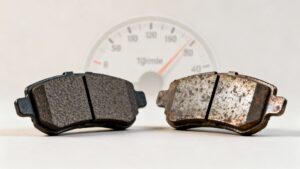
Most likely cause: worn brake pad wear indicators contacting the rotor. Urgency: next-day. Most pads have a metal tab engineered to squeal when the friction material gets low.
Pro Tip: Roll down your windows on a quiet street and brake gently. A consistent squeal every time you apply the pedal confirms it’s the wear indicator, not a one-off.
2. Grinding or growling on braking
Most likely cause: pads worn completely through, metal caliper bracket contacting rotor. Urgency: urgent. AAA warns that continuing to drive on grinding brakes damages pads, calipers, and rotors, turning a straightforward pad replacement into a far more expensive job. Book a brake inspection immediately.
3. Clicking when turning
Most likely cause: worn or failing CV joint (constant-velocity joint) on a front-wheel-drive or all-wheel-drive vehicle. The click is typically rhythmic and speeds up with wheel rotation. Urgency: next-day to routine depending on severity. Learn more about signs of worn CV joints before your appointment.
4. Engine knocking or rod knock
Most likely cause: low oil pressure, worn rod bearings, or detonation (spark knock). A deep, rhythmic knock that follows engine RPM is one of the most serious sounds a car can make. Urgency: urgent. See a detailed breakdown of engine rattle when accelerating for context on what’s happening internally.
5. Hissing under the hood
Most likely cause: vacuum leak, coolant leak onto a hot surface, or a failing radiator hose. A hiss after you shut the engine off often points to coolant. A hiss while driving can indicate a vacuum leak affecting idle quality. Urgency: next-day for a vacuum hiss; urgent if accompanied by a rising temperature gauge.
6. Rattling at idle or over bumps
Most likely cause: loose heat shield on the exhaust, worn exhaust hangers, or a loose underbody component. Rattles that only appear over bumps often point to suspension components or loose exhaust hardware. Urgency: routine to next-day. Neglected vehicle care is a common root cause here.
7. Humming or whirring that changes with speed
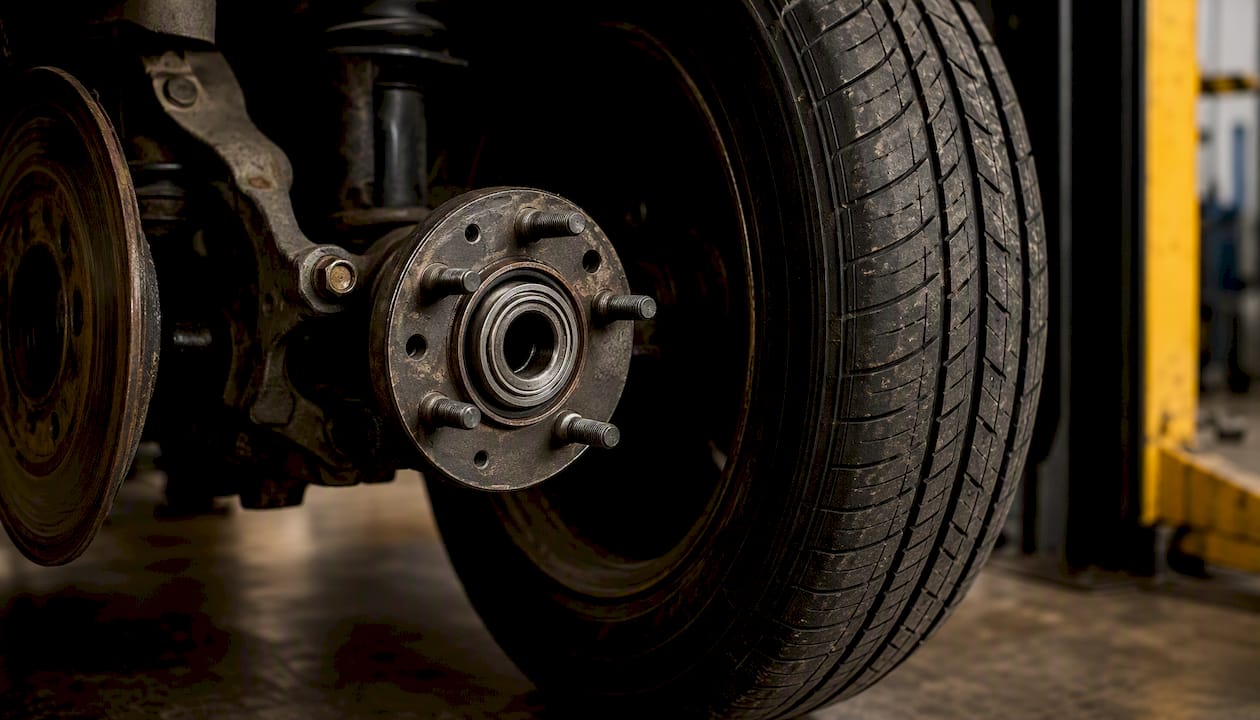
This is where wheel bearing and tire noise get confused most often. A wheel bearing produces a steady hum that rises and falls with vehicle speed, often most noticeable around 40 mph, and may shift in pitch when you gently change lanes or sway the steering. Tire noise, by contrast, tends to sound more rhythmic (a whap-whap pattern) and changes with road surface rather than speed alone. Urgency: wheel bearing noise is considered urgent depending on severity; tire noise usually requires routine attention unless a serious tire issue is visible.
8. Thumping or thudding
Most likely cause: a flat spot on a tire (common after a car sits for weeks), an out-of-balance tire, or a failing shock absorber. A rhythmic thump that matches wheel rotation points to the tire; a random thud over bumps points to suspension. Urgency: routine to next-day.
9. Clunking over bumps
Most likely cause: worn sway bar end links, loose ball joints, or worn strut mounts. A single clunk from the front when hitting a pothole is a classic sway bar end-link symptom. Urgency: next-day; worn ball joints can become urgent if play is severe.
10. High-pitched squeal at startup
Most likely cause: a slipping or worn accessory belt (serpentine belt). The squeal usually fades after the engine warms up. Urgency: routine, but don’t ignore it — a snapped serpentine belt disables the alternator, power steering, and water pump simultaneously. Check for alternator-related warning signs if the squeal is accompanied by a battery warning light.
11. Popping or backfiring
Most likely cause: ignition timing issues, a misfiring cylinder, or a failing catalytic converter. Urgency: next-day. A single pop on deceleration can be normal on some vehicles; repeated popping is not.
12. Whining that follows engine RPM
Most likely cause: power steering pump (especially on older hydraulic systems), alternator bearing, or a failing transmission pump. Urgency: next-day. A whine that rises with RPM and disappears at idle is a strong indicator of a pump or bearing issue rather than a tire or road-speed problem.
2. Simple tests to figure out where the noise is coming from
Narrowing the source before you arrive at a shop saves diagnostic time and, often, money. These checks are safe to perform in a quiet parking lot or on a low-traffic road.
-
Change speed gradually. Accelerate from 20 to 60 mph and listen. Does the noise follow engine RPM (it changes when you rev in neutral) or vehicle speed (it changes only when the wheels are turning)? RPM-linked sounds point to engine accessories, belts, or valve train. Speed-linked sounds point to wheel bearings, tires, or driveline.
-
Coast with the engine in neutral. If the noise disappears when you put the car in neutral and coast, the engine or transmission is likely involved. If it continues, the source is probably wheel-end or tire-related.
-
Brake gently, then firmly. A noise that appears only under braking narrows the field to brakes, rotors, or wheel bearings (which can also load up under braking). A noise that disappears when you brake lightly may be a loose component that gets dampened by the weight transfer.
-
Turn left and right at low speed. A clicking or clunking that appears only when turning points to CV joints (front-wheel drive), tie rod ends, or sway bar links. Wheel bearing noise often changes pitch when you sway the wheel gently at highway speed, because the load shifts from one bearing to the other.
-
Let the car idle with the hood open. A hiss, squeal, or rattle at idle with the car in park points to the engine bay: belts, pulleys, vacuum lines, or cooling system. Rev the engine gently to 2,000 RPM and listen for changes.
-
Check the decision tree:
- Does the noise change with steering input? → Wheel bearing or CV joint.
- Does it change with vehicle speed only? → Tires or wheel bearing.
- Does it change with braking? → Brakes or brake-loaded bearing.
- Does it follow engine RPM regardless of speed? → Engine accessories, belt, or valve train.
Pro Tip: Park on level ground with the parking brake fully set before opening the hood or walking around the vehicle. Never crawl under a car on a public road or soft ground.
If the noise is accompanied by brake fade, a sudden loss of steering response, or visible smoke, stop the self-tests immediately and call for a tow. A loud noise combined with a handling change is a stop-driving condition.
3. Which noises mean you should stop driving right now
Some sounds are warnings; others are emergencies. The difference matters because driving on a failing brake or a knocking engine can turn a $400 repair into a $2,000 one, or worse.
Stop driving immediately if you hear:
- Metal-on-metal grinding from the brakes. This means pad material is gone and the caliper bracket is contacting the rotor directly. Stopping distance increases and rotor damage accelerates with every mile.
- A loud, rhythmic engine knock. Rod knock or a spun bearing means internal engine damage is occurring in real time. Continuing to drive risks catastrophic engine failure.
- A sudden clunk followed by loss of steering control. This can indicate a broken tie rod, a failed ball joint, or a separated CV axle. Pull over immediately.
- Hissing with a rising temperature gauge or steam from the hood. Overheating can warp the cylinder head within minutes of the gauge entering the red zone.
- Any noise accompanied by a brake pedal that goes to the floor. This is a brake hydraulic failure and the car should not move under its own power.
If the noise is serious but not an immediate-stop condition:
- Drive slowly (under 35 mph) to the nearest shop without highway driving.
- Avoid hard braking and sharp turns.
- Call ahead so the shop can prepare for your arrival.
Pro Tip: If you’re unsure whether to drive or tow, tow. A tow truck costs far less than the repair bill from driving a failing component another five miles.
4. What a shop will do and what repairs typically cost in the U.S.
When you bring a noisy car to a shop, the diagnostic process usually starts with a road test to reproduce the sound, followed by a visual inspection and targeted component checks. For engine-related noises, an OBD-II scan can reveal fault codes that point directly to the system involved. Shops typically charge a diagnostic fee for this work, which may be applied toward repair costs if you proceed with the work.
The table below shows common noise-related repairs, typical U.S. price ranges, and approximate time in the shop. These are ballpark figures that vary by vehicle make, model, year, and region.
| Repair Type | Typical U.S. Price Range | Typical Shop Time |
|---|---|---|
| Brake pad replacement (axle) | $150 | 1–2 hours |
| Brake pad + rotor replacement (axle) | $300 | 2–3 hours |
| Wheel bearing replacement | $250 per side | 1–3 hours |
| CV axle shaft replacement | $300 | 2–4 hours |
| Serpentine belt replacement | $100 | 30–60 minutes |
| Exhaust leak repair (pipe/manifold) | $150–$400 | 1–3 hours |
| Sway bar end links | $100 | 1–2 hours |
| Engine valve adjustment / top-end work | $200 | 2–5 hours |
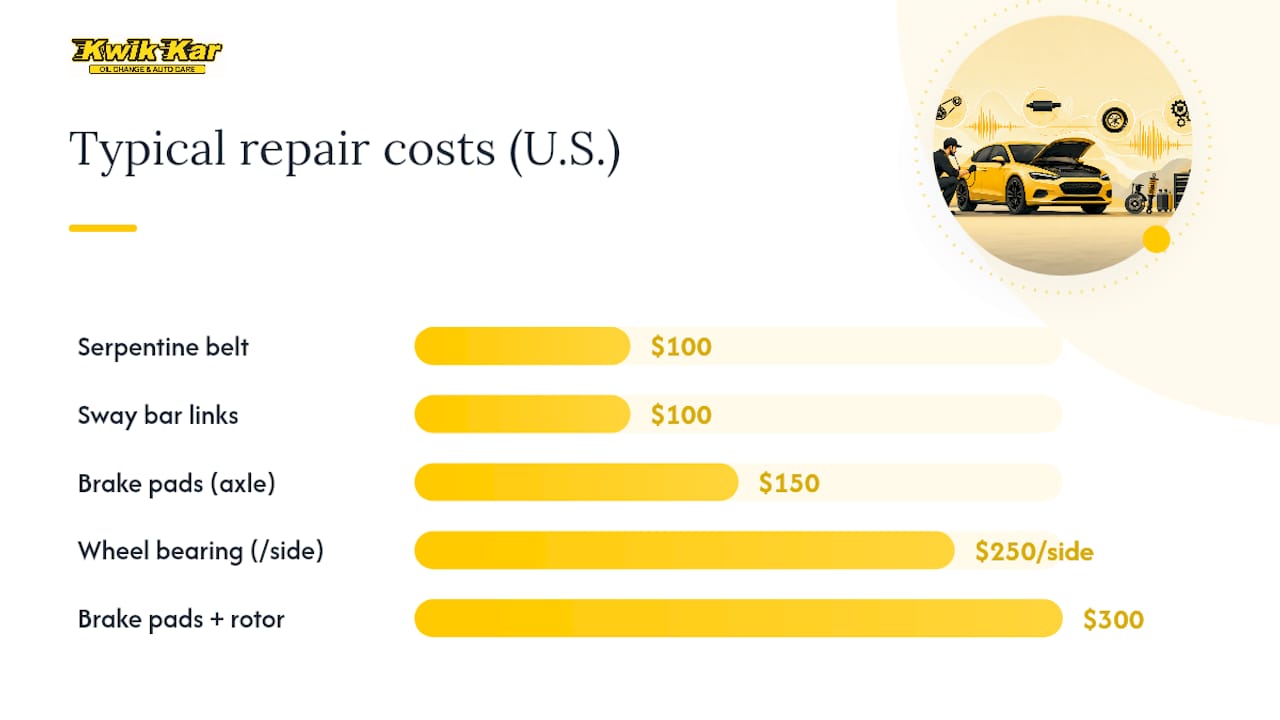
Prices are estimates for the U.S. market and will vary by vehicle and location. Always request a written estimate before authorizing work.
Always ask for a written estimate with parts and labor itemized, and confirm whether the shop offers a warranty on the repair. AAA recommends not delaying on brake and drivetrain noises specifically, because deferred repairs in those systems compound quickly.
5. How to record the noise and what to tell your mechanic
A 30-second video recorded on your phone can cut diagnostic time significantly. Mechanics who can hear the noise before the car arrives on the lift often skip straight to the likely system rather than starting from scratch.
- Record a short video with the phone placed on the seat or dashboard. Capture the noise while driving at the speed and condition where it occurs (braking, turning, highway cruise). Keep the windows up to reduce wind noise.
- Note the exact conditions: speed, whether you were braking or turning, road surface (smooth vs. rough), and whether the car was cold or warmed up.
- Write down your VIN (found on the driver’s side dashboard at the base of the windshield). This lets the shop pull your vehicle’s service history and recall status before you arrive.
- List recent repairs or impacts. A pothole hit last week or a brake job three months ago is directly relevant. Bring receipts if you have them.
- Note any dashboard warning lights, smells (burning rubber, exhaust, sweet coolant), or vibrations that accompany the noise.
Audio-diagnosis tools like FixMyCarSound can help you narrow possibilities before your appointment. The tool reports notable accuracy across multiple detectable conditions but exact figures are not verified. That’s a useful starting point, but it cannot check physical play in a wheel bearing, measure brake pad thickness, or read live OBD-II data — so treat it as a way to prepare better questions for your technician, not as a substitute for an in-person inspection.
Pro Tip: Bring a printed or digital copy of your service history. A technician who can see that your last brake service was 60,000 miles ago can prioritize the brake system immediately instead of spending time ruling it out.
6. Why a certified shop is the right next step for a noisy car
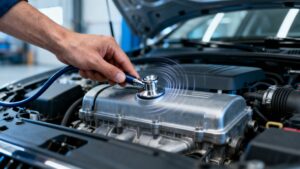
A certified shop does more than listen to your description. The diagnostic process at a quality shop typically includes a road test to reproduce the noise under the same conditions you described, a visual inspection of the brake system, belts, exhaust, and suspension, measured checks (bearing play, pad thickness, belt tension), and an OBD-II scan when a fault code is likely. That combination of steps isolates the system far more reliably than any single check alone.
The trust signals worth looking for when choosing a shop:
- ASE certification: Technicians who hold ASE credentials have passed standardized tests in specific repair categories. An ASE and RepairPal certified shop meets independent quality benchmarks beyond self-reported claims.
- Written estimates before work begins: A shop that hands you a written estimate with parts and labor itemized before touching your car is operating transparently.
- Warranty on repairs: A repair warranty tells you the shop stands behind its work.
Kwik Kar Oil Change & Auto Care employs ASE-certified technicians, provides written estimates before any repair begins, and backs its work with a repair warranty. For engine-related noise cases, the shop uses advanced engine diagnostic tools to isolate faults quickly and accurately.
For most common noise issues — brakes, wheel bearings, CV joints, exhaust, belts — a full-service shop handles the complete repair in one visit. OEM-level dealer diagnostics are worth considering only for noises tied to a known manufacturer defect or an active recall, which you can check at no cost through the NHTSA website.
7. What technicians wish you knew before bringing in a noisy car
The single biggest factor that slows down a noise diagnosis is vague information. “It makes a sound sometimes” gives a technician almost nothing to work with. “It clicks from the front left when I turn right at low speed, started two weeks ago, and gets louder in cold weather” cuts the diagnostic time in half.
A few things that consistently help:
- Share your video first. A technician who hears the noise before the car is on the lift can often identify the system before the road test even begins.
- Be specific about when it started and whether anything changed. A noise that appeared the day after a pothole is almost certainly suspension or wheel-end. One that appeared gradually over weeks is more likely wear-related.
- Don’t minimize it. Owners sometimes say “it’s probably nothing” to avoid a big bill. That instinct leads technicians to do a lighter inspection. Describe the noise accurately and let the tech make the call on severity.
Three quick actions that lead to faster, cheaper repairs:
- Bring a video recording of the noise under the exact conditions it occurs.
- Write down the speed, driving condition, and any recent maintenance or impacts.
- Arrive with your VIN and service records so the technician can skip the background research.
Kwik Kar Oil Change & Auto Care: fast diagnostics, clear pricing, and a straightforward next step
Hearing a strange noise and not knowing what it means is genuinely stressful. Kwik Kar Oil Change & Auto Care gives you a direct path from “I hear something” to “here’s what it is and what it costs to fix” without the runaround.
The shop handles the full range of noise-related repairs: brakes, wheel bearings, CV joints, exhaust, serpentine belts, engine diagnostics, and suspension work, all performed by ASE-certified technicians on both domestic and import vehicles. Every job starts with a written estimate so you can make an informed decision before any work begins. Bring your phone video, your VIN, and your service records, and the team can often move straight to the likely system rather than starting from zero.
Kwik Kar is recognized by RepairPal and NAPA AutoCare, two independent organizations that evaluate shops on quality and customer service standards. Current specials, including a $30 off maintenance service with free inspection, make it a smart time to get that noise checked before it becomes a larger repair.
Book a diagnostic at Kwik Kar Oil Change & Auto Care and get a clear answer on what your car is telling you.
Sources
The sources below were used to develop this guide. Bringing a printed or saved copy of any relevant article to your appointment can help your technician understand what you’ve already ruled out.
- 7 Car Noises You Should Never Ignore | GEICO
- Vehicle Noises You Should Never Ignore | AAA Club Alliance
- Tire Noise Vs. Wheel Bearing Noise: How To Tell The Difference
- Fix My Car Sound — Free AI Car Sound Diagnosis
FAQ
How do you identify unusual car noises quickly?
Match the sound (grinding, clicking, humming, knocking) to when it happens (braking, turning, idle, highway speed) to narrow the likely system. GEICO’s guidance recommends using that two-clue method as your first triage step.
Is there an app like Shazam for car noises?
FixMyCarSound is the closest equivalent, reporting top-1 accuracy of around 76% across 19 detectable conditions. It’s a useful starting point, but it can’t replace a physical inspection for high-risk faults like brake failure or rod knock.
What car noises signal something is seriously wrong?
Metal-on-metal brake grinding, a loud rhythmic engine knock, a sudden clunk with loss of steering, and hissing accompanied by a rising temperature gauge are all stop-driving conditions. AAA advises treating brake and drivetrain noises as urgent to avoid compounding damage.
What is commonly mistaken for wheel bearing noise?
Tire noise is the most frequent mix-up. A wheel bearing produces a steady hum that rises with vehicle speed and often shifts pitch when you change lanes; tire noise sounds more rhythmic and changes with road surface rather than speed. Testing both behaviors helps you tell them apart before visiting a shop.
How much does a car noise diagnostic typically cost in the U.S.?
Most shops charge a diagnostic fee, which typically includes a road test, visual inspection, and an OBD-II scan where applicable. Many shops apply that fee toward the repair cost if you proceed with the work.