



A brake fluid flush typically costs between $70 and $225 at a U.S. shop, with most drivers paying $100 to $200 depending on where they go and what their vehicle needs. Fluid itself is cheap; labor and shop overhead drive the price. Kwik Kar Oil Change & Auto Care offers ASE-backed flushes within that range if you’re ready to book.
TL;DR:
- Most U.S. shops charge between $100 and $225 for a brake fluid flush, with fluid costs only around $5 to $39 per quart, depending on the type.
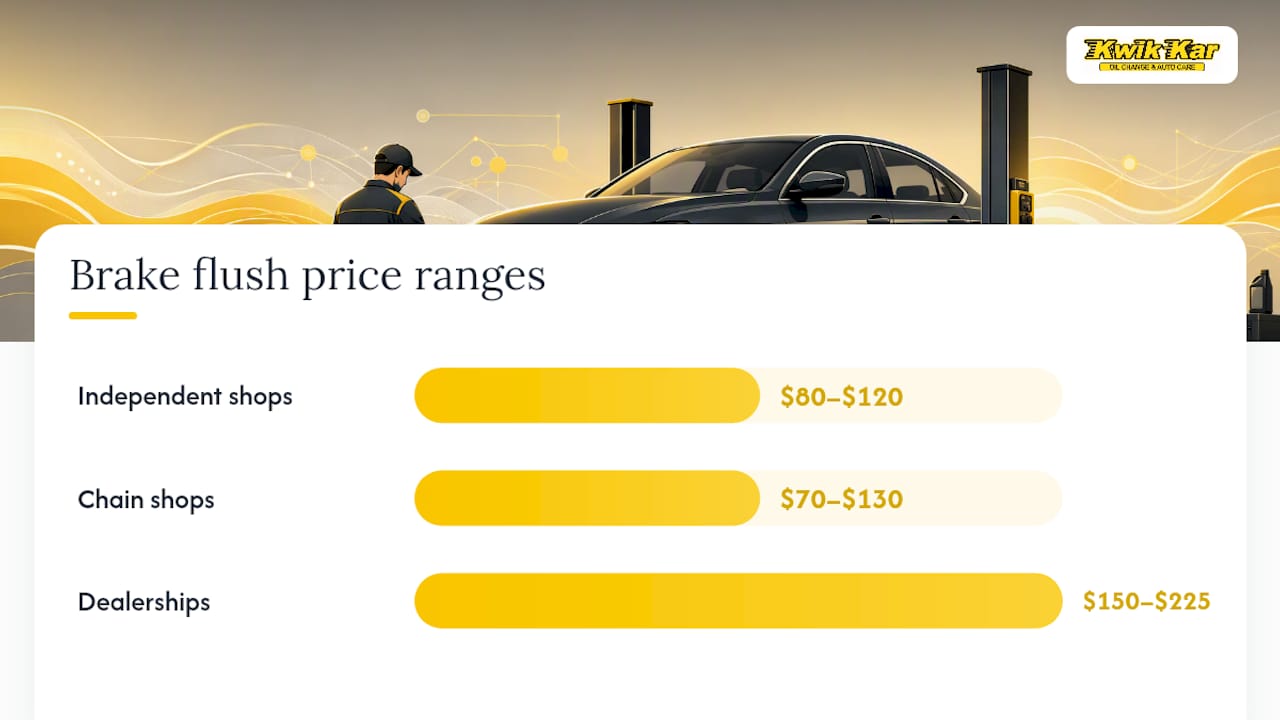
- Independent shops and chain stores usually ask $70 to $130, while dealerships often bill $150 to $225 due to OEM-spec fluids and additional services.
- A brake fluid flush is recommended every 2 to 3 years or sooner if the fluid looks dark or contaminated or if the brake pedal feels spongy.
- DIY flushes can be cheaper but risk trapping air or improper bleeding, making professional service necessary for modern vehicles with safety-critical electronic systems.
Table of Contents
- How Much Is a Brake Fluid Flush, By the Numbers?
- What Makes Brake Fluid Flush Prices Vary So Much?
- How Often Should You Flush Your Brake Fluid?
- Is a DIY Brake Fluid Flush Worth the Savings?
- What Should a Qualified Shop Include in Your Estimate?
- Cost Versus Safety: Where the Line Actually Is
- Book a Transparent Brake Fluid Flush With Kwik Kar
- Sources
- FAQ
How Much Is a Brake Fluid Flush, By the Numbers?
Shop quotes for a brake fluid flush cost cluster into three rough bands, and knowing which one applies to your car helps you spot a fair price versus a padded one. Most U.S. shops charge between $100 and $225 for a full brake fluid replacement, and that figure lines up closely with Carfax’s own estimate of roughly $100 to $160 for a typical passenger car.
The fluid itself rarely explains the bill. A quart of DOT 3 or DOT 4 fluid runs $5 to $39, and most cars only need about one quart to complete a flush, according to Carfax’s guidance. That leaves labor, shop supplies, and disposal fees carrying most of the cost. A standard flush usually takes 30 to 60 minutes of technician time, though vehicles with ABS or electronic stability control can push that closer to 90 minutes.
Here’s how that plays out across different vehicle types:
| Vehicle category | Typical total cost | Why |
|---|---|---|
| Economy sedan or hatchback (simple hydraulic system) | $70–$130 | Fast manual bleed, low fluid volume, minimal labor |
| Midrange car or crossover with ABS | $100–$170 | Standard bleed plus basic electronic module check |
| Luxury or performance model with complex ABS/ESC | $170–$225+ | Electronic bleeding required, often OEM-spec fluid |
Industry data backs this pattern up. MotorAudit’s cost breakdown shows mainstream models landing near $170 in typical examples, while European performance brands with dense ABS hardware often price higher because their systems demand scan-tool-guided bleeding rather than a simple pump-and-hold method.
A few things push a quote toward the high end:
- Four-wheel electronic bleeding instead of manual bleeding
- OEM-specified fluid rather than a generic DOT-rated equivalent
- A dealership’s shop rate versus an independent garage
- Additional caliper or line inspection bundled into the job
What Makes Brake Fluid Flush Prices Vary So Much?
Two cars with the same “brake fluid flush” line item on their invoice can end up $100 apart, and the reason almost always traces back to four variables.
Vehicle complexity tops the list. Older cars with simple hydraulic brakes need a straightforward manual bleed at each wheel. Newer vehicles with ABS and electronic stability control often require a scan tool to cycle the hydraulic control unit during the bleed, which adds both time and a fee for using diagnostic equipment.
Fluid type matters too. DOT 3 and DOT 4 fluids are widely available and inexpensive. DOT 5.1 and specialty high-temperature formulas, common on performance and European vehicles, cost more per quart and sometimes require a full system flush rather than a partial one.
Where you take the car shapes the bill more than almost anything else. MotorAudit’s data shows independent shops charging roughly $80 to $120, chain shops landing between $70 and $130, and dealerships commonly asking $150 to $225 for the same basic service. Dealers often justify the premium with OEM-spec fluid and paperwork that keeps a warranty intact, and some industry analysis notes independent shops can deliver equivalent technical results for less.
Local labor rates finish the equation. National averages hover around $120 to $159 per hour, and a city shop’s overhead rarely matches a rural garage’s.
Pro Tip: Ask for a written estimate that separates fluid cost from labor hours before the technician starts. If a shop won’t itemize it, that’s a signal to get a second quote.
How Often Should You Flush Your Brake Fluid?
Most manufacturers recommend a brake fluid flush every 2 to 3 years, though the right interval depends more on fluid condition than the calendar. Brake fluid is hygroscopic, meaning it absorbs moisture from the air over time, and that moisture lowers its boiling point and corrodes internal components from the inside out.
Fleet operators often shorten the interval and lean on measured condition instead of a fixed schedule, using boiling-point and moisture testing to decide exactly when a flush is due rather than guessing by mileage alone.
Signs you shouldn’t wait for the “official” interval:
- A brake fluid moisture test reads above 3% water content
- The fluid looks dark brown or cloudy instead of clear to light amber
- The brake pedal feels soft, spongy, or sinks lower than usual
- You tow heavy loads or track your car regularly
Skipping flushes doesn’t just risk a mushy pedal. Degraded fluid can cause ABS and hydraulic control unit valves to stick, turning a $150 maintenance item into a repair bill several times that size.
Is a DIY Brake Fluid Flush Worth the Savings?
A DIY flush can cost far less than a shop visit, but the savings come with real tradeoffs depending on your vehicle.
- Parts and tools. Expect to spend $10 to $40 on fluid alone, plus $15 to $50 for a basic one-person bleeder kit if you don’t already own one.
- Time investment. A manual two-person bleed on a simple hydraulic system takes about an hour. Doing it solo with a vacuum bleeder often takes longer.
- Risk factors. Trapped air in the lines causes a soft pedal, and any vehicle with ABS may need a scan tool to cycle the module correctly, something most home garages don’t have.
- When DIY makes sense. Older cars without ABS, and drivers comfortable bleeding brakes correctly, can reasonably handle this at home.
- When to call a shop. Any modern vehicle with ABS or ESC, or any driver unsure about proper bleed sequence, is better served paying for professional service.
What Should a Qualified Shop Include in Your Estimate?
A trustworthy estimate for a brake fluid flush lists exactly what you’re paying for, not just a single line item and a total.
Look for ASE-certified technicians performing the work; that credential means the person under your car has passed standardized testing on brake systems specifically. Shops recognized by RepairPal and NAPA AutoCare have also cleared a third-party quality bar, which is worth asking about if you’re comparing unfamiliar garages.
A solid written estimate should specify:
- The exact fluid type used (DOT 3, DOT 4, or OEM-spec)
- Labor hours and whether ABS bleeding is included
- Any moisture or boiling-point test results performed before the flush
- Turnaround time, typically same-day for most vehicles
- Warranty terms covering the parts and labor performed
Kwik Kar’s brake repair page outlines what’s included in a standard visit, and asking for that level of detail before work begins is a reasonable expectation at any reputable shop.
Cost Versus Safety: Where the Line Actually Is
The honest answer is that fluid age matters more than the price tag. If a moisture test shows contamination, or your car runs ABS and ESC, paying for a flush now is cheaper than an HCU repair later. Get quotes from both an independent shop and a dealer for the same fluid spec before deciding, and always ask what certifications the technician holds.
— Kwik Kar
Book a Transparent Brake Fluid Flush With Kwik Kar
Kwik Kar Oil Change & Auto Care runs brake fluid flushes with ASE-certified technicians who test your fluid’s condition before recommending anything, so you’re never paying for a service you don’t need yet.

A typical visit includes fluid replacement matched to your manufacturer’s spec, a full bleed of the system (electronic bleeding included for ABS-equipped vehicles), and a written estimate before any work starts. You can lower your out-of-pocket cost with the current brakes discount, and if you’re weighing a flush against other line items on a quote, the guide to overpriced repair services is worth a look first. Visit the full auto repair services page to see turnaround times and schedule a visit; most brake fluid flushes are completed same-day, backed by a service warranty you can ask about at drop-off.
Sources
- Carparts
- Brake Fluid Flush Cost: Explained With Chart – MotorAudit
- How Much Does a Brake Fluid Change Cost? – Carfax
FAQ
How much should I pay for a brake fluid flush?
Expect to pay $70 to $225 depending on your vehicle and where you go, with most drivers landing in the $100 to $200 range for a standard flush.
Is a brake flush really worth it?
Yes. Degraded fluid absorbs moisture that can corrode ABS and hydraulic control unit components, turning a routine service into a much larger repair if ignored.
How much does a quick-service chain charge to flush brake fluid?
Chain shops typically charge $70 to $130 for a brake fluid flush, generally less than dealership pricing but comparable to many independent garages.
At what mileage should you do a brake fluid flush?
Most manufacturers recommend flushing brake fluid every 2 to 3 years regardless of mileage, though a moisture test or dark, contaminated fluid can signal it’s due sooner.
Does Kwik Kar offer brake fluid flush services?
Yes, Kwik Kar Oil Change & Auto Care performs brake fluid flushes using ASE-certified technicians and provides a written estimate before starting any work.