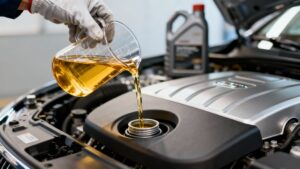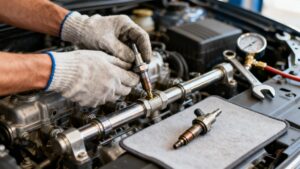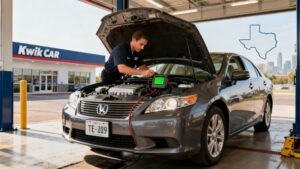




A flashing check engine light means your engine is actively misfiring and dumping unburned fuel into the exhaust system, which can destroy your catalytic converter within minutes. Pull over safely as soon as you can, shut off the engine, and avoid heavy acceleration or towing under load. The sections below walk through the likely causes, how to decide between limping to a shop or calling a tow truck, and the exact diagnostic sequence a qualified technician will run.
TL;DR:
- A flashing check engine light indicates an active misfire that can cause catalytic converter damage within minutes, requiring immediate action.
- The onboard diagnostic system flashes the warning when misfire rates exceed a threshold designed to protect the catalytic converter, unlike a steady light which signals a stored fault.
- Common causes include ignition coil failure, fouled spark plugs, fuel delivery issues, and mechanical engine failures, all of which generate specific symptoms and trouble codes.
- If the misfire persists after restarting and you notice fuel smells, smoke, or rough engine operation, towing is recommended rather than driving further.
- A proper diagnosis involves a sequence of code reading, coil swapping, spark plug inspection, fuel trim analysis, and possibly compression testing to precisely identify the problem.
Table of Contents
- Flashing Versus Solid: Why a Blink Is an Emergency
- Common Causes That Trigger a Flashing CEL
- Immediate Steps to Take Right Now
- Should You Limp Home, Drive to a Shop, or Call a Tow?
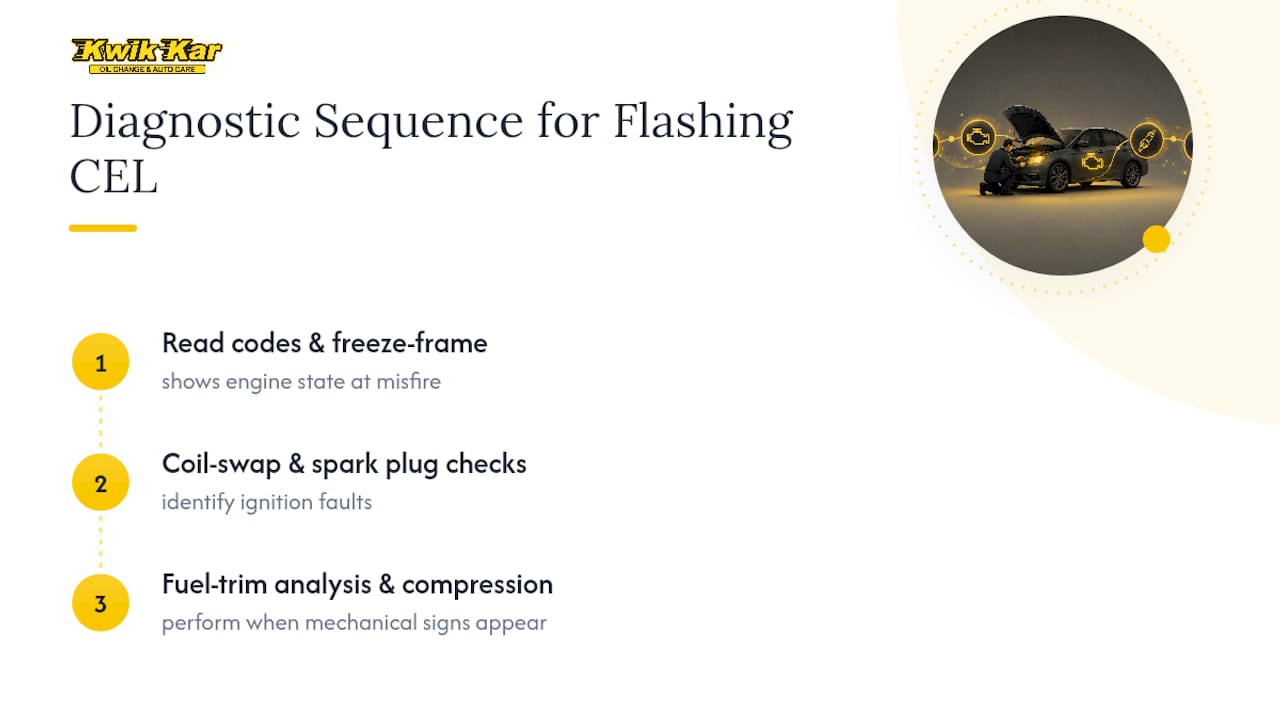
- What a Shop Checks First: the Diagnostic Sequence
- Why a Qualified Shop Matters for Advanced CEL Diagnosis
- The Real Lesson Behind a Flashing Light
- Get Your Flashing Check Engine Light Diagnosed Today
- Sources
- FAQ
Flashing Versus Solid: Why a Blink Is an Emergency
A solid check engine light and a flashing one are not the same warning, and treating them the same way is how a $200 repair turns into a $2,000 one. The onboard diagnostic system, known as OBD-II, is programmed to flash the malfunction indicator lamp specifically when the misfire rate crosses a threshold that engineers calculate will cause catalyst damage. Below that threshold, the computer stores the fault and lights the lamp steady. Above it, the lamp flashes because raw fuel is reaching the exhaust and igniting inside the catalytic converter itself.
- Steady light: A stored fault exists, but the car usually remains safe to drive to a shop within a reasonable time.
- Flashing light: An active misfire is happening right now, and every mile you drive compounds the damage.
The engine’s computer tracks freeze-frame data at the exact moment of the misfire, including RPM, load, and coolant temperature, which is exactly the information a technician needs first.
Common Causes That Trigger a Flashing CEL
Most flashing check engine lights trace back to one of four categories: ignition, fuel delivery, spark quality, or a mechanical fault deep in the engine. Knowing which symptoms point where helps you describe the problem accurately when you call for help.
- Ignition coil failure: A sudden, single-cylinder misfire that often shows up first in wet or cold weather. Coil-on-plug failures are a leading cause of sudden flashing lights, and oil pooling in the plug wells accelerates the breakdown.
- Fouled or oil-contaminated spark plugs: Rough idle and hesitation that often trace back to worn valve stem seals or piston rings letting oil reach the combustion chamber.
- Fuel delivery problems: A stuck-open injector or a failing fuel pump causes misfires that get worse under load or during hard acceleration.
- Mechanical failures: Low compression, a blown head gasket, or a stretched timing chain produce persistent misfires that don’t clear up after ignition or fuel components check out fine.
Watch for these symptom cues: a fuel smell inside or outside the cabin, white or black smoke from the tailpipe, engine roughness you can feel through the steering wheel, or a sudden loss of power. Any one of these paired with a flashing light means the situation is not something to drive through. Diagnostic trouble codes point technicians toward the right category fast. P0300 through P0308 flag cylinder-specific or random misfires, while P0171 and P0174 point to lean fuel conditions that often ride along with multi-cylinder misfires.
Immediate Steps to Take Right Now
The order you take these steps in matters almost as much as taking them at all. Each one is designed to reduce heat and stress on the catalytic converter while you get to safety.
- Ease off the throttle immediately. Downshift gently and reduce engine load rather than braking hard.
- Get off the road as soon as it’s safe. Pull into a parking lot or wide shoulder, not the travel lane.
- Turn off the engine and wait about five minutes. This lets exhaust temperatures drop before you decide your next move.
- Assess before restarting. If the light goes steady and the engine smooths out, you may be able to drive a short distance, no more than two or three miles, at low RPM to reach a shop.
- Call for a tow if anything feels wrong. A fuel smell, visible smoke, or a rough-running engine after restart means don’t attempt to drive.
Pro Tip: Never let the car idle in a closed garage or enclosed space while you’re troubleshooting a flashing light. A misfiring engine can push excess unburned fuel and carbon monoxide into the exhaust faster than normal, and you want ventilation, not a sealed space, while you wait it out.
Should You Limp Home, Drive to a Shop, or Call a Tow?
This is the decision that actually protects your wallet. Get it wrong and you risk turning an ignition coil replacement into a catalytic converter replacement.
Call for a tow when any of these apply:
- The light is still flashing after you restart the engine.
- You smell fuel or see smoke from under the hood or the tailpipe.
- The misfire feels severe, or the engine surges or hesitates badly.
- You’re more than 10 miles from a shop or your home.
Limited driving may be reasonable only when the misfire lightens up or the light goes solid after a restart, the shop is close by, and you can keep RPM and load very low the entire way. Shops generally recommend towing whenever the distance to a qualified repair facility runs more than a few miles, because towing cost is almost always cheaper than a new catalytic converter. At highway speed, a severe flashing misfire can push exhaust temperatures past 1,500 to 2,000 degrees Fahrenheit in a matter of minutes, which is more than enough to melt the converter’s internal honeycomb structure.
What a Shop Checks First: the Diagnostic Sequence
A technician who jumps straight to swapping parts is guessing. A proper diagnosis follows a sequence that narrows the cause before a single part gets replaced.
- Pull stored and pending OBD-II codes, plus freeze-frame data. This step alone often narrows the search to a specific cylinder or system before any tool touches the engine.
- Run a coil-swap test and inspect the spark plugs. Swapping a suspect coil to a different cylinder confirms or rules out ignition failure in minutes.
- Check injector balance and fuel trims. Long-term fuel trim, or LTFT, readings combined with mass airflow sensor data reveal whether a lean condition or a bad injector is behind the codes.
- Run a compression test when mechanical failure is suspected. Low or uneven compression across cylinders points toward a head gasket or timing issue that no ignition part will fix.
Reading ECU misfire thresholds correctly at the start of this sequence is what keeps a diagnostic visit from turning into a parts-replacement guessing game. Misfires tied to highway speed or load often only show up under those same conditions, so technicians sometimes need to reproduce your exact driving scenario to catch an intermittent fault.
Why a Qualified Shop Matters for Advanced CEL Diagnosis
Guessing at parts is how simple misfires turn into expensive repeat visits. Kwik Kar Oil Change & Auto Care’s ASE-certified technicians work through the same ordered sequence outlined above: codes and freeze-frame data first, then coil-swap and spark plug checks, then fuel-trim analysis and compression testing when the mechanical signs point that way.
When you bring your vehicle in for a flashing check engine light, expect a freeze-frame readout that shows exactly what the engine was doing when the misfire hit, a written estimate before any repair work starts, and a clear explanation of your options. Kwik Kar Oil Change & Auto Care’s recognition from organizations like RepairPal and NAPA AutoCare, combined with available service coupons and fast turnaround times, means you get answers without guesswork tacked onto your bill.
The Real Lesson Behind a Flashing Light
Most drivers treat every dashboard light the same way: annoying, but not urgent. That instinct is exactly backward for a flashing check engine light, and it’s the single biggest reason otherwise minor repairs balloon into catalytic converter replacements.
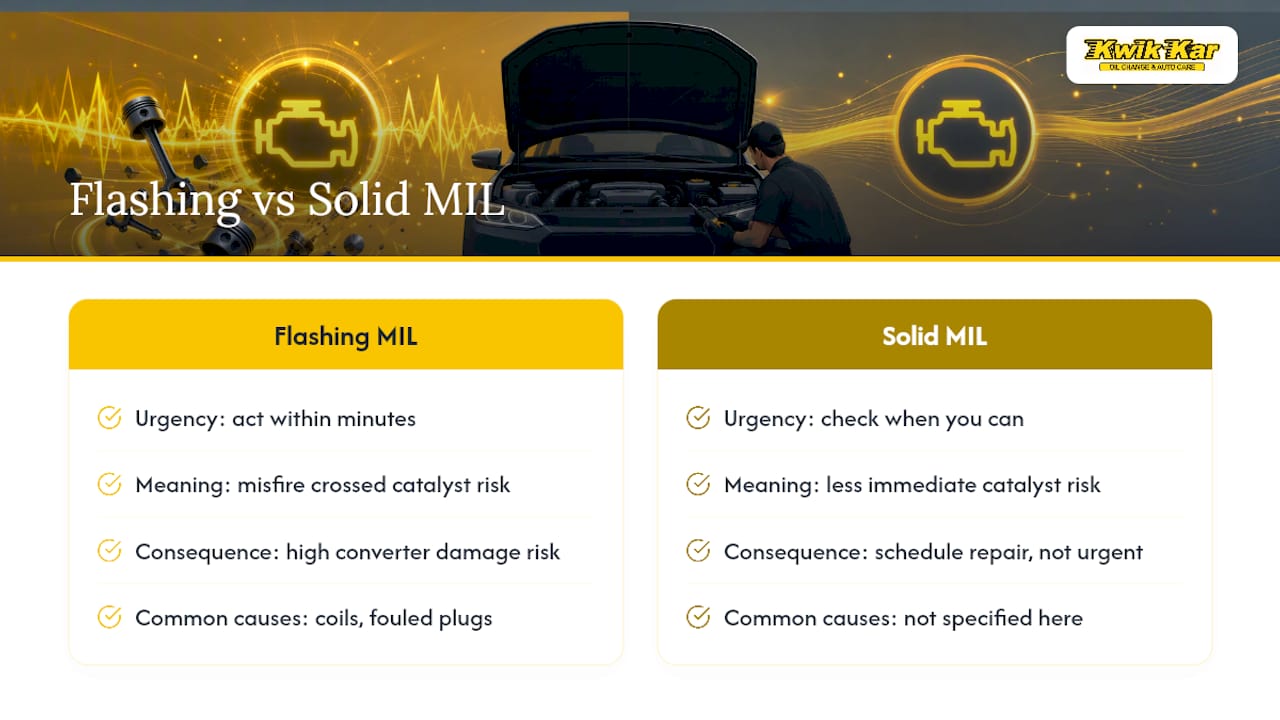
The conventional advice to “get it checked when you can” works fine for a solid light. It’s dangerous advice for a flashing one. The research is consistent on this point: a flashing MIL means the misfire rate has already crossed the threshold engineers built into OBD-II specifically to flag catalyst risk. That’s not a warning to schedule around your week. It’s a signal to act within minutes, not days.
What the data also makes clear is that the fix is rarely as expensive as drivers fear, if they act fast. Ignition coils and fouled plugs cause a large share of these emergencies, and both are inexpensive compared to a converter. The mistake isn’t the misfire. It’s continuing to drive on it because the car “still runs fine.”
— Kwik Kar
Get Your Flashing Check Engine Light Diagnosed Today
Once you’re safely parked or towed in, the fastest way to stop guesswork is a technician who runs the full diagnostic sequence instead of swapping parts on a hunch. Kwik Kar Oil Change & Auto Care’s advanced check engine light service covers freeze-frame analysis, coil-swap testing, fuel-trim checks, and compression testing under one visit, with a written estimate before any repair begins.
When you call or bring your vehicle to our Spring Valley Road location in Dallas, have a few details ready: any codes your own scanner pulled if you have one, when the flashing started, whether you noticed a fuel smell or smoke, and how the engine has been running since. That information alone can shave real time off the diagnosis. If your vehicle needs work beyond the initial check, ask about our mechanical repair coupon to save on the fix. Our full auto repair services team is ready to get you back on the road safely, with clear pricing and no surprise add-ons. Call ahead or stop by to schedule your engine diagnostic now.
Sources
- Flashing Check Engine Light: What to Do Now
- How Long Does It Take a Misfire to Damage the Catalytic Converter? Risk Guide
- Check Engine Light Flashing – DiagGarage
- Check Engine Light Flashing vs Solid: What to Do (2026 Mechanic Guide)
FAQ
Can I Drive My Car With the Check Engine Light Blinking?
Driving is risky. A flashing light means an active misfire, and continued driving, especially at highway speed, can destroy the catalytic converter within minutes. Reduce engine load, pull over safely, and have the vehicle towed if the light stays flashing after restart.
What Is the Most Common Cause of a Flashing Check Engine Light?
Ignition coil failure is one of the leading causes, particularly on coil-on-plug engines, and it often shows up suddenly in wet or cold weather. Fouled spark plugs and lean-condition codes like P0171 or P0174 are close behind.
How Do You Fix a Flashing Engine Light?
A technician first pulls OBD-II codes and freeze-frame data, then runs a coil-swap test and inspects the spark plugs before checking fuel trims and compression. The fix depends on what that sequence finds, but it typically involves replacing a failed coil, fouled plugs, or a faulty injector.
Which Is Worse, a Blinking or a Solid Check Engine Light?
A blinking light is worse. It signals an active misfire that risks rapid catalytic converter damage, while a solid light usually means a stored fault that still allows limited driving to a shop for diagnosis.
Meta Title: Check Engine Light Flashing? What It Means & What to Do
Meta Description: A flashing check engine light signals an active misfire that can damage your catalytic converter fast. Learn the causes, red flags, and next steps.