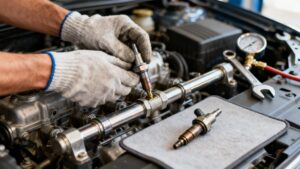




If the sound coming from your wheels is a hum or growl that gets louder with speed and shifts when you steer, you’re most likely dealing with a failing wheel bearing. Run the sway test and jack checks below to confirm which corner is at fault, and stop driving immediately if you feel play in the wheel or hear grinding, as these symptoms indicate urgent repair is needed.
TL;DR:
- A wheel bearing failing noise starts as a faint hum around 30 to 40 mph and worsens with speed, turning louder during tight turns.
- The sway test effectively pinpoints the faulty wheel by observing noise changes as the vehicle weaves left and right at speed.
- Driving with a loud growl or wheel play can cause further damage, including wheel wobble, ABS sensor faults, and increased repair costs.
- Wheel bearing repair usually costs between $150 and $400 per wheel, depending on whether a simple bearing or a full hub assembly is required.
- Proper diagnosis involves visual inspection, road tests, and confirming that the noise does not change with road surface or tire rotation.
Table of Contents
- What Wheel Bearing Noise Sounds Like and How It Progresses
- How to Diagnose Which Wheel Is Making Noise
- Wheel Bearing Noise vs. Tire Noise vs. Brake Noise
- When to Keep Driving, When to Limit Driving, and When to Tow
- Repair Options, Shop Expectations, and Typical Costs
- What a Professional Diagnosis Actually Looks Like
- What Causes a Wheel Bearing to Fail
- Preventative Maintenance Tips to Extend Bearing Life
- A Shop’s Honest Take on Bearing Noise Mistakes
- Schedule a Wheel Bearing Inspection at Kwik Kar Spring Valley
- Sources
- FAQ
What Wheel Bearing Noise Sounds Like and How It Progresses
Wheel bearing noise almost always starts quietly and gets worse. Drivers usually describe it with one of four words: hum, growl, rumble, or grinding. Each term roughly maps to a stage of wear, and knowing which one you’re hearing tells you how much time you have.
The defining trait is that the noise tracks with vehicle speed, not engine RPM. A failing wheel bearing typically produces a low-pitched, rhythmic growl or hum that grows louder as speed increases, and it often becomes noticeable somewhere between 30 and 40 mph. Rev the engine in park and the sound won’t change at all, which is one of the fastest ways to rule out an engine or belt issue.
The other tell is steering sensitivity. Bearings carry lateral load, so turning the wheel shifts weight onto one side of the hub. That’s why the noise often gets louder in a left turn if the right bearing is failing, and vice versa.
Typical progression looks like this:
- Faint hum around 30 to 40 mph, barely noticeable over road noise
- Growl or drone that’s audible at normal driving speeds and louder in turns
- Rumble that vibrates through the seat or steering wheel
- Grinding or clicking, often paired with looseness you can feel in the steering
Pro Tip: Keep a mental note of the speed where the noise first appears. If it used to start at 45 mph and now shows up at 25 mph, the bearing is deteriorating fast, not staying stable.
How to Diagnose Which Wheel Is Making Noise
Before you assume the worst, a few simple tests can narrow down the noisy corner. Do these only if the vehicle feels stable and there’s no grinding or wobble yet.
- Run the highway sway test. On an empty, straight road at a safe speed, gently weave the car left and right. If the noise gets louder swerving one direction, the lateral load test typically identifies the bad corner within seconds because loading that side amplifies the growl.
- Try a tire rotation. If your tires haven’t been rotated recently, swapping front to back is a low-cost way to see if the noise follows the tire or stays put. If it moves with the tire, suspect tread wear or a separated belt, not the bearing.
- Jack up each corner and check for play. With the wheel off the ground, grab it at the 12 and 6 o’clock positions and rock it. Then check at 3 and 9 o’clock. Any looseness at 12/6 usually points to a bearing problem, since jacking each corner to check for play at 12 and 6 o’clock is one of the most reliable hands-on diagnostics available to a driver without a lift.
- Spin the wheel by hand. With the wheel raised, spin it and listen and feel for grinding, catching, or roughness. A smooth, silent spin rules out that corner.
- Use a stethoscope or a long screwdriver as a listening aid. Placing the tip near the hub while a helper drives slowly, or while the wheel is spinning on a lift, isolates the sound to one specific hub rather than the whole undercarriage.
Front bearings are usually easy to isolate this way. Rear bearings are trickier. The sway test is very reliable for front wheels, but rear bearings often need a lift inspection and hand-spin comparison to pin down with confidence.
Stop testing and call a shop the moment you feel measurable play, notice the wheel wobbling, or hear grinding metal. At that point, DIY diagnosis has done its job.
Wheel Bearing Noise vs. Tire Noise vs. Brake Noise
Misdiagnosis is common because tire noise, brake noise, and bearing noise can all sound like a “hum” at highway speed. The differences show up once you know where to look.
Tire noise changes with road surface. Drive from smooth asphalt onto concrete or a chip-seal road, and tire noise will noticeably shift in pitch or volume. Bearing noise mostly ignores the road surface; tire noise typically changes with road texture while wheel bearing noise stays fairly constant across surfaces and instead changes with steering input. That single test, driving over two different surfaces at the same speed, eliminates a lot of guesswork.
Brake noise tends to be a squeal, click, or grinding tied to pedal pressure, not steering. Drivetrain noise (CV joints, differential) often shows up as a clicking sound specifically during turns at low speed, rather than a steady hum that builds with highway speed.
- Tire noise: louder on rough pavement, unaffected by steering direction
- Bearing noise: steady across surfaces, changes when you turn
- Brake noise: tied to braking, often a squeal or grinding at low speed
- CV joint or drivetrain noise: clicking specifically in tight, slow turns
| Symptom | Most likely cause | Confirming test |
|---|---|---|
| Hum grows on rough road, fades on smooth road | Tire wear or defect | Road-surface comparison test |
| Hum steady on all surfaces, louder in one turn direction | Wheel bearing | Sway test plus jack check |
| Squeal or grinding when braking | Brake pads or rotors | Apply brakes gently, listen for change |
| Clicking only in slow, sharp turns | CV joint | Turn wheel fully in a parking lot at low speed |
If the ABS light is on along with the noise, that’s a separate clue worth checking, since a damaged bearing can knock out the wheel speed sensor it houses.
When to Keep Driving, When to Limit Driving, and When to Tow
Not every bearing noise means pull over immediately, but every bearing noise deserves a timeline. Technicians generally recommend addressing early-stage humming within weeks, repairing measurable play within days, and stopping immediately once grinding appears.
- Faint hum, no play felt: Drive normally but schedule an inspection soon; don’t wait months.
- Noticeable growl plus play at 12/6: Limit driving to short, careful trips and get it inspected within days.
- Grinding, wobble, or the wheel feels loose: Stop driving. Call for a tow rather than risking the drive to a shop.
Ignoring a grinding bearing doesn’t just risk a bigger repair bill. It can progress to wheel wobble, ABS sensor faults, CV axle damage, and in the worst case, wheel seizure or separation while the car is moving. If you must move the vehicle even a short distance, keep speeds low and avoid hard turns toward the affected side.
Repair Options, Shop Expectations, and Typical Costs
Most modern vehicles use one of two bearing designs, and the difference affects both labor time and price. Older or simpler setups use a press-fit bearing that gets pressed into the hub separately. Most newer vehicles use a bolt-on hub assembly, where the bearing, hub, and often the ABS speed sensor come as one sealed unit that bolts directly to the knuckle.
A trustworthy inspection should check and document more than just “yes, it’s the bearing.” Expect a shop to verify:
- Measurable play at the hub under load
- Heat coming off the hub after a short test drive (a sign of internal friction)
- Whether ABS sensor codes are present or the wiring is intact
- Which corner or corners are affected, not just the one you suspect
On typical U.S. jobs, wheel bearing repair commonly runs in the ballpark of $150 to $400 per wheel, though that range climbs when a hub assembly with an integrated ABS sensor is required or when a neglected bearing has already damaged the CV axle. Costs vary by vehicle and by how far the failure has progressed, so ask for a written estimate with the expected replacement part type before any work starts, and request photos or video of the actual worn part if the shop offers digital inspections.
What a Professional Diagnosis Actually Looks Like
A DIY sway test gets you most of the way to an answer. A shop visit closes the gap with tools and training you don’t have in your driveway. ASE-certified technicians typically combine a road test, a lift inspection, and a stethoscope check to confirm exactly which hub is failing before recommending a repair.
Here’s what to ask for at any shop, including ours:
- A written estimate before any work begins, not a verbal ballpark
- Photos or video of the worn bearing, play measurement, or heat reading
- Clear documentation of which corner failed and why
- Warranty terms on the replacement part and labor
Pro Tip: If a shop can’t show you the worn part or explain the specific test that confirmed the diagnosis, ask more questions before authorizing the repair.
What Causes a Wheel Bearing to Fail
Bearings wear out from friction over time, but several factors speed that up. Ordinary mileage accumulation is the baseline cause. Every bearing has a rated service life, and constant rolling friction under the vehicle’s weight eventually wears down the internal races and rollers no matter how carefully you drive.
Water and road contamination push failure earlier. Bearings are sealed, but seals degrade, and Texas downpours combined with standing water on Dallas roads can push moisture past a worn seal. Once water gets in, it washes out lubricating grease and starts corrosion inside the hub, which turns a smooth roll into the growl described earlier.
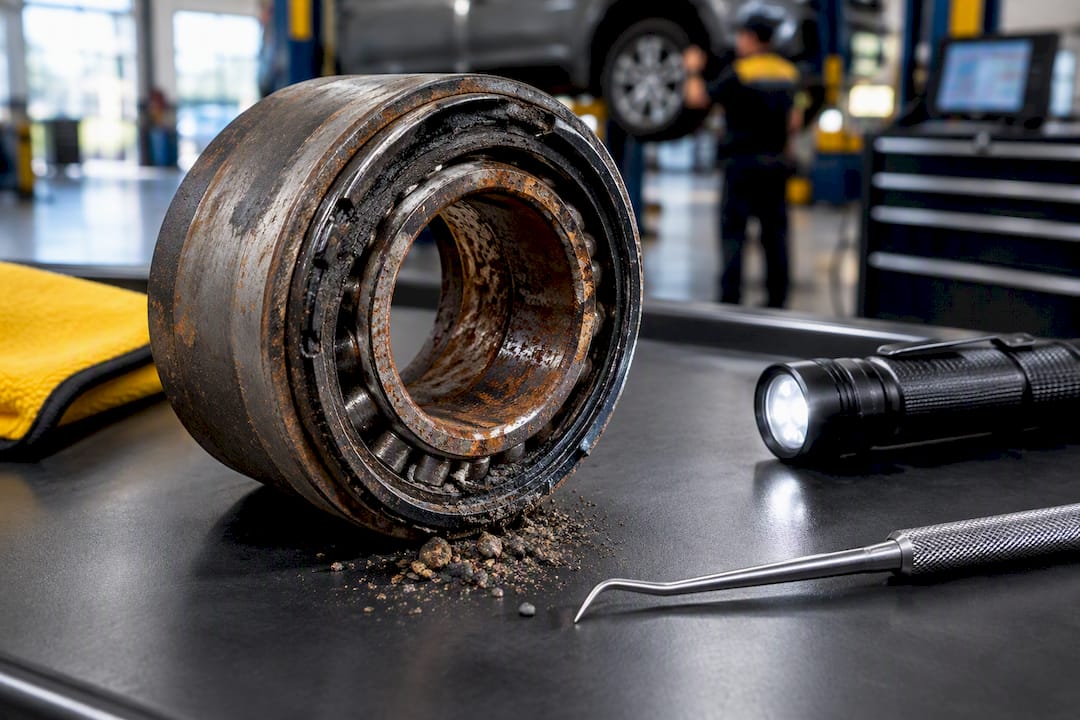
Impact damage is another major factor. Hitting a deep pothole, curbing a wheel hard, or driving through construction debris can shock-load a bearing even if nothing looks bent from the outside. That kind of hidden damage often shows up as noise weeks or months after the actual impact, which makes it easy to forget the pothole was the real cause.
A few other risk factors worth knowing:
- Aggressive driving: Hard cornering repeatedly overloads one side of the bearing
- Poor-quality aftermarket parts: Lower-grade bearings tend to fail sooner than OEM-spec parts
- Improper installation: A bearing pressed in unevenly wears unevenly, sometimes within months
- Towing or overloading: Extra weight adds stress that the bearing wasn’t rated to handle long term
Preventative Maintenance Tips to Extend Bearing Life
Bearings aren’t a scheduled maintenance item the way oil is, but a few habits genuinely stretch their lifespan.
Rotate your tires on a regular schedule. Beyond even tread wear, rotation gives a technician a routine opportunity to spin each wheel by hand and catch early bearing roughness before it turns into a full growl.
Address suspension problems quickly. Worn control arm bushings or struts let the wheel move more than it should, and that extra movement transfers stress directly into the bearing. Fixing a minor suspension issue early protects the bearing behind it.
Avoid deep potholes and curbs when you can, and get the wheel checked after any hard impact even if the car seems to drive fine afterward. A quick post-impact inspection is far cheaper than discovering hidden bearing damage six months later.
- Keep up with routine tire rotations and inspections
- Fix suspension noise or looseness promptly instead of waiting
- Have wheels checked after hitting a significant pothole or curb
- Ask your technician to hand-spin each wheel during routine service
- Don’t ignore a faint hum just because it’s not loud yet
A Shop’s Honest Take on Bearing Noise Mistakes
The most expensive mistake we see is simple: drivers wait. A faint hum gets dismissed as “just road noise” for months until it turns into a grinding, four-figure repair involving a damaged CV axle. The second most common mistake is misdiagnosing tire noise as a bearing and paying for a replacement that doesn’t fix anything.
Before your next visit, run the sway test, note when the noise started and at what speed, and write down your VIN and any recent tire or suspension work. That five minutes of prep gets you a faster, more accurate diagnosis.
— Kwik Kar
Schedule a Wheel Bearing Inspection at Kwik Kar Spring Valley
A hum that’s getting louder isn’t a problem to guess your way through, and it’s not one you should have to pay to have diagnosed twice. A professional auto care center runs an active road test, a lift inspection with play checks at 12/6 and 3/9, and a stethoscope confirmation before recommending any repair, and every job comes with a written estimate before work begins.
Our ASE Certified Master technicians document what they find with digital photos and video, so you see the actual worn bearing instead of taking someone’s word for it. Repairs are backed by a 24 month or 24,000 mile warranty, and we handle everything from a single hub replacement to a full suspension and brake inspection if the noise turns out to be something else entirely. If you’re also noticing uneven tread while you’re at it, ask about our tire coupon when you book.
Visit our full auto repair services page to see everything we cover, or call ahead to schedule a diagnostic at our Spring Valley Road location in Dallas. Request a written quote and inspection photos before any repair moves forward, that’s standard practice here, not an upsell.
Sources
- Wheel Bearing: How Do I Know if I Need a Replacement? – Kelley Blue Book
- Can You Drive With A Bad Wheel Bearing? Honest Mechanic Advice | The Motor Guy
- How to Tell Which Wheel Bearing Is Bad in Six Simple Steps – Tire Advise
- Wheel Bearing Failure Driving Is Extremely Dangerous – CarXplorer
FAQ
What does a wheel bearing sound like when it’s going bad?
A failing wheel bearing usually sounds like a low hum, growl, or rumble that grows louder as your speed increases, often starting between 30 and 40 mph. The noise typically gets louder when you turn one direction and quieter the other, since turning shifts load onto one bearing.
Is it safe to drive with wheel bearing noise?
It depends on the stage. A faint hum with no play felt in the wheel is usually safe to drive on short trips while you schedule a repair, but grinding noise or measurable wheel play means you should stop driving and call for a tow rather than risk wheel seizure.
How much does it cost to fix a wheel bearing?
Wheel bearing repair in the U.S. commonly falls in the $150 to $400 per wheel range, though cost rises if a full hub assembly with an integrated ABS sensor is needed or if delayed repair damaged nearby parts. A reputable auto care center provides a written estimate with the exact part and price before any work starts.
How can I tell which wheel bearing is bad?
The most reliable method is a highway sway test: gently weave the car and listen for which side gets louder, since the lateral load test typically identifies the bad corner within seconds. Jacking each corner to check for play at 12 and 6 o’clock and hand-spinning the wheel confirms the finding.
How do I know if it’s a bad bearing and not just tire noise?
Drive over two different road surfaces at the same speed. Tire noise changes with road texture, while bearing noise stays fairly constant across surfaces and instead changes with steering input. A tire rotation is also a low-cost way to check, since noise that follows the tire to a new position points to the tire, not the bearing.