


The most common sign of a bad CV axle is a clicking or popping noise when you turn, especially at low speed and under power. Other signs are a clunk when you accelerate or let off the gas, a vibration that builds as you speed up, and dark grease flung around the inside of a front wheel. If you notice any of these, have the car inspected soon, because a worn axle can fail completely.
This guide covers what each symptom sounds and feels like, how to tell a CV axle from a wheel bearing, what you can safely check yourself, how urgent the repair is, and what it typically costs. We are Kwik Kar Oil Change & Auto Care at 8280 Spring Valley Rd in Dallas, and we see these axles every week from drivers across North Dallas, Addison, Richardson and Farmers Branch.
TL;DR
- Clicking or popping in turns points to a worn outer CV joint. It usually gets louder as you accelerate through the turn.
- Grease on the inside of the wheel or a split rubber boot means the joint has lost its protection. Caught early, it may only need a boot. Caught late, the whole axle is usually replaced.
- Vibration alone is not proof. Out-of-balance wheels and tires are a more frequent cause, so get it diagnosed before buying parts.
- Do not wait if symptoms are constant. A severe failure can leave you without drive or without control of the car.
- Cost varies widely by vehicle. One national estimate puts a replacement at $1,283 to $1,381 before taxes and local differences, so ask for a written estimate first.
Table of Contents
- What does a CV axle do?
- CV axle symptoms to watch for
- Torn CV boots: what happens and what to do
- CV axle vs. wheel bearing noise
- How to check a CV axle yourself
- How urgent is a CV axle repair, and how long can you keep driving?
- How much does a CV axle replacement cost?
- Our perspective: what we tell Dallas drivers about CV axles
- Get a CV axle inspection in Dallas
- FAQ
- Sources
What does a CV axle do?
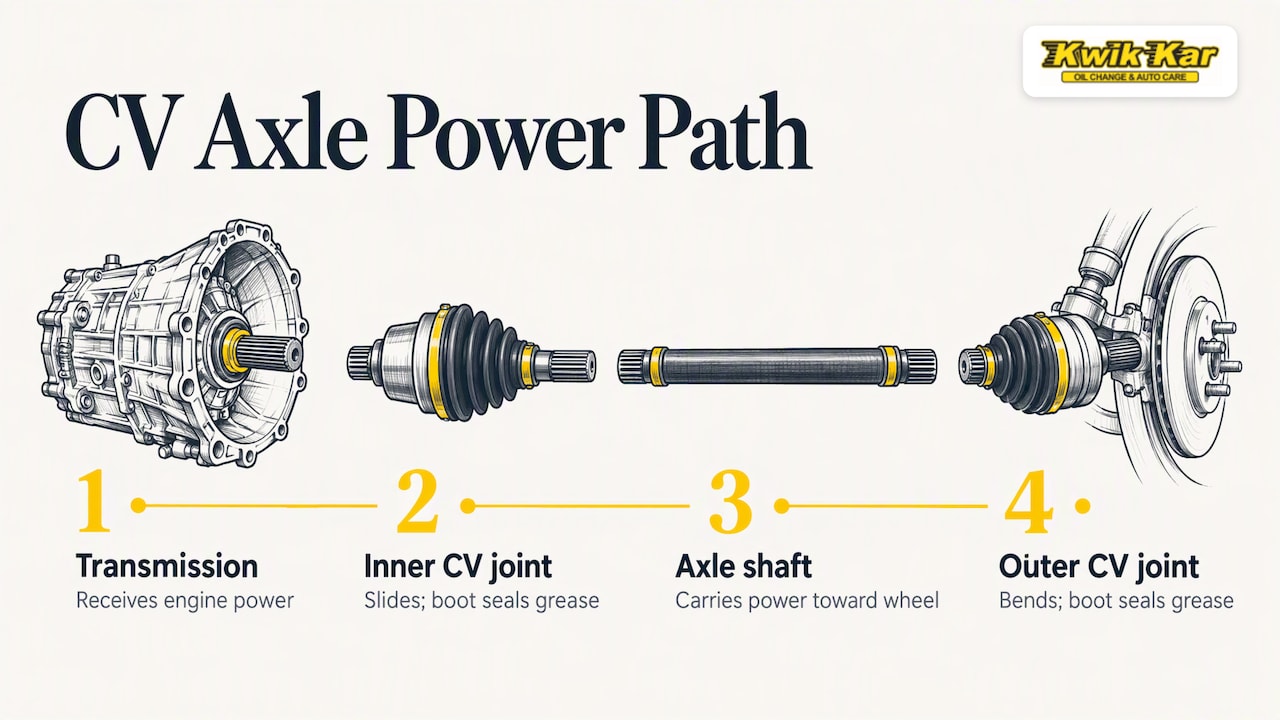
On a front-wheel-drive or all-wheel-drive car, the engine’s power reaches the wheels through two drive axles, also called half-shafts. Each one has a constant velocity (CV) joint at both ends. The joints let the axle keep delivering power smoothly while the wheel moves up and down with the suspension and swings left and right when you steer.
The outer joint, near the wheel, bends the most, so it is the one that typically makes noise in turns. The inner joint, near the transmission, slides in and out as the suspension moves. Each joint is packed with grease and sealed under a flexible rubber boot. That boot is the weak point: once it tears, grease escapes and dirt and water get in.
CV axle symptoms to watch for
Clicking or popping when turning
This is the classic one. A worn outer joint clicks or pops during sharp, low-speed turns, like pulling into a parking space or turning out of a driveway on Spring Valley Road. AutoZone’s guide describes clicking or popping during sharp turns at low speed as a sign of a worn outer joint.
The sound comes from wear inside the joint. According to a driveline manufacturer’s instruction sheet, a clicking CV joint develops small dimples in the cage windows where the balls travel in and out. That is why the noise follows the turn: the joint is working at its steepest angle.
A useful test is to find an empty parking lot, turn the wheel fully to one side, and drive slowly in a circle. Then repeat in the other direction. If the clicking appears mainly in one direction, the joint on the opposite side of the turn is the usual suspect. Because the pattern can be confusing, treat this as a clue for the technician, not a verdict.
Clunking or knocking when you accelerate or decelerate
A single clunk when you shift from drive to reverse, or a knock as you get on or off the gas, can point to excessive wear in a CV joint. AutoZone lists clunking or knocking during acceleration or deceleration as a sign of this wear. Inner joints and worn splines are often involved here, because the load changes as you go from pushing the car to coasting.
Vibration while driving, especially under acceleration
A worn or damaged axle can shake the car, and the shake often shows up or gets worse when you press the accelerator. This is also where drivers most often get misled. A technical bulletin from a replacement-axle maker, SurTrack’s tech bulletin, warns that vibration is rarely caused by a CV joint alone and that out-of-balance wheels or tires are more frequent culprits.
In practice, a vibration that you feel at a particular highway speed regardless of throttle usually points to wheels and tires. A shudder that appears when you lean on the throttle, particularly with clicking in turns or grease on the wheel, is more likely the axle. If the shake appears when you brake, that is a different set of causes, which we cover in our guide to front end shaking when braking.
Grease on the inside of the wheel or on the suspension
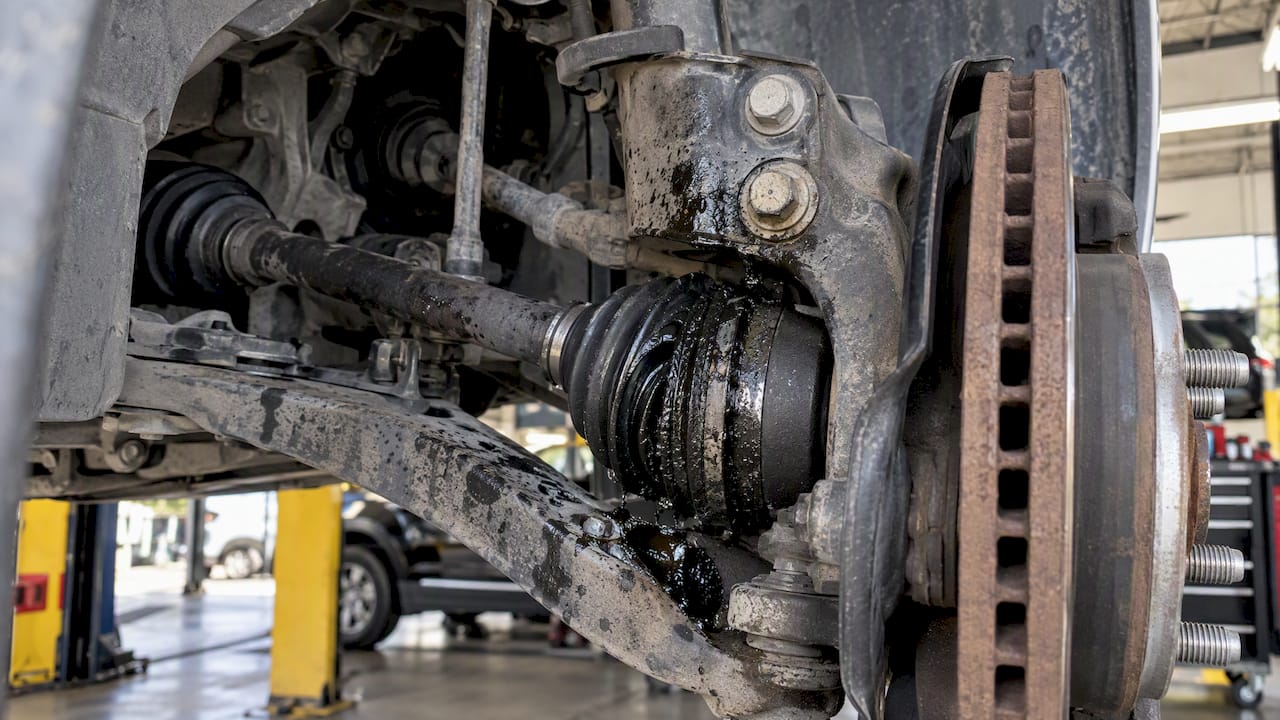
When a boot splits, centrifugal force slings grease outward as the axle spins. AutoZone lists grease on the inside of the wheels or on the knuckle as a common symptom. Look behind the front wheel, on the inner edge of the tire, and on nearby suspension parts. A dark, thick smear that looks like fresh wheel-bearing grease is the giveaway.
A cracked, torn or dry boot
You do not have to wait for noise. A boot that is cracked, split, dry or leaking is a symptom by itself. A service-manual publisher lists leaks and dry, cracked or torn boots as signs of a damaged CV boot, and recommends checking the boot once a year or any time you are under the car. There is no fixed replacement interval for drive axles, so inspection is the real maintenance.
The car will not move
In the worst case, the joint or axle breaks. The engine revs and the car does not go, or you lose drive in one front wheel. This is the endpoint of ignored symptoms, and it can happen without much warning once a joint is badly worn.
Torn CV boots: what happens and what to do
A torn boot is the most common starting point for axle failure. The joint is designed to run in clean grease. When the boot splits, grease leaves, and road dirt, sand and moisture enter and grind the surfaces. Dallas drivers deal with long stretches of high-speed highway driving on the Dallas North Tollway and US-75 as well as constant stop-and-go turning in parking lots and neighborhood streets. All of it keeps the joints flexing, which accelerates damage once the boot is open.
What counts as a torn boot matters, because not every dirty axle needs to be replaced. A MINI service bulletin filed with NHTSA says normal dirt or grease buildup alone is not a reason to replace a boot or half-shaft. Replacement is indicated for a cracked or torn boot, a missing clamp, an outer clamp that moves or rotates easily, or visible grease sling around the joint area. That bulletin is for one manufacturer, but the logic applies broadly: we look for actual damage, not just grime.
Replace the boot or the whole axle?
It depends on how long the boot has been open. AutoZone notes that if grease leaking is the only symptom, replacing the boot may work. If you also have clicking, clunking or vibration, the joint is likely already damaged and replacing the whole axle is the safest option. If dirt is already inside, a new axle may be necessary.
For a deeper look at how boots are replaced and what clamp types are used, see this walkthrough on CV joint boot replacement steps. For most everyday vehicles, a new or quality remanufactured axle assembly is the more practical repair, a view shared by Mobil’s maintenance guidance for the average do-it-yourselfer.
CV axle vs. wheel bearing noise
These two problems are confused all the time, and the repair and cost are very different. Here is how they usually compare.
| Clue | Bad CV axle | Bad wheel bearing |
|---|---|---|
| Sound | Clicking or popping | Humming, growling or roaring |
| When it happens | Mostly when turning, worse under power | Rises with road speed, may change when you steer left or right on the highway |
| Noise when driving straight | Usually quiet, unless the inner joint is worn | Present, constant and speed-related |
| Visible clue | Grease on the wheel or a torn boot | Often none |
| Feel | Clunk or shudder under acceleration | Rough or loose feeling in the wheel, sometimes steering wheel vibration |
If you hear a hum that grows with speed and does not care whether you are turning, read our guide to diagnosing wheel bearing noise. If the sound is a rhythmic click in tight turns, the axle is more likely. Both can exist at once, and tires, brakes and suspension parts can add their own noises, so a road test with a technician is the reliable way to separate them. One axle manufacturer’s guidance stresses that a technician should ask specific questions and take the test drive with the customer to pinpoint a noise.
How to check a CV axle yourself
You can do a basic look without special tools, but only do the under-car part when the car is properly raised and supported on jack stands on level ground, never on a jack alone.
- Look at the boots. Turn the steering wheel to full lock and use a flashlight to look behind each front wheel. You are looking for splits, cracks, missing clamps and flung grease.
- Check the inside of the wheel and tire. Grease spatter here suggests a boot has been open for a while.
- Listen in a slow, tight circle. Do this in an empty lot at low speed with the radio off.
- Check for play. With the car raised and supported, one service-manual source says to check for play in the axle and joints with the car in gear. Any clunking movement in the joint or any play that feels like slack is a sign to stop and have it inspected.
- Compare sides. If one boot looks different from the other, or one wheel is dirtier on the inside, note it for your technician.
What you cannot tell by hand is how much internal damage exists, whether dirt has gotten in, or whether the real cause is a bearing, a mount or a tire. That is the reason we recommend professional diagnosis when more than one cause fits the symptoms.
How urgent is a CV axle repair, and how long can you keep driving?
There is no honest mileage number, because it depends on severity. A torn boot with no noise gives you time, but not unlimited time, since dirt will keep entering. Occasional clicking in tight turns is a warning. Constant noise or vibration is a reason to book immediately. AutoZone says that if symptoms occur constantly, you should not wait to replace the axle, and that a severe failure can cause loss of control or stop the vehicle from moving. The Drive similarly warns that the noises and vibrations are warnings, and failure while driving could cost you control.
Our practical rule:
- Torn boot, no noise: schedule soon. This is the cheapest moment to act.
- Clicking in turns: schedule within days, and avoid sharp turns under heavy throttle in the meantime.
- Clunking, vibration or grease plus noise: treat it as urgent and limit driving, especially at highway speed.
- Loss of drive, loud bang or severe shaking: stop driving and arrange a tow.
In North Texas, summer heat makes rubber parts age faster and long highway commutes add steady miles, so it is worth looking at your boots at least once a year, such as when you come in for an oil change. We do not have local statistics to quote on that, but heat and mileage are both factors in rubber wear that any technician will recognize.
How much does a CV axle replacement cost?
The price depends heavily on vehicle, axle type and whether other parts are needed. RepairPal’s estimator, updated in September 2026, gives a national average of $1,283 to $1,381, with labor estimated at $208 to $306 and parts at $1,075 to $1,076. The estimate excludes taxes and fees and does not factor in location, and related repairs may also be needed. Older guidance from Haynes puts a replacement axle and nut at $125 to $250 for typical vehicles, and says doing the job yourself can save $250 to $500 in labor. Those numbers come from 2017 and different assumptions, which shows how wide the range can be.
We do not publish a flat price for this repair, because the right quote depends on your exact vehicle and what the inspection finds. What we do is give you an estimate before any work begins. If you want to understand why two shops quote differently, our article on axle shaft repair for Dallas drivers walks through the parts and labor involved.
Things that change the quote
- Whether you need one axle or both
- New, remanufactured or aftermarket axle assemblies
- All-wheel-drive or luxury models with more complex axles
- Whether the wheel bearing, a ball joint or a mount needs attention at the same time
- Whether an alignment is advisable after the work
It is usually smart to replace worn axles before the damage spreads. A failed axle can leave you stranded, and a tow plus emergency repair is almost always a larger bill than a planned visit.
Our perspective: what we tell Dallas drivers about CV axles
Most axle jobs we see could have been simpler. A boot splits, the grease goes, and the driver hears nothing for months. By the time the click shows up, the joint is already worn. So we treat boots as an inspection item on every visit, not an afterthought.
We also try not to guess. Clicking, humming, vibration and clunking each have several possible causes, and the parts are not cheap. Our ASE-certified technicians start with a road test and an inspection, and we use digital vehicle inspections with photo and video so you can see the torn boot or the leaking grease yourself before approving anything. You get the estimate before work begins, and qualifying repairs carry our 24-month/24,000-mile warranty, subject to the applicable terms. We are a family-owned shop with nearly 30 years of local experience, and the point of all of it is that you should know what is wrong and why before you pay.
— Kwik Kar
Get a CV axle inspection in Dallas
If you hear clicking in turns, see grease behind a front wheel, or just want your boots checked, our team at 8280 Spring Valley Rd can look at your axles, brakes, tires and suspension in one visit. See the full range on our auto repair services page, including engine, transmission, brake, tire and electrical work for domestic and import vehicles. We serve drivers from Far North Dallas, Addison, Richardson and Farmers Branch, and you can schedule an appointment online whenever it suits you.
FAQ
Can you drive with a bad CV axle?
For a short time, sometimes, but it is a gamble. A torn boot with no noise gives you a little time, while constant clicking, clunking or vibration means the joint is wearing fast. A severe failure can stop the car from moving or cause loss of control, so limit driving and get it inspected as soon as you can.
What does a bad CV axle sound like?
A worn outer joint usually makes a rhythmic clicking or popping noise in turns, getting louder as you accelerate through the turn. A worn joint can also clunk or knock when you accelerate or let off the gas. A humming noise that rises with speed is more typical of a wheel bearing.
Can a bad CV axle cause vibration?
Yes, especially under acceleration, but it is not the most common cause of vibration. Wheels and tires that are out of balance are more frequent culprits, so an inspection should rule those out first. If the vibration comes with clicking in turns or grease around the wheel, the axle becomes a much stronger suspect.
Can I just replace a torn CV boot?
Sometimes. If grease leaking is the only symptom and no dirt has gotten into the joint, a new boot may be enough. If you also have noise or vibration, the joint is probably damaged, and replacing the whole axle is usually the safer repair.
How is a bad CV axle different from a bad wheel bearing?
CV axle problems typically show up as clicking when turning, plus grease on the wheel or a torn boot. Wheel bearing problems typically show up as a hum or growl that changes with speed whether you are turning or not. A road test and inspection will confirm which one you have.
Sources
- How to Tell if Your CV Axles are Going Bad, AutoZone
- Performance Driveline & Axles Instruction Sheet, GSP North America
- Replacement Driveline & Axles Tech Bulletin, SurTrack
- Diagnosing Front Axle Issues service bulletin, NHTSA
- Drive Axle Removal and Installation, Haynes
- Ten steps to replacing CV axles, Mobil
- What Is a CV Axle and What Are Its Replacement Costs?, The Drive
- CV Axle Replacement Cost Estimate, RepairPal
- CV Joint Boot Replacement: Cost, Steps and Clamp Types