



The national average alternator replacement cost in 2026 runs about $550, with most owners paying somewhere between $300 and $900 depending on your vehicle and where you live. Luxury cars, trucks with high-output alternators, and hybrids with integrated charging systems can push well past that range.
Before you accept any quote, here’s what to check:
- Ask whether the part is remanufactured, aftermarket, or OEM.
- Confirm the labor hours and hourly rate separately.
- Find out if a core charge or diagnostic fee is baked into the total.
Pro Tip: Get two quotes before you commit. A shop that lists part type, labor hours, and warranty terms up front is showing you it has nothing to hide.
Key Takeaways
Alternator replacement cost depends most on part choice and vehicle class, and a written estimate listing part type, labor hours, and warranty length is the clearest sign of a fair quote.
| Point | Details |
|---|---|
| National average cost | Most owners pay $300 to $900, with a $550 national average as your baseline. |
| Part choice drives price | Remanufactured units cost roughly $100 to $300 and often carry 1 to 3 year warranties. |
| Vehicle class matters | Trucks and luxury vehicles commonly run $500 to $1,400+, while economy cars stay closer to $300 to $500. |
| Labor is the biggest variable | Accessible jobs take 1 to 2.5 hours; difficult designs can stretch to 4 to 6 hours. |
| Compare quotes before deciding | Kwik Kar Oil Change & Auto Care provides ASE-backed diagnostics and a transparent, itemized estimate before any repair begins. |
Table of Contents
- Alternator Replacement Cost Breakdown: Parts vs. Labor
- OEM, Aftermarket, or Remanufactured: Which Part Makes Sense?
- How Your Vehicle Type Changes the Total Cost
- How Long Does Alternator Replacement Take?
- Is DIY Alternator Replacement Worth the Savings?
- What an Honest Alternator Diagnosis and Estimate Look Like
- Why the “Cheapest Quote” Mindset Backfires
- Ready to Get a Straight Answer on Your Alternator Quote?
- Sources
- FAQ
Alternator Replacement Cost Breakdown: Parts vs. Labor
Your total bill splits into two buckets: the part itself and the labor to install it. Getting a feel for both helps you spot a quote that’s padded or missing something.
Part prices vary widely by quality tier:
- Remanufactured alternators: roughly $100 to $300, often with a 1 to 3 year warranty.
- Aftermarket units: roughly $150 to $350, depending on brand and vehicle.
- New OEM parts: $200 to $600 or more, especially for high-output or specialty alternators.
Labor typically runs 1 to 2.5 hours for a straightforward job. What you pay per hour depends heavily on who’s doing the work. Independent shops often quote noticeably less than national chains for the identical job, which is why comparison shopping pays off.
A few line items catch people off guard. Diagnostic fees (sometimes waived if you proceed with the repair), a core charge on remanufactured units (usually refunded when you return the old alternator), and sales tax all show up on the final invoice. If your serpentine belt is worn, expect an add-on cost of roughly $20 to $80 for parts, or more if the shop installs it. That’s a smart upsell to accept, not a red flag, since replacing a tired belt while the front end is already open saves you a second labor charge down the road.
OEM, Aftermarket, or Remanufactured: Which Part Makes Sense?
For most drivers, a remanufactured alternator delivers the best balance of cost and reliability. Remanufactured units typically cost significantly less than new parts and usually come with multi-year warranties., which covers you through the period when a rebuilt unit is most likely to show a defect if it has one.
OEM parts cost more, but they make sense in specific situations: your car is still under a factory warranty you want to protect, it’s a newer luxury model with tight electrical tolerances, or you simply want the exact part the manufacturer specced.
Aftermarket doesn’t mean lower quality. Reputable brands like Denso, Bosch, and Valeo often match OEM performance on mainstream vehicles at a lower price point. The key is matching the amperage and spec to your vehicle, not just the physical fit.
Before you approve any quote:
- Ask what brand the shop is installing.
- Confirm the core charge amount and how you get it credited back.
- Get the warranty length in writing, on parts and labor both.
Experts generally agree it pays to prioritize part quality over the rock-bottom quote, since an early failure means paying for labor twice.
How Your Vehicle Type Changes the Total Cost
Vehicle class is one of the biggest swing factors in your final number. Here’s a realistic ballpark by category:
- Economy cars: $300 to $500 total.
- Midsize sedans and crossovers: $400 to $650 total.
- Trucks and larger SUVs: $500 to $800 total, thanks to higher-output alternators.
- Luxury and performance vehicles: $600 to $1,400 or more, driven by specialty parts and tighter labor access.
These figures track closely with the broader national data showing most owners land between $300 and $900, with the outliers explaining most of that spread.
One category deserves a specific warning. Vehicles with start-stop technology or 48-volt mild-hybrid systems often rely on a belt-integrated starter generator instead of a traditional alternator. Repairs on these integrated systems tend to cost substantially more, partly because shops frequently replace the entire module rather than servicing a single component. If your car has stop-start, budget toward the higher end of any range you see quoted.
How Long Does Alternator Replacement Take?
Labor time is the single biggest variable in your quote, more so than part price in many cases. Here’s what drives it:
- Accessibility of the alternator. Most mainstream vehicles allow a straightforward 1 to 2.5 hour job.
- Obstructions in the way. Removing a cooling fan, undertray, or even an axle to reach the alternator can stretch the job to 4 to 6 hours.
- Related electrical diagnosis. If your symptoms could point to a bad battery, wiring, or a failing voltage regulator instead, the technician needs time to isolate the real cause before replacing anything.
Ask any shop for the specific labor hours they’ve quoted and their hourly rate, and confirm whether the diagnostic time is included in that number or billed separately. A vague verbal estimate without those two numbers is a sign to ask more questions.
Is DIY Alternator Replacement Worth the Savings?
Doing the swap yourself eliminates the labor line, which can mean real savings on accessible engine bays. But it comes with risk: matching amperage to your exact trim, torquing the mounting bolts correctly, and re-tensioning the belt without damaging bearings all matter more than most DIY guides admit. Get the amperage wrong and you can trigger dashboard warnings or an ECU fault that costs more to diagnose than you saved.
A shop trip costs more upfront, but you get:
- A load-tested diagnosis confirming the alternator is actually the problem.
- Warranty coverage on both the part and the labor.
- Technicians who catch a fraying belt or corroded connector while everything’s already apart.
Pro Tip: Rebuilding your own alternator (replacing brushes or a bearing) can make sense on an older or classic car where OEM units are scarce, but it’s rarely worth the time on a daily driver.
What an Honest Alternator Diagnosis and Estimate Look Like
A trustworthy shop doesn’t just swap the part and hand you a bill. Before recommending replacement, a proper diagnostic checklist covers the battery, the charging system, and the alternator itself, confirming the failure before you pay for a new part.
That checklist typically includes:
- A battery load test to rule out a simple battery problem.
- A voltage and regulator check under load.
- A belt and tensioner inspection.
- Verification that the replacement matches your vehicle’s amperage spec, not just its physical footprint.
A clear estimate listing part type, core charge, labor hours, and warranty length is the strongest signal you’re dealing with a shop worth trusting. Skipping quote comparison is where drivers lose money, often overpaying $200 to $600 for the identical job available elsewhere in the same metro area.
A charging-system diagnosis worth paying for checks the battery under load, tests the voltage regulator, inspects the belt and tensioner, and confirms the amperage spec before anyone recommends a new alternator.
Kwik Kar Oil Change & Auto Care’s ASE Certified technicians follow this exact sequence, and our recognition from RepairPal and NAPA AutoCare reflects a shop-wide commitment to giving you a transparent, pre-repair estimate rather than a surprise invoice.
Why the “Cheapest Quote” Mindset Backfires
Most advice on this topic treats price like the only variable that matters, and that’s where drivers get burned. The real comparison isn’t quote A versus quote B, it’s the total cost of ownership over the alternator’s life, including whether you’ll pay for labor twice if a bargain part fails early.
The conventional wisdom of “get three quotes and pick the lowest” misses the more important question: does each quote list the same part type, the same warranty, and the same labor scope? A $350 quote with a 90-day warranty and a $420 quote with a 3-year warranty aren’t actually comparable numbers.
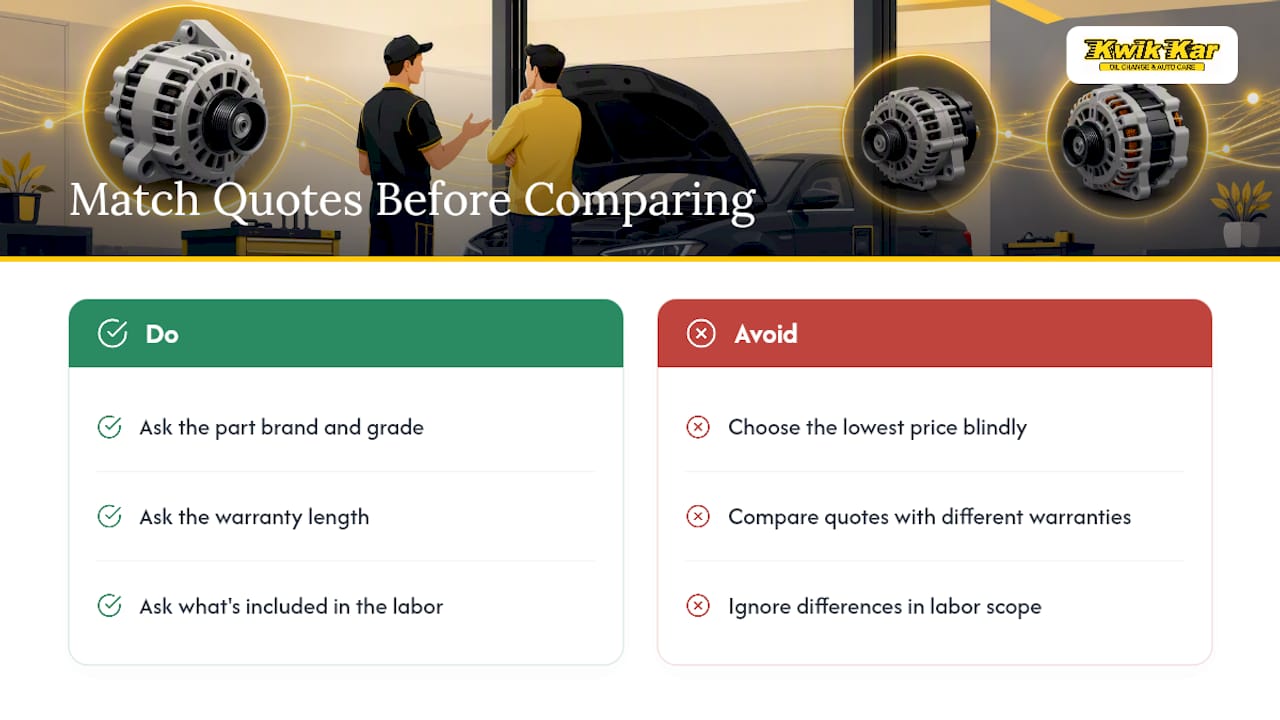
If you take one thing from this, prioritize matching quotes apples to apples before you compare dollar figures. Ask every shop the same three questions: what part brand and grade, what warranty length, and what’s included in the labor line. That single habit does more to protect your wallet than chasing the lowest sticker price ever will.
Ready to Get a Straight Answer on Your Alternator Quote?
You don’t have to guess whether a quote is fair or figure out amperage specs on your own. Kwik Kar Oil Change & Auto Care gives you a written estimate before any work starts, built by ASE Certified technicians who run the full diagnostic checklist first, confirming it’s actually the alternator before you pay for one.

Every alternator job includes your choice of remanufactured or OEM parts, a clear breakdown of labor hours and any core charge, and warranty coverage on both parts and labor. You can browse our full auto repair services or check our alternator and starter repair page for details on what’s included. For a more complete price comparison beyond alternators, the team at Kwik Kar White Settlement also breaks down parts and labor costs in detail.
When you call or book online, bring your VIN and describe your symptoms (dimming lights, a battery warning, slow cranking) so we can give you an accurate quote on the first visit instead of a rough guess.
Sources
- How long to replace an alternator and cost breakdown (HowLongFor)
- MechanicNow 2026 alternator cost benchmarking (MechanicNow)
- How much does it cost to replace an alternator? (ConsumerAffairs)
FAQ
What is a fair price for alternator replacement?
A fair total typically falls between $300 and $900, depending on your vehicle and part choice. A remanufactured part with a 1 to 3 year warranty and clear labor hours listed on the estimate is a strong sign you’re getting a fair deal.
How long does an alternator typically last?
Most alternators last a long time, though heat, electrical load, and driving conditions all affect that lifespan. Watch for dimming lights, a battery warning, or slow cranking as early warning signs it’s wearing out.
How long does it take to replace an alternator?
Most jobs take 1 to 2.5 hours on vehicles with accessible alternators, while difficult designs requiring fan or undertray removal can take 4 to 6 hours. Ask your shop for the specific labor hours quoted before you approve the work.
Why does alternator replacement cost so much?
The cost reflects both the part and specialized labor: alternators contain precision electrical components, and reaching them on some engines requires removing other parts first. Part choice alone can swing your total by hundreds of dollars, which is why comparing OEM, aftermarket, and remanufactured options matters before you approve a quote.