



For most drivers, full synthetic oil is the stronger choice if you tow, drive a turbocharged engine, or face frequent short trips and extreme heat, while a synthetic blend can be a smart, budget-friendly option when your owner’s manual allows it. Your owner’s manual and the API/ILSAC specification on the oil cap are the final word on which one your engine actually needs.
TL;DR:
- Full synthetic oil provides better cold start flow, resistance to heat breakdown, and sludge prevention, especially in high-temperature or towing scenarios.
- Synthetic blends offer a cost-effective compromise but may vary in performance depending on the ratio of base stocks and additive quality.
- Longer oil change intervals for full synthetic, often up to 10,000 miles, can offset its higher upfront cost compared to conventional oil with shorter intervals.
- The choice between full synthetic and blend depends mainly on driving conditions like towing, turbo use, extreme temperatures, and short trips, as specified in the vehicle manual.
- Proper oil selection and interval tracking are crucial for engine protection, and discussing exact specifications with your shop ensures compatibility and maintains warranty coverage.
Table of Contents
- What full synthetic and synthetic blend oils actually are
- How full synthetic and blend oils perform under real driving stress
- What the price gap actually costs you over time
- Which oil fits your vehicle and driving habits
- Common myths about synthetic and blended oils
- What to tell your shop when you switch or schedule an oil change
- How we handle oil changes and what you can expect
- A practical note on picking between the two
- Book your next oil change with us
- FAQ
- Sources
What full synthetic and synthetic blend oils actually are
Motor oil starts with a base stock, and the type of base stock is what separates full synthetic from a blend. Conventional and many blended oils use Group II base stocks, which come straight from refined crude oil. Full synthetic oils rely on Group III or Group IV base stocks that are chemically engineered for a more uniform molecular structure, which is why they have better resistance to breakdown under heat and stress.
A synthetic blend mixes a portion of synthetic base oil with conventional oil, giving you some of the performance gains of a full synthetic at a lower price point. According to Edmunds, full synthetic oil is lab-made with higher purity and performs better at temperature extremes, while a synthetic blend delivers part of that benefit at a reduced cost.
The additive package matters just as much as the base stock. Detergents, dispersants, anti-wear agents, and viscosity modifiers are blended into both synthetic and conventional formulas, and they’re a big reason why two oils with the same base stock can behave differently on the road. A few practical distinctions worth knowing:
- Molecular uniformity: Full synthetic molecules are more consistent in size and shape, which helps the oil flow predictably across a wider temperature range.
- Additive strength: Full synthetic formulas typically carry a more robust additive package tuned for extended drain intervals.
- Blend variability: Because blends combine two base stocks in varying ratios, performance can differ noticeably from one brand to the next.
- Base-stock sourcing: API technical guidance explains how base-stock manufacturing methods influence everything from cold flow to compatibility with modern engine designs.
How full synthetic and blend oils perform under real driving stress
The practical differences between these oils show up most clearly in situations that stress an engine: cold mornings, long highway runs in summer heat, stop-and-go traffic, and towing. Full synthetic oil’s more uniform molecular structure gives it better cold-flow properties, so it circulates to critical engine parts faster on a cold start instead of sitting thick in the pan.
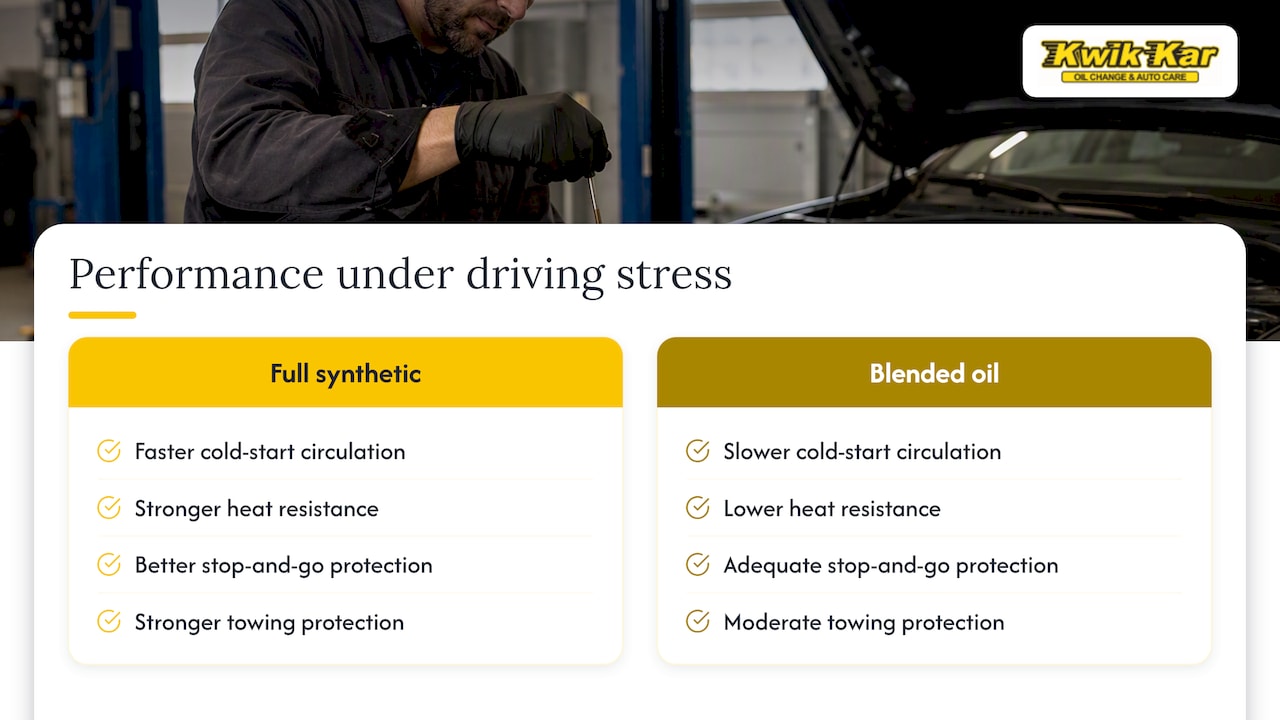
On the other end of the temperature range, full synthetic resists oxidation and thermal breakdown more effectively than conventional or blended oils. That matters because oxidized oil thickens, loses lubricity, and leaves behind sludge and deposits that can clog oil passages over time. Consumer Reports notes that synthetic oil resists heat breakdown and oxidation better than conventional oils, offering stronger protection under severe conditions like frequent short trips, stop-and-go driving, extreme temperatures, or heavy towing.
Synthetic oil can resist heat breakdown and oxidation better than conventional formulations, which Consumer Reports ties directly to stronger protection under towing, stop-and-go driving, and temperature extremes. That’s the practical case for full synthetic if your daily driving looks more like a stress test than a cruise.
Turbocharged engines add another layer to the conversation. Turbos run hotter and spin at far higher speeds than naturally aspirated engines, so oil has to resist breakdown at the bearing surfaces while also controlling deposits that can contribute to pre-ignition. Blended oils can handle moderate driving reasonably well, but engines under frequent load benefit from the added thermal stability that full synthetic provides.
It’s worth being realistic about where the differences matter most. For a vehicle driven gently on short, mild-weather commutes, the gap between a quality blend and full synthetic may be modest in day-to-day feel. The real payoff from full synthetic tends to show up over the life of the engine, in the form of less sludge buildup and more consistent protection rather than an instant difference you’d notice behind the wheel.
What the price gap actually costs you over time
Full synthetic oil carries a noticeably higher price tag than conventional or blended oil, but the math isn’t as simple as comparing one bottle’s price to another. Consumer Reports reports that full synthetic typically costs more than conventional oil, but it can last significantly longer between changes, which means fewer total oil changes over the same number of miles driven.
Interval length is where the value case gets interesting. AAA research and reporting from Cars.com note that many automakers now allow intervals of 5,000 to 10,000 miles for synthetic oil, while conventional oil is typically changed every 3,000 to 7,500 miles depending on the vehicle and driving conditions. Severe-service driving, including towing, extensive idling, or frequent short trips, shortens whichever interval your manual recommends, synthetic or not.
Say you drive 15,000 miles a year. With a conventional oil change every 5,000 miles, that’s three changes a year. With full synthetic rated for 10,000 miles, that’s one and a half changes a year, meaning you’re paying a higher price per change but roughly half as often. Whether that nets out as savings or a wash depends heavily on your specific oil’s price and interval, so it’s worth asking your shop to run the comparison using the actual products and intervals available to you.
A few points worth keeping straight when you’re weighing the cost:
- Upfront cost: Full synthetic runs higher per oil change than conventional oil.
- Change frequency: Longer intervals on full synthetic can offset some of that higher cost over a year of driving.
- Severe-service caveat: Towing, short trips, and extreme heat shorten intervals regardless of oil type.
- Blend as middle ground: A synthetic blend often splits the difference in both price and interval length.
If your manual permits either oil type and your driving is mostly light commuting, a blend can be a reasonable way to balance cost against protection. For synthetic blend oil change service, we can walk you through what fits your specific driving pattern.
Which oil fits your vehicle and driving habits
The decision starts with one document: your owner’s manual. Edmunds draws an important distinction between oil that’s “required” versus “recommended.” If your manual requires a specific synthetic specification, straying from it risks warranty complications and potential engine wear. If synthetic is merely recommended, you have more flexibility to choose a blend without voiding anything.
Beyond the manual, a few honest questions about how you actually drive will steer you toward the right answer:
- Does your owner’s manual or oil cap specify full synthetic, or just recommend it?
- Do you tow a trailer, haul heavy loads, or drive a turbocharged engine regularly?
- Are most of your trips under 10 minutes, where the engine rarely reaches full operating temperature?
- Do you live somewhere with extreme summer heat or hard winter cold?
- Is your vehicle older or higher mileage, with no manufacturer requirement for synthetic?
- Is cost per oil change a meaningful factor in your maintenance budget this year?
If you answered yes to towing, turbocharging, extreme temperatures, or frequent short trips, full synthetic is the stronger match for how your engine is actually working. If your manual allows flexibility and your driving is mostly mild commuting, a blend can be perfectly adequate, and it keeps more money in your pocket at each service.
Older and high-mileage vehicles deserve a quick note of their own. Many were designed before synthetic formulations were common, and while synthetic oil is compatible with older engines in the vast majority of cases, a technician can check your specific engine’s seal condition and consumption history before recommending a switch.
Pro Tip: Check the oil cap itself, not just the manual. It often lists the exact viscosity and specification your engine needs, which is the fastest way to confirm you’re asking for the right oil at the counter.

Common myths about synthetic and blended oils
A few persistent myths are worth clearing up before your next oil change. First, mixing synthetic and conventional oil in an emergency top-off is safe for your engine, but AAA notes it can dilute some of the specific benefits of full synthetic until your next full change.
Second, synthetic oil doesn’t cause leaks in most vehicles. Older seals sometimes shrink slightly with age, and a fresh full synthetic fill can seem to “reveal” a leak that conventional oil had been masking, but the synthetic oil itself isn’t the cause.
Third, not all synthetic oils are identical. Specification matters more than the word “synthetic” on the bottle:
- Mixing is a stopgap, not a routine: Fine occasionally, but don’t make it a habit.
- Leaks are usually a seal issue, not a synthetic issue: Have a technician inspect any new leak regardless of oil type.
- Specs beat labels: Two bottles marked “full synthetic” can differ in additive strength and base-stock quality.
- When in doubt, ask for an inspection: A quick look at your seals and oil history clears up most concerns fast.
What to tell your shop when you switch or schedule an oil change
Getting the right oil starts with giving your shop three specific pieces of information instead of a general request.
- State the SAE viscosity grade listed in your manual or on the oil cap, such as 5W-30.
- State the API or ILSAC specification your engine calls for, since current standards like API SP and ILSAC GF-6A protect against issues like low-speed pre-ignition and timing-chain wear in modern engines.
- Say clearly whether you want full synthetic or a synthetic blend, rather than leaving it to the technician’s default.
- Ask the shop to record the oil type, mileage at service, and the next recommended interval on your invoice.
- Request OEM-specified oil and documentation if your vehicle is still under warranty, since a recorded service history protects both your warranty and resale value.
How we handle oil changes and what you can expect
We confirm the correct viscosity and API/ILSAC specification for your vehicle before any oil goes in, and we provide a transparent estimate before work begins so there are no surprises on the invoice. We document the service, including oil type and the next recommended interval, so you have a record to refer back to at your next visit.
When something looks off, like an unexpected leak or unusual wear, we explain what we found before recommending next steps. A few things you can count on at every visit:
- Upfront estimates: You’ll know the cost and the oil specification before we start.
- Certified technicians: Certified technicians handle the service.
- Documented intervals: We record oil type and mileage so your next change is easy to track.
- Open conversation: Ask us directly about full synthetic versus blend for your specific driving pattern.
A practical note on picking between the two
Most of the noise around synthetic versus blend oil treats it like a brand loyalty question, when it’s really a math problem about how you drive. If you tow, drive a turbo, or spend a lot of time in stop-and-go traffic, the long-term protection from full synthetic is worth the extra cost at the pump. If your commute is mild and your manual gives you room to choose, a blend isn’t a compromise. It’s the sensible choice.
The habit that matters more than either oil choice is tracking what went in and when. Ask your shop to log the oil type and the next interval every time, so you’re making an informed decision at each visit instead of guessing.
— Kwik Kar
Book your next oil change with us
Whether your vehicle calls for full synthetic or a synthetic blend fits your driving pattern and budget, the right specification is confirmed before any service begins. Technicians check your manual’s requirements, run a diagnostic check where needed, and provide a transparent estimate before any work begins, so you know exactly what you’re paying for and why.
We also document your oil type and next recommended interval on the invoice, which makes your next visit faster and keeps your maintenance history clean for warranty or resale purposes. If you’re weighing full synthetic oil against a blend, or you’re not sure which interval applies to your driving, our team is glad to walk through it with you at your appointment.
- ASE Certified Master technicians handle every oil change we perform.
- Transparent estimates are provided before any work begins.
- Documented service intervals help you plan your next visit with confidence.
Ready to get the right oil in your engine? Schedule your oil change service with us today, and if your next visit also calls for brake, tire, or diagnostic work, our team handles that under one roof as well.
FAQ
Is synthetic blend the best option for every driver?
Not necessarily. A synthetic blend is a solid cost-balanced choice for many daily commutes, but drivers who tow, drive turbocharged engines, or face frequent extreme temperatures tend to benefit more from full synthetic’s stronger resistance to heat breakdown and oxidation, as Consumer Reports notes.
What is a conventional oil change?
A conventional oil change uses oil made from Group II base stocks refined directly from crude oil, without the synthetic processing used in full synthetic or blended formulas. Conventional oil generally requires more frequent changes, often every 3,000 to 7,500 miles depending on the vehicle and driving conditions.
Are all synthetic oils the same?
No. While all full synthetic oils use more refined base stocks than conventional oil, additive packages and base-stock quality vary by brand, so the specific API and ILSAC rating on the bottle matters more than the word “synthetic” alone. Checking that the product meets your manufacturer’s specification is the reliable way to confirm quality.
Why do oil changes at some shops cost more than others?
Pricing differences usually come down to the oil type used (conventional, blend, or full synthetic), the volume of oil your engine requires, and whether additional services like filter replacement or a multi-point inspection are included. Asking your shop for an itemized estimate before work begins is the clearest way to understand what you’re paying for.
Sources
- Should you use synthetic oil in your car? — Consumer Reports
- Full synthetic vs synthetic blend oil — Edmunds