




The most common ignition coil symptoms are an engine that misfires or idles roughly, a check engine light (flashing if the misfire is severe), hard starting, weaker acceleration, worse gas mileage and occasional backfiring. Any one of these can also come from a worn spark plug, a wiring fault or a fuel problem, so the symptom tells you where to look, not what to replace. If you drive in Dallas, Addison, Richardson or Farmers Branch and your car is stumbling, this guide explains what you are feeling, how a shop confirms the cause, and when to stop driving.
TL;DR
- A failing coil usually shows up as a misfire: shaking at idle, hesitation under throttle, a jerk when you accelerate, and a check engine light.
- A flashing check engine light means an active, severe misfire. Reduce driving to the minimum until the car is diagnosed.
- Coils, spark plugs, plug wires, connectors and fuel delivery can all cause the same symptoms, so scan for codes before buying parts.
- Heat, vibration and worn spark plugs shorten coil life, which matters in a North Texas summer.
- Clunking over bumps and bouncy handling are not coil symptoms. Those point to struts, shocks or strut mounts.
Table of Contents
- What does an ignition coil do?
- The main ignition coil symptoms
- Is it the ignition coil, the spark plug or something else?
- How a shop diagnoses a bad ignition coil
- Why ignition coils fail
- Is it safe to drive with a bad ignition coil?
- Emissions testing in Dallas County
- Replacement: what to expect
- Are you sure it is the coil? Struts and shocks can feel “off” too
- Our perspective: diagnose before you replace
- Get your misfire diagnosed on Spring Valley Road
- What to do right now
- FAQ
- Sources
What does an ignition coil do?
Your engine needs a very high-voltage spark to ignite the air and fuel mixture in each cylinder. The battery supplies only about 12 volts, so the ignition coil steps that up to the thousands of volts a spark plug needs. Many newer engines use one coil per cylinder, mounted directly on the spark plug (coil-on-plug). Older or simpler designs use a single coil pack feeding several cylinders through plug wires.
When one coil weakens, its cylinder fires poorly or not at all. The other cylinders keep working, which is why the engine still runs but feels wrong. That partial failure is the reason the symptoms are often intermittent at first.
The main ignition coil symptoms
1. Engine misfires and rough idle
A misfire feels like a stumble, a shudder or a brief loss of power, and at a stoplight the whole car may shake. AutoZone lists misfires, jerking and rough running among the classic signs of a bad coil. You may notice it most at idle, when the engine has less momentum to smooth over a dead cylinder.
2. Check engine light, steady or flashing
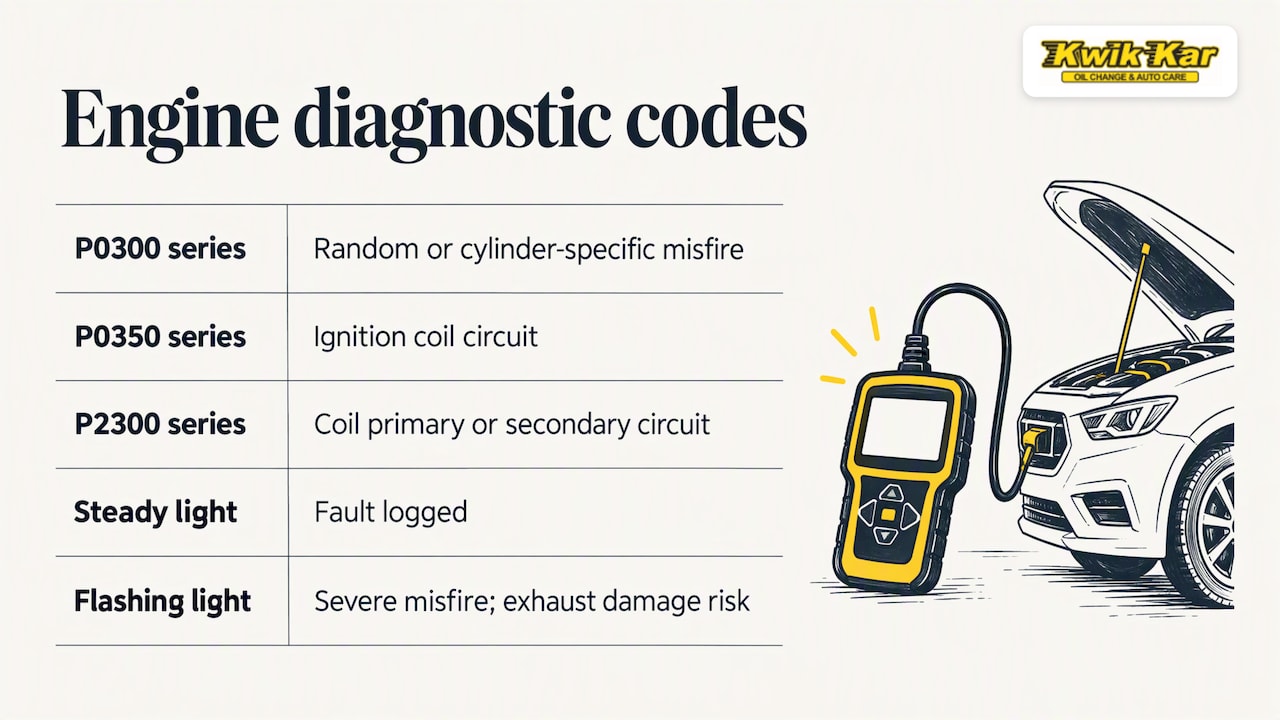
The engine computer watches crankshaft speed and sets a code when a cylinder falls behind. Typical codes include the P0300 series (random or specific-cylinder misfire), the P0350 series (ignition coil circuit) and the P2300 series (coil primary or secondary circuit), per AutoZone’s diagnostic overview. A steady light means a fault was logged. A flashing light means the misfire is severe enough that it can damage the exhaust system, and you should treat it as urgent.
3. Hard starting
If several coils are weak, the engine may crank longer before it catches, or fail to start at all. A single bad coil on a multi-cylinder engine usually does not stop it from starting, but it can make the first few seconds rough.
4. Poor acceleration and loss of power
With a cylinder not contributing, the engine has less power to give. You notice it most when merging onto Central Expressway or LBJ Freeway, passing on a highway, or climbing an overpass with the A/C running. The car may hesitate, then catch.
5. Worse fuel economy
Unburned fuel from a misfiring cylinder is wasted, and the computer may also add fuel to compensate. If your mileage has dropped for no clear reason and the engine feels slightly off, ignition is worth checking. Keep in mind that tire pressure, driving habits and A/C use also move your mileage, so this symptom alone proves little.
6. Backfiring or sputtering
Unburned fuel can ignite in the exhaust, producing a pop or sputter. This is another sign that combustion is not happening properly in at least one cylinder.
7. Stalling
An engine with a badly failing coil may stall at idle or when you slow for a light, especially if more than one coil is weak. Stalling is a safety issue in traffic, so do not wait on this one.
8. Symptoms that come and go with conditions
A marginal coil may misfire in damp weather, first thing in the morning, or when it is very hot or cold, according to Haynes. That is why some drivers see a misfire only on a hot afternoon, then nothing for days. An intermittent problem is still a real problem, and it usually gets worse.
Is it the ignition coil, the spark plug or something else?
This is the question that saves or wastes the most money. A misfire is a clue that the ignition system or fuel supply has a problem, not proof of a bad coil. Haynes notes that fuel-supply problems, a spark plug or a plug wire can also be responsible.
The relationship also runs the other way. AutoZone points out that coils often fail because of bad spark plugs or plug wires: a worn plug with a wide gap makes the coil work harder until it gives up. Replace a coil without addressing a worn plug and the new coil may not last.
| Likely cause | What it tends to look like | How it gets confirmed |
|---|---|---|
| Failed ignition coil | Misfire on one cylinder, code for that cylinder or coil circuit | Coil swap, resistance and signal tests |
| Worn or fouled spark plug | Misfire, rough idle, hard start, often at higher mileage | Plug inspection, gap and condition check |
| Cracked coil boot or bad plug wire | Misfire, sometimes worse in damp weather | Visual inspection for cracks, burn marks, corrosion |
| Fuel injector or fuel delivery problem | Misfire, hesitation, lean or rich codes | Fuel pressure and injector tests |
| Low compression | Persistent misfire that follows the cylinder, not the coil | Compression test |
| Wiring or connector fault | Intermittent misfire, no obvious part failure | Connector and circuit inspection |
On some vehicles a vacuum leak or a failing sensor can also create a rough idle. If you want to see how a sensor problem mimics ignition trouble, our guide to mass air flow sensor symptoms covers checks worth doing before any part is replaced.
How a shop diagnoses a bad ignition coil
A proper diagnosis follows a sequence, not a guess. O’Reilly Auto Parts describes the usual steps, and they match what a careful technician does:
- Scan for codes. A misfire code names the cylinder, which narrows the search to one coil, one plug and one injector.
- Inspect the coil and boot. Look for cracks, burn marks, corrosion and a damaged boot.
- Swap the coil. On coil-on-plug engines, move the suspect coil to another cylinder and clear the codes. If the misfire follows the coil, the coil has failed. If it stays with the original cylinder, the cause is the plug, injector, compression or wiring.
- Test resistance and signal. A meter reading compared with the manufacturer’s specification, plus a check that the coil is receiving its command signal.
- Use a spark tester. An in-line tester can show whether a coil stops firing under load, which catches faults that bench tests miss.
Change one thing at a time. Replacing the coil, plugs and wires all at once may cure the car, but you will not know what failed, and you may pay for parts you did not need. The exception is when manufacturer service intervals say the plugs are due anyway.
Why ignition coils fail
Coils are simple parts, but they live in a harsh place at the top of a hot engine. JEGS lists excessive heat, vibration and mechanical stress, and bad electrical connections as causes of premature failure.
For Dallas drivers, a few local conditions are worth thinking about, without overstating them:
- Summer heat. Under-hood temperatures climb well above the outside temperature, and coils sit right in that heat. Age makes insulation less tolerant of it.
- Stop-and-go traffic. Long idling in heavy traffic keeps the engine hot with little airflow across it.
- Highway commutes and long trips. High mileage adds up to heat cycles and vibration, and plug wear follows mileage.
- Deferred spark plug service. Plugs have a manufacturer-specified replacement interval in your owner’s manual. Going well past it puts extra load on the coils.
Follow your owner’s manual for plug intervals and specifications. Plug type matters, and the wrong one can cause its own misfire.
Is it safe to drive with a bad ignition coil?
A mild, occasional stumble is not an emergency, but an active misfire is not something to live with. O’Reilly advises driving as little as possible, or not at all, until a misfire is diagnosed and repaired.
The reasons are practical:
- Catalytic converter damage. A misfire sends unburned fuel into the exhaust, and it can overheat and damage the catalytic converter, as Tire Review explains. That turns a modest repair into an expensive one.
- Unpredictable power loss. A car that hesitates when you pull into traffic or stalls at a light is a hazard.
- Progression. A weak coil rarely heals. Other coils on the same engine are usually the same age and have seen the same heat.
If the light is flashing, the car is shaking hard, or it smells of raw fuel, pull over safely and call a shop. A steady light with mild symptoms can usually be driven a short distance to get it scanned, but do not delay.
Emissions testing in Dallas County
A misfire can also cost you at inspection time. Texas stopped requiring annual safety inspections for most non-commercial vehicles on January 1, 2025, but the Texas Department of Public Safety says vehicles in emissions counties still need an annual emissions inspection. The Texas DMV lists Dallas County among them. Qualifying commercial vehicles remain subject to the applicable safety inspection requirements.
A car with an active check engine light for a misfire will not pass the emissions inspection, so fixing the cause first saves you a trip. If your car is registered in Dallas County, handle ignition and engine codes before your inspection window, not at the last minute. Check the Texas DPS page for current rules.
Replacement: what to expect
The work varies a lot by engine. Synchrony notes that domestic vehicles such as the Ford F-150 often cost less to service because of accessible engine designs and widely available parts, while imports can cost more because of part pricing and engine layout. Access is the other variable: on many four-cylinder engines the coils sit on top and come out with one bolt each, while on some V6 engines the rear bank sits under the intake manifold or other components and needs extra disassembly.
A few practical points before you approve any repair:
- Ask whether the quote covers one coil or a full set, and why.
- Ask whether the plugs are being inspected or replaced at the same time.
- Ask for the misfire codes and what testing confirmed the diagnosis.
- Get the estimate before work begins.
We do not publish a flat price for coil replacement because it depends on your vehicle, the number of coils, and what the diagnosis finds. For a deeper walkthrough, see our guide to fixing a bad ignition coil.

Are you sure it is the coil? Struts and shocks can feel “off” too
Many drivers searching for engine symptoms are actually feeling the suspension. The two are easy to separate by when and how it happens. Engine misfires show up as shaking at idle or hesitation under throttle, regardless of the road. Suspension problems show up over bumps, in corners and under braking.
Bad struts and worn shocks symptoms
Monroe lists these signs of worn shocks and struts:
- Nose dive when braking
- Excessive bouncing after bumps
- Swaying or body roll in corners
- Uneven tire wear such as cupping
- Rear squat when accelerating
- Clunking or knocking over bumps
Strut mount noise
A clunk or knock over bumps can also come from a worn strut mounting plate or worn mounting hardware, according to Monroe’s installation guidance. The same guidance warns that improper mount loading during installation can cause noise, mount damage or a crushed bearing. That is why a shop should inspect and usually replace mounts when it replaces struts. If you are unsure which part your car needs, read struts vs. shocks first.
Our perspective: diagnose before you replace
We see the same pattern often. A driver arrives with a flashing light, a car that shakes at idle, and a plan to replace a coil they read about online. Sometimes that is exactly right. Other times the plug is worn out, a boot is cracked, or an injector is the real issue, and the new coil would have failed to fix anything.
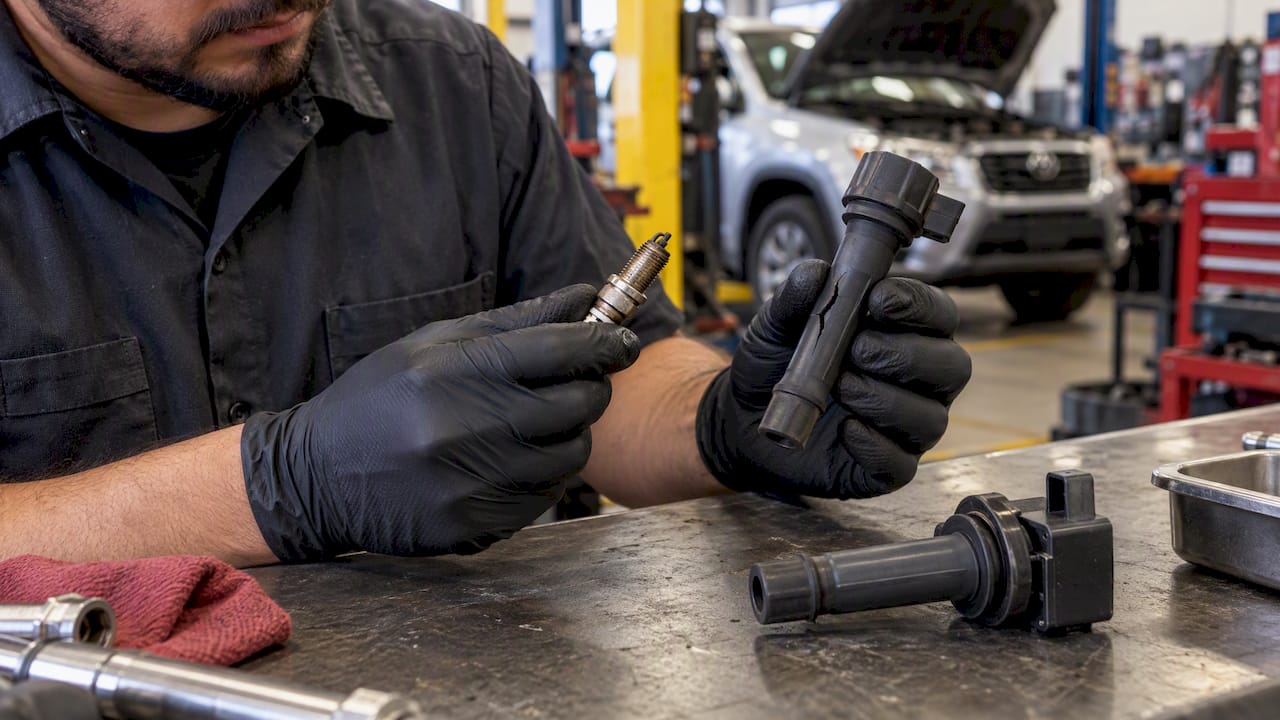
That is why we start with the scan and the inspection, not the parts. Our ASE-certified technicians use advanced diagnostic tools, and we give you an estimate before work begins. Our digital vehicle inspections include photo and video, so you can see what the technician saw: the cracked boot, the oil-soaked coil, the worn plug. You decide with the evidence in front of you.
We are a family-owned shop with nearly 30 years of local experience, and we would rather you pay for the one repair your car needs than three it did not. When a repair qualifies, our 24-month/24,000-mile warranty applies, subject to its terms, so ask us what is covered on your job.
— Kwik Kar
Get your misfire diagnosed on Spring Valley Road
Kwik Kar Oil Change & Auto Care is a full-service maintenance and mechanical repair center at 8280 Spring Valley Rd, Dallas, TX 75240, serving North Dallas, Far North Dallas, Addison, Richardson and Farmers Branch. If your check engine light is on or your engine is stumbling, our engine diagnostics service finds out whether it is the coil, the plugs or something else before any parts are replaced. We work on both domestic and import vehicles. You can also see everything we do at kwikkarspringvalley.com.

Offers and coupons change, so ask about current ones when you book.
What to do right now
- Note when it happens: idle, acceleration, cold start, hot afternoons.
- If the check engine light is flashing, limit driving and call a shop.
- Have the codes read and the cylinder identified.
- Ask for the plugs, boots and wiring to be checked along with the coil.
- Fix the cause before your Dallas County emissions inspection.
When you are ready, schedule an appointment at Kwik Kar Spring Valley and tell us the symptoms you have noticed. The details help us diagnose faster.
FAQ
Can a bad ignition coil cause a check engine light?
Yes. The computer sets a misfire or coil circuit code when a cylinder is not firing properly. Codes in the P0300, P0350 and P2300 families commonly point to misfires or coil circuits. A flashing light signals a severe misfire and should be treated as urgent.
How do I tell a bad coil from a bad spark plug?
They cause nearly identical symptoms, so testing is the only reliable answer. On coil-on-plug engines, a technician can swap the suspect coil with a neighboring cylinder and see whether the misfire moves. If it follows the coil, the coil is bad. If it stays, the plug, injector, compression or wiring is the cause.
Can I drive with a bad ignition coil?
Avoid it. Driving with an active misfire can damage the catalytic converter and may leave you with sudden power loss or stalling. Drive as little as possible until the car is diagnosed, and not at all if the check engine light is flashing.
Should I replace all ignition coils at once?
Not automatically. If one coil failed, the others have the same age and heat exposure, so some owners and shops replace them together on high-mileage engines or when access is difficult. The decision depends on your vehicle, the mileage and the test results, so ask your technician to explain the reasoning.
Do bad struts cause the same symptoms as a bad ignition coil?
No. Bad struts cause bouncing, nose dive, swaying, uneven tire wear and clunks over bumps. A bad coil causes misfires, rough idle, hesitation and a check engine light. If you hear a knock over bumps, have the suspension and strut mounts inspected.
Sources
- How To Tell If Ignition Coils Have Gone Bad? (AutoZone)
- Ignition Coil Packs: A Simple Guide (Haynes)
- How to Test An Ignition Coil (O’Reilly Auto Parts)
- Bad Ignition Coil Symptoms (JEGS)
- Misfire Catalytic Converter Damage (Tire Review)
- Inspection Items for the Annual Inspection (Texas DPS)
- Vehicle Safety Inspection Program Changes (Texas DPS)
- Texas vehicle inspection changes (Texas DMV)
- How Much Does Ignition Coil Replacement Cost? (Synchrony)
- Signs of Bad Shocks & Struts (Monroe)
- Shock & Strut Installation Tips (Monroe)