


That dark puddle under your parked car almost always means an engine oil leak, usually from a valve cover gasket, oil pan gasket, drain plug, or oil filter housing. Check your dipstick and dashboard warning lights right away. If the level is stable and no light is on, a short drive to a shop is usually fine. If the oil pressure light is on or the puddle is growing fast, shut the engine off and call for a tow.
TL;DR:
- Most oil leaks originate from the valve cover gasket, oil pan gasket, drain plug, or oil filter housing, each leaving distinct leak signs.
- Detecting the leak involves a level check, leak pattern observation, and visual inspection, with photos aiding tracking over several days.
- Driving with a small, stable leak may be safe if no warning lights or rapid puddle growth are present, but a fast-growing puddle or warning lights require immediate towing.
- Repair costs are mostly driven by labor, especially for internal seals like the rear main, and a proper diagnosis before repairs helps avoid unnecessary expenses.
- DIY fixes are limited to simple tasks like tightening drain plugs or replacing filters, while complex leaks from internal seals require professional service to prevent further damage.
Table of Contents
- Common Causes of Oil Leaks and Where They Come From
- How Do You Know Where the Oil Leak Is Coming From?
- Is It Safe to Drive With an Oil Leak?
- Repair Options and What They Typically Cost
- Can You Fix an Oil Leak Yourself or Do You Need a Shop?
- How Can You Prevent Future Oil Leaks?
- Why the Shop You Choose Changes the Outcome
- Our Take on the Fastest Path From Oil Spot to Fixed Car
- Book an Oil Leak Diagnosis at Kwik Kar Spring Valley
- Sources
- FAQ
Common Causes of Oil Leaks and Where They Come From
Not every oil leak looks the same, and the location of the stain tells you a lot before you even pop the hood. Engine oil leaks typically trace back to one of five spots, and each leaves its own calling card.
- Valve cover gasket: Oil runs down the sides of the engine and sometimes pools in the spark plug wells, which can cause a rough idle or misfire if it gets bad enough.
- Oil pan gasket or drain plug: This produces a puddle centered directly under the middle of the engine, usually the classic “oil spot on the driveway” scenario.
- Oil filter or filter housing: Leaks here often show up right after an oil change, pointing to a filter that was not seated or torqued correctly.
- Crankshaft seal (front or rear main): Oil appears further back toward the firewall or gets slung outward by the crankshaft pulley and accessory belts.
- Oil cooler or turbo lines (if your vehicle has them): These create a distinct wet trail near the cooler fittings rather than a single puddle.
Common leak sources like these account for the vast majority of engine oil leak causes owners report, and knowing which one you’re dealing with saves real diagnostic time at the shop.
How Do You Know Where the Oil Leak Is Coming From?
Detecting oil leaks under your car doesn’t require a lift or a flashlight the size of a lightsaber. A little patience and a few household items will get you most of the way to an answer.
- Park on level ground overnight, then slide a large piece of cardboard or newspaper under the engine. Fresh spots the next morning tell you the leak is active, not just old residue.
- Note the exact position of the new stain. Front-center usually points to the oil pan or drain plug, the sides suggest the valve cover, and anything toward the firewall or transmission hints at a rear main seal.
- Check the dipstick with the engine off and cold. Note both the level and the color. Oil that looks milky or unusually thin deserves a second look beyond just the leak itself.
- Open the hood and check for wetness around the valve cover, oil on the exhaust manifold, or oil residue flung onto the drive belts.
- Snap time-stamped photos each time you check. A pattern of growing wetness over a few days is far more useful than a single glance.
These are the same practical steps mechanics use to narrow down a leak before ever putting a wrench on the car. Some shops use a UV dye tracer for stubborn leaks, but pressurized system checks and dye tracing are best left to a lift and a trained eye.
Pro Tip: Take your engine-bay photos in daylight and from the same angle every time. Side-by-side comparisons make a slow leak obvious days before you’d notice it by eye alone. If you’re photographing a dirty engine bay to spot leaks more clearly, cleaning the bay safely first makes new oil trails much easier to see.
Is It Safe to Drive With an Oil Leak?
Sometimes yes, sometimes absolutely not, and the difference comes down to a short checklist rather than a gut feeling.
- Stop and call a tow if: the oil pressure warning light is on, you see smoke from under the hood, the puddle is visibly growing by the hour, or the level drops below the MIN mark even after topping up.
- A short, cautious drive may be okay if: the oil level has stayed stable over a day or two, no warning lights are lit, and you don’t see oil dripping onto the exhaust manifold.
Oil pressure loss and rapid puddle growth are the two clearest signs you’re looking at a major leak rather than a minor seep, and both call for a tow, not a test drive. Driving on low oil risks engine starvation, where moving parts run without lubrication and can seize within minutes. Leaked oil that lands on hot exhaust components also raises fire risk, and it can soften rubber belts and hoses over time, turning one leak into several repair bills.
Repair Options and What They Typically Cost
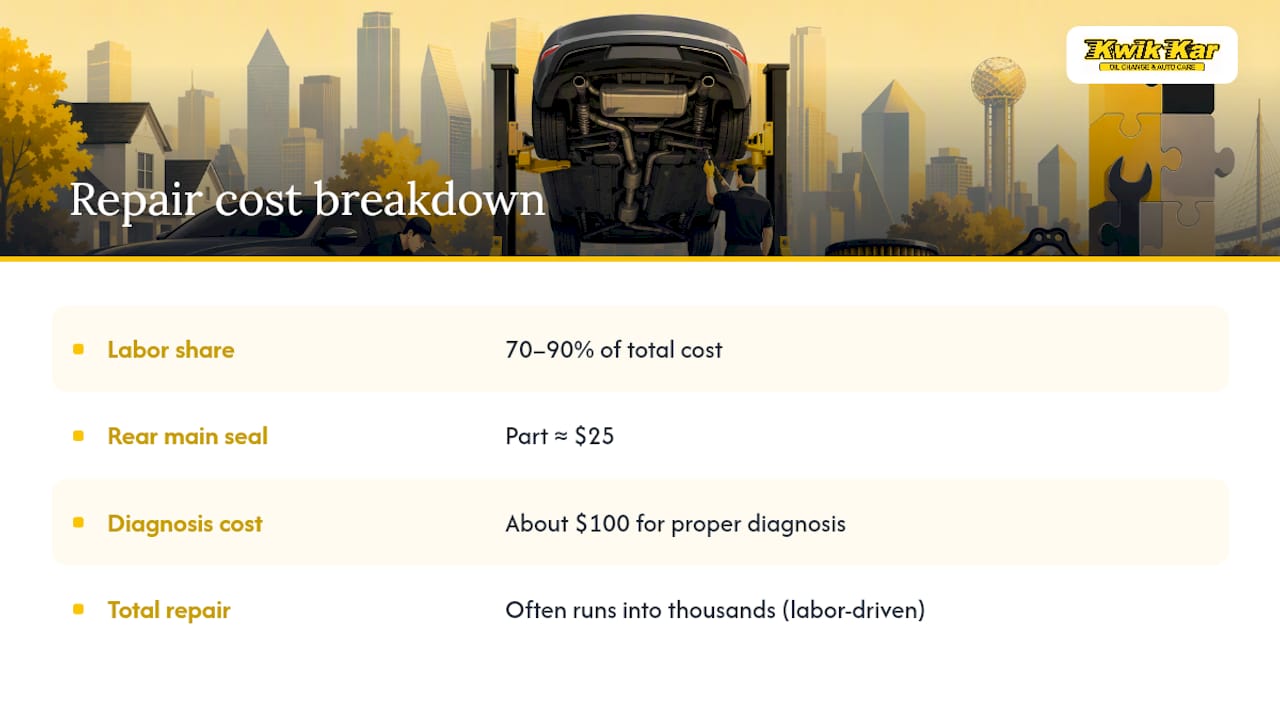
Fixing an oil leak under your car usually falls into a fairly predictable price range, but the part itself is rarely what drives the bill. Labor accounts for the bulk of most oil leak repairs, often 70 to 90 percent of the total, because reaching a gasket or seal frequently means removing other components first.
A rear main seal part can cost as little as $25, yet the job still runs into thousands because of the labor involved, not the hardware. A proper diagnosis typically runs around $100, and paying for that upfront diagnosis usually saves money by preventing guesswork repairs that don’t fix the actual leak. When you get an estimate, ask for a line-item breakdown of parts versus labor and confirm whether the repair carries a warranty. You can read more about the factors that drive repair costs up or down depending on your vehicle’s layout.
Can You Fix an Oil Leak Yourself or Do You Need a Shop?
Some oil leaks are legitimately DIY-friendly. Others are a fast track to a bigger repair bill if you get them wrong.
- Reasonable DIY fixes: tightening a loose drain plug to spec, replacing a crush washer, swapping a poorly seated oil filter, or retorquing an accessible valve cover bolt. Always check your owner’s manual for the correct torque value. Overtightening a drain plug is a common way people create a leak that wasn’t there before.
- Bring it to a shop when: the leak traces to a rear main seal, timing cover, or any internal seal; oil is spraying onto the exhaust; or the leak keeps coming back after a DIY fix.
- What to bring: your photos, your drip-map notes, and recent service history. Ask for a digital inspection and a written, line-item quote before any work begins.
If the source still isn’t obvious, an engine diagnostic service can trace it without guesswork.
How Can You Prevent Future Oil Leaks?
Most leaks are maintenance problems waiting to happen, and a few habits go a long way toward avoiding them.
- Stick to regular oil and filter changes using the correct oil grade for your engine.
- Torque the drain plug and filter to spec every time, since overtightening damages gaskets just as much as leaving them loose.
- Keep the PCV valve and breather system serviced. A clogged PCV builds crankcase pressure that pushes oil past gaskets and seals.
- Ask your technician to inspect rubber grommets and hoses during routine service, since these degrade with age and heat.
Pro Tip: Ask for a quick visual leak check every time you’re in for an oil change. It costs you nothing extra and catches most leaks while they’re still a $75 fix instead of a $700 one.
Why the Shop You Choose Changes the Outcome
An accurate diagnosis is the single biggest lever on your final repair bill. A tech who correctly identifies the leak source the first time avoids the “let’s replace this and see” approach that runs up labor charges without fixing anything. The shop has technicians certified in automotive service and holds accreditation from recognized industry organizations. Estimates are written and shared before any work starts, and digital vehicle inspections with photo and video documentation show you exactly what a technician found under your car, not just a verbal summary. That transparency matters most on oil pan gasket and rear main seal jobs, where labor hours (and cost) can swing widely depending on what’s actually wrong.
Our Take on the Fastest Path From Oil Spot to Fixed Car
Most guides treat every oil leak as an emergency or, worse, as something you can ignore until the next oil change. Neither instinct serves you well. The research is clear that early, correct diagnosis is what actually controls cost, not how fast you get to a shop. A stable, slow seep with no warning lights genuinely can wait a few days for a scheduled appointment.
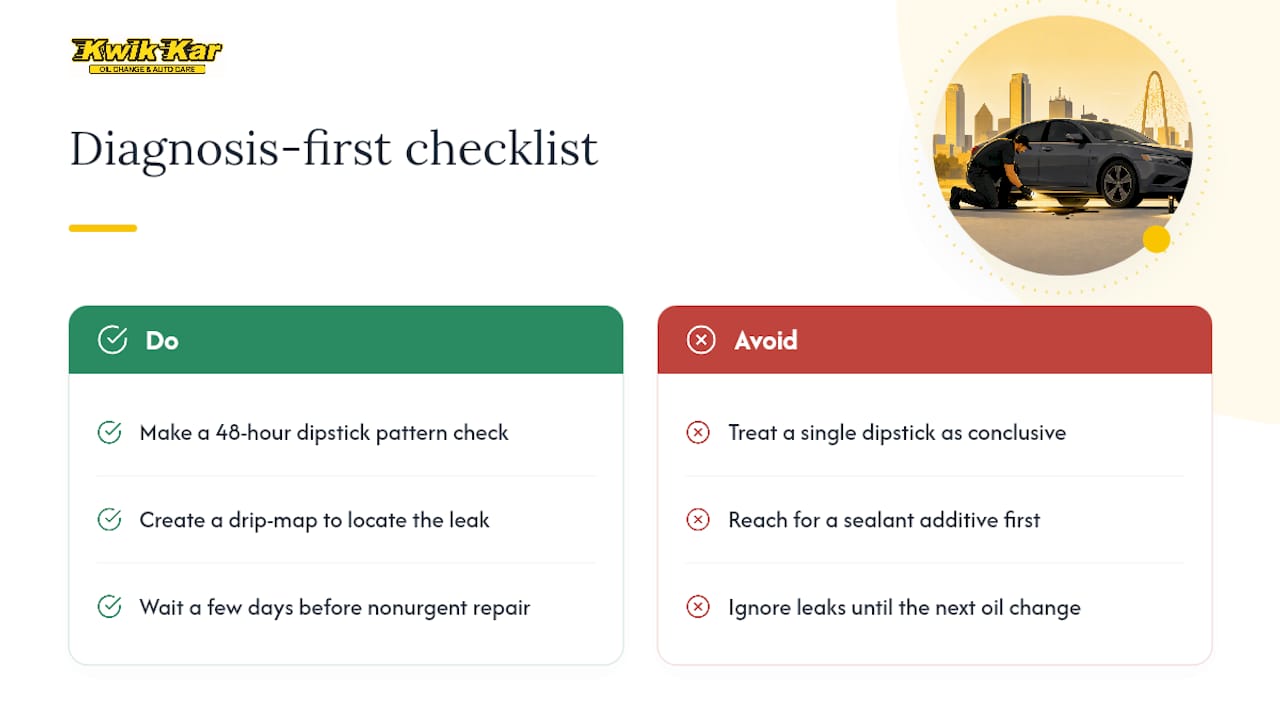
Where conventional advice falls short is in treating “check engine oil” as a one-time glance rather than a pattern over 48 hours. A single dipstick check tells you almost nothing; a cardboard test over two mornings tells you whether you’re dealing with a $75 fix or an $800 one. We’d also push back on the instinct to reach for a sealant additive as a first move. It sometimes masks a symptom without addressing what’s actually leaking, and it can complicate an honest diagnosis later.
Prioritize the drip-map and the dipstick check first. Everything else, including whether to fix it yourself or hand it to a tech, follows naturally from what those two checks show you.
— Kwik Kar
Book an Oil Leak Diagnosis at Kwik Kar Spring Valley
Guesswork gaskets and vague estimates cost you twice: once on the wrong repair, once on the right one. At this repair center, you receive a written, line-item estimate before any work begins, supported by certified technicians and digital vehicle inspections with photographic and video documentation of the leak.
Whether you’re dealing with a stubborn valve cover gasket, a puddle under the oil pan, or you just need a fast, honest read on that new stain in your driveway, our Spring Valley team handles oil changes, engine diagnostics, and full gasket and seal repairs for both domestic and import vehicles. Call the shop, book online, or drive in and let a certified technician map the leak while you wait. Commuters, families, and local fleets across Dallas trust us to tell them exactly what’s wrong and exactly what it costs before we start.
Sources
- Synchrony
- Engineerskill
- Decide If You Can Drive With An Oil Leak: Safety Risks & Next Steps For Car Owners (Minor Vs Major) – Carsymp
- Oil Leak Repair Cost Guide – Current Cost
FAQ
Is It Okay to Drive My Car if It’s Leaking Oil?
It depends on the severity. A small, stable seep with no warning lights and no smoke can usually tolerate a short, cautious drive to a shop, but a growing puddle, an oil pressure light, or visible smoke means you should stop and arrange a tow instead.
How Much Does It Cost to Fix an Oil Leak Under the Car?
Most oil leak repairs run roughly $150 to $1,200, depending on the source. Simple fixes like a drain plug or filter housing sit at the low end, while a rear main seal or timing cover repair can climb past $2,000 because of the labor involved.
How Do I Know if My Oil Leak Is Serious?
A serious leak usually comes with a fast-growing puddle, a lit oil pressure warning light, visible smoke, or oil level that keeps dropping even after you top it up. Any one of those signs means the leak needs immediate attention, not a wait-and-see approach.
Is It Worth Fixing an Oil Leak?
Yes. An unaddressed leak risks engine damage from low oil pressure and can spread to belts, hoses, and other components over time, turning a moderate repair into a far more expensive one. Catching it early, ideally with an engine diagnostic to confirm the source, keeps the fix affordable and protects the rest of the engine.