



When a power window not working leaves your glass stuck up or down, the cause is usually one of five things: a locked child-safety switch, a blown fuse or bad relay, a failing door switch, a dead motor or worn regulator, or a broken wire at the door hinge. Start with the two fastest checks: try the master switch and every alternate control first, then pull the fuse box cover and run the dome light test to confirm power is actually reaching the door.
TL;DR:
- Most window issues are caused by a blown fuse, broken relay, or wiring problem, not a dead motor, and quick checks can confirm these in minutes.
- Unusual noises like grinding or silence during operation help identify whether the fault lies with the motor, regulator, or electrical circuit.
- Electric tests, including continuity checks and voltage measurement, are essential to distinguish between switch, wiring, and motor failures before replacement.
- Temporary fixes, such as tapping the motor or using hand pressure, are only short-term solutions and risk damage if overused.
- Complex or damaged components, like broken glass or internal mechanical faults, require professional repair with diagnostic tools and proper part replacement.
Table of Contents
- Why Is My Window Stuck? Fast Checks Before You Touch a Tool
- What Your Window’s Sound Tells You About the Cause
- How to Test a Power Window Electrically (Without Guessing)
- Temporary Ways to Raise a Stuck Window Safely
- When to Stop DIY and Call a Repair Shop
- What Our Technicians Want You to Know
- Get Your Window Fixed Right the First Time
- Sources
- FAQ
Why Is My Window Stuck? Fast Checks Before You Touch a Tool
Before assuming the worst, rule out the easy stuff. Most car window issues trace back to something you can check in under five minutes, no wrench required.
- Test the child lock and try every switch. Many drivers forget the child-safety lock on rear doors, and a window that only responds to the driver’s master switch (not the door’s local switch) points to a wiring or connector issue at that door, not a dead motor.
- Check the fuse box and relay. Pull your owner’s manual, find the window fuse and relay locations, and inspect for a broken filament or a relay that doesn’t click. A blown fuse or failed relay is a common reason all windows stop at once, and it’s the cheapest fix on this list.
- Run the dome light test. Turn on your interior light, then press the window switch. If the dome light dims or flickers, power is reaching that circuit; if nothing happens at all, the fault is further upstream.
- Watch for other electrical symptoms. If your headlights dim or the radio cuts out at the same time, the problem may not be the window at all. Weak output from the alternator or a failing battery can starve every accessory in the car, windows included.
What Your Window’s Sound Tells You About the Cause
The noise (or silence) your window makes when you press the switch narrows the diagnosis fast.
- Total silence: usually an upstream electrical problem, like a dead fuse, a failed switch, or a break in the wiring before the motor ever gets power.
- Humming or whirring with no glass movement: the motor is spinning, but the regulator or track has likely failed, or the glass has slipped off its channel.
- Grinding or a stripping sound: stripped regulator gears or a snapped cable, mechanical damage that a switch or fuse swap won’t fix.
- All windows dead vs. one window dead: every window down points to a shared circuit (fuse, relay, or main power feed); one dead window points to a local fault at that door.
- Intermittent operation: the window works sometimes and not others, which usually means voltage drop or corroded contacts rather than a fully dead component.
Roughly a third of window complaints that mechanics see come down to a switch or connector issue rather than a dead motor, which is exactly why testing before replacing anything saves money.
How to Test a Power Window Electrically (Without Guessing)
Before you touch a probe, confirm the ignition is off or in accessory mode as your manual specifies, pull the relevant fuse if you’ll be working near the connector, and wear gloves if you’re near any sharp trim edges. Never bridge a circuit with anything but a properly fused jumper wire.
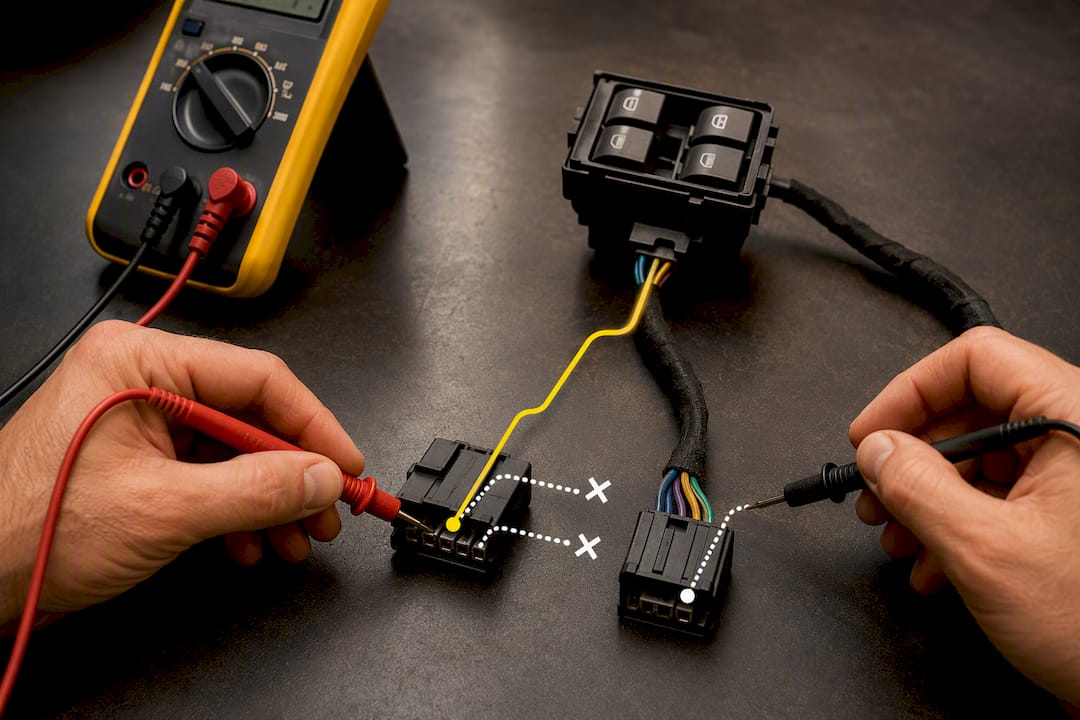
- Bench test the switch for continuity. Remove the switch and use a multimeter to check continuity across its terminals in each position. No continuity in the “up” or “down” position means the switch itself has failed internally.
- Measure voltage at the motor connector under load. With the switch pressed, check voltage at the motor plug. Full battery voltage with no window movement suggests a bad motor; a significant voltage drop, even a volt or so, points to a corroded connector or damaged wiring even if continuity looked fine.
- Run a fused motor bypass test. Using a fused jumper, apply direct power to the motor’s terminals. If the motor spins freely off the switch circuit, your switch or wiring is the culprit, not the motor.
- Reconsider mechanical causes if the motor tests good. A motor that runs strong on a bypass test but still won’t lift the glass usually means the regulator, cable, or track is binding, not an electrical fault at all.
Pro Tip: If your window works fine “up” but not “down” (or vice versa), suspect the switch’s internal contacts for that direction rather than the motor. It’s a cheap part to test and an easy one to rule out first.
For anything beyond a basic multimeter check, pulling the vehicle-specific wiring diagram from your owner’s documentation or a shop reference saves time and prevents testing the wrong pins.
Temporary Ways to Raise a Stuck Window Safely
If your window is stuck down and you need to drive now, a few short-term tricks can help, but treat them as a stopgap, not a repair.
- Palm-sandwich method: place your palms flat against the outside and inside of the glass near the top corner and push up together while a helper watches from inside. This can coax a partially working motor or regulator to finish its travel, but it won’t fix a truly dead motor.
- Door slam or targeted tap: a firm door slam or a light tap directly over the motor housing can sometimes free a sticking brush or gear, but limit yourself to two or three attempts.
- Manual panel access: if you’re comfortable removing interior door trim, you can sometimes reach the regulator directly and crank or wedge the glass into place using a rubber block or foam wedge for support.
Pro Tip: A motor that only responds after tapping usually has worn brushes or a dead spot on the armature. Tapping is a workaround, not a cure, and it tends to stop working eventually. Forcing the glass repeatedly, whether by hand or by hammering on the motor, risks snapping the regulator cable or cracking the glass itself, so treat every temporary fix as a one-time bridge to a real repair.
When to Stop DIY and Call a Repair Shop
Some situations call for a lift, not a screwdriver. Stop testing and bring the vehicle in if any of the following apply:
- You see broken glass, exposed regulator springs, or bent tracks inside the door.
- Diagnosing further means removing door trim or interior panels you’re not confident reinstalling correctly.
- Your bypass and voltage tests point to an internal wiring harness fault rather than a simple part.
A proper shop visit starts with load and voltage-drop testing, a connector inspection, and, on newer vehicles, a module scan to rule out a control-module fault behind auto-up or auto-down failures. From there, typical repairs include switch replacement, a full motor-and-regulator assembly swap, wiring or connector repair, or relay replacement, and part costs vary widely depending on whether your vehicle uses a simple rocker switch or a complex integrated door module. An ASE-certified shop tests before replacing, which means you’re not paying for a new motor when the actual fault was a $15 connector.
What Our Technicians Want You to Know
Technicians generally follow the same sequence outlined here: verify power, test the switch, test the motor, then inspect the regulator, documenting findings to show exactly what failed. The most common mistake we catch is a driver who already replaced a switch or motor that tested fine all along. If your checks point to something mechanical inside the door, bring it in and we’ll show you the proof before we recommend a repair.
— Kwik Kar
Get Your Window Fixed Right the First Time
A DIY multimeter test tells you whether the switch, wiring, or motor is the problem, but confirming a regulator or module fault usually calls for a lift, a scan tool, and a technician who’s done this hundreds of times. Kwik Kar Oil Change & Auto Care on Spring Valley Road diagnoses your window electrically before you replace a single part, so you’re never paying for a motor when the real issue was a $15 connector or a corroded ground wire.

Technicians often back their work with a digital vehicle inspection, complete with photos and video, to show exactly what failed and why before any work begins. If your quick checks and dome light test point to something beyond a fuse swap, or your window tests “motor good” but still won’t move, it’s time for a proper diagnostic. Bring your vehicle to our Spring Valley Road location, or start by browsing our full auto repair services to see how we handle electrical and mechanical window repairs, from a simple switch swap to a full regulator replacement. If you’re also noticing dimming lights or slow cranking alongside your window trouble, ask us to check your electrical system while your car’s already in the bay.
Sources
- RepairPal — Window switch replacement & troubleshooting
- ToolsAdvisers — How to test window switch with a multimeter
- Tonful — Power window switch vs motor vs regulator
- CarParts — Window switch: function, diagnosis, and symptoms
FAQ
How do I reset my power window?
Most vehicles need a window “auto-up/auto-down” recalibration after a battery disconnect or repair: hold the switch in the full up position for a few seconds after the window reaches the top, then repeat in the down direction. Exact steps vary by make and model, so check your owner’s manual for the precise sequence.
Can I fix the power window myself?
You can often diagnose and sometimes fix simple causes yourself, like a blown fuse, a locked child-safety switch, or a loose connector, using basic tools and a multimeter. Mechanical failures like a stripped regulator or a dead motor usually call for a shop with lift access and the right replacement parts.
Can you manually pull up a power window?
Yes, temporarily. The palm-sandwich method, a firm door slam, or a light tap over the motor housing can sometimes raise a stuck window, but these are short-term workarounds, not permanent repairs.
How do I tell if it’s the window motor or the switch?
Bench test the switch for continuity in each position, then run a fused bypass test directly on the motor. If the motor spins on bypass power but not through the switch, the switch or its wiring is the fault; if the motor stays silent even on bypass, it’s likely the motor itself.